
Cannabis and Gastritis: What the Research Says
Cannabis and Gastritis: What the Research Says
Separating medical fact from cannabis folklore when it comes to stomach inflammation
Gastritis — inflammation of the stomach lining — affects millions of Americans, and if you're one of them, you know how disruptive it can be. Burning stomach pain, nausea, bloating, and that general feeling that your gut is working against you. It's no wonder that people with gastritis often look beyond conventional treatments for relief, and cannabis has become an increasingly popular option. But what does the research actually say about cannabis and gastritis? Can it help, or can it make things worse? Here's what the science shows, what the limitations are, and what Rockland County patients should know before visiting a dispensary like Treehouse Cannabis.
What Is Gastritis and Why It Matters
Gastritis isn't a single condition — it's an umbrella term for any condition that inflames or irritates the stomach's protective mucosal lining. The most common causes include infection with Helicobacter pylori (H. pylori), long-term use of NSAIDs like ibuprofen or aspirin, excessive alcohol consumption, and chronic stress. Smoking, autoimmune disorders, and bile reflux can also trigger or worsen it.
The symptoms range from mild discomfort to severe pain. Patients may experience burning pain in the upper abdomen, nausea, vomiting, a feeling of fullness in the upper abdomen after eating, and loss of appetite. In some cases, gastritis can lead to stomach ulcers or even increase the risk of stomach cancer if left untreated.
What's notable is how many gastritis patients turn to complementary approaches. A 2017 review in the journal Cannabis and Cannabinoid Research found that GI conditions, including gastritis and functional dyspepsia, were among the top reasons patients reported using medical cannabis. But using cannabis for gastritis isn't the same as understanding how it interacts with the condition — and the distinction matters.
At Treehouse Cannabis in Rockland County, our team regularly talks to customers managing GI conditions. Many arrive with questions about whether cannabis could help their symptoms or whether it might make things worse. The honest answer is: it depends on the type of gastritis, the product chosen, and how it's consumed.
How Cannabis Interacts With the Endocannabinoid System and Gut
To understand whether cannabis helps or hurts gastritis, you first need to understand the endocannabinoid system (ECS) — a network of receptors and signaling molecules that plays a surprisingly active role in GI function.
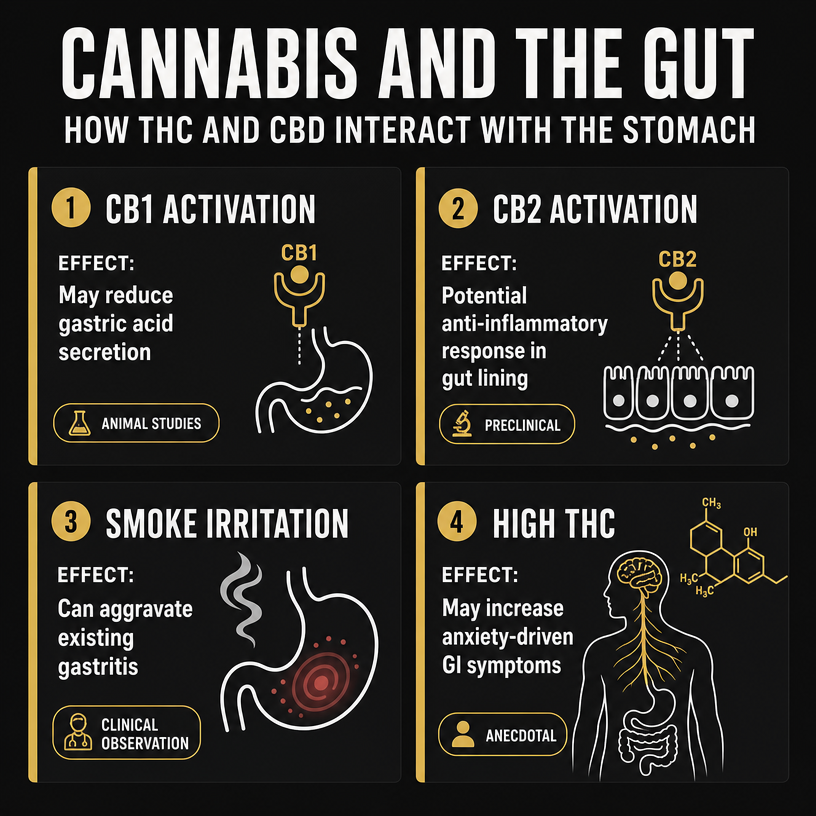
The ECS is found throughout your digestive tract. CB1 receptors are found in high concentrations in the enteric nervous system (the "gut brain") and in vagal afferent neurons that relay information between the gut and brain. CB2 receptors are expressed in immune cells lining the GI tract, including mast cells and macrophages that regulate inflammation. This means your gut has a built-in system that responds to cannabinoids like THC and CBD.
When THC activates CB1 receptors in the gut, it can influence gastric acid secretion, GI motility (how fast food moves through your system), and visceral sensitivity (how much pain you feel from a given stimulus). Animal studies dating back to the 1970s suggested that activating CB1 receptors could reduce gastric acid secretion — a potential benefit for some types of gastritis. However, the doses used in those early studies were much higher than what most consumers encounter, and the findings don't always translate cleanly to humans.
CB2 receptor activation by CBD or certain synthetic cannabinoids has shown more consistent anti-inflammatory effects in preclinical models. CBD's interaction with CB2 receptors in gut immune cells may modulate the inflammatory response, which is why some researchers are interested in its potential for inflammatory GI conditions. However, "preclinical" means cell cultures and animal models — not human trials.
This is a critical distinction. The science on cannabis and gastritis is still in early stages, and what happens in a mouse gut doesn't always predict what happens in yours.
What the Research Actually Says on Cannabis and Gastritis
The available research on cannabis and gastritis can be divided into several categories, each with different levels of quality and relevance.
Animal and preclinical studies form the bulk of the evidence. Multiple animal studies have shown that cannabinoid agonists (compounds that activate CB1/CB2 receptors) can reduce gastric acid secretion and protect against NSAID-induced gastric damage. A 2006 study published in European Journal of Pharmacology found that FAAH inhibitors (which increase the body's own endocannabinoids) reduced inflammation in a rat model of gastritis. Another line of research suggests that the endocannabinoid system is dysregulated in inflammatory GI conditions — meaning the body's own cannabinoid signals may be part of the natural healing response that's been disrupted.
Synthetic cannabinoid drugs have been studied more rigorously than plant cannabis. Dronabinol (synthetic THC) and nabilone (a synthetic THC analog) are FDA-approved for chemotherapy-induced nausea and AIDS-related weight loss. These medications have documented effects on GI function, including reduced nausea and increased appetite. However, they're prescribed in controlled doses for specific conditions — not equivalent to smoking cannabis or using over-the-counter products.
Human clinical trials specifically for gastritis are essentially nonexistent. Most of the human evidence for cannabis and GI conditions focuses on more severe conditions like Crohn's disease, ulcerative colitis, and chemotherapy-induced nausea. A 2023 review in Frontiers in Pharmacology noted that while the ECS is a promising therapeutic target for inflammatory GI diseases, clinical data remains limited and inconsistent. Most studies use synthetic cannabinoids or specific extracts, not the whole-plant products available at dispensaries.
The reality is that no large-scale, placebo-controlled clinical trial has tested cannabis for gastritis specifically. The evidence is promising in a preclinical sense, but it's incomplete. If you're reading that "cannabis cures gastritis" online, that claim isn't supported by current evidence.
For those interested in exploring whole-plant options at a dispensary, something like Slingria — a sativa-dominant option from our current menu — represents the kind of product customers ask about when they're trying to understand what different strains might offer for their specific situation.
Potential Benefits: When Cannabis Might Help
Despite the limited clinical data, many gastritis patients report real symptomatic benefits from cannabis. Understanding where those benefits come from can help you make more informed decisions.
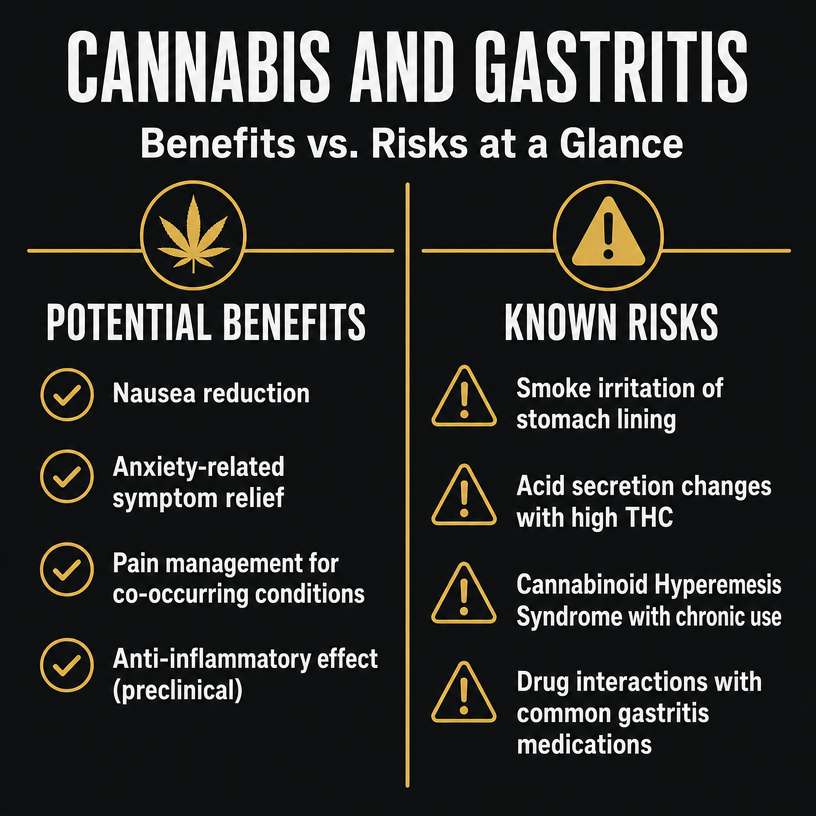
Nausea and appetite stimulation are the most consistently reported benefits. If gastritis has you feeling sick after eating or unable to keep food down, THC's antiemetic effects are well-documented. A 2011 report from the National Academies of Sciences recognized substantial evidence that THC and synthetic cannabinoids reduce chemotherapy-induced nausea. For gastritis-related nausea specifically, the mechanism is similar — reduced signaling in the vomiting center of the brain, modulated by CB1 activation. If you're experiencing gastritis-related nausea and want to explore options, Sour Diesel | Flower | Sativa | 28G is a sativa strain some customers report helps with energy and mood while managing nausea.
Anxiety-driven gastritis symptoms may improve with certain cannabis products. Stress and anxiety are known triggers for gastritis flare-ups — the gut-brain axis is a real, bidirectional communication system. Some people find that cannabis helps reduce the anxiety that worsens their GI symptoms, creating a secondary benefit beyond any direct effect on the stomach lining itself. Indica-leaning strains like Northern Lights are commonly reported by customers to promote relaxation and calm, which some gastritis patients find helpful during flare-ups.
Pain management matters for gastritis patients whose primary complaint is abdominal pain or discomfort. Cannabis, particularly THC, has well-documented analgesic effects that may help manage the visceral pain associated with severe gastritis. This is particularly relevant for patients with chronic gastritis who also deal with other pain conditions and are looking for alternatives to NSAIDs (which can themselves cause gastritis).
Anti-inflammatory effects from CBD are theoretically promising for inflammatory gastritis. CBD's interaction with CB2 receptors in gut immune cells could theoretically modulate inflammation. However, it's important to manage expectations: even if CBD does reduce inflammation in the stomach lining, the effect size and consistency in humans is unknown.
The key distinction here is symptom management versus disease modification. Cannabis may help you feel better — reduce nausea, manage pain, lower anxiety — but there's no evidence it addresses the underlying inflammation that causes gastritis. If H. pylori is the cause of your gastritis, cannabis won't eradicate it. If NSAIDs are causing the damage, cannabis won't protect your stomach lining. Think of it as a tool that may help you cope with symptoms, not one that treats the root cause.
Risks and Caveats: When Cannabis Can Worsen Gastritis
Cannabis isn't universally helpful for gastritis. In some scenarios, it can make things worse — and these risks deserve equal attention.
Smoke irritation is a real concern. Combustion produces irritants — acrolein, acetaldehyde, polycyclic aromatic hydrocarbons — that can directly irritate the gastric lining, particularly in people with existing inflammation. If you're smoking cannabis and have active gastritis, you may be aggravating the condition with every inhale. This isn't theoretical; it's basic physiology. Smoke is a known gastric irritant regardless of the substance being smoked. Gas Lit is a potent product at 31%+ THC, and if consumed via smoking with active gastritis, the combustion byproducts could potentially worsen inflammation in some users.
High-THC products may increase stomach discomfort in some users. While THC can reduce nausea at certain doses, higher doses of THC can sometimes cause anxiety or tachycardia, which may indirectly worsen GI symptoms. Some users report that very high-THC strains make them feel "too high" — anxious, paranoid, nauseated — which could be confused with or amplify gastritis symptoms. The relationship between dose and GI effect isn't linear; it can be bell-shaped, meaning more isn't always better.
Cannabinoid Hyperemesis Syndrome (CHS) is a real condition associated with chronic, heavy cannabis use. It causes cyclic vomiting, nausea, and abdominal pain — symptoms that can be misdiagnosed as gastritis or mistakenly attributed to it. If you've been using cannabis heavily for months or years and develop new-onset nausea and vomiting, CHS should be on your radar. The treatment for CHS is cannabis cessation. This condition isn't common, but it's not rare either — emergency room visits for CHS have increased as cannabis use has risen.
Drug interactions are an underappreciated risk. Cannabis (particularly CBD and high-THC products) can interact with common gastritis medications, including proton pump inhibitors (PPIs) like omeprazole, H2 blockers like famotidine, and antibiotics used to treat H. pylori (like amoxicillin and clarithromycin). CBD inhibits cytochrome P450 enzymes in the liver, which metabolize many drugs. This can increase or decrease the effectiveness of medications you're taking for gastritis. Always discuss cannabis use with your gastroenterologist if you're on prescription GI medications.
For those with gastritis looking at options, Cherry Bomb from our menu — an indica-hybrid with 23%+ THC and noted effects of calm and relaxation — may be worth discussing with a budtender if you're looking for a lower-key experience that some customers associate with gentle, calming effects rather than intense psychoactivity.
Practical Guidance: Using Cannabis Responsibly With Gastritis
If you have gastritis and are considering cannabis, here's what the available evidence and common-sense guidance suggest.
Avoid smoking if you have active gastritis. The combustion irritants alone are enough to potentially worsen inflammation. If you want the benefits of cannabis for GI symptoms, explore alternatives: tinctures, edibles, vaping (which avoids combustion), or topical products. Vaporized flower or concentrate produces far fewer irritants than smoked cannabis.
Consider CBD-forward or balanced products. High-CBD products may offer anti-inflammatory potential without the psychoactive intensity of high-THC strains. For some gastritis patients, a 1:1 THC:CBD ratio or a CBD-dominant product may provide symptom relief while minimizing the risks associated with high THC.
Start low, go slow. If you have gastritis, your GI system may be more sensitive to cannabis's effects — both positive and negative. Start with the lowest effective dose, wait at least 90 minutes before considering more (edibles in particular have delayed onset), and avoid consuming on an empty stomach, which can increase the intensity of both therapeutic effects and side effects.
Discuss with your gastroenterologist. This is the most important guidance. Cannabis can interact with your medications, and your gastroenterologist needs to know you're using it so they can monitor for interactions or adjust treatment plans accordingly. At Treehouse Cannabis in Rockland County, our team can help you explore product options, but we're not a replacement for medical guidance from your doctor.
Know your gastritis cause. If your gastritis is caused by H. pylori, you'll need antibiotics — cannabis won't fix it. If NSAIDs are causing your gastritis, the solution is discontinuing the NSAIDs, not adding cannabis. Understanding the root cause of your condition is essential for making good decisions about treatment.
Looking for CBD-forward products or want to discuss options with our team? Visit Treehouse Cannabis in Rockland County to explore our carefully curated selection and get personalized guidance.
Frequently Asked Questions
Does cannabis cure gastritis?
No. There is no clinical evidence that cannabis cures gastritis. Some preclinical research suggests certain cannabinoids may reduce stomach inflammation, but human data is limited and no treatment has been validated. Cannabis may help manage symptoms like nausea and pain, but it does not address the underlying causes of gastritis, which require specific medical treatment depending on the root cause.
Can smoking cannabis make gastritis worse?
Yes — smoke itself is an irritant to the gastric lining. Combustion byproducts like acrolein and polycyclic aromatic hydrocarbons can exacerbate inflammation, especially with frequent use. Non-smokable forms (edibles, tinctures, vaporized products) avoid this risk. If you have active gastritis, smoking is generally not the best route of administration.
Does CBD help with gastritis symptoms?
Early animal studies show CBD may reduce GI inflammation via CB2 receptor activation in gut immune cells, but human clinical trials are lacking. Some patients report reduced nausea and abdominal discomfort, but results vary significantly between individuals. More research is needed before any definitive claims can be made.
Is it safe to use cannabis if I have gastritis?
It depends on the severity, cause, and your consumption method. Light edible use with low THC may be lower risk than smoking, but you should discuss with a gastroenterologist before combining cannabis with any diagnosed GI condition. Be especially cautious if you're on prescription GI medications, as drug interactions are possible.
What strains or products are best for gastritis?
There is no clinical consensus. High-CBD, low-THC products (like CBD oils or tinctures) are theoretically lower risk for GI irritation. Avoid high-THCV and acid-form cannabinoids that may stimulate stomach acid. If you're exploring options at Treehouse Cannabis, ask about our CBD-forward selection and discuss your symptoms with our knowledgeable budtenders.
Sources
- National Academies of Sciences, Engineering, and Medicine — The Health Effects of Cannabis and Cannabinoids
- Frontiers in Pharmacology — Cannabinoids and the Endocannabinoid System in Gastrointestinal Function
- Cannabis and Cannabinoid Research — Role of the Endocannabinoid System in Gastrointestinal Disorders
- European Journal of Pharmacology — Cannabinoid agonists and gastritis
- Project CBD — Cannabinoids and Gastrointestinal Inflammation
This content is for educational purposes only and does not constitute medical advice. Treehouse Cannabis is a licensed adult-use dispensary. Must be 21+ to purchase.



Shop our products

Shop All

Deals

Flower

Pre-rolls

Vaporizers

Edibles

Drinks

Concentrates

Tinctures

Topicals

CBD

Pet CBD

Accessories