
What Is a Tolerance Break and How Do You Do One?
What Is a Tolerance Break and How Do You Do One?
A tolerance break — commonly called a t-break — is a planned period of abstinence from cannabis, typically lasting two to four weeks. The purpose is to give the body's CB1 receptors a chance to resensitize after regular use has made them less responsive PubMed — CB1 Receptor Downregulation Study. When these receptors are downregulated, you need more cannabis to achieve the same effects, which increases cost and can diminish the overall experience.
What Is a Tolerance Break and Why Would You Take One?
Regular users pursue tolerance breaks for a few straightforward reasons:
- Restoring cannabis sensitivity so you can use less and feel more
- Getting back the quality of effects that has flattened over time
- Reducing use for personal or health reasons without quitting entirely ADAI — University of Washington
Whatever the motivation, a tolerance break is a practical tool — not a punishment.
How Long Does a Tolerance Break Take to Work?
Research and harm-reduction guides consistently point to a minimum of 21 consecutive cannabis-free days for meaningful tolerance reset Kennesaw State University — Center for Addiction Recovery and Prevention Education. This is not an arbitrary number — it reflects the time required for CB1 receptor density in the brain to recover from chronic downregulation caused by regular exposure PubMed — CB1 Receptor Downregulation Study.
Here is how shorter breaks compare:
| Break Duration | Receptor Recovery | Effect Strength | Research-Backed? |
|---|---|---|---|
| 48-72 hours | Minimal | Slight improvement | No |
| 1 week | Low | Modest improvement | No |
| 2 weeks | Partial | Moderate improvement | Some benefit |
| 21+ days | Full | Near-complete reset | Yes |
Skipping short intervals or restarting early undermines the process. The evidence is clear: longer is better, and 21 days is the floor, not the ceiling National Institute on Drug Abuse (NIDA).
What Happens to Your Body During a Tolerance Break?
The first few days bring the most noticeable turbulence. Common side effects include:
- Sleep disruption — vivid dreams, trouble falling asleep, waking through the night
- Appetite decrease initially
- Mood changes such as irritability or restlessness PMC — Chemistry, Metabolism, and Toxicology of Cannabis
These symptoms reflect the body's adjustment to functioning without external cannabinoid input, not a sign anything is wrong.
By the end of the first week, sleep and appetite begin to normalize in most people. By the third and fourth weeks, CB1 receptors have substantially resensitized. When cannabis is reintroduced after a full break, effects are noticeably stronger at previously routine doses. Starting with half the former amount is the smartest way to gauge the new baseline 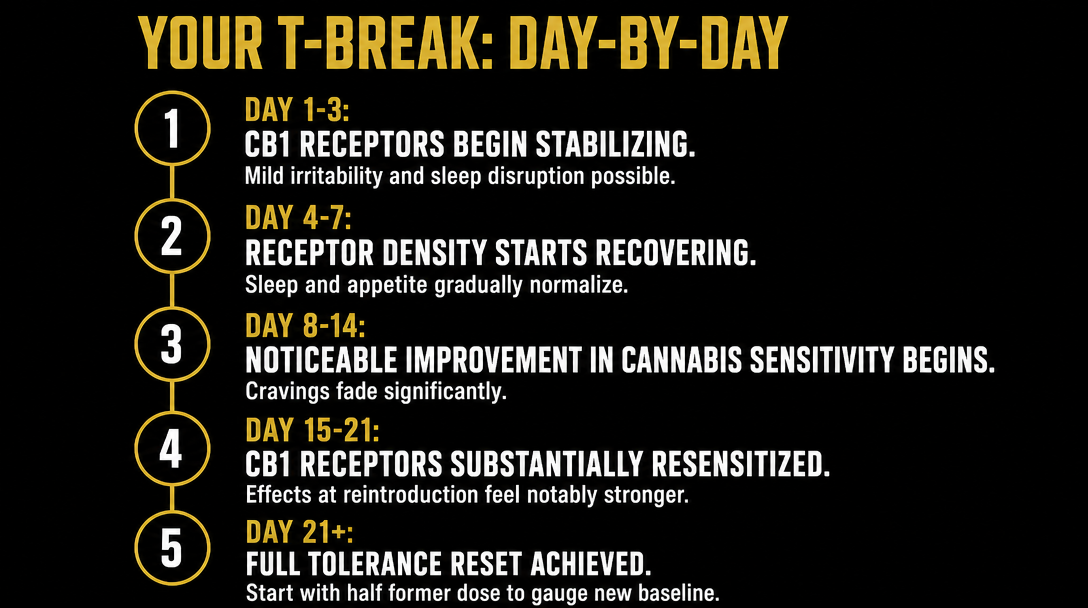 .
.
How to Do a Tolerance Break: A Practical Guide
Setting a clear duration before starting makes all the difference. Key steps include:
- Decide on your break length — 21 days is the research-backed minimum — and mark start and end dates on a calendar
- Tell a trusted friend or two for accountability without making it a public announcement
- Store any remaining cannabis products out of immediate reach or with someone you trust
- Fill the time intentionally with hobbies, exercise, and social activities
A sample break structure:
- Days 1-7: Focus on sleep hygiene and light exercise. Expect mild irritability. Stay busy.
- Days 8-14: Routine starts settling. Energy and mood improve. Cravings fade noticeably.
- Days 15-21: Physical and mental baseline feels restored. Plan your reintroduction dose in advance.
When the break ends, resist the urge to jump back in at your former dose. Effects will feel significantly stronger. Start with half your previous amount and wait to assess before taking more 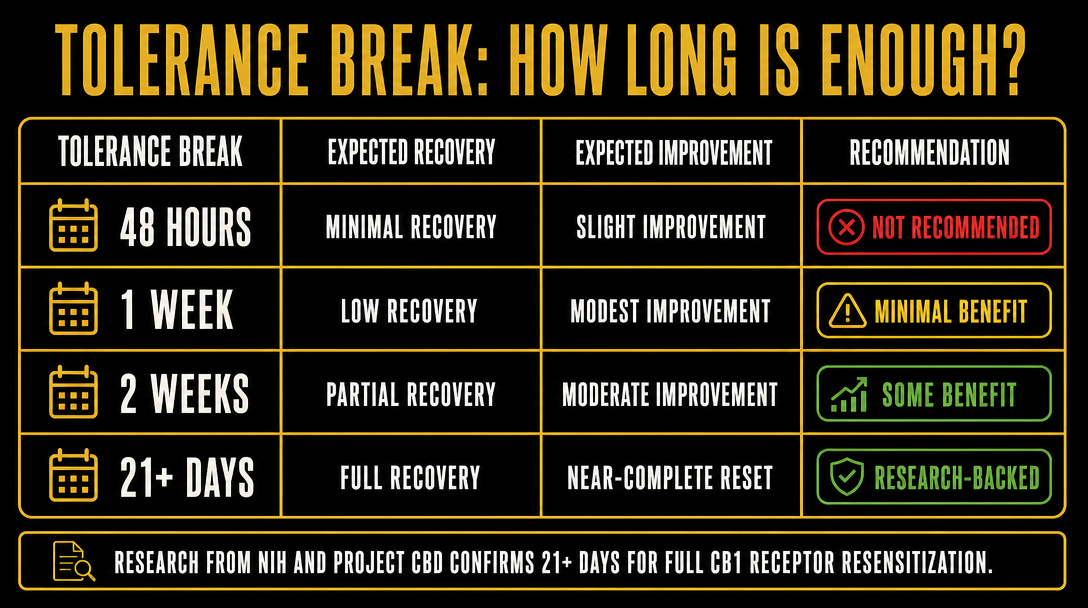 .
.
Does a Tolerance Break Actually Work?
Yes — the mechanism is well-documented. Chronic cannabis use causes CB1 receptor downregulation in the brain, meaning fewer receptors are available to bind with THC and produce effects PubMed — CB1 Receptor Downregulation Study. This is a normal physiological adaptation, not a sign of dependence. With sustained abstinence, receptor density recovers and sensitivity to cannabis returns.
Evidence-backed points to keep in mind:
- Studies on cannabis metabolism and receptor dynamics support the 21-day threshold as the point where resensitization becomes meaningful PMC — Chemistry, Metabolism, and Toxicology of Cannabis
- The Kennesaw State University harm-reduction guide recommends at least three weeks for a genuine tolerance reset Kennesaw State University — Center for Addiction Recovery and Prevention Education
- Real-world reports from regular users consistently align with the research: a properly executed break delivers noticeably stronger effects upon reintroduction
There are no shortcuts. Microdosing during a break, switching products, or taking shorter breaks all undermine receptor recovery. Complete abstinence for the full duration is the only evidence-backed approach.
Ready to reset your tolerance? Browse Treehouse Cannabis' selection of flower and low-dose edibles to find the right products for your post-t-break experience.
This article is intended for adult consumers in jurisdictions where cannabis use is legal. It does not constitute medical advice. Always consume responsibly and in accordance with local laws.
Sources
- National Institute on Drug Abuse (NIDA) — Federal research authority on cannabis and marijuana, including tolerance and de
- ADAI — University of Washington — University-affiliated cannabis education resource covering tolerance, dependence
- Kennesaw State University — Center for Addiction Recovery and Prevention Education — T-Break guide recommending at least 21 days for tolerance reset, sourced from ha
- PubMed — CB1 Receptor Downregulation Study — Peer-reviewed study demonstrating CB1 receptor downregulation in human brains fo
- PMC — Chemistry, Metabolism, and Toxicology of Cannabis — Peer-reviewed review of cannabis metabolism, including pharmacodynamic tolerance
- National Center for Complementary and Integrative Health (NCCIH) — NIH-aligned resource covering the endocannabinoid system and cannabis pharmacolo
About Treehouse Cannabis
Treehouse Cannabis is a Rockland County dispensary offering premium cannabis products including flower, concentrates, edibles, and accessories. Visit our West Nyack location or shop online for curated products across categories like flower and edibles.

Shop our products

Shop All

Flower

Pre-rolls
Vaporizers

Edibles

Drinks

Concentrates
Tinctures

Topicals

CBD

Pet CBD

Accessories