
Because the culture doesn’t start or stop with a date
420 comes and goes. The culture stays.
Written by
Treehouse Cannabis
420 comes and goes. The culture stays.
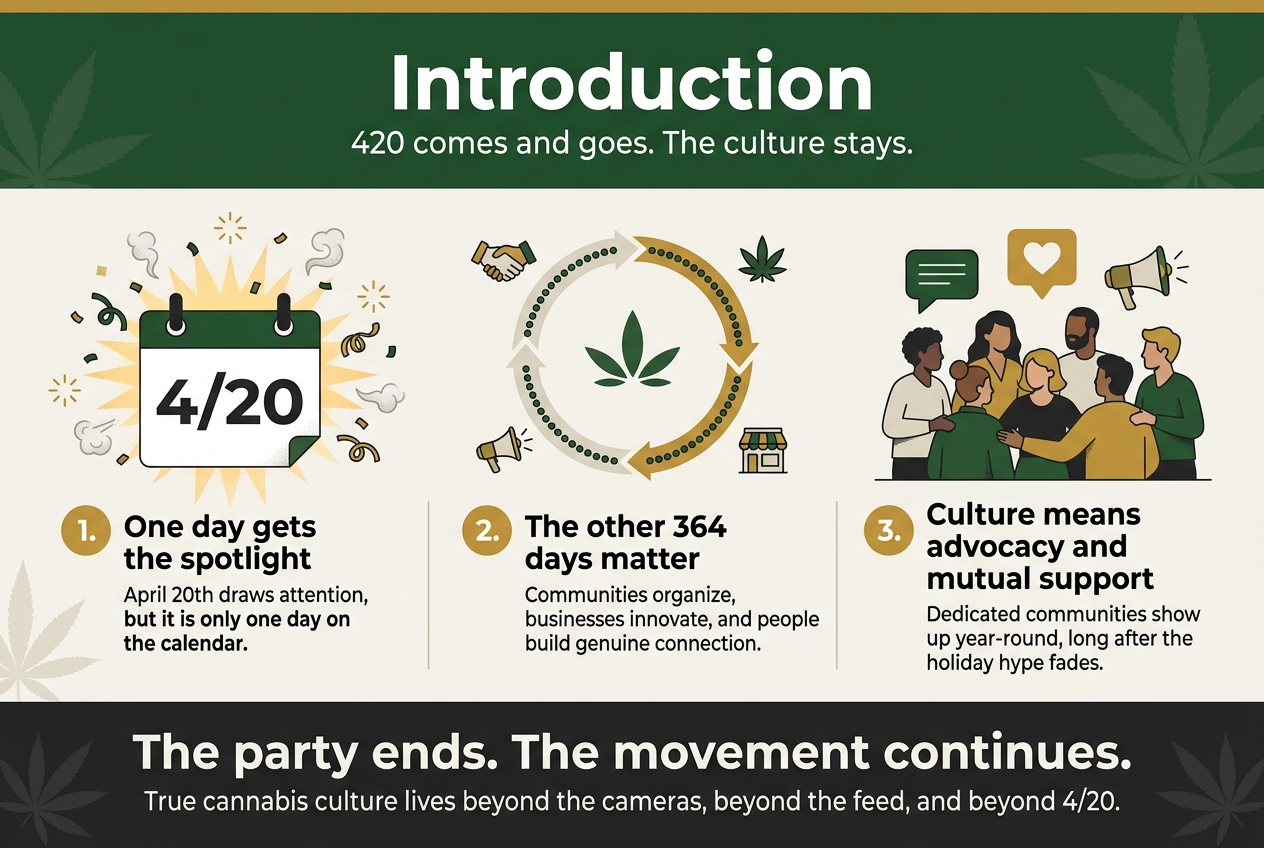
420 came and went, but what it represents runs a lot deeper than a single day. For some, it was a tradition. For others, it was an introduction. Either way, it brought people together and put a spotlight on something that’s been part of everyday life for a long time.
There was a certain energy around it. People showed up, shared experiences, and took a moment to appreciate how far things have come. Something that used to stay more in the background now has space to be seen, talked about, and understood in a different way. That shift means a lot.
Now that the day has passed, the culture hasn’t gone anywhere. It’s still there in the routines, the conversations, and the connections people build around it. It shows up in the everyday. It’s in the places people trust, the things they come back to, and the sense of familiarity that keeps them connected.
That’s what makes it meaningful. Not just the celebration itself, but everything that surrounds it before and after.
More Than a Moment
420 is meaningful, but just one snapshot of something bigger
The story of 420 begins with a simple code between friends that transformed into a global cultural phenomenon. In the early 1970s, a group of California high school students known as the Waldos created what would become one of the most recognizable terms in cannabis culture. These students used "420" as their secret code to meet at 4:20 PM, embarking on adventures to search for an abandoned cannabis crop that had captured their imagination.
What started as teenage code-switching quickly evolved into something much larger than its creators could have anticipated. The term's journey from a high school hallway to worldwide recognition illustrates how authentic cultural movements often emerge from the most organic, grassroots moments. The Waldos' connection with the legendary band Grateful Dead became the catalyst that propelled their private language into the broader music scene, where it found fertile ground among like-minded communities.
Through the Dead's extensive touring network and devoted fanbase, "420" traveled across the country, spreading through concert venues, record stores, and the interconnected web of counterculture communities. This wasn't a marketing campaign or corporate initiative—it was pure cultural transmission, moving from person to person, city to city, carried by those who understood its significance.
By the 1990s, this humble code had achieved mainstream recognition, with April 20th becoming an unofficial holiday celebrated by cannabis enthusiasts worldwide. The transformation from secret student slang to globally recognized symbol demonstrates how meaningful cultural elements can transcend their origins while maintaining their authentic spirit.
Despite numerous myths attempting to explain 420's origins—from false claims about police codes to incorrect assertions about cannabis chemistry—the true story remains refreshingly simple: genuine culture often begins with real people creating something meaningful together, not through official designations or institutional decree.
When people talk about cannabis culture, it’s easy to picture the big moments. The events, the crowds, the once-a-year energy. But the reality is, most of it lives in the day to day. It’s built over time, shaped by the people in it, and carried forward in ways that don’t always get attention.
It’s not just one thing, and it doesn’t look the same for everyone. It’s a mix of experiences, habits, and connections that keep it moving, even when there isn’t a spotlight on it.
What the culture really looks like:
- The everyday routines that people settle into over time
- The conversations that happen naturally, without a script
- The people who were part of it long before it was widely accepted
- The ones just starting to explore and find their place in it
- The constant evolution of products, preferences, and perspectives
That’s the part that doesn’t come and go. It’s steady, it’s real, and it’s always there in the background, whether people are paying attention to it or not.
Showing Up Year-Round
Showing Up Year-Round
When the energy around 420 faded, what was left was what’s always been there. The everyday rhythm. The familiar moments. The ways people connect with it in their own time.
Showing up year-round doesn’t mean being part of it every single day. For some people, it’s something they engage with often. For others, it’s occasional. Sometimes it’s social, sometimes it’s personal, and sometimes it’s just about being around it in a way that feels right for them.
That’s what makes the culture what it is. It isn’t one way or one pace. It’s flexible, it’s evolving, and it leaves room for everyone to find their own place in it without pressure.
Whether someone taps in once a year, once a week, or somewhere in between, it all counts. It all adds to something bigger that continues to grow and shift over time.
Why It Still Matters After 4/20
After 420 passes, things settle back into a more familiar pace. The crowds thin out, the noise quiets down, and the spotlight moves on. But what it brought attention to doesn’t disappear with it.
It still matters because the culture is bigger than a single day. It’s rooted in people, in shared experiences, and in something that has continued to evolve over time. For some, it’s a form of expression. For others, it’s part of how they unwind, connect, or just take a step back. However it shows up, it has a place.
Moments like 420 help bring awareness and energy, but what keeps it meaningful is everything that happens in between. The everyday interactions, the sense of familiarity, and the way people continue to shape it in their own way.
That’s why it carries on. Not because of the calendar, but because of the people who keep it going long after the day is over.
420 came and went, but what it represents didn’t leave with it. The energy may have shifted, but the foundation is still the same.
The culture has always been built on more than a single day. It lives in the people, the routines, and the small moments that don’t always get attention but matter just as much. It’s something that continues to grow, change, and make space for anyone who connects with it in their own way.
That’s what makes it last. Not the date, not the hype, but everything that exists beyond it.
Because in the end, 420 comes and goes. The culture stays.
Shop our products

Shop All
Flower

Pre-rolls
Vaporizers
Edibles
Drinks

Concentrates
Tinctures

Topicals
CBD

Pet CBD
Accessories