
Exploring the ancient spiritual roots and modern perspectives of cannabis across world religions
Cannabis in Religions: Sacred Herb or Forbidden Fruit
Cannabis in Religions: Sacred Herb or Forbidden Fruit?
For thousands of years, cannabis has been intertwined with human spirituality. From ancient Vedic rituals in India to modern Rastafarian ceremonies in Jamaica, this controversial plant has held sacred status in cultures across the globe. Today, as cannabis legalization spreads throughout the United States and beyond, many are rediscovering these ancient connections between the herb and the divine.
At Treehouse Cannabis, we're committed to educating our community about all aspects of cannabis culture—including its rich spiritual heritage. Whether you're a curious consumer, a history enthusiast, or someone exploring your own relationship with this plant, understanding its religious significance offers a fascinating glimpse into human spirituality and our enduring connection to nature's gifts.
The Ancient Roots: Cannabis in Early Civilizations
The history of cannabis as a sacred plant dates back millennia. Archaeological evidence suggests humans have been using cannabis for spiritual purposes for at least 10,000 years, with the earliest confirmed use appearing in ancient Central Asia[^1]. The plant's journey through human civilization reads like an epic—traveling along trade routes, weaving through religious traditions, and earning reverence as a bridge between the earthly and divine.
Cannabis in the Vedas: Hinduism's Sacred Connection
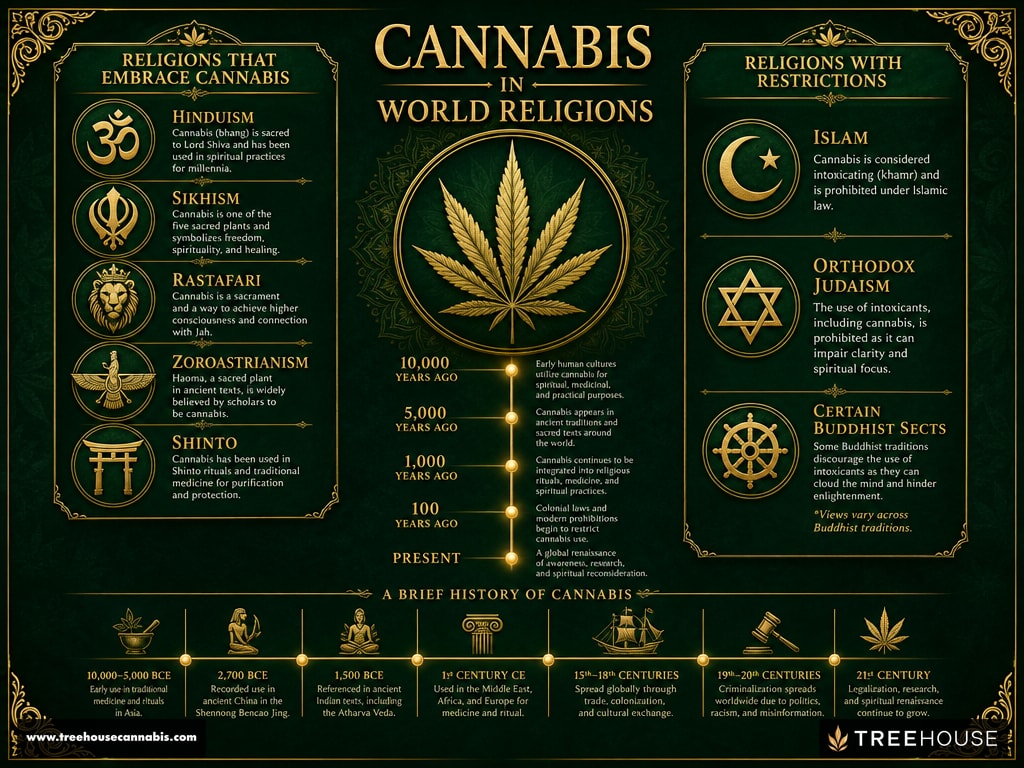
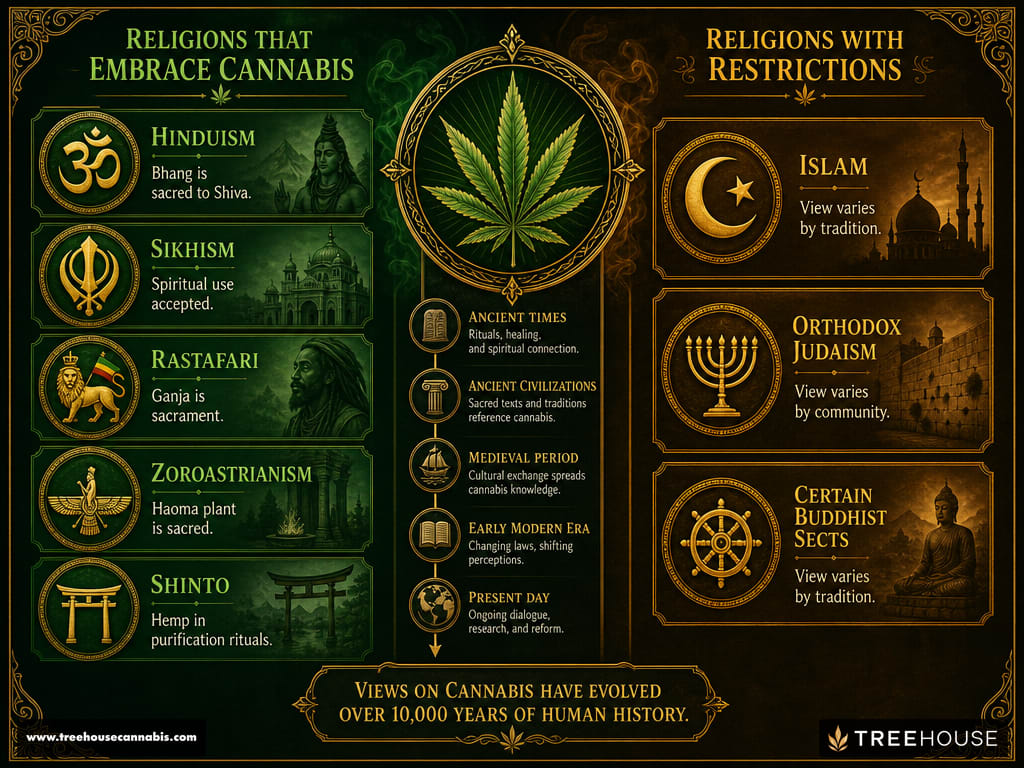
Within Hinduism, one of the world's oldest living religions, cannabis holds a place of honor. The Atharva Veda—one of the four sacred texts of Hinduism—lists cannabis among five sacred plants, describing it as a source of happiness, joy, and freedom from anxiety[^2]. The plant is closely associated with Lord Shiva, one of the most revered deities in the Hindu pantheon.
According to Hindu tradition, Shiva is said to have discovered the benefits of cannabis after spending long periods in deep meditation. Upon tasting the leaves, he experienced profound bliss and enlightenment. This association has made cannabis—known in Hindi as bhang, ganja, or charas depending on its preparation—a sacramental substance used in worship of Shiva, particularly during the festival of Shivaratri[^3].
Shiavite devotees often smoke cannabis through clay pipes called chillums, believing the herb helps them connect with Shiva's energy and achieve spiritual clarity. For millions of Hindus worldwide, cannabis remains a sacred gift from the gods—a tool for meditation, devotion, and transcendence.
Ancient Persia and the Scythians
Moving westward, cannabis also played important roles in ancient Persian religious practices and Scythian burial rituals. Archaeological discoveries in Siberia uncovered ancient burial mounds containing cannabis seeds and smoking equipment, suggesting the Scythians used cannabis in ceremonial rituals dating back to around 500 BCE[^4]. These nomads believed the smoke carried prayers to the heavens and honored their dead.
The ancient Persians incorporated cannabis into their Zoroastrian fire ceremonies, where the plant was burned as a sacred offering. This practice influenced later religious traditions throughout the Middle East and Central Asia.
Buddhism and the Middle Way
The relationship between Buddhism and cannabis presents a fascinating paradox. While some traditions associate cannabis with Buddhist meditation practices—particularly in regions like Thailand, Nepal, and Japan where Theravada and Vajrayana Buddhism融合了 local traditions—the Buddha himself is traditionally said to have rejected extremes in favor of the "Middle Way."
Most mainstream Buddhist schools discourage the use of intoxicants, including cannabis, as they are seen to cloud the mind rather than sharpen it. However, certain esoteric Buddhist traditions, particularly in Tibet and Nepal, have incorporated cannabis into tantric practices as a tool for spiritual awakening[^5]. These uses are highly contextual and not representative of Buddhist practice as a whole.
In Nepal, where Hinduism and Buddhism intertwine, cannabis grows wild and has been used by wandering holy men (sadhus) for centuries. These ascetics believe the plant helps suppress physical sensations and hunger, allowing them to focus on meditation and spiritual pursuits. The government's traditionally lenient stance toward religious cannabis use reflects this deep cultural integration.
The Rastafarian Faith: Ganja as Scripture
Perhaps no modern religion is more closely associated with cannabis than Rastafarianism. Born in Jamaica during the 1930s, Rastafarianism elevates cannabis—called "ganja," "the herb," or "the holy herb"—to the status of a sacred sacrament[^6].
Rastafarians interpret biblical references to "herbs" and "green herbs" as endorsements of cannabis use. They point specifically to Genesis 1:29, where God grants humanity "every herb bearing seed" and "every tree, in the which is the fruit of a tree yielding seed." For Rastafarians, cannabis is a gift from Jah (God), meant to be used in spiritual communion and meditation.
The ritual use of ganja typically involves smoking it in a communal "session" called a "reasoning," where members gather to discuss spiritual matters and seek divine guidance. The smoke is seen as carrying prayers upward to heaven, and its effects are believed to open the mind to truths hidden from ordinary consciousness[^7].
"From the smoke of the herb, we receive wisdom," explained one Rastafari elder in a documentary on the faith. "It clears the mind and allows us to see the truth of Babylon's lies and Jah's righteousness."
In June 2023, Jamaica's parliament passed legislation allowing Rastafarians to legally use cannabis for sacramental purposes—an acknowledgment of the faith's constitutional protections and a step toward reconciliation with a community that had faced generations of persecution[^8].
Indigenous and Shamanic Traditions
Cannabis has also played roles in various indigenous spiritual practices around the world. In Southern Africa, the Bantu people used cannabis—known locally as "dagga"—in religious rituals for centuries. The plant was used in ceremonies marking transitions of life, healing rituals, and communication with ancestors[^9].
Mexican Native American communities have incorporated cannabis into religious ceremonies, sometimes leaving bundles of the herb on church altars for congregants to consume during worship. This blending of Catholic and indigenous traditions reflects the complex religious landscape of colonial Latin America.
In the American Southwest, some Native American tribes have integrated cannabis into traditional ceremonies, though its use varies significantly between communities. The plant's role in indigenous spirituality continues to evolve as tribes navigate questions of tradition, sovereignty, and the modern legalization landscape.
The Abrahamic Religions: Complex Relationships
The Abrahamic faiths—Judaism, Christianity, and Islam—present complex and often contradictory relationships with cannabis.
Judaism: Ancient Use, Modern Debate
Historical evidence suggests cannabis was used in ancient Jewish traditions. Some scholars believe the "cannabis" reference in Exodus 30:23—where God commands Moses to make a holy anointing oil containing "kaneh-bosem," a Hebrew term phonetically similar to "cannabis"—validates the plant's sacred status in early Judaism[^10].
Modern Jewish law (Halakha) generally prohibits recreational intoxication, though medical marijuana is widely accepted within the Jewish community. However, several prominent rabbis have begun reconsidering cannabis, noting that Jewish tradition has historically embraced certain plants and substances for spiritual purposes. The mystical tradition of Kabbalah, for instance, incorporates various meditative and physical practices that some interpret as compatible with cannabis use[^11].
Christianity: Theological Tensions
Christianity's relationship with cannabis remains contested. While the Bible does not explicitly mention cannabis, some theologians point to verses supporting the use of natural herbs (Genesis 1:29, Psalms 104:14) as evidence that cannabis could be acceptable.
However, traditional Christian theology emphasizes mental clarity and sobriety for spiritual discernment, leading most mainstream denominations to discourage recreational cannabis use. The 2024 Pew Research Center survey found that 44% of Americans who identify as Christian believe marijuana use is morally acceptable, though views vary dramatically by denomination and political affiliation[^12].
Some progressive Christian communities have embraced cannabis as a tool for meditation, prayer, and communal bonding—viewing it as a way to quiet the ego and open hearts to divine love. These communities often emphasize personal discernment and responsible use over blanket prohibitions.
Islam: Varying Interpretations
Islamic perspectives on cannabis also diverge significantly. The Quran prohibits khamr (intoxicating substances), though interpretations of what qualifies vary. Most conservative Islamic authorities consider cannabis impermissible, citing hadith about avoiding anything that clouds the mind.
However, several predominantly Muslim nations—including Lebanon, Morocco, and parts of Pakistan—have historically tolerated or even cultivated cannabis for traditional and religious purposes. More recently, countries like Lebanon (now Lebanon) and Malta have legalized cannabis for medical and recreational use, reflecting shifting attitudes within the Muslim world.
The Ismaili Shia Muslim community has perhaps the most explicit historical connection to cannabis. The medieval Nizari Ismailis (popularly known as the "Assassins") were documented using cannabis in spiritual practices, and certain Sufi traditions incorporate the plant into mystical practices aimed at achieving spiritual ecstasy[^13].
Cannabis, Meditation, and the Modern Spiritual Movement
As cannabis legalization has spread, many people have rediscovered its potential as a tool for spiritual practice. A growing movement of "cannabis-friendly" meditation communities, yoga studios, and spiritual retreats now incorporate the plant into practices designed to enhance mindfulness and self-discovery.
Research suggests cannabis may facilitate certain aspects of spiritual experience. A 2022 study published in the journal PLOS ONE found that cannabis users reported increased feelings of closeness to others, nature, and the divine during use—experiences they often described as deeply meaningful[^14]. While researchers caution against overgeneralizing these findings, they suggest cannabis may lower psychological barriers to spiritual experience for some individuals.
At the same time, critics worry about potential risks—particularly for individuals with histories of mental health challenges or those using cannabis primarily to avoid dealing with difficult emotions. The relationship between cannabis and spirituality, like the relationship between cannabis and religion, ultimately reflects the complexity of human experience itself.
The Future of Cannabis and Religion
As society continues to reconsider cannabis, religious communities are also evolving their perspectives. Some faith traditions are formally reconsidering their stances, while others maintain traditional prohibitions. A few have begun developing guidelines for sacramental or spiritual use.
This dialogue between ancient tradition and modern reality represents an opportunity for deeper understanding—not just of cannabis, but of what religion itself means to different people. For many, cannabis remains a sacred gift meant to be used in communion with the divine. For others, it's a medicine, a recreational substance, or simply a plant.
At Treehouse Cannabis, we believe everyone deserves to make informed choices about their relationship with cannabis—spiritual, recreational, or otherwise. Our team of knowledgeable budtenders can help you explore our curated selection of products, answer your questions, and guide you toward experiences that align with your goals.
Final Thoughts
The history of cannabis in religion is vast, complex, and far from concluded. From the ancient Vedic rituals of India to the reasoning circles of modern Rastafarians, from the meditation caves of Nepal to the medical marijuana debates in Jewish law, cannabis has served as a bridge between humans and the divine for millennia.
As legal barriers fall and cultural attitudes shift, we're likely to see even more diversity in how religious and spiritual communities approach this ancient plant. What remains constant is cannabis's remarkable capacity to inspire, connect, and transform human experience.
Whether you're exploring cannabis for spiritual purposes, seeking relief from physical discomfort, or simply curious about this storied plant, Treehouse Cannabis is here to serve our community with expertise, integrity, and respect for all paths.
Visit us in New York to discover products and learn more about cannabis culture. Our team is committed to providing accurate information, premium products, and a welcoming environment for everyone.
Sources
- PMC - Journey of Marijuana From Folk Tales to Doors of Justice
- Cannigma - Cannabis and the Spring Equinox: From Ancient Entheogen to Modern Ritual
- Royal Queen Seeds - Cannabis and Spirituality: The Use of Weed in World Religions
- The Emerald Magazine - Entheogen: Cannabis
- Wikipedia - Entheogenic Use of Cannabis
- RastaRootz - History of Rastafari Culture & Cannabis
- ResearchGate - The Significance of Ganja in the Rastafari Movement
- YouTube - Rastafarians Gain Sacramental Rights to Marijuana (2023)
- My7Engines - Cannabis Wisdom: Ancient Indigenous Applications
- Aish - Marijuana and Judaism: What Does Jewish Law Say
- Duke Center for Jewish Studies - Holy Smoke
- PMC - Religious Involvement and Marijuana Use
- Wikipedia - Cannabis and Religion
- Flora Flex - Cannabis in Native American Rituals and Ceremonies
About Treehouse Cannabis
Treehouse Cannabis is a licensed New York adult-use dispensary serving the Nyack community since 2022. Our team includes certified cannabis educators dedicated to helping customers find the right products for their needs.
📍 Visit Us: Nyack, NY
📞 Call: (845) 315-2049
✉️ Email: info@treehousecannabis.com
🌐 Website: treehousecannabis.com
Adult-Use Disclaimer: This content is for educational purposes only. Cannabis products are for adult use only (21+). Consult a healthcare provider before using cannabis, especially if you have existing health conditions or take medications.



Shop our products

Shop All
Flower

Pre-rolls
Vaporizers

Edibles
Drinks

Concentrates
Tinctures

Topicals
CBD

Pet CBD

Accessories