

Cannabis and Lucid Dreaming: What Happens When You Smoke Before Bed
Cannabis and Lucid Dreaming: What Happens When You Smoke Before Bed
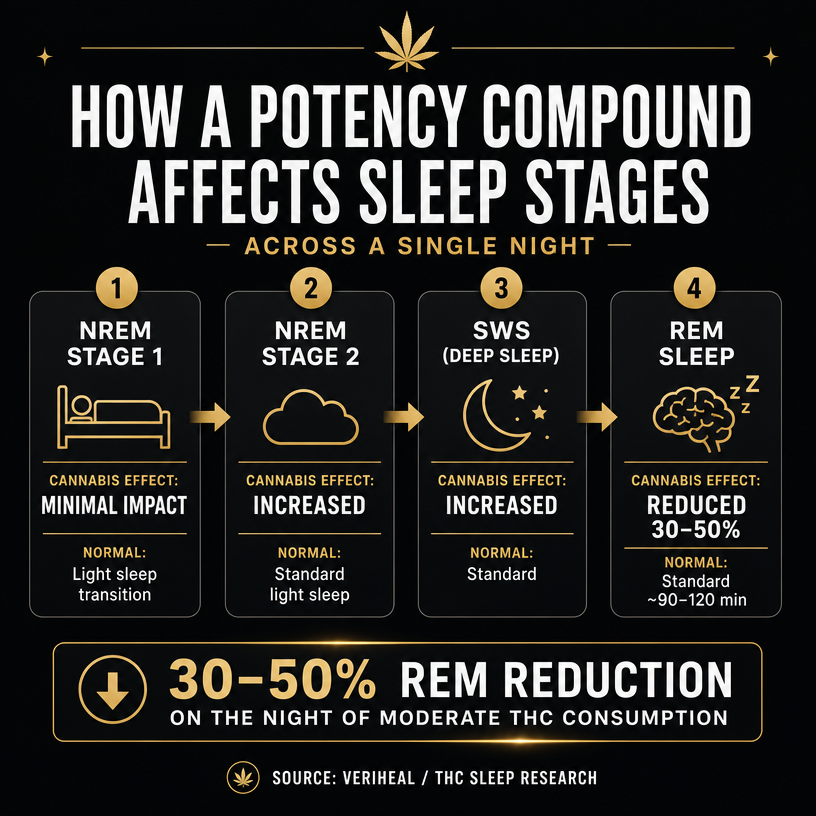
Cannabis directly suppresses REM sleep — the stage where vivid dreams and lucid awareness occur. THC can reduce REM sleep by 30 to 50 percent on the night of use, meaning if you smoke before bed you spend far less time in the dream state and wake with little to no dream recall. This effect is one reason so many regular cannabis consumers report almost never remembering their dreams. Veriheal
How Does Cannabis Affect Your Dreams?
Cannabis affects dreams primarily through its interaction with the brain's endocannabinoid system. When THC binds to CB1 receptors, it signals the brain to reduce REM sleep and shift sleep toward slow-wave deep sleep instead. This is why many people feel cannabis helps them fall asleep faster — the sleep feels deeper early on. But the cost is that the REM stage, where dreaming happens, gets compressed or skipped entirely on nights when cannabis is used. Neurotherapeutics
Roughly 77 percent of men and 64 percent of women between the ages of 21 and 64 have used cannabis to sleep at some point, according to the Sleep Foundation. Sleep Foundation At Treehouse, we hear from customers in Rockland County and surrounding areas who rely on cannabis as part of their evening routine — and many are surprised to learn how profoundly it reshapes their dream life.
The impact on dreaming varies by usage pattern:
- One-time use: REM reduction of 30 to 50 percent that night only
- Regular use: Brain adapts by consistently suppressing REM; dream recall becomes rare
- Long-term use: Tolerance builds, and withdrawal symptoms can disrupt sleep worse than before cannabis was ever introduced Cannabis and Cannabinoid Research
Why Does Cannabis Suppress REM Sleep?
THC suppresses REM sleep through the brain's endocannabinoid system. CB1 receptors — the same receptors THC activates to produce its psychoactive effects — also modulate sleep-stage transitions. When THC activates these receptors, it tilts the balance away from REM and toward slow-wave sleep (SWS), the deep restorative phase. Neurotherapeutics
This is not a minor neurochemical quirk. REM sleep is energetically expensive for the brain. It is associated with elevated heart rate, vivid imaginative activity, and memory consolidation. Some researchers believe the brain prioritizes SWS over REM when it senses that overall sleep quality is compromised — and THC can create that signal, even if the user feels they slept well. Neuroscience & Biobehavioral Reviews
The net result is that cannabis consumers often fall asleep faster and report subjectively deeper sleep, but they lose access to a significant portion of their dream time. Early research suggests this trade-off may have cognitive consequences over the long term, though more large-scale human studies are needed to confirm these effects. Neurotherapeutics
Key mechanisms behind this suppression:
- CB1 receptor activation directly inhibits REM-promoting neurons
- THC increases slow-wave sleep (SWS) at the expense of REM stages
- The brain treats THC-induced sleep as "compromised quality," prioritizing restoration over dreaming
- Tolerance develops with regular use, worsening the REM suppression effect over time
What Is REM Rebound and Why Does It Happen When You Quit Weed?
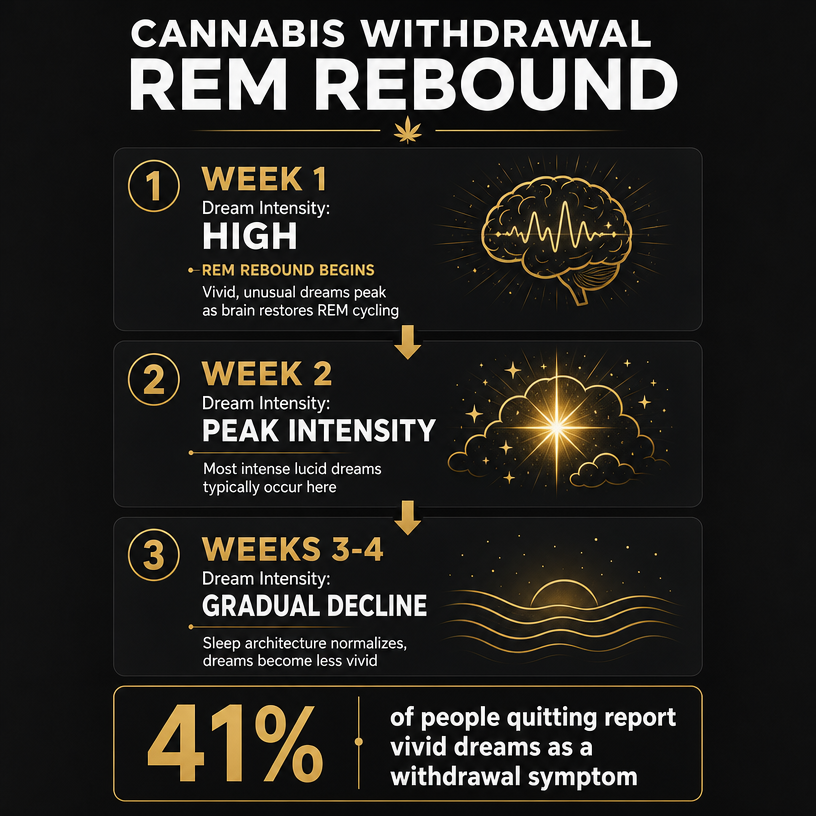
REM rebound is the brain's mechanism for catching up on lost dream time. When cannabis is removed after regular use, the brain increases REM sleep beyond normal levels to compensate. Dreams during this phase tend to be far more vivid, strange, and emotionally intense than usual. Roughly 41 percent of people quitting cannabis report vivid dreams as a withdrawal symptom. Zamnesia
More than 53 percent of treatment-seeking cannabis users report sleep disruptions during the withdrawal period, which includes the REM rebound phase. Cannabis and Cannabinoid Research The timeline varies by individual, but most people notice their most intense dreams peaking in the first two weeks of abstinence before gradually leveling off.
REM rebound plays out in predictable stages:
- Days 1-3: Sleep architecture begins recalibrating; dreams may already intensify
- Week 1-2: Peak vividness and emotional intensity as REM overshoots baseline
- Week 3-4: REM gradually normalizes; dream intensity tapers toward baseline
- Week 4+: Most users see full normalization; heavy long-term users may take longer
For those exploring cannabis products at Treehouse Cannabis in Rockland County, understanding this trade-off is an important part of using cannabis responsibly.
Can You Still Have Lucid Dreams While Using Cannabis?
Lucid dreaming while using cannabis is technically possible, but it requires very specific circumstances. Lucid dreaming is defined as becoming aware that you are dreaming while you are dreaming, with some degree of volitional control over the dream narrative. It is associated with increased gamma brain wave activity and activation of the anterior prefrontal cortex during REM sleep. Neuroscience & Biobehavioral Reviews THC suppresses both of these neurological signatures, which makes achieving lucidity significantly harder for regular users.
Occasional users and those who practice deliberate lucid dreaming techniques sometimes report success. Techniques that support lucidity include:
- Reality checks: Habitual awareness checks performed throughout the day to build dream-time consciousness
- Dream journals: Recording dreams immediately upon waking to strengthen dream recall
- Wake-back-to-bed protocol: Waking after 4-5 hours of sleep to catch the REM window when lucidity is most likely
Micro-dosing THC before bed, rather than consuming a full dose, may reduce the REM-suppressing effect enough to preserve some dream recall. However, these outcomes are highly individual, and more research is needed to understand the dose-dependent relationship between THC and lucid dreaming capacity. Neuroscience & Biobehavioral Reviews
For customers at our Rockland County dispensary who are interested in lucid dreaming, the honest answer is that consistent cannabis use and reliable lucid dreaming are fundamentally at odds with each other.
How Long Do Vivid Dreams Last After You Stop Smoking Weed?
Vivid dreams from cannabis withdrawal typically peak during the first two weeks of abstinence. As the brain's sleep architecture normalizes, REM patterns return to baseline gradually. Most users notice dream intensity tapering off after roughly two weeks, though heavy long-term consumers may experience disrupted dream patterns for a month or longer. Veriheal
The brain does not reset overnight. After chronic cannabis use, the endocannabinoid system needs time to recalibrate its CB1 receptor expression, which affects sleep-stage transitions. During this period, sticking to a consistent sleep schedule helps the brain re-establish healthy REM cycling faster.
Staying hydrated, managing stress, and avoiding other sleep-disrupting substances during this window also supports a smoother transition. Most people who stop using cannabis report that their dreams eventually return to baseline, and the vivid phase — while intense — is temporary and self-resolving.
Is Smoking Weed Before Bed a Healthy Sleep Strategy?
Short-term cannabis use can help you fall asleep faster. Roughly 74 percent of medical cannabis users report it helps with sleep, with 83 percent finding it effective. Cannabis and Cannabinoid Research However, regular use comes with a significant caveat: tolerance builds, the sleep-onset benefits fade over time, and withdrawal symptoms such as insomnia and vivid dreams can ultimately disrupt sleep worse than before cannabis was ever introduced. Neurotherapeutics
Cannabis acts as a sleep aid in the same way that alcohol does — it may help you pass out, but it disrupts the architecture of the sleep itself. True restorative sleep requires adequate time in each stage, including REM.
For Rockland County adults exploring cannabis as a relaxation tool before bed, understanding this trade-off is key to using it responsibly and avoiding long-term dependence on a substance that ultimately degrades the very rest it promises.
For those interested in exploring cannabis flower and other products for evening use, the Treehouse Cannabis team in Nanuet can help you find options that fit your routine — with or without the dreams.
Shop Products
Browse our curated selection of cannabis products at Treehouse Cannabis. Stop by our Rockland County dispensary or explore our full menu online.
Flower
- GG4 · Flower · 28g
- Muffin Bomb • Flower • 70g
- Birthday Cake · Small Bud Flower · 14g
- Sour Candy · Pre-Ground Flower · 14g
- Headbanger · Small Buds · 28g
- Gas Lit • Flower • 28g
Frequently Asked Questions
Does cannabis stop you from dreaming?
Yes, cannabis suppresses REM sleep — the stage where vivid dreams occur. THC can reduce REM sleep by 30 to 50 percent on the night of use. Regular users often report little to no dream recall because their brains have adapted to spending less time in REM. Dreams return during periods of abstinence through a phenomenon called REM rebound.
Why are dreams more intense when you stop smoking weed?
When you stop using cannabis after regular consumption, your brain experiences REM rebound — it compensates for suppressed REM sleep by increasing REM duration and intensity. Within one to two weeks of quitting, dreams become unusually vivid, strange, and emotionally charged as your sleep architecture recalibrates back to baseline.
How long do vivid dreams last after quitting cannabis?
Vivid dreams from cannabis withdrawal typically peak during the first one to two weeks of abstinence and gradually diminish over the following weeks. Heavy long-term consumers may see disrupted dream patterns persist for a month or more as their brain restores normal REM cycling.
Does THC affect lucid dreaming ability?
Yes. Lucid dreaming depends on gamma brain wave activity and prefrontal cortex activation during REM sleep — both of which THC suppresses. While occasional users may still experience lucid dreams, regular cannabis use significantly reduces the electrical conditions needed for lucidity to occur.
What is REM rebound and how does it relate to cannabis withdrawal?
REM rebound is the brain's compensatory increase in REM sleep after periods of suppression. When you regularly use cannabis and then stop, your brain cycles into extended, intense REM periods as it catches up on lost dream time. This is the mechanism behind the vivid, unusual, and often lucid dreams that characterize cannabis withdrawal.
Sources
- Neuroscience & Biobehavioral Reviews — Lucid dreaming is defined as becoming aware one is dreaming while dreaming, with
- Cannabis and Cannabinoid Research — Cannabis use alters circadian rhythms and negatively impacts sleep; 74% of medic
- Neurotherapeutics — Acute THC administration decreases REM sleep and increases slow-wave sleep, whil
- Sleep Foundation — Roughly 77% of men and 64% of women between 21 and 64 have used cannabis to slee
- Veriheal — Even moderate THC doses can reduce REM sleep by 30-50% on the night of consumpti
- Zamnesia — Cannabis withdrawal produces a REM rebound effect, with vivid and unusual dreams
Treehouse Cannabis is a licensed adult-use dispensary in Rockland County, New York. Must be 21+ to purchase. This content is for informational purposes only and is not medical advice.
About Treehouse Cannabis
Treehouse Cannabis is Rockland County's premier adult-use dispensary, offering a carefully curated selection of premium cannabis products including flower, concentrates, edibles, and more. Our knowledgeable team is dedicated to helping both new and experienced consumers find the right products for their needs in a welcoming, judgment-free environment. Visit us at treehousecannabis.com to learn more about our current selection and special offers.


Shop our products

Shop All

Flower

Pre-rolls
Vaporizers

Edibles

Drinks

Concentrates

Tinctures

Topicals

CBD

Pet CBD

Accessories