
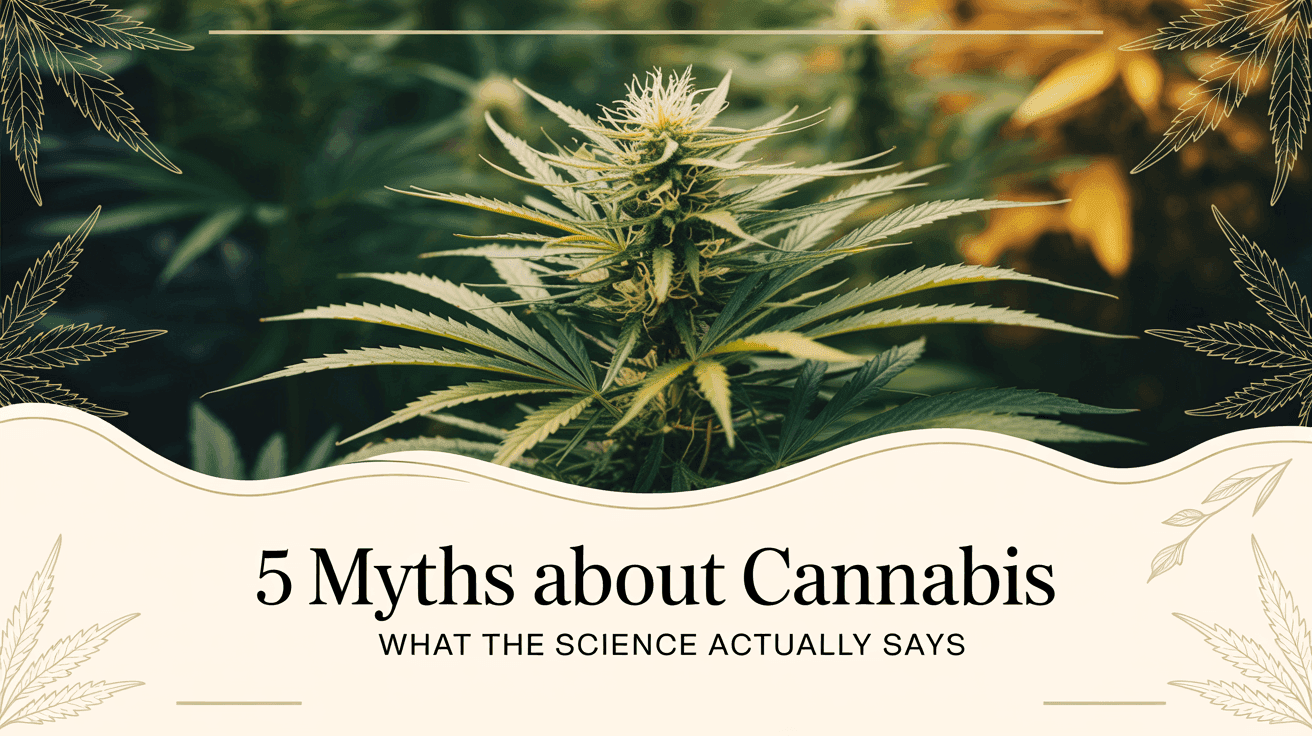
Indica vs sativa, THC%, holding smoke longer, the gateway drug theory, and more — debunked with research.
5 Myths About Cannabis — What Science Actually Says
Cannabis has been around for thousands of years, but the way we talk about it is full of half-truths, leftover propaganda, and wishful thinking. Some of those "facts" your friend swears by at the cookout? They're myths. Here are five of the most common ones, and what the research actually says.
Myth #1: "Indica = couch-lock, Sativa = energetic"
This is the single most repeated "fact" in any dispensary. Indica for sleep, sativa for creativity, hybrid for somewhere in between. It's intuitive — and almost entirely wrong.
The terms indica and sativa originally described the physical shape of the plant: short and bushy versus tall and thin. They were never about effects. The effect you feel comes from the plant's chemical profile — its mix of cannabinoids (THC, CBD, minor cannabinoids) and terpenes (the aromatic compounds like myrcene, limonene, pinene). A 2020 review in the journal Molecules looked at this directly and concluded that the indica/sativa labels are "meaningless" for predicting effects — what actually matters is the chemotype (THC-dominant, balanced, or CBD-dominant) and the terpene profile.
A few real examples: a strain labeled "sativa" that's high in the terpene myrcene will likely feel sedating — because myrcene is sedating, regardless of the plant's lineage. Conversely, a so-called "indica" with terpinolene-dominant terps can feel uplifting. Dispensaries still use the labels because shoppers expect them, but the science has moved on.
Takeaway: Judge the flower by its lab-tested cannabinoid percentages and its dominant terpenes, not by the leaf shape on the jar.
Myth #2: "Stronger weed (high THC%) is always better"
Walk into a dispensary and the highest-THC strain is usually the most expensive. Buyers assume more THC = stronger effect = better experience. The relationship is more complicated than that.
First, THC has what's called a biphasic effect curve: too little and you don't feel it, the sweet spot gives you the effect you want, and too much actually makes the experience worse — anxiety, racing thoughts, couch-lock you didn't sign up for. The biphasic effect is well-documented across both preclinical and human studies. Second, modern high-THC flower is bred for raw potency, often at the expense of the terpenes and minor cannabinoids that shape the actual character of the high. A 24% THC strain with a rich terpene profile will frequently feel more enjoyable than a 32% THC strain that's been bred to maximize the lab number.
Third — your tolerance matters more than the percentage on the jar. Someone who rarely consumes will get a meaningful effect from 15% flower. A daily consumer may barely register it. Higher THC doesn't overcome tolerance; it just pushes the dose up.
Takeaway: The "best" strain is the one with the cannabinoid and terpene profile that matches what you actually want to feel. Don't shop by THC percentage alone.
Myth #3: "Holding smoke in longer gets you higher"
This one has been folk wisdom since the 1970s: inhale, hold for ten seconds, exhale. The longer you hold, the higher you get, right?
The THC in cannabis smoke is absorbed through the lungs almost immediately. The classic 1989 study by Zacny and colleagues at the University of Chicago, and a follow-up in 1995 by Azorlosa at Johns Hopkins, both measured blood THC levels after varying breath-hold durations. Their finding: holding smoke for 10 or 20 seconds versus zero seconds raised blood THC slightly, but did not increase the subjective "high." In other words, you're not getting more effect — you're just exposing your lungs to more tar, more heat, and more carbon monoxide.
What breath-holding does do is give you more exposure to the combustion byproducts. That's a respiratory cost with no psychoactive benefit.
Takeaway: Inhale smoothly, exhale when you're ready. There's no need to play breath-hold Olympics.
Myth #4: "You have to smoke it to feel it"
Smoking is the most familiar delivery method, but it's far from the only one — and for many people, it's not even the best one.
Cannabis works through your body's endocannabinoid system, which has receptors throughout the brain, gut, skin, immune system, and nervous system. You can deliver cannabinoids to those receptors in several ways:
- Edibles — THC and CBD absorbed through the digestive tract. Slower onset (30–90 minutes), longer duration (4–8 hours), and the effect feels different: more body-heavy, often more intense.
- Tinctures — alcohol- or oil-based extracts taken under the tongue. Faster than edibles, more controllable dosing.
- Topicals — lotions and balms infused with cannabinoids. They don't get you high, but they're useful for localized soreness.
- Vaporizers — heat cannabis below combustion, releasing cannabinoids without smoke. Fewer combustion byproducts than smoking.
A 2019 review in Cannabis and Cannabinoid Research documented medical cannabis patients across all of these methods, and a 2022 mixed-methods study in Journal of Cannabis Research found that patients often rotate between methods to manage different symptoms at different times of day.
Takeaway: Smoking is one tool, not the only one. If you're curious about cannabis, the delivery method you choose changes the experience meaningfully.
Myth #5: "Cannabis kills brain cells / is a gateway drug"
These are two related myths that came out of the same era, and both deserve a careful answer.
The "kills brain cells" claim is mostly a 1970s anti-drug campaign artifact. The original research it was based on was later criticized for methodological problems and has not held up under replication. Modern imaging studies show a more nuanced picture: heavy, long-term cannabis use — particularly starting in adolescence — is associated with changes in memory, attention, and decision-making regions of the brain, but the effect is dose- and age-dependent. A 2019 review in Frontiers in Psychiatry and a 2025 study in Brain Sciences both found that the picture is complex: some studies show working-memory effects, others show no significant structural change, and recent research on middle-aged adults even suggests a possible association with better cognitive outcomes in some measures. The honest summary: cannabis is not the cartoon "fried egg" brain, but heavy adolescent use is not risk-free either.
The "gateway drug" theory — that cannabis use leads to harder drugs — has been extensively tested and the original framing has not survived. A 2017 review in NEJM and subsequent longitudinal studies have found that the apparent "gateway" pattern is largely explained by shared risk factors (social environment, mental health, access to substances), not by cannabis itself causing progression to other drugs. Most cannabis users do not progress to other illicit substances.
Takeaway: Cannabis is not the "Reefer Madness" caricature, but it's also not harmless. The accurate framing is somewhere in the middle — a substance with real effects, real therapeutic value, and real risks when misused or overused.
What This Actually Means
Cannabis is one of the most researched botanicals in modern medicine, and the more we study it, the more the old certainties fall away. The indica/sativa shorthand is breaking down in favor of chemotype. The "more THC = better" race is being questioned by researchers and experienced consumers alike. Even the most familiar folk wisdom about how to smoke it is being debunked.
What hasn't changed: cannabis is a real plant with real effects, and like any psychoactive substance, it rewards informed use. Learn the actual science, pay attention to what your own body tells you, and don't let twenty-year-old myths make your decisions for you.
Sources
- Hanuš, L. O., et al. (2020). Terpenes/Terpenoids in Cannabis: Are They Important? Molecules. https://pmc.ncbi.nlm.nih.gov/articles/PMC8489319/
- Stuyt, E. (2018). The Problem with the Current High Potency THC Marijuana. Journal of Psychoactive Drugs. https://pmc.ncbi.nlm.nih.gov/articles/PMC6312155/
- Washington State Liquor and Cannabis Board. Understanding THC Concentration and Potency. https://lcb.wa.gov/education/understanding_thc_concentration_and_potency
- Zacny, J. P., et al. (1989). Breathhold duration and response to marijuana smoke. Pharmacology Biochemistry and Behavior. https://pubmed.ncbi.nlm.nih.gov/2554344/
- Azorlosa, J. L., et al. (1995). Marijuana smoking effects of varying puff volume and breathhold duration. Psychopharmacology. https://pure.johnshopkins.edu/en/publications/marijuana-smoking-effects-of-varying-puff-volume-and-breathhold-d-3/
- Boehnke, K. F., et al. (2022). A mixed methods analysis of cannabis use routines for chronic pain. Journal of Cannabis Research. https://pmc.ncbi.nlm.nih.gov/articles/PMC8750808/
- Burggren, A. C., et al. (2019). Cannabis effects on brain structure, function, and cognition. Frontiers in Psychiatry. https://pmc.ncbi.nlm.nih.gov/articles/PMC7027431/
- Guha, A., et al. (2025). Lifetime Cannabis Use Is Associated with Brain Volume. Brain Sciences. https://pmc.ncbi.nlm.nih.gov/articles/PMC12889878/
- Centers for Disease Control and Prevention. Cannabis and Brain Health. https://www.cdc.gov/cannabis/health-effects/brain-health.html
Shop our products

Shop All

Flower

Pre-rolls
Vaporizers

Edibles
Drinks

Concentrates
Tinctures

Topicals

CBD

Pet CBD

Accessories