
Cannabis and Sleep Quality: What Actually Works (and What Doesn't)
Cannabis and Sleep Quality: What Actually Works (and What Doesn't)
What the research says about THC, CBD, REM sleep, tolerance, and timing — and how to use cannabis as a sleep aid without wrecking your nights.
Cannabis and sleep have a complicated relationship. Low-to-moderate THC doses taken occasionally can shorten sleep onset and improve perceived sleep quality, but the same compound used nightly is consistently tied to worse sleep efficiency, reduced deep sleep, REM suppression, and vivid dreams during withdrawal.
Does Cannabis Actually Help You Sleep?
Cannabis can help some people fall asleep faster and feel like they slept better — but chronic use is tied to worse measurable sleep. The answer depends on dose, frequency, and which part of sleep is broken.
The scale of cannabis as a sleep aid is striking:
- About 4% of Americans 18 and older report using cannabis products most days or every day as a sleep aid, according to the latest CDC data [6].
- A separate survey put the broader figure at roughly one in six American adults reporting cannabis use to mitigate sleep disturbances or improve sleep quality [7].
- Across medical-cannabis studies, sleep scales like the Pittsburgh Sleep Quality Index have shown measurable improvement, with responder rates of roughly 70% in PTSD and cancer cohorts and more modest gains in chronic-pain patients [8].
So why do clinicians keep warning about heavy use? Because polysomnographic studies tell a different story than patient self-reports. People who use cannabis frequently often rate their sleep as improved while the lab data shows the opposite. That gap — between how cannabis feels and what it actually does to sleep architecture — is the rest of this article.
How Does Cannabis Affect Sleep Architecture?
THC binds to CB1 receptors in the brain's endocannabinoid system, which sits on top of the circuits that govern the sleep-wake cycle. On the night of use, it pushes sleep toward the deep end of the spectrum.
What the research shows on the night of use:
- Sleep onset (falling asleep): shortened, especially with low-dose THC [2].
- Slow-wave (deep) sleep: increased, which can mean more physical restoration [2].
- REM sleep (dreaming): reduced roughly 30–50% on the night of use [2].
- Total sleep time: mixed — a 2025 polysomnographic meta-analysis found no consistent change in total time, efficiency, or staging on the nights people use it [3].
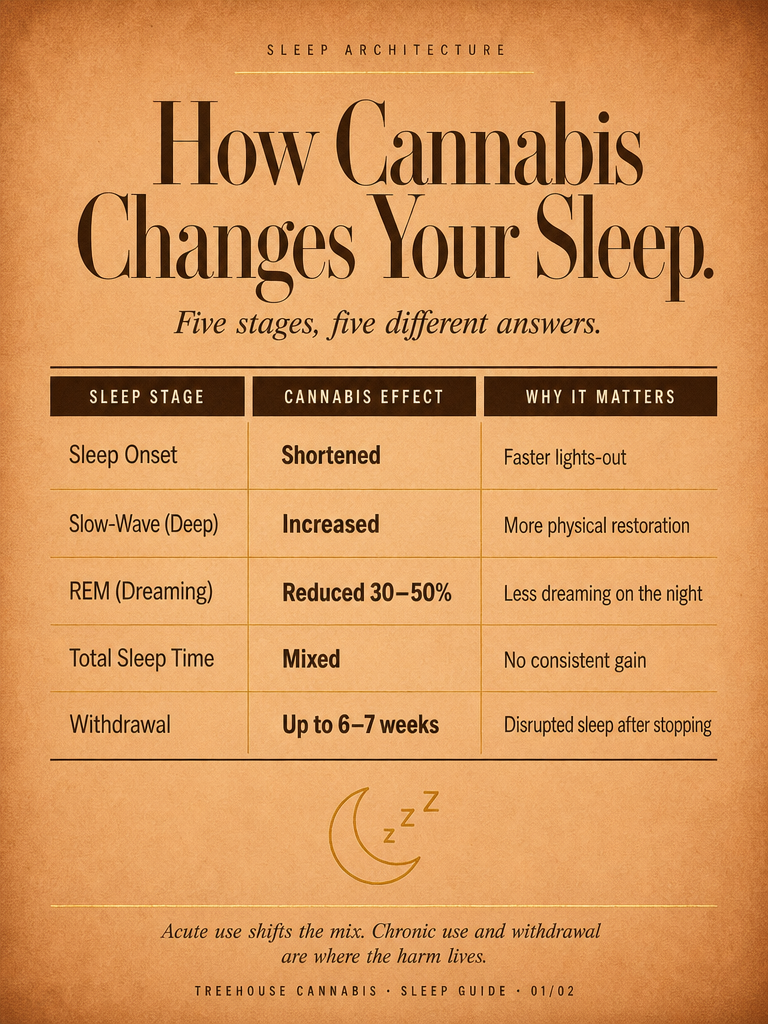
The picture gets messier when you zoom out. Withdrawal from regular use reliably cuts total sleep, lengthens sleep onset, and triggers REM rebound — the return of vivid dreams and even nightmares when someone stops [2].
Net effect: the headline "THC helps you sleep" is true at the cost of architecture changes your brain notices when you stop. Acute use shifts the mix; chronic use and withdrawal are where the harm lives.
Related guide: A Guide to Terpenes and Their Effects.
Is THC or CBD Better for Sleep?
THC has the strongest short-term sedating effect and is more consistently tied to subjective sleep improvement, while CBD on its own has gentler, mixed results. The two are not interchangeable.
| Factor | THC | CBD |
|---|---|---|
| Sedating effect | Strong, dose-dependent | Mild to mixed |
| Sleep onset latency | Shortens at low doses | Mixed — low doses can be alerting |
| REM sleep | Suppresses (30–50% reduction) | Minimal suppression |
| Next-day grogginess | Common at higher doses | Less common |
| Tolerance risk | High — develops within days to weeks of nightly use | Low |
| Best fit | Acute sleep onset, anxiety-driven insomnia | Anxiety-driven insomnia, daytime-adjacent sleep |
CBD does have a real sleep story, especially for anxiety-driven insomnia:
- A survey of 72 adults with anxiety and poor sleep found that roughly two-thirds of participants reported improved sleep after one month of CBD use [5].
- In community samples, higher reported CBD concentration has been tied to better sleep efficiency and duration, particularly in older adults [1].
- Low-dose CBD, however, can be alerting — the opposite of what most people want at bedtime.
The most common sleep-friendly approach in the research is a balanced THC:CBD ratio — enough THC to take the edge off, enough CBD to soften the next-day fog and REM loss. Chasing either cannabinoid alone tends to give you the downside without the upside.
Related guide: How THC and CBD Work.
What's the Best Cannabis Product Type for Sleep?
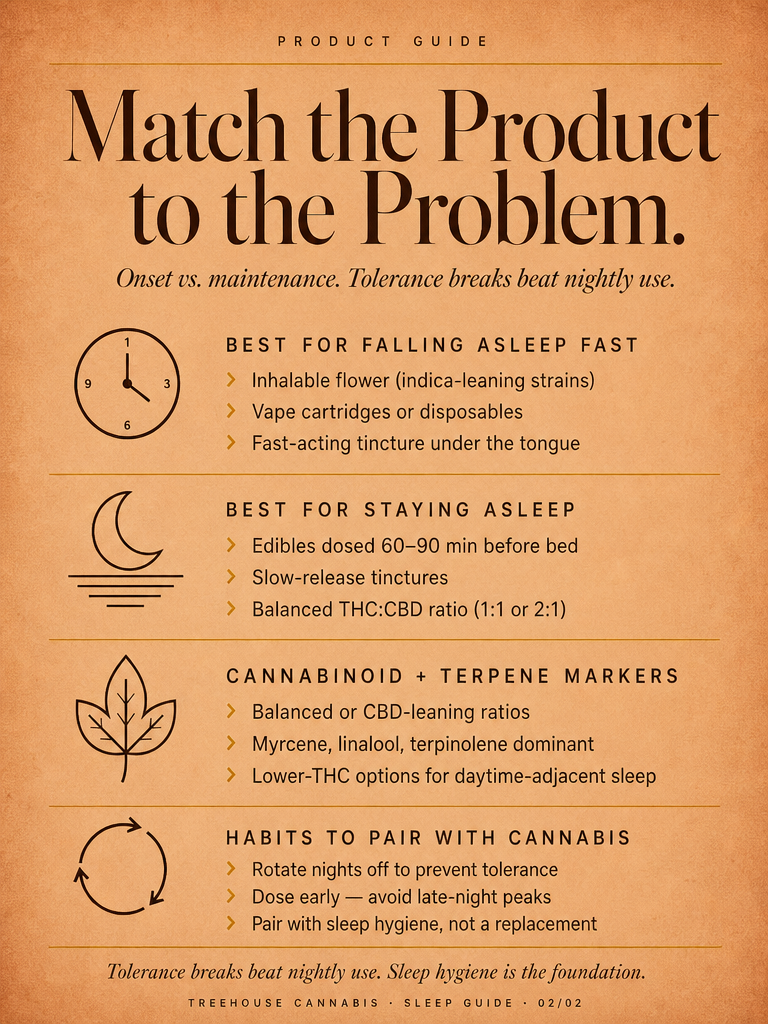
The right product depends on which part of sleep is broken. Inhalables work in minutes for falling asleep; edibles and tinctures last six to eight hours and are better for staying asleep.
Match the format to the problem:
- Trouble falling asleep: inhalation (flower, vape), fast-acting sublingual tincture.
- Trouble staying asleep: edible or capsule dosed 60–90 minutes before bed, slow-release tincture.
- Anxiety-driven sleep disturbance: balanced THC:CBD ratio (1:1 or 2:1) in any format.
- Want to limit next-day grogginess: lower-THC, CBD-leaning options with dominant myrcene, linalool, or terpinolene [4].
Two notes from the research: balanced THC:CBD ratios tend to outperform pure-THC products for overall sleep quality, and products with dominant sedating terpenes — myrcene, linalool, terpinolene — are most commonly reported as sleep-friendly [4].
Across multiple medical-cannabis studies, cannabinoids produced measurable improvements on validated sleep scales, with responders ranging from roughly 70% in PTSD and cancer cohorts to more modest gains in chronic-pain patients [8].
Related guide: Indica Vs Sativa.
Browse the full lineup: Flower.
If you want a verified pick, Northern Lights Flower 14G from the Treehouse shop is a great place to start.
If you want a verified pick, Blackberry Kush Flower 28g from the Treehouse shop is a great place to start.
How Long Before Bed Should You Take Cannabis?
Timing matters as much as dose, and the answer is not the same for every format.
Format-specific timing:
- Inhalation (flower, vape): lands within minutes — dose 15 to 30 minutes before target sleep [4].
- Edibles (gummies, chews, capsules): take 30 to 90 minutes to kick in and peak around 2 to 4 hours after ingestion — dose about 60 to 90 minutes before bed [4].
- Sublingual tinctures: 15 to 30 minutes before bed, depending on whether the formula is fast-acting or slow-release.
- Topicals: not effective for sleep — they do not reach the bloodstream in meaningful amounts.
Dose too close to sleep and you risk a peak that wakes you in the second half of the night — the classic "edible kicked in at 2 a.m." story, which Exploring the Potential Health Benefits of Cannabis breaks down in detail. Dose too early and you may be drowsy at lights-out without any maintained sleep benefit later on.
If you want to keep titration simple: start with the lowest dose that gets you to sleep on a night you can afford to feel groggy the next morning, then adjust timing — not potency — based on what happens in the second half of the night.
Browse the full lineup: Gummies Edibles.
Can You Build a Tolerance to Cannabis as a Sleep Aid?
Yes, and quickly. Research on regular cannabis users shows tolerance to the sleep-promoting effects develops within days to weeks of nightly use [2].
What tolerance looks like in practice:
- Same dose stops working — you need more for the same sleep effect.
- Worse rebound insomnia when you stop — sudden cessation cuts total sleep and lengthens onset.
- Withdrawal sleep disturbance can persist for up to 6 to 7 weeks in heavy users [2].
- The more you rely on cannabis to fall asleep, the more you rely on cannabis to fall asleep — nightly use becomes the trap.
Two practical takeaways. First, rotating nights off and taking scheduled tolerance breaks tends to keep lower doses effective longer than nightly use does. Second, most clinicians and the survey literature agree on the same playbook — occasional or intermittent use rather than nightly dosing, paired with non-pharmacologic sleep hygiene, tends to produce more durable results than treating cannabis as a daily substitute for a routine [4].
Frequently Asked Questions
Common questions about cannabis and sleep, answered from the research above.
- Does cannabis actually help you sleep?
- Is THC or CBD better for sleep?
- How long does it take for cannabis edibles to work before bed?
- Can you build a tolerance to cannabis as a sleep aid?
- Does cannabis help with insomnia or make it worse?
- What's the best cannabis product type for sleep?
- Is it bad to use cannabis every night to sleep?
Does cannabis actually help you sleep?
Short-term, low-to-moderate THC doses can shorten the time it takes to fall asleep and improve perceived sleep quality, but chronic or heavy use is consistently linked to worse sleep efficiency, reduced deep sleep, REM suppression, and vivid dreams during withdrawal — so cannabis can both help and hurt sleep depending on how often and how much is used.
Is THC or CBD better for sleep?
THC has the strongest short-term sedating effect and is more consistently tied to subjective sleep improvement, while CBD on its own has gentler, mixed effects — moderate to high CBD doses may increase total sleep, but low-dose CBD can be alerting, and many users benefit from a low THC:CBD ratio rather than either cannabinoid alone.
How long does it take for cannabis edibles to work before bed?
Edibles typically take 30 to 90 minutes to kick in and peak around 2 to 4 hours after ingestion, so most people dose about 60 to 90 minutes before their target bedtime; taking them too close to sleep can produce a "second peak" that disrupts the second half of the night.
Can you build a tolerance to cannabis as a sleep aid?
Yes — research on regular cannabis users shows tolerance to the sleep-promoting effects develops within days to weeks, requiring higher doses for the same impact and producing worse rebound insomnia when use is stopped; this is why most clinicians suggest occasional or intermittent use rather than nightly dosing.
Does cannabis help with insomnia or make it worse?
Acute use often reduces insomnia symptoms, but frequent use is associated with worse sleep onset, more nighttime awakenings, and higher global PSQI scores; people with chronic insomnia who use cannabis daily tend to report worse long-term sleep than non-users, even though they perceive an immediate benefit.
What's the best cannabis product type for sleep?
Inhalable flower and vapes act within minutes and are useful for falling asleep, while oral edibles and tinctures last 6 to 8 hours and may help with sleep maintenance; products with higher CBD content, balanced THC:CBD ratios, and dominant terpenes like myrcene, linalool, and terpinolene are most commonly reported as sleep-friendly.
Is it bad to use cannabis every night to sleep?
Nightly use raises the risk of tolerance, dependence, REM suppression, next-day grogginess, and withdrawal-driven rebound insomnia if you stop abruptly; rotating nights off, taking tolerance breaks, and pairing cannabis with non-pharmacologic sleep hygiene tend to produce more durable results than relying on it every night.
Sources
- National Library of Medicine (PMC) — In a community sample of adult moderate cannabis users, current cannabis use was
- National Library of Medicine (PMC) — Acute low-dose THC shortens sleep onset latency and improves sleep maintenance,
- PubMed / Sleep Medicine Reviews — Polysomnographic data show cannabis administration does not consistently alter t
- Sleep Foundation — Prolonged or heavy cannabis use may impair sleep quality, reduce total sleep, di
- Leafly — A survey of 72 adults with anxiety and poor sleep found that two-thirds of parti
- NORML — An estimated 4% of Americans 18 and older acknowledge using cannabis products mo
- NORML — Roughly one in six American adults report using cannabis as a sleep aid to mitig
- National Library of Medicine (PMC) — Across multiple medical-cannabis studies, cannabinoids produced measurable impro
About Treehouse Cannabis
Treehouse Cannabis is an adult-use dispensary in Nanuet, serving Rockland, Orange, and Westchester counties. We stock indica-leaning flower, balanced THC:CBD edibles, slow-release tinctures, and a curated sleep-friendly menu for adults 21 and older. Our staff can walk you through dosing, timing, and product fit — no medical advice, just honest guidance from people who care about how you actually sleep.
This content is for adults 21 and older in New York State. Treehouse Cannabis is an adult-use dispensary; this article is for educational and informational purposes only and is not medical advice. If you have a sleep disorder, are taking other medications, are pregnant or nursing, or have any health condition, talk to a licensed clinician before using cannabis for sleep. Please consume responsibly and do not drive or operate machinery while impaired.

Shop our products

Shop All

Deals

Flower
Pre-rolls
Vaporizers

Edibles
Drinks

Concentrates
Tinctures

Topicals

CBD

Pet CBD

Accessories