30-Day Cannabis Tolerance Reset: A Practical Plan
30-Day Cannabis Tolerance Reset: A Practical Plan
A cannabis tolerance reset is a planned break long enough for CB1 receptors to recover sensitivity. PET imaging of chronic daily cannabis smokers found roughly 20% lower CB1 receptor availability than controls, and that downregulation reversed after about four weeks of monitored abstinence. That measured window, not marketing, is why 30 days is the practical planning number. [1]
No drink or supplement speeds that up. What changes during a break is how efficiently receptors signal and how many of them sit on the cell surface, and both move on a biological schedule. [7] What follows is the plan: the receptor timeline, the withdrawal timeline, a week-by-week structure, symptom management, and a return protocol.
What is a cannabis tolerance reset, and why plan for 30 days?
A cannabis tolerance reset is a planned break that lets CB1 receptors regain sensitivity after frequent use. It is not a purification ritual or a way to clear THC out of your body. [7]
Tolerance comes from two receptor adaptations that are easy to blur together. Desensitization is a change in signaling efficiency, so the same amount of THC produces a weaker response. Downregulation is structural: fewer CB1 receptors remain on the cell surface, so there is less for THC to bind to. [7]
The human imaging is what makes a month a sensible horizon. In 30 chronic daily cannabis smokers, PET scans showed roughly 20% lower CB1 receptor availability than controls across cortical regions, reversing after about four weeks of monitored abstinence, measured at 26 plus or minus 5 days. [1]
Thirty days is a planning convenience built on that window, not a magic threshold. Tolerance to different effects also fades at different rates, which is why some people feel close to baseline in two weeks and others need the full month.
- A reset targets receptor sensitivity, not the presence of THC in your body.
- Desensitization changes signaling efficiency at your usual amount.
- Downregulation removes receptors from the cell surface, and it is slower.
- Four weeks is the measured reversal window behind the 30-day plan.
| Adaptation | What changes | What it means for a break |
|---|---|---|
| Desensitization | Receptors signal less efficiently at the same exposure | Effects feel weaker at your usual amount |
| Downregulation | About 20% lower CB1 availability in chronic daily users | The slower change, and why a month is the number |
For the general what-and-why rather than this plan, What Is a Tolerance Break and How Do You Do One? covers the basics and Cannabis Tolerance Break: The Complete Guide to Resetting Your System goes deeper on the process. This article does not repeat either.
How fast do CB1 receptors recover during a t break?
Measurable receptor differences are largely gone after roughly four weeks of abstinence. In one small study, the group difference was no longer statistically evident after just two days.
That two-day result gets quoted badly, so here it is in full. Eleven cannabis-dependent men were scanned at baseline, 2 days, and 28 days of monitored abstinence. Composite CB1 availability was about 15% lower at baseline, the difference from controls was no longer statistically evident by day 2, and no significant difference remained at day 28. Lower baseline availability also tracked with more severe withdrawal at 48 hours. [2]
Eleven people losing statistical separation is a statement about a small sample, not proof of full recovery in 48 hours. The larger imaging study put reversal at roughly four weeks, at 26 plus or minus 5 days. [1] Genetics explain part of the spread too: genetic variation may account for up to 50% of between-person differences in withdrawal severity. [4]
- Availability was about 15% lower at baseline in one small study of dependent men.
- Statistical separation from controls was gone by day 2 in that sample.
- No significant difference remained at day 28.
- Lower availability tracked with worse withdrawal at 48 hours.
- Genetics may explain up to half the difference in severity.
| Timepoint | What the research showed | What it does not mean |
|---|---|---|
| 48 hours | Withdrawal near its worst; receptor differences no longer statistically apparent in 11 men | That receptors are restored after two days |
| About 4 weeks | Downregulation reversed after 26 plus or minus 5 days of abstinence | That your first session back feels like the first ever |
If your frustration is topping up sooner than you meant to, How Long Should You Wait Before Taking More Cannabis? covers spacing sessions deliberately rather than reflexively.
What does the cannabis withdrawal symptoms timeline look like?
Withdrawal usually begins 24 to 48 hours after the last use, peaks between days 2 and 6, and can run three weeks or longer in heavy users. [4]
Prevalence is lower than most people expect and higher than the "it is not real" crowd admits. A pooled analysis of more than 20,000 regular or dependent users found 47% report withdrawal overall, with 17% in community, 54% in outpatient, and 87% in inpatient samples. [4] In a nationally representative sample of 1,527 frequent users, 12.1% met DSM-5 criteria in the past year, an estimate NIDA also cites. [3] [5]
Among those cases, nervousness or anxiety was reported by 76.3%, hostility by 71.9%, sleep difficulty by 68.2%, and depressed mood by 58.9%. [3] NIDA's list adds restlessness, decreased appetite, insomnia, unsettling dreams, headaches, sweating, abdominal pain, and tremor. [5]
Sleep disruption is the part people assume they are imagining. It is not. Polysomnography across two weeks of abrupt abstinence showed increased REM sleep, shortened REM latency, reduced sleep efficiency and total sleep time, and more periodic limb movements. [6]
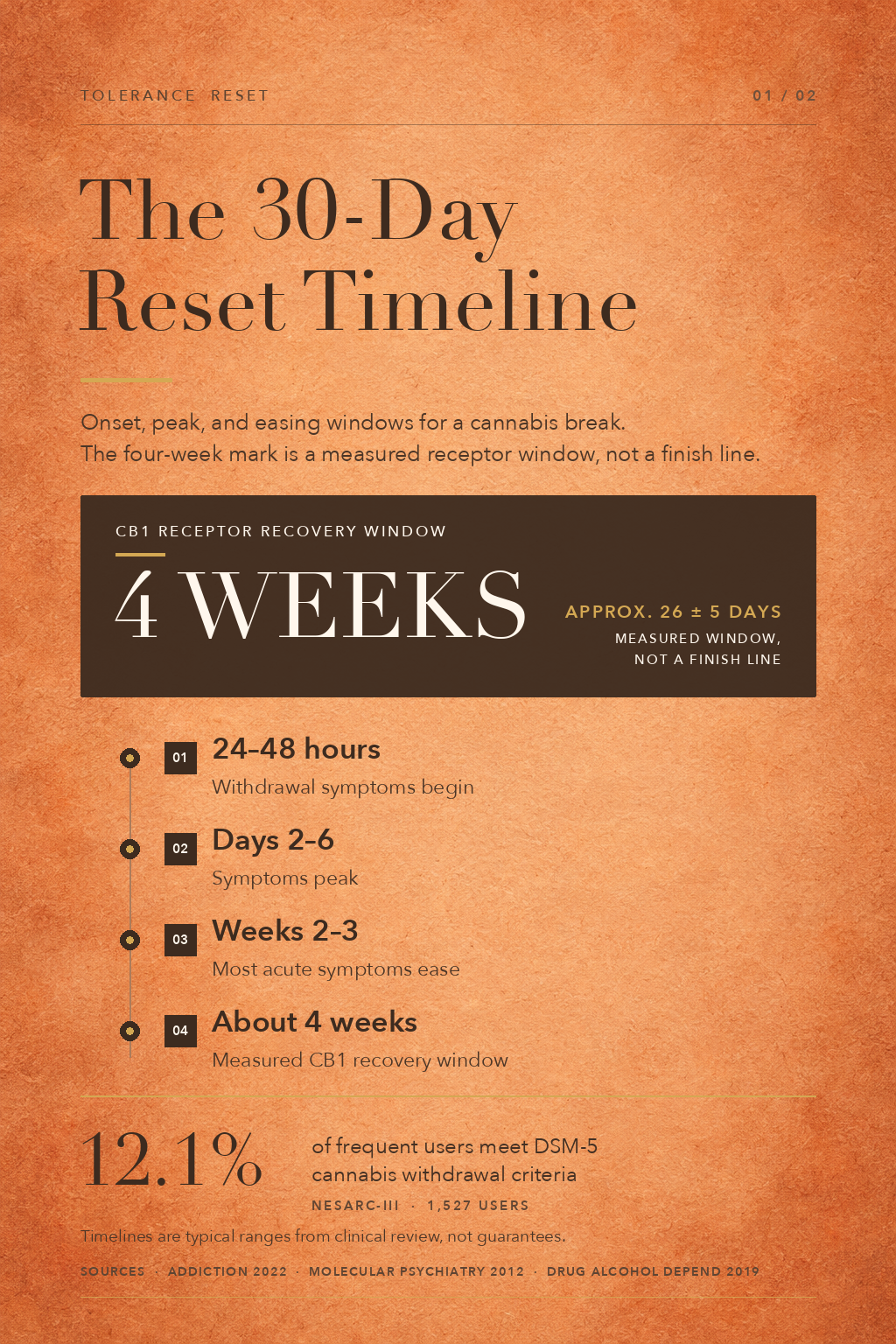
- Onset is typically 24 to 48 hours after the last use.
- Most symptoms peak between days 2 and 6.
- Some symptoms persist three weeks or longer in heavy users.
- Sleep disruption is measurable on polysomnography, not just reported.
- Get help for severe mood changes or days without eating or sleeping.
| Symptom | Typical window | Notes |
|---|---|---|
| Irritability, anxiety, restlessness | Onset 24 to 48 hours, peak days 2 to 6 | Anxiety reported by 76.3% of DSM-5 withdrawal cases |
| Sleep difficulty, vivid dreams | First one to two weeks | Increased REM sleep and shortened REM latency measured |
| Reduced appetite | Days 2 to 6, easing over one to two weeks | Listed by NIDA among common symptoms |
| Headache, sweating, abdominal discomfort | Early, usually short-lived | Reported by users; not everyone gets every symptom |
One pattern ends more breaks than anything else: as effects fade, the temptation is to take more to compensate, which is what How to Avoid Taking Too Much Cannabis addresses directly. That is not a willpower failure. It is the predictable result of chasing an effect that receptor changes have made harder to reach.
Seek professional support for severe mood changes, thoughts of self-harm, inability to eat or sleep for days, or repeated failed attempts to cut back. Heavy long-term users with anxiety, depression, or other substance use benefit most from supported planning. [4]
How do you plan a 30-day t break, week by week?
Pick your stop date and format first, then follow four weeks of structure. Expect symptoms in week one, work cravings and sleep in week two, let mood settle in week three, and plan the return in week four.
The taper-or-abrupt question has no universal answer. Clinical guidance does not favor one over the other for everyone, and direct evidence for specific taper schedules is limited. First-line management recommends psychoeducation, craving coping skills, nutrition, hydration, exercise, and sleep hygiene rather than medication. [4] Consumer guidance also describes formats beyond simply stopping, useful if an all-or-nothing quit has failed before. [8]
A gradual reduction suits heavy daily users because it softens the peak. An abrupt stop suits occasional users and anyone who wants a fixed date. Either way, this is a structure, not a prescription, and the weeks are typical rather than guaranteed.
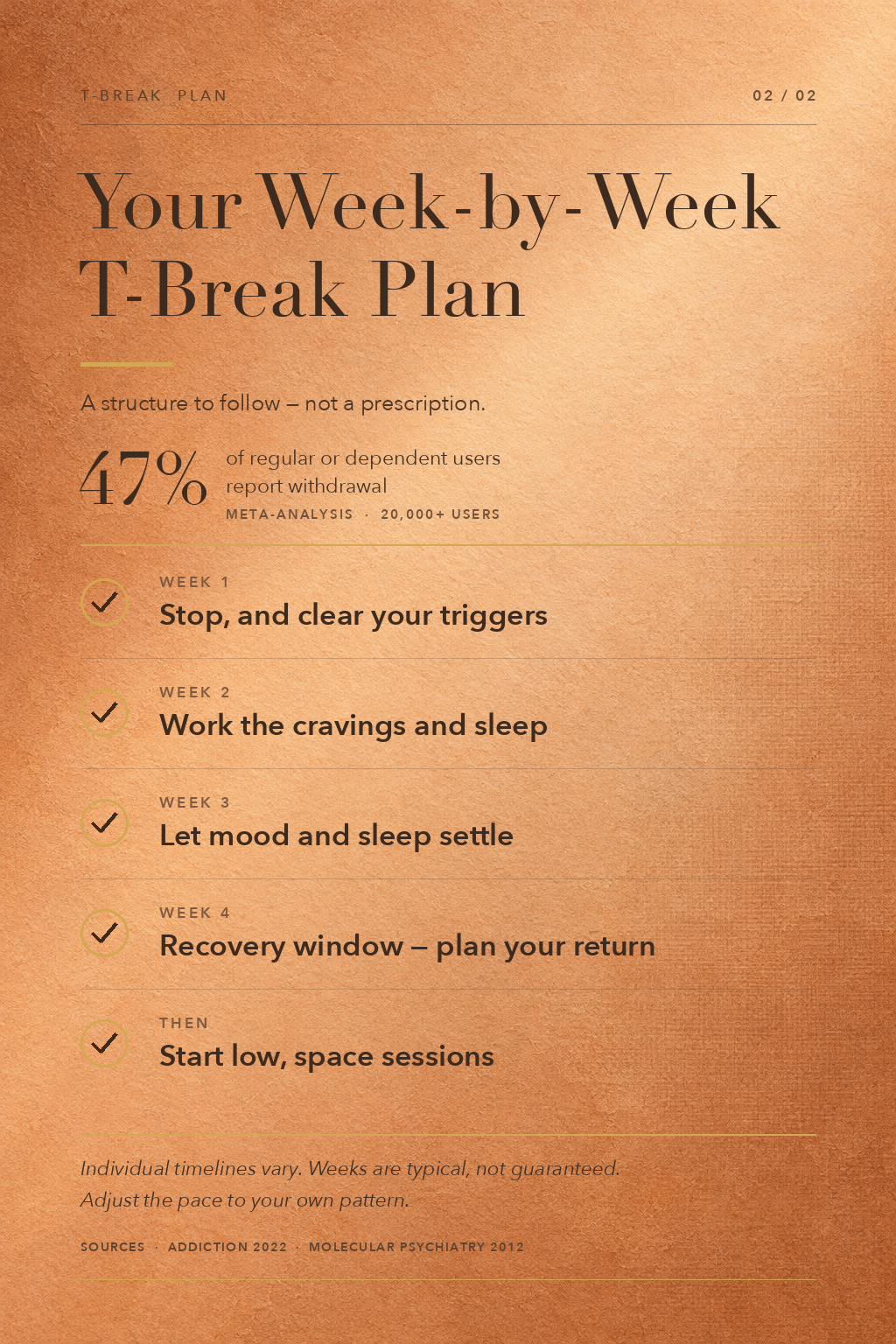
- Week 1: set a stop date, clear access and triggers, expect onset within 24 to 48 hours.
- Week 2: run craving coping skills and sleep hygiene daily, not just when things get bad.
- Week 3: most acute symptoms ease, though heavy users may still feel off.
- Week 4: you are inside the measured receptor window, so plan the return now.
- Before day 30: write your return plan while you still have no tolerance.
| Approach | Best fit | Tradeoffs |
|---|---|---|
| Gradual taper | Heavy daily users who want a softer peak | Slower to zero; needs a firm final stop date |
| Abrupt stop | Occasional users who want a clean line | Sharper peak around days 2 to 6 |
Two details do most of the work. Remove access before the stop date, because the decision is easier to keep when it is not made at 9pm with a full jar in the drawer. Then mark the four weeks on a calendar so week three does not feel like limbo.
How do you manage sleep, cravings and appetite during a tolerance break?
There is no medication shortcut in first-line guidance. The supported toolkit is psychoeducation, craving coping skills, nutrition, hydration, exercise, and sleep hygiene. [4]
Sleep is the lever people feel first. Keep a fixed sleep and wake time even on bad nights, get light early, limit late caffeine and alcohol, and keep the room cool and dark. Expect a REM rebound: polysomnography during abstinence shows increased REM sleep, shortened REM latency, reduced sleep efficiency, and more awakenings. [6] Vivid dreams are temporary and generally settle within two to three weeks. For the evidence behind that, Cannabis and Sleep Quality: What Actually Works (and What Doesn't) is the companion read.
Hardware is a cue too. If your evening routine runs through a device, box it up for the month rather than fighting the reminder nightly; a Limited Edition Sapphire Blue | Pivot Mobile Vaporizer left within reach is the hardest cue to ignore.
Cravings respond to unglamorous moves: delay for a set interval, distract with something that uses your hands, change rooms or company, and lean on someone who knows what you are doing. They rise and pass rather than climbing indefinitely. Appetite usually returns on its own schedule, and smaller meals more often with steady hydration beat forcing three full plates.
- Keep a fixed sleep and wake time, and get light early in the day.
- Expect vivid dreams, because REM rebound is measured, not imagined.
- Use delay, distraction, and a change of context for cravings.
- Eat smaller meals more often and stay hydrated.
- Ask a clinician or pharmacist before adding any sleep or anxiety product.
On CBD: it binds CB1 receptors only weakly and acts differently from THC, so it does not meaningfully reverse THC tolerance, and evidence that it relieves withdrawal is limited. [7] [5] If a clean receptor reset is the goal, keep THC out of the break entirely.
How should you return to cannabis after a break without spiking tolerance?
Restart below your previous amount, favor lower-potency or balanced-ratio formats, and space sessions out. Tolerance is an adaptive response, so it rebuilds with resumed frequent use.
The mechanism has not changed just because you took a month off. Reintroduce the same daily pattern and the same desensitization and downregulation return, usually faster than the first time felt. People who return to their previous routine typically find tolerance back within a few weeks of consistent use. [7]
Tolerance to different effects also develops at different rates, which explains a common disappointment. A lower amount may restore the experience you were chasing without restoring the intensity you remember.
Treat the first session as a titration, not a celebration. The break lowered your tolerance, not your memory of it, and the gap between those two is where most bad first nights come from. A written record of amount and frequency for two weeks is the cheapest way to catch tolerance creeping back.
- Start below your old amount rather than at it.
- Choose a lower-potency or balanced-ratio format for the first sessions.
- Keep sessions spaced instead of returning to daily use.
- Track amount and frequency for two weeks so you can see tolerance rebuild.
- Expect tolerance to return faster if you resume your previous routine.
Format literacy beats any single product choice. A dosed dropper with a stated ratio makes it easier to portion a deliberately small first session and to know what you actually took, which is the point of starting low. If tinctures are the format you want, Everyday Drops | Tincture | 150mg is one option in that category, and reading the label matters more than the marketing on it. [8] For flower, pre-portioned options remove some guesswork, and Pre Ground Flower is one place to compare current listings.
What else should adults know about a cannabis tolerance reset?
The short version: 30 days is a planning window built on measured receptor recovery, withdrawal is real but usually time-limited, and the return matters as much as the break.
- Receptor recovery is measured over roughly four weeks, not overnight.
- Withdrawal typically starts in 24 to 48 hours and peaks around days 2 to 6.
- Sleep and mood settle over the first two to three weeks for most people.
- Tolerance rebuilds with resumed use, so the return plan is part of the reset.
How long does a cannabis tolerance reset take to work?
CB1 availability begins rising within about 48 hours of stopping, and receptor differences are largely resolved after roughly four weeks of abstinence. Most people notice a clear drop in tolerance within two to three weeks, which is why a 30-day window leaves margin. [1] [2]
Does a 30-day break fully reset cannabis tolerance?
It substantially reverses tolerance but is not a factory reset. CB1 availability recovers over about four weeks, yet tolerance to different effects develops and fades at different rates. Memory-related tolerance is well documented; tolerance to the feeling of being high is far less consistent. [1] [7]
What does the first week of a tolerance break feel like?
Symptoms usually begin 24 to 48 hours after the last use and peak around days 2 through 6. The most common are irritability, anxiety, insomnia, reduced appetite, vivid dreams, headaches, restlessness, and sweating. Most acute symptoms ease within one to two weeks. [4] [3]
Is it better to taper or quit cold turkey?
Tapering softens the peak, while stopping abruptly is simpler and faster. Clinical guidance does not favor one over the other for everyone, and direct evidence for tapering schedules is limited. A gradual reduction suits heavy daily users; occasional users often do fine stopping outright. [4] [8]
Will my tolerance come back after the break?
Yes. Tolerance is an adaptive response, so it rebuilds with resumed frequent use, though usually more slowly from a lower amount and frequency. Returning to your previous daily pattern typically brings it back within a few weeks. [7]
Why are my dreams so vivid during a tolerance break?
THC suppresses REM sleep, so stopping triggers a rebound. Polysomnography during abstinence shows increased REM sleep and shorter REM latency. Vivid dreams are a predictable, temporary effect that generally settles over the first two to three weeks. [6]
Can I use CBD during a cannabis tolerance break?
CBD binds CB1 receptors only weakly and acts differently from THC, so it does not meaningfully reverse THC tolerance. Some consumers use it for general calm, but evidence that it relieves withdrawal is limited. If your goal is a clean receptor reset, keep the break free of THC. [5] [7]
When should someone talk to a clinician about a tolerance break?
Seek support if withdrawal brings severe mood changes, self-harm thoughts, inability to eat or sleep for days, or repeated failed attempts to cut back. Heavy long-term users with anxiety, depression, or other substance use benefit most from supported planning. [4] [5]
Sources
- Molecular Psychiatry (Nature) / National Institutes of Health — PET imaging of 30 chronic daily cannabis smokers found roughly 20% lower CB1 rec
- Biological Psychiatry: Cognitive Neuroscience and Neuroimaging / National Institutes of Health — In 11 cannabis-dependent men scanned at baseline, 2 days, and 28 days of monitor
- Drug and Alcohol Dependence / National Institutes of Health (NESARC-III) — In a nationally representative sample of 1,527 frequent cannabis users (three or
- Addiction (journal) / National Institutes of Health — This clinical review reports that withdrawal symptom onset typically occurs 24 t
- National Institute on Drug Abuse (NIDA), National Institutes of Health — NIDA's federal research summary states that people may experience withdrawal aft
- Sleep Medicine / National Institutes of Health — Objective polysomnography across two weeks of abrupt abstinence in heavy cannabi
- Biochemical Pharmacology / National Institutes of Health — This review explains that cannabinoid tolerance arises from two distinct CB1 rec
- Leafly — Consumer-facing overview describing multiple practical tolerance-break formats b
About Treehouse Cannabis
Treehouse Cannabis publishes adult-use education for customers in Rockland County, New York. Nothing here is medical advice, and a planned break is not a treatment plan. If withdrawal feels unmanageable or you keep failing to cut back, talk to a healthcare professional rather than pushing through alone.
Cannabis is for adults 21 and older. Keep all cannabis products away from children and pets. This article is educational and is not medical advice. Do not drive or operate machinery while impaired.

Shop our products

Shop All

Deals

Flower

Pre-rolls
Vaporizers

Edibles
Drinks

Concentrates
Tinctures

Topicals

CBD

Pet CBD

Accessories