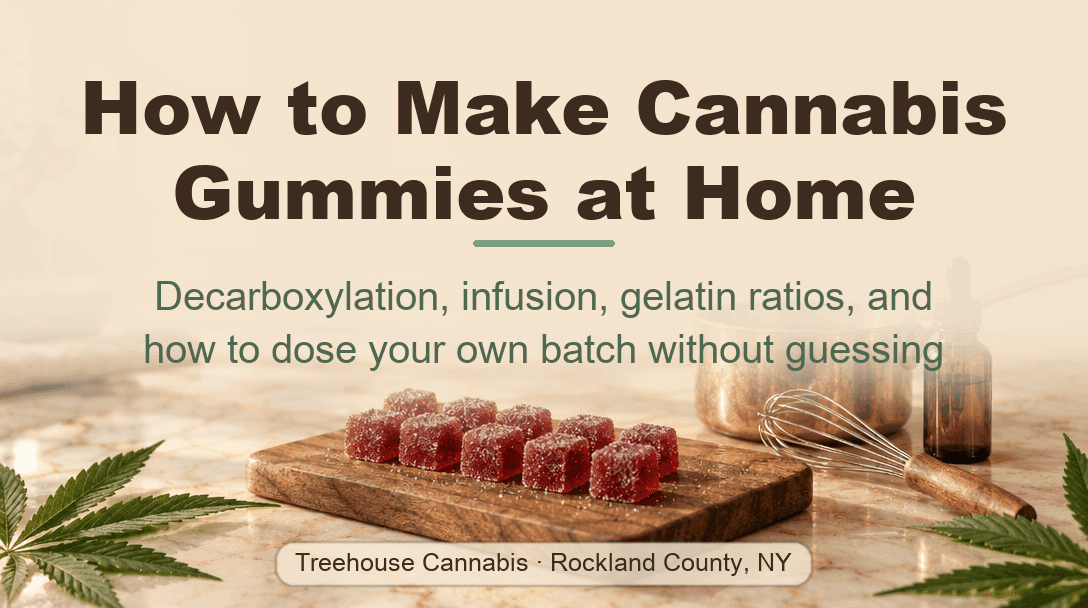
How to Make Cannabis Gummies at Home
How to Make Cannabis Gummies at Home
How to make cannabis gummies at home: decarboxylate the flower, infuse it into coconut or MCT oil, blend that oil into a gelatin or pectin base with lecithin, then fill moulds and chill. Four things matter more than any gadget: an accurate scale, an oven thermometer, a proper gelling ratio, and a realistic estimate of milligrams per piece.
Most first batches fail for boring reasons. The flower was never heated enough to activate, the oil separated because nothing emulsified it, the gelatin got boiled and refused to set, or nobody wrote down how much THC went into the pot. Each of those is fixable, and none of them require special equipment.
This guide walks the whole sequence at the temperatures and ratios published research actually measured, then covers the part most recipes skip: how to estimate what is in a single gummy, and what New York law allows a home grower to do with their own harvest.
What Do You Need to Make Cannabis Gummies at Home?
Making cannabis gummies at home takes four things: decarboxylated cannabis, a fat or oil carrier, a gelling agent, and a mould. A gram scale, an oven thermometer, a heavy saucepan, and silicone moulds cover the rest of the equipment list.
The ingredient choices decide whether the batch sets, and the equipment decides whether you can repeat it.
- A kitchen scale accurate to 0.1 g for weighing flower and finished batch weight.
- An independent oven thermometer, because home ovens routinely run 10 to 15 degrees off at decarboxylation temperatures.
- Decarboxylated cannabis, ground coarsely and spread thin and even before heating.
- A fat or oil carrier - refined coconut oil or MCT oil sets better in gummies than butter.
- A gelling agent: gelatin for a chewy commercial texture, or pectin and agar for vegetarian batches.
- Sunflower lecithin as the emulsifier that keeps infused oil from pooling on the surface.
- Silicone moulds plus a squeeze bottle or syringe for clean, even fills.
The scale and the thermometer are not upsells. A batch is only as consistent as its two weakest measurements: how much flower went in, and how hot the oven actually got. An oven dial set to 110C (230F) can cycle well above that, and a batch that overshoots loses cannabinoids you already paid for.
Starting material matters too. Pre Ground Flower skips the grinding step and gives you a more uniform particle size, which decarboxylates more evenly than hand-crushed buds. Whatever you start with, keep the label, because a listing like Panama Red | Flower | 3.5g tells you the THC percentage you need for the batch arithmetic later. Without a labeled percentage, every dose estimate downstream is a guess dressed up as a number.
Gelatin load is the other number worth writing down. A peer-reviewed confectionery formula used 220 Bloom bovine gelatin at 8.5 percent of final product mass, hydrated for 10 minutes at room temperature and dissolved at 60C, with finished gummies holding roughly 25 to 30 percent water. [8] That is a tested starting point, not a rule - but it is a far better place to begin than a recipe that lists "one packet."
Why Must You Decarboxylate Cannabis Before Making Gummies?
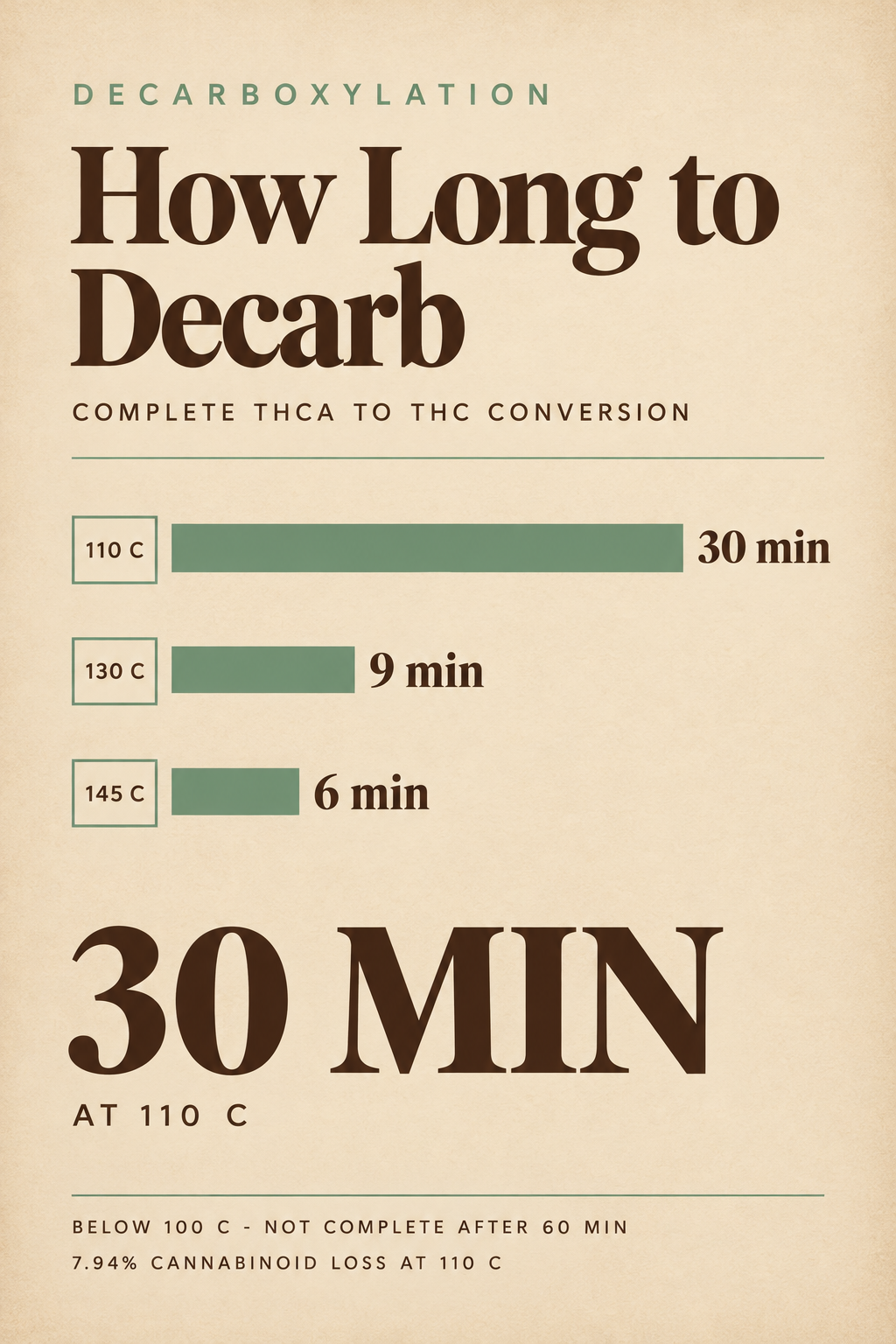
You must decarboxylate cannabis before making gummies because raw flower holds THC mostly as THCA, which is not intoxicating. Heat removes a carboxyl group and converts it to THC; a 2016 kinetics study measured complete conversion in 30 minutes at 110C, 9 minutes at 130C, and 6 minutes at 145C. [1]
Skip this step and you have made candy, not an edible.
The study measured conversion at several temperatures, and the shape of the results is the useful part:
- 110C (230F) for 30 minutes - complete conversion in the measured study.
- 130C (266F) for 9 minutes - complete conversion, faster but hotter.
- 145C (293F) for 6 minutes - complete conversion at the shortest measured time.
- Below 100C (212F) - the reaction had not finished after 60 minutes.
- 7.94 percent - total cannabinoid lost at 110C, which is why gentler is not automatically worse.
| Oven temperature | Time to complete conversion | What it means at home |
|---|---|---|
| 110C (230F) | 30 minutes | Gentlest measured setting, lowest cannabinoid loss |
| 130C (266F) | 9 minutes | Faster, needs close attention to avoid scorching |
| 145C (293F) | 6 minutes | Fastest measured, easiest to overshoot |
| Below 100C (212F) | Not complete at 60 minutes | Under-decarbed batch, weak effect |
Those times come from a vacuum oven with a controlled setpoint. A home oven swings, so the practical translation is a thin, even layer of coarsely ground flower on a lined tray, covered with foil to hold an even temperature, and timed from when the thermometer - not the dial - reads the target. Check at the low end of the range rather than assuming the clock is exact.
Two things are worth saying plainly. Heat degrades as well as activates: push the temperature higher to save time and you trade some THC for convenience, which is exactly what the 7.94 percent loss figure at 110C measures. And the reaction does not need to be perfect to be useful, so a slightly under-decarbed batch is a weaker batch, not a ruined one.
If you start from activated distillate or lab-made infused oil, the entire step is unnecessary. Those products are already decarboxylated, which is a large part of why commercial edibles dose so predictably.
How Do You Infuse Butter or Oil for Homemade Gummies?
Infuse cannabis into coconut oil or MCT oil by combining decarboxylated flower with melted oil at roughly a 1:1 ratio by weight, holding it at 70 to 90C for two to three hours, then straining through cheesecloth and pressing the plant material to recover the oil. Coconut oil sets better in gummies than butter.
Cannabinoids are fat-soluble, so the carrier has to be a fat. That is the whole reason infusion works, and the reason a water-based gummy mix needs help holding the oil later.
- Combine decarboxylated cannabis with melted coconut or MCT oil at about 1:1 by weight for a strong infusion.
- Hold the mixture at 70 to 90C for two to three hours, stirring occasionally; do not let it boil.
- Strain through cheesecloth, then press the plant material to recover the oil that would otherwise be lost.
- Whisk in sunflower lecithin so the oil binds to the water-based mix instead of pooling on top.
- Skip this entire step if you are starting from activated distillate or lab-made infused oil.
Butter works, but it brings water and milk solids into a recipe that needs a clean fat. In gummies those extra components interfere with the set and shorten shelf life. Refined coconut oil or MCT oil stays liquid at room temperature, carries cannabinoids well, and disperses more predictably. If you want the butter route anyway, How to Make Cannabutter: A Beginner-Safe Guide covers it properly - just expect a softer result in a mould.
The pressing step is where home batches quietly lose potency. Cheesecloth alone leaves a meaningful share of oil in the spent plant material. Squeezing it, or running it through a potato ricer, recovers oil you already infused. How to Make Cannabis-Infused Coconut Oil goes deeper on the coconut oil version, including how to judge when the infusion is finished.
New York's home cultivation rules permit exactly this kind of processing. Home growers may turn their cannabis into concentrates such as butters, oils, and ghee by infusion, agitation, or rosin press, while flammable solvent extraction - including heated ethanol and volatile gases - is prohibited. [7] Infusion is the legal lane; open-loop solvent work is not.
Emulsification is the last piece. Oil and water-based juice do not mix, and without an emulsifier the fat separates and rises as it cools. Sunflower lecithin is the usual fix: whisk it into the warm oil before the oil meets the juice, and keep whisking until the mixture goes from slick and separated to uniformly cloudy.
How Do You Make Cannabis Gummies Step by Step?
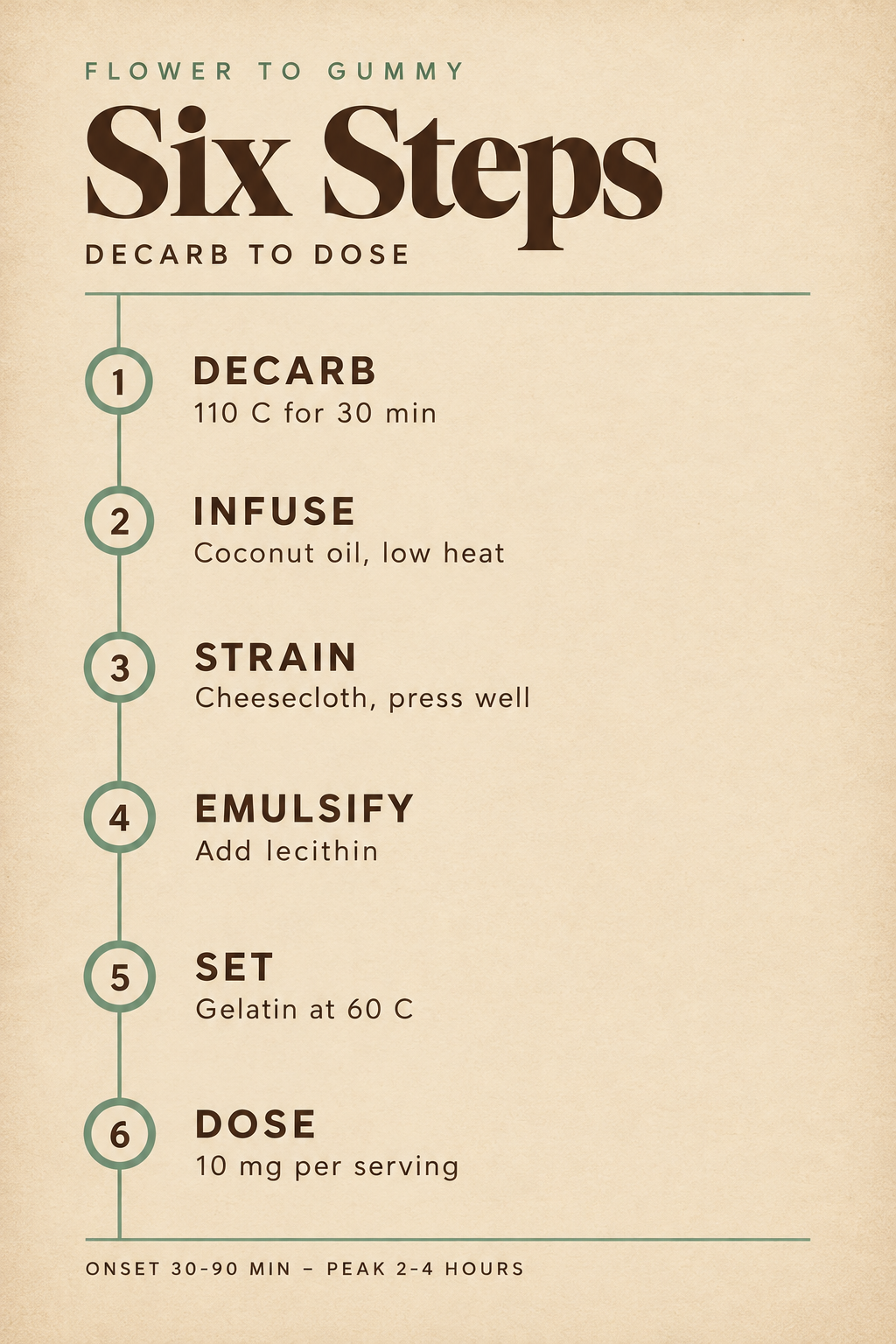
To make cannabis gummies, bloom gelatin in cold liquid, warm juice and sugar until dissolved, blend in the infused oil with lecithin until uniform, dissolve the gelatin at 60C, skim the foam, fill the moulds, and chill for at least two hours. A tested formula used 220 Bloom gelatin at 8.5 percent of final product mass. [8]
Work in this order and the batch behaves predictably:
- Bloom the gelatin in cold liquid for 10 minutes at room temperature.
- Warm fruit juice or puree with sugar until the sugar fully dissolves.
- Blend in the infused oil and sunflower lecithin until the mixture goes from separated to uniform.
- Dissolve the bloomed gelatin into the warm mix at 60C - never boil it, because heat above that range destroys the set.
- Skim the foam off the surface so the finished gummies are clear rather than cloudy.
- Fill the moulds with a squeeze bottle or syringe, working quickly before the mix starts to set.
- Chill at least two hours, then calculate total batch THC and label the container with date and milligrams per piece.
Two failure modes account for most disappointing batches, and both are easy to name in advance. Boiling gelatin breaks down the protein chains that form the gel, so a mix that hit a rolling boil will stay syrupy no matter how long it chills. Adding infused oil without lecithin leaves a permanent slick on the surface and an uneven distribution of THC from piece to piece - the gummy that happens to catch more oil hits harder than its neighbour.
Gelling agents are not interchangeable, even though they all produce something chewy.
| Gelling agent | Set behaviour | What it needs | Texture |
|---|---|---|---|
| Gelatin | Sets as it cools | Hydration, then heat to dissolve | Chewy, commercial-style |
| Pectin | Sets with sugar and acid | Sugar plus acid, careful pH | Softer, fruit-forward |
| Agar | Sets hot, firm snap | Brief boil to activate | Firmer, less elastic |
Gelatin is the forgiving option for a first batch because the set is thermal - it thickens as it cools, so you can see the mixture start to work. Pectin depends on sugar concentration and acidity, which makes it fussier, and agar needs a real boil to activate, which conflicts with the instruction to keep infused oil away from prolonged high heat. Choose the agent before you buy ingredients, not after.
Finally, calculate the batch before you fill, not after. Knowing total THC in the pot tells you whether you are making forty 5 mg pieces or forty pieces you should not hand to a friend. How to Calculate THC in Homemade Edibles walks that arithmetic in detail. Write the number on the lid while the moulds are still in the fridge; nobody reconstructs it accurately a week later.
How Do You Dose Homemade Cannabis Gummies Safely?
Dose homemade gummies by estimating total batch THC - grams of flower times its labeled THC percentage, discounted for extraction and decarboxylation loss - then dividing by the number of pieces. A standard regulated serving is 10 mg THC, and only 6 to 10 percent of swallowed THC reaches circulation. [2]
The arithmetic is straightforward. The honesty is the hard part, because a homemade estimate is an estimate.
- 10 mg THC is one standard regulated serving, with a 100 mg cap per package.
- Only 6 to 10 percent of swallowed THC reaches circulation, compared with inhalation.
- Onset runs 30 to 90 minutes and the peak lands 2 to 4 hours in, so wait a full two hours before a second piece.
- 83 percent of tested edibles missed their label by more than 10 percent - treat your own figure as an estimate, not a measurement.
- Label the container with batch date and estimated milligrams per piece.
- Refrigerate in an airtight container, because gelatin gummies sweat and support mould at room temperature.
- Keep the container locked and out of sight of children and pets; THC gummies look exactly like candy.
The 83 percent figure deserves a pause. If professionally manufactured edibles in regulated markets missed their stated content by more than 10 percent in a majority of samples, a kitchen batch built on an assumed flower percentage and an assumed extraction efficiency is working with wider error bars still. [2] The CDC makes the same point from the other direction: THC concentration is difficult to measure and often inaccurate on labels, which is precisely how people end up eating far more than they intended. [3]
Potency of the starting flower adds another variable. Delta-9 THC in seized illegal cannabis rose from 3.96 percent in 1995 to 16.14 percent in 2022, a quadrupling that makes any inherited recipe from an older generation badly out of date. [5] A "pinch" scaled to 1990s flower is a different dose today.
Why the delay matters so much:
| Measure | Edible (swallowed) | Smoked |
|---|---|---|
| Onset | 30-90 minutes | About 20-30 minutes to peak |
| Peak effect | 2-4 hours | Roughly 20-30 minutes |
| Bioavailability | 6-10 percent | Higher and faster via the lungs |
| Metabolism | First-pass liver conversion to 11-OH-THC | Mostly delta-9 THC reaching circulation |
Because swallowed THC passes through the liver before it reaches circulation, it becomes 11-OH-THC, a more potent metabolite, and the whole process runs on a delay. That gap is where accidental overconsumption happens: someone feels nothing at forty minutes, eats two more pieces, and meets the first one an hour later. How Long Should You Wait Before Taking More Cannabis? explains the waiting logic in more depth, and it applies double to a batch of unknown strength.
Cannabis also affects memory, learning, attention, decision making, coordination, and reaction time, and it can raise heart rate and blood pressure. [4] That is the reason the label and the lock matter beyond dosing accuracy - an unlabeled tray of candy in a refrigerator is a household risk, not just a potency problem.
Is It Legal to Make Cannabis Gummies at Home in New York?
Yes, for adults 21 and older who grow their own. New York permits home cultivation of three mature and three immature plants per person, up to twelve plants per household, and allows homegrown cannabis to be infused into butters, oils, and ghee, while prohibiting flammable solvent extraction and any sale or barter of homegrown cannabis. [6]
The cultivation right is real, and so are its edges.
- Allowed: three mature and three immature plants per person, six of each per household, twelve plants maximum per household.
- Allowed: infusing homegrown cannabis into butters, oils, and ghee by infusion, agitation, or rosin press.
- Allowed: home possession up to 5 pounds of flower or the 22.5 ounce concentrate equivalent.
- Prohibited: flammable solvent extraction, including heated ethanol and volatile gases.
- Prohibited: selling, trading, or bartering homegrown cannabis in any form, gummies included.
Two distinctions trip people up. First, a cultivation right is not a licence: growing your own and infusing it at home is lawful for adults 21 and older, but selling or bartering the result is not, and neither is gifting it in a way that functions as a sale. Second, the extraction ban is about process, not intent - ethanol heated over an open flame or a volatile gas setup is prohibited at home regardless of how small the batch, while infusion, agitation, and a rosin press are permitted routes. [7]
Possession limits tie back to the rest of it. How Much Cannabis Can You Legally Possess in New York? sets out how much cannabis a New Yorker may legally possess, which is the ceiling on what a home harvest can reasonably become - gummies included.
For anyone who would rather not estimate a dose from an assumed flower percentage, a licensed retailer is the simpler path. Treehouse Cannabis in Rockland County carries lab-tested gummies and tinctures labeled with exact milligrams per piece, so the arithmetic is already done. Customers can browse Gummies Edibles for lab-tested options, or ask the team which serving size fits their experience level.
Making gummies at home is a measurement exercise more than a cooking one. Get the decarboxylation temperature right, infuse into a clean fat, emulsify properly, respect the gelatin's heat limit, and write the milligram estimate on the lid. Do those five things and the batch is predictable - which is the only thing a homemade edible really needs to be.
What Are the Most Common Questions About Making Cannabis Gummies?
The recurring questions are about decarboxylation, oven temperature, why the effect arrives late, and how to estimate milligrams per piece. The short answers come back to four points:
- Unheated flower is mostly THCA, which is not intoxicating until it is decarboxylated.
- A tested home range is 110 to 120C for 30 to 45 minutes in a thin, even layer.
- Swallowed THC is slower and less bioavailable than inhaled THC, so the wait is longer.
- A homemade milligram figure is an estimate, and should be labeled as one.
Do You Have to Decarboxylate Cannabis Before Making Gummies?
Almost always. Flower and trim hold THC mostly as THCA, which is not intoxicating until heat removes a carboxyl group. A 2016 kinetics study found conversion was complete in 30 minutes at 110C, 9 minutes at 130C, and 6 minutes at 145C, but did not finish within an hour below 100C. [1]
What Oven Temperature Works for Decarbing at Home?
Most home guides target 110 to 120C (230 to 250F) for 30 to 45 minutes in a thin, even layer. Lower heat needs more time, while higher heat converts faster but risks THC loss. The same study measured 7.94 percent total cannabinoid loss at 110C, so gentler conditions preserve more. [1]
Why Do Homemade Gummies Hit Later and Last Longer?
Swallowed THC passes through the liver first, where it becomes 11-OH-THC, a more potent metabolite. Only 6 to 10 percent reaches circulation, onset runs 30 to 90 minutes, and the peak lands 2 to 4 hours in, versus roughly 20 to 30 minutes when smoked. That lag is what drives accidental overconsumption. [2]
How Do You Estimate THC per Gummy?
Multiply the flower weight by its labeled THC percentage, discount for incomplete decarboxylation and extraction, then divide by the number of pieces. Regulated markets treat 10 mg as one serving and cap packages at 100 mg. Homemade batches vary, so treat the figure as an estimate rather than a measurement. [2]
Can You Make Cannabis Gummies Without Gelatin?
Yes. Pectin, agar, and modified starch all set gummies. Pectin requires sugar and acid to gel, while gelatin sets as it cools. A 2024 confectionery study used 220 Bloom gelatin at 8.5 percent of final mass, hydrated 10 minutes and dissolved at 60C, for a chewy commercial-style texture. [8]
Can You Use Distillate or Infused Oil Instead of Flower?
Yes, and activated oil or distillate skips the decarboxylation step entirely. Infused coconut or MCT oil still has to be emulsified into the mix, usually with sunflower lecithin, or it separates and pools. Uneven dispersion is the most common reason one gummy in a batch hits harder than the rest. [7]
Is Making Cannabis Gummies at Home Legal in New York?
For adults 21 and older who grow their own, yes. New York allows three mature and three immature plants per person and permits infusing homegrown cannabis into oils and butters. Flammable solvent extraction is prohibited, and selling or bartering homegrown cannabis is illegal. [6]
How Should Homemade Cannabis Gummies Be Stored?
Refrigerate them in an airtight container, because gelatin gummies sweat and support mould at room temperature. Label the container with the batch date and estimated milligrams per piece. Keep it locked and out of sight of children and pets, since THC gummies are visually indistinguishable from candy. [3]
Sources
- National Center for Natural Products Research, University of Mississippi (Cannabis and Cannabinoid Research) — Heating cannabis converted THCA-A to THC completely in 30 minutes at 110C, 9 min
- RTI International (Methods Report, RTI Press) — Oral THC has only 6 to 10 percent bioavailability and a 30 to 90 minute onset wi
- Centers for Disease Control and Prevention (CDC) — Edibles can take 30 minutes to 2 hours to produce intoxicating effects, THC conc
- Centers for Disease Control and Prevention (CDC) — Cannabis use directly affects brain functions including memory, learning, attent
- National Institute on Drug Abuse (NIDA) — Delta-9 THC potency in seized illegal cannabis quadrupled from 3.96 percent in 1
- New York State Office of Cannabis Management (OCM) — New Yorkers 21 and older may cultivate up to six cannabis plants at home for per
- New York State Office of Cannabis Management (OCM) — New York permits home cultivators to turn their cannabis into concentrates such
- Polymers (MDPI), peer-reviewed confectionery study — A tested gelatin gummy formula used 220 Bloom bovine gelatin at 8.5 percent of f
About Treehouse Cannabis
Treehouse Cannabis shares adult-use education to help customers understand cannabis formats, labels, and serving sizes. Staff cannot provide medical advice or tell you how much THC is appropriate for you, and a homemade batch cannot be lab-verified by anyone at the counter. Questions about a specific product's labeled potency are fair game; questions about what dose suits a health condition belong with a qualified healthcare professional.
This article is for educational purposes only and is not medical or legal advice. Cannabis is for adults 21 and older. Keep all cannabis products away from children and pets. Do not drive or operate machinery while impaired.


Shop our products

Shop All

Deals

Flower

Pre-rolls
Vaporizers

Edibles

Drinks

Concentrates
Tinctures

Topicals

CBD

Pet CBD

Accessories