
You Can't Dream on Weed: The Science of REM Suppression and What Happens After a T-Break
You Can't Dream on Weed: The Science of REM Suppression and What Happens After a T-Break
You Can't Dream on Weed: The Science of REM Suppression and What Happens After a T-Break
Why cannabis kills your dreams — and exactly what to expect when you take a break
If you've ever taken a break from cannabis and found yourself jolting awake from the most vivid dreams of your life, you're not imagining it. You're experiencing what's known as REM rebound — and it's one of the most predictable, well-documented effects of regular cannabis use that almost nobody talks about honestly.
This guide breaks down exactly what cannabis does to your sleep, why your dreams disappear while you're using, and what happens to your body and brain during the days and weeks after you stop.
 What happens to your sleep architecture during a T-break
Why Does Cannabis Kill Your Dreams?
The short answer: THC suppresses REM sleep.
When you consume cannabis — especially regularly — THC binds to CB1 receptors in your brain. These receptors are part of your endocannabinoid system (ECS), which plays a role in regulating sleep architecture, mood, memory, and dozens of other physiological processes.
One of the ECS's jobs is modulating the REM (Rapid Eye Movement) phase of sleep. REM is the stage where most dreaming occurs, where your brain processes emotions, consolidates memories, and runs its nightly "defragmentation cycle."
THC dampens REM activity. Studies consistently show that THC decreases both the number of REM episodes and the total duration of REM sleep. The higher your dose and the more frequently you use, the more pronounced this effect becomes.
Bottom line: If you're a regular cannabis user, you're spending significantly less time in REM sleep than you would without it. Your dreams aren't gone — they're suppressed.
How Does THC Actually Affect Sleep Architecture?
Sleep isn't one uniform state. It moves through distinct stages: light sleep (Stage 1-2), deep sleep (Stage 3, also called slow-wave sleep), and REM. Each stage serves a different function.
- Stage 1-2: Basic rest, memory consolidation of motor skills
- Stage 3 (Deep Sleep): Physical recovery, immune function, growth hormone release
- REM: Emotional processing, creative problem-solving, memory integration
Research from the NIH shows that THC:
- Reduces REM sleep duration and frequency
- Often increases time in deep (Stage 3) sleep
- Can decrease sleep latency (time to fall asleep) in the short term
So cannabis doesn't just "make you sleep." It reshapes your sleep architecture — pushing you toward deeper, slower sleep while crowding out the REM phase where dreaming and emotional processing happen.
What Happens to Your Brain and Body When You Stop
When you quit or cut back, your brain doesn't just magically return to normal sleep patterns. It takes time — and the adjustment comes with a set of predictable symptoms.
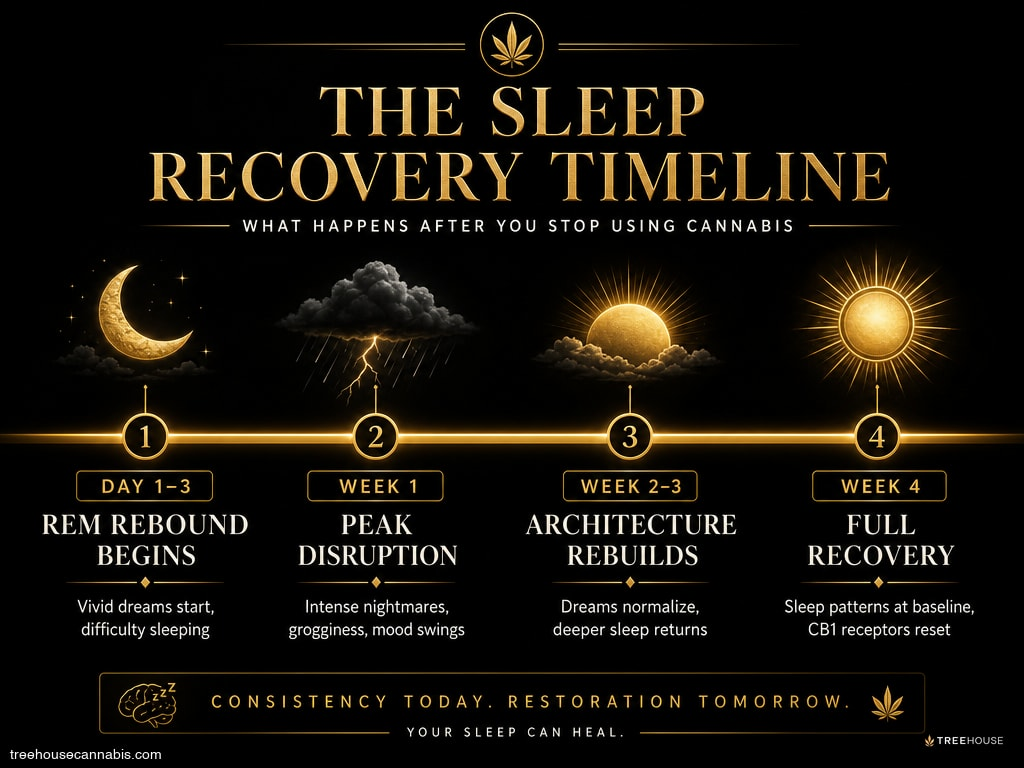
The First Few Days (Days 1-3)
Within 24-48 hours of your last session, your body begins to experience cannabis withdrawal. For sleep specifically, this means:
- Difficulty falling asleep
- Vivid, intense dreams beginning as early as day 2
- More frequent awakenings throughout the night
- General restlessness
This is your brain's REM rebound kicking in — it's trying to make up for all the REM it lost.
Week One: The Worst of It
By the end of the first week without cannabis, most users report:
- Dreams that feel more vivid and bizarre than usual
- Occasional nightmares (especially with high-THC, low-CBD strains)
- Daytime grogginess from disrupted sleep architecture
- Mood swings or increased anxiety (partly sleep-related)
The good news: this phase is temporary. Your endocannabinoid system is recalibrating, and your CB1 receptors are upregulating after being downregulated by chronic THC exposure.
Weeks Two and Three: The Adjustment Period
By week two, your sleep architecture begins to normalize:
- REM cycles start returning to baseline levels
- Dream recall improves significantly
- Deep sleep stages rebalance
- Overall sleep quality begins to improve
Research suggests the most critical window is 2-4 weeks for full CB1 receptor sensitivity recovery. After about two weeks of abstinence, most users report feeling like their "normal" sleep patterns have largely returned.
After One Month: Full Recovery?
For most occasional-to-moderate users, sleep architecture appears to return to baseline after 3-4 weeks of abstinence. However, some studies suggest that very long-term, heavy users may experience longer recovery periods — and some changes to sleep patterns could persist longer.
The Endocannabinoid System: Your Built-In Sleep Regulator
To understand why T-breaks work, you need to understand the ECS.
Your endocannabinoid system is a vast network of receptors (CB1 and CB2), natural endocannabinoids (like anandamide and 2-AG), and enzymes that regulate everything from appetite to immune response to sleep.
CB1 receptors are particularly abundant in areas of the brain involved in sleep regulation, including the hypothalamus and brainstem. When you use cannabis regularly, THC constantly activates these receptors, and your brain responds by:
- Downregulating (reducing the number of) CB1 receptors
- Desensitizing remaining receptors
- Reducing natural endocannabinoid production
This is the physiological basis of cannabis tolerance — and why you need more over time to get the same effects.
When you stop using cannabis, the reverse happens:
- CB1 receptors begin upregulating again
- Receptor sensitivity increases
- Natural endocannabinoid production resumes
This is why a T-break of 2-4 weeks is typically recommended for meaningful tolerance reduction. Less than a week, and you're mostly just clearing residual THC from your system — the receptor-level changes take longer.
Surviving the REM Rebound: Practical Tips
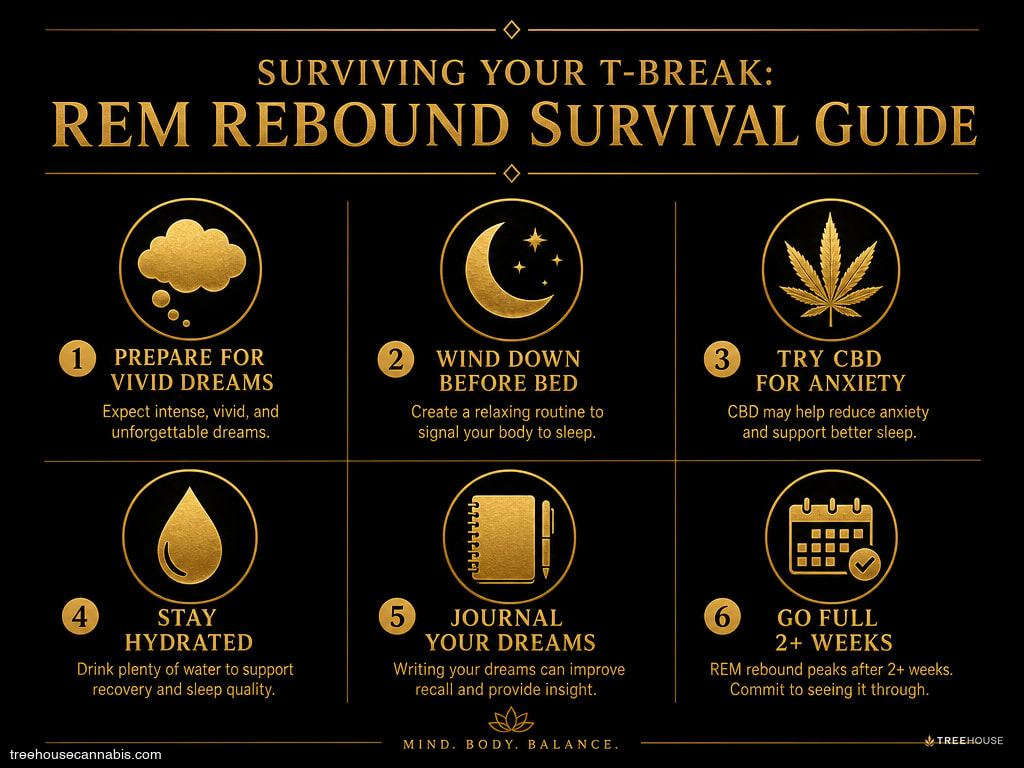
Going through a T-break is manageable if you know what's coming. Here's how to make it easier:
Prepare for weird dreams. Don't be alarmed if your dreams feel unusually vivid or intense. This is your brain catching up on REM sleep. It's a sign the system is resetting, not breaking.
Limit screen time before bed. Blue light and stimulating content can compound sleep disruption during withdrawal. Build in 30-60 minutes of wind-down time.
Consider CBD. Some users find that a small amount of CBD during a T-break helps with sleep anxiety and eases the transition. CBD modulates the same endocannabinoid system without strong CB1 activation.
Stay hydrated and active. Withdrawal symptoms (including sleep disruption) are worse when you're dehydrated or sedentary. Light exercise can improve sleep quality naturally.
Journal your dreams. Keeping a dream journal during your T-break can help you process the intense dream content and track your recovery progress.
Give it the full time. A 48-hour break is better than nothing, but it's mostly just a tolerance micro-hack. For real recovery of sleep architecture and receptor sensitivity, plan for at least two weeks.
 Practical tips for surviving vivid dreams during a tolerance break
Frequently Asked Questions
How long does it take for dreams to come back after stopping cannabis?
Most users report noticing more vivid dreams within 2-4 days of stopping. By the end of the first week, dream recall is typically significantly higher. Full normalization of REM sleep architecture takes approximately 2-4 weeks of abstinence.
Are the intense dreams after quitting cannabis dangerous?
No. Vivid dreams during cannabis withdrawal are a normal physiological response to REM rebound — your brain is compensating for suppressed REM sleep. While they can feel jarring, they're not harmful. However, if you experience severe insomnia, panic attacks, or persistent mood disturbances lasting more than two weeks, consider speaking with a healthcare provider.
Will my tolerance go back to zero after a month-long T-break?
Probably not completely zero, but significantly lower. Research suggests CB1 receptor density and sensitivity recover substantially after 2-4 weeks of abstinence, but individual factors — genetics, usage history, metabolism — affect the degree of recovery. Some heavy long-term users may need longer breaks to fully reset.
Can I use CBD instead of THC during a T-break and still sleep well?
Possibly. CBD doesn't strongly bind to CB1 receptors the way THC does, so it doesn't produce the same REM-suppression effect. Some users report that CBD helps with sleep anxiety and can support better sleep quality during a T-break. However, the evidence for CBD as a sleep aid is mixed, and results vary.
Does the type of cannabis product matter for sleep effects?
Yes. High-THC, low-CBD products produce the strongest REM suppression. Products with more balanced THC:CBD ratios may have less dramatic effects on sleep architecture. Concentrates and edibles, which deliver higher THC doses than smoking, tend to produce more pronounced REM suppression than flower.
How much does cannabis affect deep sleep vs. REM sleep?
Cannabis generally increases deep (Stage 3, slow-wave) sleep while suppressing REM. This might sound beneficial — deep sleep is important for physical recovery — but both stages are necessary. REM's role in emotional processing and memory consolidation is equally vital. A balanced sleep architecture requires both.
The Bottom Line
Cannabis suppresses REM sleep. Regular use reshapes your sleep architecture in measurable, reversible ways. When you stop, your brain rebounds — producing vivid dreams, temporary insomnia, and a recalibration period that typically lasts 2-4 weeks.
Understanding what's happening physiologically doesn't make the withdrawal symptoms fun, but it does make them less alarming. The dreams aren't random. The restlessness isn't a sign something is wrong. It's your endocannabinoid system doing exactly what it's supposed to do: recover.
Whether you're taking a T-break to lower your tolerance, explore your relationship with cannabis, or just curious about what's happening in your brain — now you have the science.
Treehouse Cannabis is located in Blauvelt, NY. Visit us in store or browse our selection online. Our team is happy to help you find the right product for your goals — tolerance breaks included.
Shop our products

Shop All

Deals

Flower

Pre-rolls
Vaporizers

Edibles
Drinks

Concentrates
Tinctures

Topicals

CBD

Pet CBD

Accessories