

Understanding the aromatic compounds that shape your high
The Science of Cannabis Terpenes: Beyond THC

When cannabis consumers talk about their experience with a particular strain, they often focus on THC content. But anyone who's tried two strains with identical THC levels and felt completely different effects has already discovered a deeper truth about cannabis: THC is just part of the story.
The missing piece? Terpenes.
Terpenes are aromatic compounds found in cannabis and hundreds of other plants. They're what give lavender its calming scent, citrus its bright aroma, and pine its sharp, clean fragrance. In cannabis, these compounds do far more than provide smell — they interact with cannabinoids to shape the overall experience in ways researchers are only beginning to understand.
What Are Terpenes, Exactly?
Terpenes are volatile hydrocarbon compounds produced by the same resin glands that generate THC, CBD, and other cannabinoids. They're not unique to cannabis — you'll find them in black pepper, rosemary, cloves, and countless other plants. The cannabis plant can produce over 200 different terpenes, though most appear only in trace amounts.
The dominant terpenes in most cannabis varieties are myrcene, limonene, pinene, linalool, caryophyllene, and humulene. These six account for the vast majority of the aromatic diversity you'll encounter at a dispensary. Each one has a distinct chemical structure that influences how it interacts with the body's endocannabinoid system and other neurotransmitter pathways.
The global terpenes market was valued at approximately $885 million in 2023 and is projected to reach over $1.8 billion by 2032, driven largely by demand from the cannabis and hemp industries [^1]. This growth reflects a broader shift in how consumers approach cannabis — moving beyond THC percentage as the sole indicator of potency toward a more nuanced understanding of whole-plant chemistry.
The Entourage Effect: Terpenes Working With Cannabinoids
The term "entourage effect" was coined by Israeli researchers Raphael Mechoulam and Shlomo Cohen in the late 1990s. Their hypothesis: cannabinoids and terpenes don't work in isolation. Instead, they act synergistically, with terpenes modulating the effects of THC and other cannabinoids in ways that neither could achieve alone.
Research published in the NIH's PMC database suggests that various therapeutic benefits of terpenes include myrcene for relaxation, linalool as a sleep aid, and limonene for anxiety relief [^2]. A 2024 human clinical trial from Johns Hopkins found that the terpene limonene significantly reduced anxiety and paranoia sometimes associated with high-THC cannabis use [^3].
This synergy helps explain a phenomenon every experienced cannabis user has noticed: a 20% THC sativa doesn't always feel more "energetic" than a 15% THC hybrid. The terpene profile — not just the cannabinoid content — plays a crucial role in determining whether a strain produces a clear-headed, uplifting high or a heavy, couch-locking experience.
The Big Six: Understanding Individual Terpenes
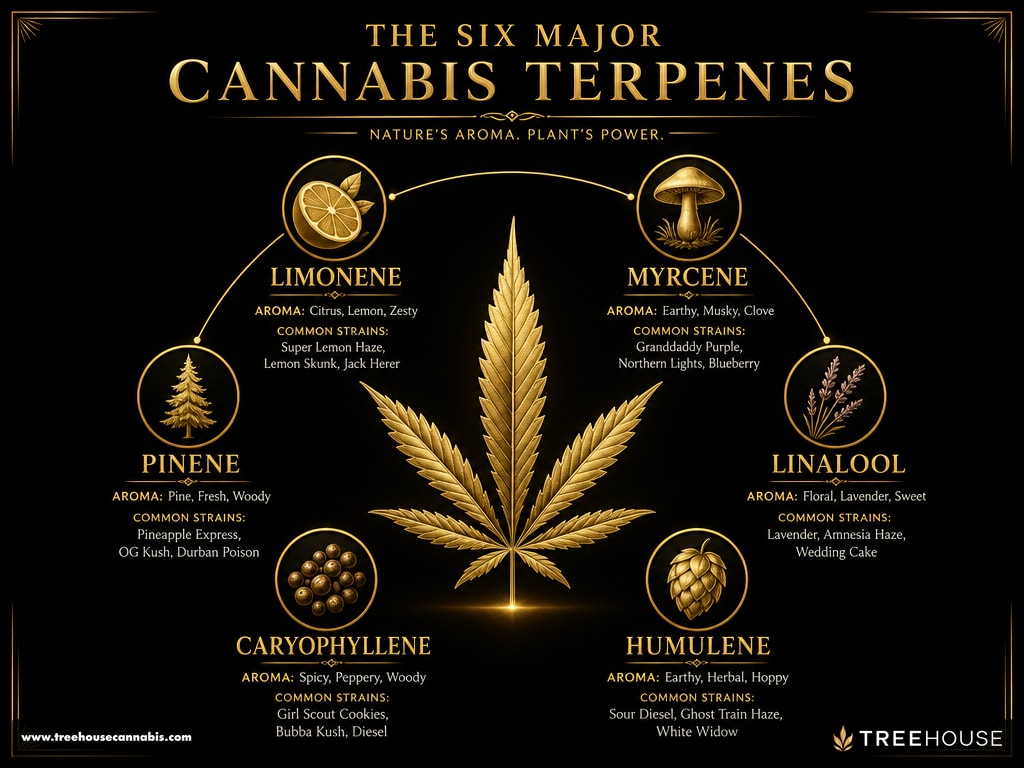
Limonene
Limonene is the second-most abundant terpene in nature and the third-most common in cannabis. As the name suggests, it's found in citrus fruit rinds, rosemary, and peppermint. Cannabis strains high in limonene tend to produce bright, uplifting effects that many users describe as euphoric and stress-relieving.
From a physiological standpoint, limonene is absorbed rapidly through the lungs and crosses the blood-brain barrier efficiently. Research suggests it may modulate serotonin and dopamine transmission, contributing to mood elevation. Some users report that limonene-dominant strains help take the edge off anxiety without sedating them — a quality that makes these strains popular for daytime use.
Strains known for high limonene content include Sour Diesel, Super Lemon Haze, and Jack Herer.
Myrcene
Myrcene is the most prevalent terpene in commercial cannabis varieties, often comprising over 50% of a strain's total terpene content. It has a distinctive earthy, musky aroma with hints of grape and clove — think of the smell of fresh-cut mangoes or tropical fruit.
The effects of myrcene are perhaps the most well-documented of any terpene. Multiple peer-reviewed studies suggest that myrcene has sedative properties, potentially increasing the permeability of the blood-brain barrier and amplifying the psychoactivity of THC [^4]. This may explain why myrcene-dominant strains are frequently associated with deep physical relaxation and are often preferred for evening use.
Beyond cannabis, myrcene is found in hops — which is why beer brewed with hops can produce similar sedative effects. Strains high in myrcene include Granddaddy Purple, OG Kush, and Blue Dream.
Pinene
Pinene exists in two forms: alpha-pinene, which smells like pine needles and fir trees, and beta-pinene, which has an herbaceous, parsley-like aroma. Alpha-pinene is the more common in cannabis and is notable for its potential neuroprotective properties.
One of the most compelling findings in recent cannabis research involves pinene's interaction with THC. A 2025 study published on PubMed tested whether alpha-pinene could attenuate the acute memory-impairing effects of inhaled delta-9-THC in humans. The results suggested that pinene may indeed offer some protection against cannabis-related memory impairment [^5].
Pinene also acts as a bronchodilator, which may help counteract THC's tendency to cause short-term respiratory constriction. For users who want the benefits of cannabis without the feeling of reduced airflow, pinene-dominant strains may offer a meaningful difference.
Strains high in pinene include Jack Herer, Sour Diesel, and Blue Dream.
Linalool
Linalool has a distinctive floral scent reminiscent of lavender — it's actually one of the primary compounds that makes lavender oil so effective for relaxation. In cannabis, it appears in smaller concentrations than myrcene or limonene, but its effects are pronounced.
Research indicates that linalool may have anxiolytic (anxiety-reducing), sedative, and analgesic properties. A study published in Frontiers in Psychiatry noted that several essential oils containing linalool as a major constituent exert therapeutic benefits relevant to brain health, including reduction of anxiety and depressive symptoms [^6].
For cannabis users who experience paranoia or racing thoughts from high-THC strains, linalool-dominant varieties may provide a smoother, more grounded experience. Strains such as Lavender Kush, Amnesia Haze, and LA Confidential tend to feature elevated linalool levels.
Caryophyllene
Caryophyllene is notable for its spicy, peppery aroma — it's the compound that gives black pepper its characteristic bite. In cannabis, it's one of the most pharmacologically active terpenes because it directly binds to CB2 receptors in the endocannabinoid system, functioning almost like a cannabinoid itself.
This makes caryophyllene particularly interesting for users seeking anti-inflammatory or pain-relieving effects. Research published in MDPI's Pharmaceuticals journal noted that among cannabis constituents, terpenes like caryophyllene are gaining recognition for their capacity to modulate the pathophysiological processes underlying chronic pain syndromes [^7].
Caryophyllene is also found in cloves, cinnamon, and hops. Strains with notable caryophyllene content include Girl Scout Cookies, Gorilla Glue, and Super Silver Haze.
Humulene
Humulene has an earthy, woody aroma with musky, hoppy notes — it's one of the primary components of hops (Humulus lupulus) and is also found in sage and ginseng. While less prominent in cannabis than some other terpenes, it contributes meaningfully to the "hoppy" quality of certain strains.
Humulene is notable for its potential appetite-suppressing properties, which could make it valuable for users looking to avoid the "munchies" effect commonly associated with high-THC cannabis. It also has anti-inflammatory and analgesic properties, making it a component of interest for therapeutic applications.
Strains with notable humulene content include Headband, Sour Diesel, and Pink Kush.
Uplifting vs. Relaxing: Matching Terpene Profiles to Your Goals
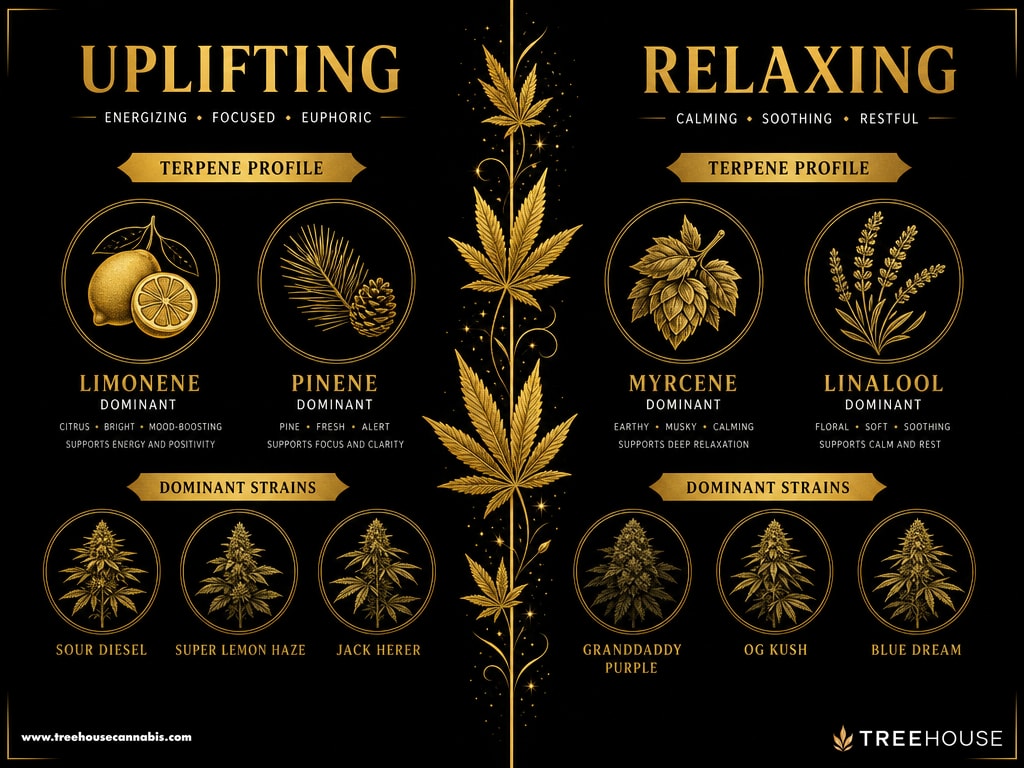
Understanding terpenes allows you to make more informed decisions at the dispensary. While individual biochemistry varies, general patterns emerge based on dominant terpene content.
Uplifting, energizing strains tend to be dominated by limonene and pinene, with lower myrcene content. These varieties are often described as cerebral, creative, and motivating — suitable for daytime use or social situations. The limonene provides mood elevation while pinene supports mental clarity, potentially offsetting some of the cognitive fog associated with high-THC products.
Relaxing, sedating strains typically feature myrcene as the dominant terpene, sometimes accompanied by linalool. These combinations produce the "couch-lock" effect that many experienced users seek for evening consumption, stress relief, or sleep support.
Balanced hybrid strains often feature a more even distribution of multiple terpenes, providing a middle ground between energy and relaxation. Caryophyllene and humulene can appear in these strains, contributing to the pain relief and anti-inflammatory properties without strongly favoring sedation or stimulation.
Beyond the Label: How to Use Terpene Information
Most licensed dispensaries now provide terpene test results alongside THC and CBD percentages. These lab reports typically show the concentration of individual terpenes as a percentage of total weight — anything above 0.5% is generally considered significant, while 1% or higher indicates a truly dominant terpene.
When reviewing these reports, look for the top two or three terpenes rather than getting lost in the full breakdown. A strain listing 1.2% myrcene, 0.8% limonene, and 0.6% pinene, for example, will likely produce relaxing effects with some uplifting qualities — a profile that matches many popular hybrid strains.
It's also worth noting that terpene profiles can vary significantly between batches of the same strain, depending on growing conditions, harvest timing, curing methods, and storage. Two jars of "Gorilla Glue" from different cultivators may have meaningfully different effects. Testing and batch tracking represent an emerging frontier in cannabis quality control that more operators are beginning to prioritize.
The Future of Terpene Research
As the cannabis industry matures, terpene science is moving beyond observation into active application. Some cultivators are now using "terpene harvesting" techniques designed to maximize aromatic compound retention during post-harvest processing. Others are developing strain-specific cultivation protocols that optimize environmental factors — light spectrum, temperature, nutrient delivery — to influence terpene expression.
Extraction companies are similarly refining their processes to preserve delicate terpenes that are often lost during hash or concentrate production. The emergence of "live resin" and "fresh frozen" products reflects this shift: these concentrates capture the plant's aromatic profile more completely by processing frozen material immediately after harvest, before drying and curing can degrade volatile terpenes.
Some researchers and companies are even exploring terpene isolation and reinjection — adding specific terpenes back to extracts to create products with precisely engineered effect profiles. This raises interesting questions about the future of cannabis consumption: are we moving toward a model where patients and consumers can dial in their exact desired experience by selecting terpenes the way we currently select THC potency?
Sources
- Business Research Insights — Terpenes Market Report
- NIH PMC — The Entourage Effect in Cannabis Medicinal Products
- CBD Nationwide — Terpenes and Their Effects: Science-Backed Guide
- Humboldt Family Farms — Top Ten Cannabis Terpenes
- PubMed — The Individual and Interactive Effects of Alpha-Pinene and Delta-9-THC
- Frontiers in Psychiatry — A Review of the Potential Use of Pinene and Linalool
- MDPI Pharmaceuticals — Phytochemical Modulators of Nociception
About Treehouse Cannabis
Treehouse Cannabis is a licensed New York adult-use dispensary serving the Nyack community since 2022. Our team includes certified cannabis educators dedicated to helping customers find the right products for their needs.
📍 Visit Us: Nyack, NY
📞 Call: (845) 315-2049
✉️ Email: info@treehousecannabis.com
🌐 Website: treehousecannabis.com
Adult-Use Disclaimer: This content is for educational purposes only. Cannabis products are for adult use only (21+). Consult a healthcare provider before using cannabis, especially if you have existing health conditions or take medications.



Shop our products

Shop All

Deals

Flower

Pre-rolls
Vaporizers

Edibles

Drinks

Concentrates
Tinctures

Topicals

CBD

Pet CBD

Accessories