Learn the fundamentals of cooking with cannabis — from decarboxylation to dosing — with simple recipes even beginners can follow.
Cooking with Cannabis: A Simple Guide to Cannabis-Infused Edibles
Cooking with Cannabis: A Simple Guide to Cannabis-Infused Edibles
From decarboxylation to dosing — everything you need to make your first batch of weed brownies (and not screw it up).
Cannabis-infused edibles are one of the most popular ways to enjoy cannabis, and for good reason: they offer a longer, more body-focused experience than smoking, and you can incorporate them into almost any recipe. Getting the fundamentals right — decarboxylation, infusion, and dosing — is what separates a batch of genuinely potent weed brownies from a disappointing one. Here's what you need to know to cook with cannabis safely and effectively.
What is Decarboxylation and Why Does It Matter for Cannabis Edibles?
Decarboxylation is the process of heating cannabis to convert THCA (tetrahydrocannabinolic acid) into psychoactive THC — and without this step, your edibles simply won't produce any high. Leafly
Raw cannabis flower contains mostly THCA, the non-psychoactive precursor to THC. Heat changes the molecular structure, releasing the carboxyl group and activating the THC. This happens naturally when you smoke or vaporize cannabis. For cooking, you need to do it deliberately before you add the flower to any recipe.
How to decarboxylate your cannabis:
- Preheat your oven to 220°F (105°C)
- Break up your ground cannabis into small, even pieces on a baking sheet — spread it out in a single layer
- Bake for 30-40 minutes, stirring halfway through for even heat distribution
- Let it cool before using it in your recipe
The decarboxylated cannabis is now ready to be infused into butter or oil. This step is non-negotiable — skip it, and you'll be eating cannabis that contains no active THC.
How Do You Make Cannabis-Infused Butter (Canna-Butter) at Home?
Canna-butter is the foundation of most edible recipes — and making it at home is simpler than you might think. Cannabis is lipophilic, meaning it binds to fat, which is why butter and oil are the ideal carriers for THC extraction. Verilife
To make canna-butter, you will need:
- 1 cup (225g) of butter
- 3.5–7 grams of decarboxylated cannabis (depending on your target potency)
- 1 small saucepan
- A fine-mesh strainer or cheesecloth
- A glass jar for storage
Steps:
- Melt the butter in your saucepan over low heat (never go above 190°F — higher temperatures degrade THC) Food52
- Add the decarboxylated cannabis and stir gently
- Simmer on the lowest heat setting for 45-60 minutes, stirring occasionally
- Remove from heat and let cool slightly
- Strain through the fine-mesh strainer, pressing the plant material to extract all the butter
- Pour into a glass jar and refrigerate
The same method works for canna-oil — just substitute olive oil or coconut oil for the butter. Coconut oil is particularly popular because its high saturated fat content makes it an excellent carrier for THC.
Here's a quick reference for your cannabis cooking:
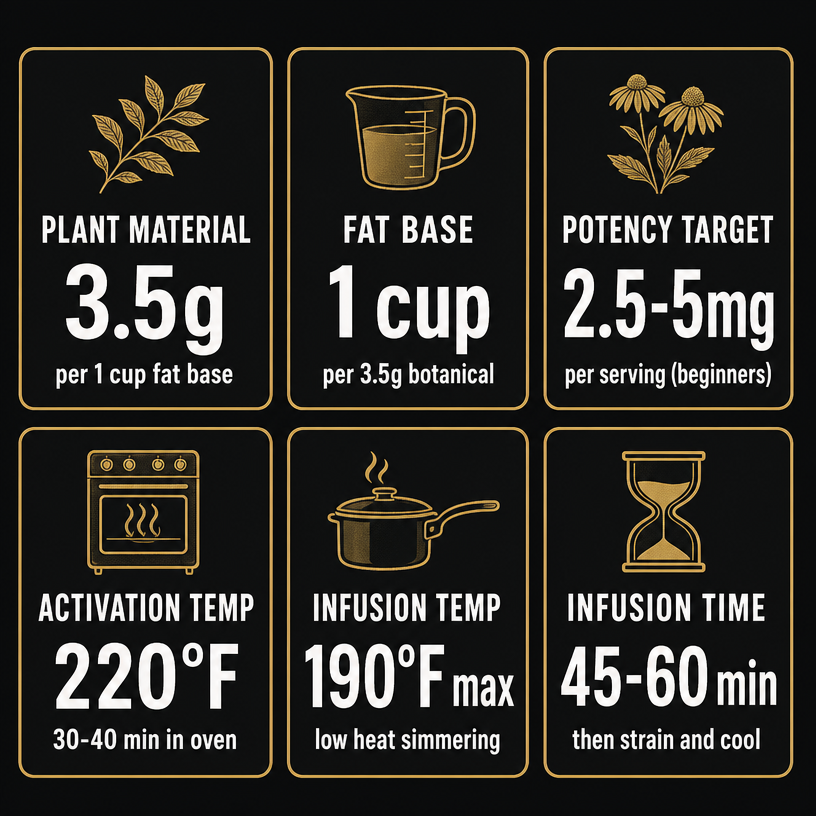
How much cannabis per batch? The general starting target is 2.5–5 mg THC per serving. If your cannabis is around 15% THC, roughly 3.5 grams of flower per stick of butter will get you to about 2.5 mg per serving in a standard batch. Adjust up or down based on your experience level and tolerance. Early research suggests that homemade edibles often have uneven THC distribution, making precise dosing challenging — this is why starting low and going slow is essential. Government of British Columbia
What is the Right Starting Dose for Cannabis Edibles?
Start with 2.5 mg THC or less per serving if you're new to edibles — this is the threshold where most people feel noticeable effects without discomfort. Government of British Columbia
Dosing is the most important safety consideration when cooking with cannabis. Unlike smoking, where effects hit within seconds, edibles take time to kick in, and the experience lasts much longer.
Key dosing guidelines:
- New to cannabis: Aim for 2.5 mg THC per serving or less
- Moderate experience: 5-10 mg THC per serving is a reasonable starting point
- Never rush the dose: Wait up to 2 full hours before considering another serving
- Full effects may take 4-12 hours to fully manifest — don't re-dose based on not feeling anything at the 30-minute mark
When you're cooking at home, start with a conservative amount of cannabis in your infusion. You can always make it stronger next time, but there's no way to undo taking too much.
Understanding how edibles work in your body is crucial for staying safe:
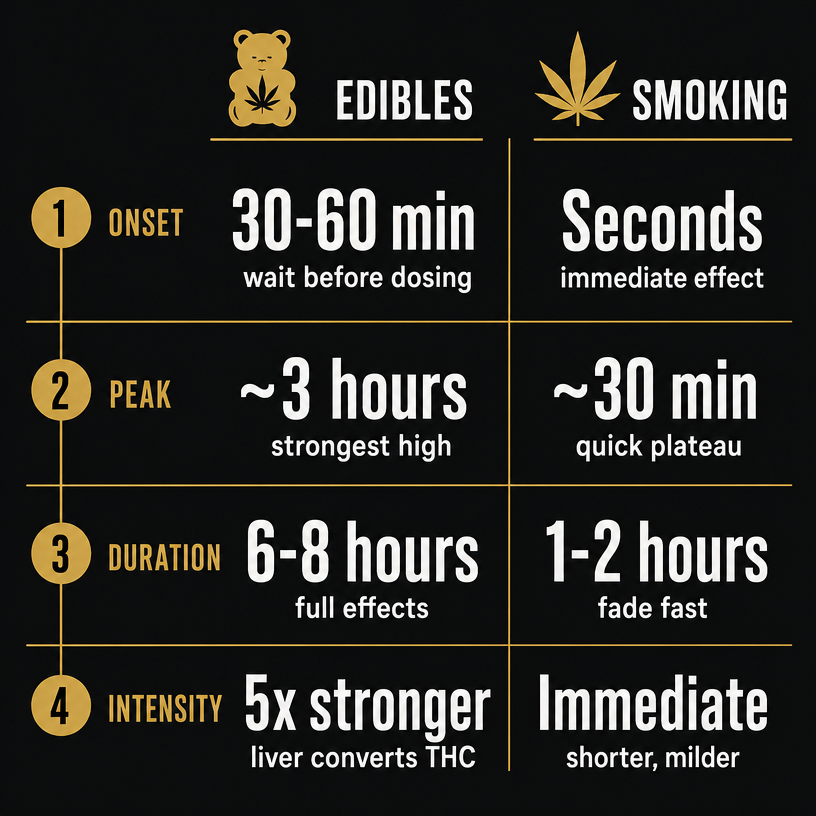
The 2-hour rule exists because of how your body processes THC. After ingesting an edible, your liver converts THC into 11-hydroxy-THC — a compound significantly more potent than the THC you inhale when smoking. This conversion takes time, and the effects build gradually. Rushing to take more because you don't feel anything at 30 minutes is the most common mistake beginners make — and it can result in an uncomfortably intense experience that lasts hours. Healthline
How Do Edibles Feel Different From Smoking — and Why?
Edibles feel more intense than smoking because your liver converts THC into a stronger compound (11-hydroxy-THC) that crosses the blood-brain barrier more efficiently. Healthline
When you eat cannabis, your liver metabolizes the THC and transforms it into 11-hydroxy-THC. Research from Colorado's cannabis testing program suggests that eating 1 mg THC from an edible delivers roughly the same effect as smoking 5.71 mg THC — which is why beginners often underestimate how strong a homemade brownie can be.
Key differences between edibles and smoking:
| Factor | Edibles | Smoking |
|---|---|---|
| Onset time | 30-60 minutes | Seconds |
| Peak effects | ~3 hours | ~30 minutes |
| Total duration | 6-8 hours | 1-2 hours |
| Intensity | 5x more potent (liver conversion) | Immediate, shorter |
The duration difference is significant. A smoking high fades within 1-2 hours, while an edible high can linger for 6-8 hours — with residual effects sometimes lasting into the next day. This is why many people prefer edibles for sleep, relaxation, or longer-lasting symptom management: the experience is slower to build but much longer lasting.
The body high is different too. Edibles tend to produce a heavier, more body-centered effect compared to the heady, immediate high from smoking. For some people this is preferable; for others, especially those with lower tolerance, it can feel overwhelming if they take too much.
How Do You Make Classic Weed Brownies — A Simple Cannabis Recipe?
Classic weed brownies use canna-butter as the fat base — substitute it 1:1 for regular butter in any brownie recipe. For a standard 9x13 pan (about 24 servings), you'll need roughly 1 cup of canna-butter with your target dose baked in per serving.
What you need:
- 1 cup canna-butter (made following the steps above)
- 1 cup sugar
- 1/2 cup cocoa powder
- 3 eggs
- 1 tsp vanilla extract
- 1/2 cup flour
- 1/4 tsp salt
Steps:
- Preheat your oven to 350°F (175°C) and grease a 9x13 baking pan
- Make your canna-butter first if you haven't already (see previous section) and let it cool slightly
- Mix the wet ingredients: In a large bowl, combine the canna-butter, sugar, eggs, and vanilla. Whisk until smooth.
- Add dry ingredients: Fold in the cocoa powder, flour, and salt until just combined — don't overmix
- Bake for 25-30 minutes — a toothpick should come out slightly moist
- Let cool completely before cutting — this is important! Brownies continue to set as they cool, and cutting too early causes them to fall apart
Label your homemade edibles clearly. Store them in an airtight container, away from children and pets. Unlike dispensary products, homemade edibles lack child-resistant packaging. The THC content in homemade baked goods can also vary significantly between pieces, so portion carefully — one standard brownie corner is not necessarily one dose.
Starting recommendation: If your canna-butter was made with 3.5g of 15% THC flower per cup of butter, and you cut the pan into 24 squares, each brownie contains roughly 2.5 mg THC. Start with half a brownie (about 1.25 mg) if you're new to edibles, and wait 2 hours to see how it affects you.
For those ready to source quality flower for their first batch, from Treehouse Cannabis offers a range of options to explore. And if you're not quite ready to cook at home, from our dispensary menu provide a consistent, professionally dosed alternative.
Frequently Asked Questions
What is decarboxylation and why does it matter for edibles?
Decarboxylation is heating cannabis to convert THCA into psychoactive THC — without this step at 220°F for 30-40 minutes, your edibles won't produce any high. It's the non-negotiable first step in any cannabis cooking recipe.
How do I make canna-butter at home?
Simmer decarboxylated cannabis in butter at 190°F max for 45-60 minutes, then strain through a fine mesh filter. Target 2.5–5 mg THC per serving: for 15% THC flower, use about 3.5 grams per stick of butter. Canna-oil follows the same method with olive or coconut oil.
Why do edibles feel stronger than smoking?
Your liver converts THC into 11-hydroxy-THC, a compound roughly 5x more potent than inhaled THC. Eating 1 mg THC from an edible hits harder than smoking 5+ mg THC — which is why even experienced smokers get surprised by homemade edible strength.
How long do edibles take to kick in and how long do they last?
Edibles take 30-60 minutes to onset, peak around 3 hours, and last 6-8 hours total. Compare that to smoking, which kicks in within seconds and fades in 1-2 hours. Always wait 2 hours before considering a second dose.
What is a safe starting dose for cannabis edibles?
2.5 mg THC or less per serving for beginners. If you're more experienced, 5-10 mg THC is a reasonable starting point. Never rush the dose — wait up to 2 hours before considering another dose, since homemade edibles often have uneven THC distribution.
Sources
- Leafly — What is Decarboxylation?
- Verilife — Guide to Baking with Cannabis
- Food52 — How to Make Cannabutter
- Healthline — How Long Do Edibles Take to Kick In?
- Government of British Columbia — Cannabis Edibles Safe Use Fact Sheet
Treehouse Cannabis is a licensed adult-use dispensary in Rockland County, New York. Must be 21+ to purchase. This content is for informational purposes only and is not medical advice.
About Treehouse Cannabis
Treehouse Cannabis is Rockland County's premier adult-use dispensary, offering a carefully curated selection of premium cannabis products including flower, concentrates, edibles, and more. Our knowledgeable team is dedicated to helping both new and experienced consumers find the right products for their needs in a welcoming, judgment-free environment. Visit us at treehousecannabis.com to learn more about our current selection and special offers.
Shop our products

Shop All

Flower
Pre-rolls
Vaporizers

Edibles
Drinks
Concentrates
Tinctures

Topicals

CBD

Pet CBD
Accessories