
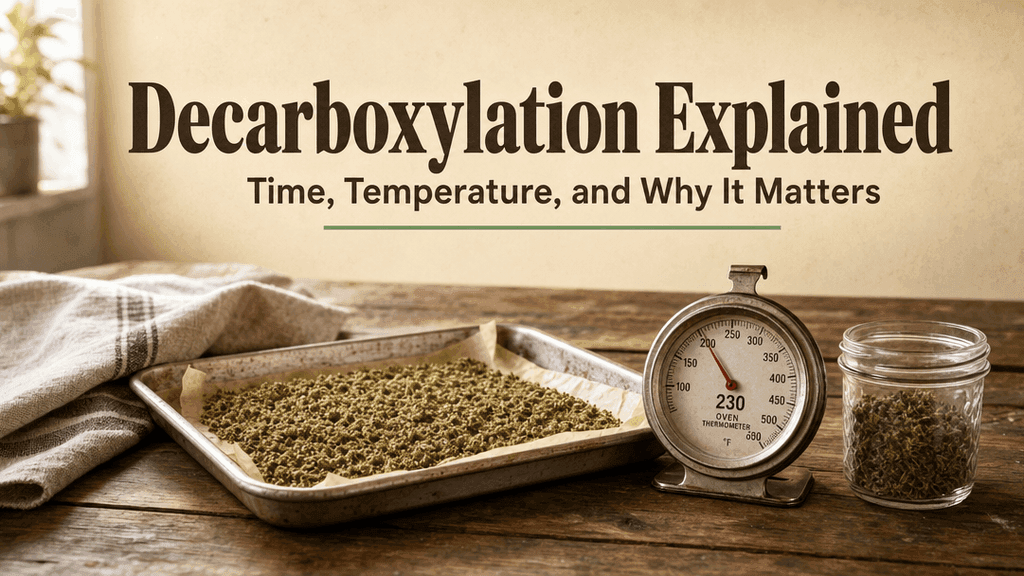
Decarboxylation Explained: Time, Temperature, and Why It Matters
Decarboxylation Explained: Time, Temperature, and Why It Matters
Decarboxylation is the heat-driven chemical reaction that strips a carboxyl group (COOH) off the cannabinoid acids in raw cannabis flower, converting inactive THCA into psychoactive THC and CBDA into CBD. Without that reaction, the THCA sitting in a jar of Flower does very little — it will not get you high no matter how much you eat.
What Is Decarboxylation and Why Does It Matter for Cannabis?
Decarboxylation is the heat-driven chemical reaction that strips a carboxyl group (COOH) off the cannabinoid acids in raw cannabis flower, converting inactive THCA into psychoactive THC and CBDA into CBD. Without that reaction, the THCA sitting in a jar of Flower does very little — it will not get you high no matter how much you eat.
Health Canada defines cannabis pharmacology for clinicians and notes that complete decarboxylation of Δ9-THCA to Δ9-THC has been shown to occur from 98°C up to 200°C [2]. That temperature window is the entire reason cannabis behaves so differently depending on how you use it.
Combustion and vaporization decarb cannabis on contact, which is why a single hit from a bowl feels almost instant. Anything you eat, though, has to be heated first — or it just sits there as an acid cannabinoid that does not bind effectively to the CB1 receptors.
The practical implications for an adult-use consumer are straightforward:
- Combustion and vaporization decarb cannabis on contact, so inhaled flower is immediately psychoactive.
- Edibles, capsules, and tinctures must be heated first — either by the manufacturer or at home — before they will work.
- Topicals without heat penetration deliver primarily the inactive acid cannabinoids rather than activated THC or CBD.
- Any cannabis product you swallow has been decarboxylated at some point before it lands in your kitchen.
Decarboxylation is the single chemical step that makes oral, edible, and topical cannabis products actually work. For most adult-use consumers, the practical takeaway is simple: any cannabis product you swallow has been decarboxylated at some point, either by the manufacturer or by you, before it lands in your kitchen.
What Is THCA and How Does Heat Turn It Into THC?
THCA (tetrahydrocannabinolic acid) is the natural form of THC produced by the living cannabis plant. It carries an extra carboxyl group that prevents it from binding to the CB1 receptor, so raw, unheated flower is pharmacologically mostly inert — the molecule is there, but the lock and key do not fit.
When heat breaks that group off as CO2, what remains is Δ9-THC — the molecule that produces the psychoactive effects people associate with cannabis. The reaction follows predictable kinetics, mapped carefully by the Wang et al. 2016 study published in Cannabis and Cannabinoid Research [1]:
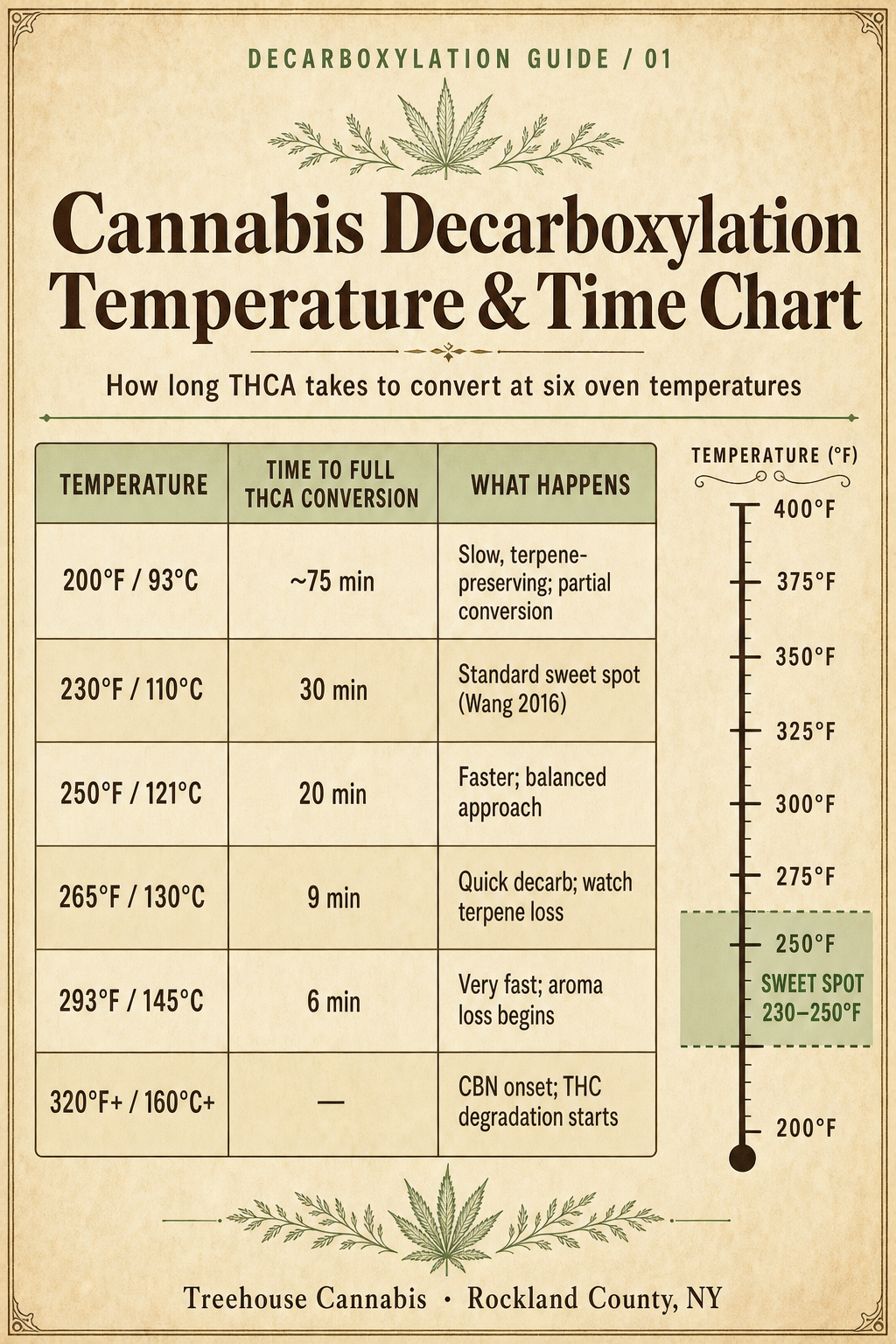
- At 110°C (230°F), THCA reaches near-complete conversion in 30 minutes
- At 130°C (265°F), conversion completes in 9 minutes
- At 145°C (293°F), conversion completes in 6 minutes
Understanding this curve is what lets you dial in the right decarb window for any recipe or infusion. Higher temperatures work faster, but they trade off against something you probably want to keep — the volatile terpenes that give each cultivar its character.
If you have ever wondered why a fresh-picked bud tastes different from cured flower, decarboxylation is part of the answer: even slow drying and curing drive some THCA conversion at room temperature, just over weeks rather than minutes.
What Is the Best Temperature and Time to Decarboxylate Cannabis?
The widely cited sweet spot is 230–250°F (110–121°C) for 30–40 minutes — long enough to drive THCA close to zero while staying below the temperatures that damage terpenes. Project CBD recommends 230°F for 40 minutes for full THCA activation [3].
A Weedmaps guide written with neuroscientist Dr. Adie Rae suggests 250°F for 20 minutes as an equally valid point [5]. Both approaches are defensible. Lower temperatures (around 200°F) preserve more aroma compounds but take longer. Higher temperatures (above 300°F) risk burning off the volatile terpenes that shape flavor and effect.
CBDA decarboxylates slightly more slowly than THCA, so if you are working with a CBD-rich flower, plan on 45 minutes at 230°F to fully convert CBDA into CBD [4]. That difference is small, but it is the one that catches most home infusion recipes off guard.
A useful mental model: pick a temperature in the 230–250°F window, then pick the time that matches your patience.
- If you want full aroma, lean toward the low end and add ten minutes.
- If you want speed and do not mind a flatter smell, lean toward the high end and shave ten.
- If you are decarbing a CBD-rich cultivar, add ten minutes on top of whatever THCA schedule you pick.
Can You Over-Decarboxylate Cannabis and Ruin It?
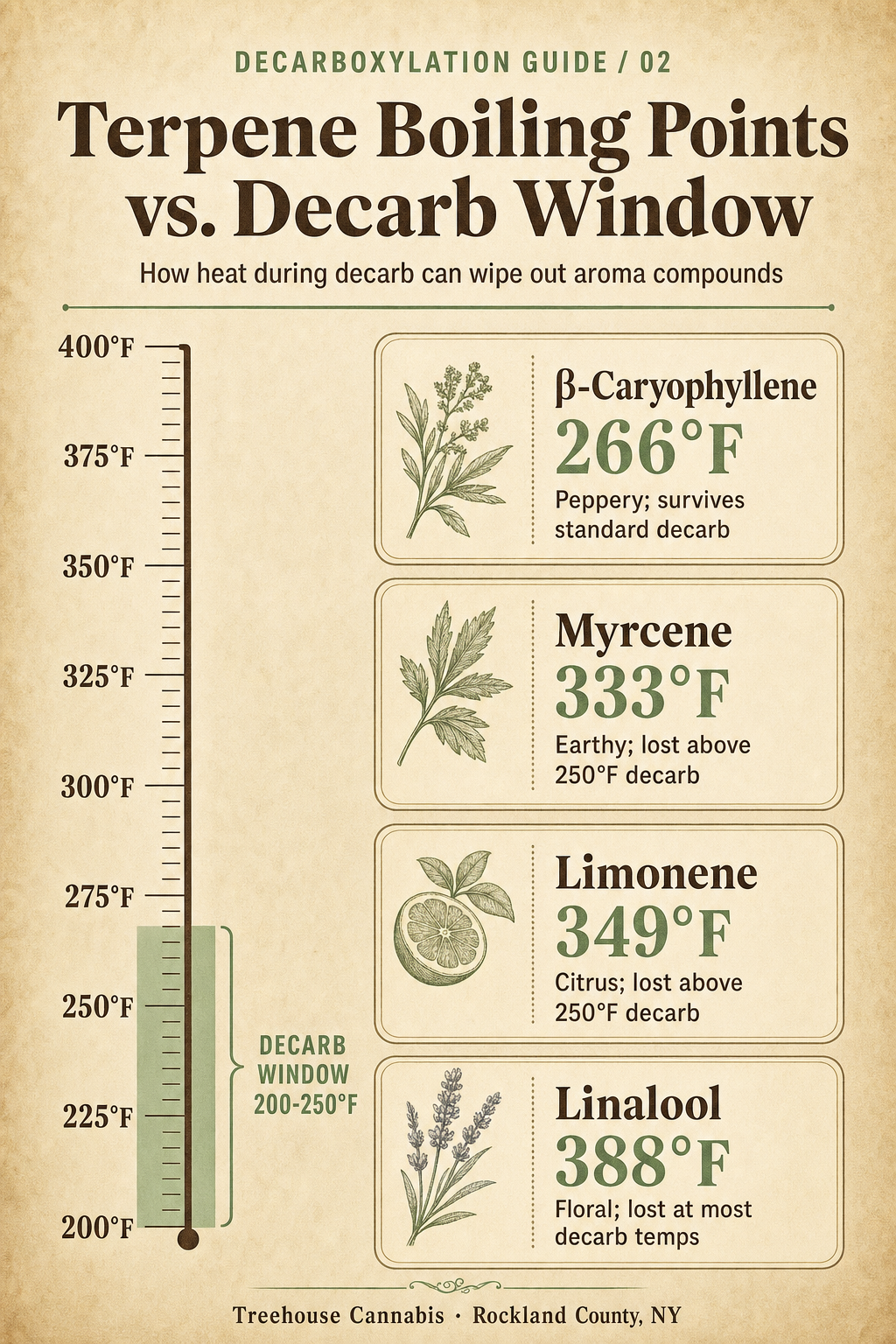
Yes — heat cannabis too long or too hot and THC degrades into cannabinol (CBN), a less-psychoactive, more sedating cannabinoid. CBN starts appearing at temperatures around 160°C (320°F) and climbs from there [1].
Volatile terpenes evaporate well before the decarb window closes. Per a 2022 Molecules review, myrcene boils at 168°C (333°F), limonene at 176°C (349°F), and linalool at 198°C (388°F) [6] — meaning a sloppy decarb can knock out most of the aromatic profile before the THCA even finishes converting.
This is exactly why sources cap decarb temperatures in the 200–250°F range and warn against using smoking-temperature ovens or open flames. The terpene balance that distinguishes one cultivar from another is, in fact, what gives an Indica its sedative reputation versus a Sativa's buzzy lift — see Indica Vs Sativa for the full picture on that.
A simple oven thermometer is the cheapest insurance against a ruined batch — most kitchen ovens drift ±20°F from their dial setting.
- If your oven runs hot, drop the target by 20°F and add ten minutes.
- If it runs cool, stretch the time instead of pushing the dial higher.
- If you are decarbing at 300°F or above, you have already lost the fight — pull the tray.
What Does a Decarboxylation Temperature and Time Chart Look Like?
The Wang et al. 2016 study mapped the canonical THCA-to-THC conversion curve [1]: at 80°C conversion is slow and partial, at 110°C THCA approaches zero in roughly 30 minutes, at 130°C in 9 minutes, and at 145°C in 6 minutes.
Below 100°C the reaction is too slow to be practical. Above ~160°C, degradation into CBN begins to outweigh activation. For CBD-rich flower, the curve shifts slightly to the right — CBDA needs about 45 minutes at 230°F for full conversion [4].
A side-by-side chart comparing temperature, time to full decarb, and CBN onset is the single most useful reference for anyone dialing in a home decarb routine. Print it, pin it to the fridge, and use it every time you run a new batch.
What the chart really shows is a tradeoff, not a winner:
- Low temperature + long time = maximum aroma retention, slower CBN risk.
- Mid temperature + medium time = balanced default for most kitchen setups.
- High temperature + short time = fastest activation, highest terpene loss.
Do You Have to Decarboxylate Cannabis Before Smoking or Vaping It?
No — combustion and vaporization reach temperatures high enough to decarboxylate THCA into THC on contact, which is why inhaled cannabis is immediately psychoactive. This is also why a flame hits harder than the same flower eaten raw.
Decarboxylation only becomes essential when cannabis is consumed orally — as in Dark Cherry "Nightly Nightcap" | 20 Pack | Gummies | THC: 100mg, CBN: 100mg, capsules, or tinctures — or applied without further heat, as in topicals. For infused oils and butter, decarb the flower before infusion. For alcohol-based tinctures, you can either decarb first or rely on the gentle heat of an alcohol evaporation step to drive the reaction.
This is also why timing can feel so unpredictable with ingestibles. If an edible seems to peak hours later than expected — or never quite hits — the dose likely went through a decarb window that did not fully activate the starting material. See You’re Not Lazy—Your Edible Just Peaked at the Wrong Time for what is actually happening on the absorption side, and why the chemistry in this article matters more than the recipe card says.
For most adult-use consumers in Rockland, Orange, and Westchester Counties, the practical version is simple:
- Smoke or vape and the decarb is automatic — flame or coil handles it on contact.
- Eat or apply and you need to trust the manufacturer or do it yourself.
- If the edible timing feels off, suspect the decarb window before suspecting your tolerance.
How Do You Decarb Cannabis at Home — Step by Step?
A reliable home decarb routine, in order:
- Preheat the oven to 230°F (110°C) and confirm with an oven thermometer — most kitchen ovens drift ±20°F from their dial.
- Break the Sour Diesel | Flower | 28g into small pieces or coarsely grind it — finer grind means faster, more even decarb.
- Spread the material in a single layer on a parchment-lined baking sheet. A 28-gram jar of something like Sour Diesel | Flower | 28g is enough for several batches of infused butter.
- Cover loosely with foil to retain terpene-rich vapor without trapping steam.
- Bake for 30–40 minutes, then let the decarbed flower cool fully before handling.
- Store airtight for later use, or move directly into a fat infusion.
For a more aromatic result, drop the temperature to 200°F and extend to 60 minutes. For speed, raise to 250°F for 20 minutes, watching closely for color shift to medium brown. Anything darker than toast brown and you have crossed into CBN territory — which is fine if that is what you want, but not what most people are after.
Skip the microwave. It heats unevenly, often runs hot enough to vaporize terpenes in patches, and is the most common way home decarb batches end up half-activated and half-degraded. A dedicated decarb machine or mason jar in a water bath both work, but a sheet pan and an oven thermometer cover 90% of what home consumers actually need.
Cannabis is for adults 21 and older. Keep all cannabis products out of the reach of children and pets. This article is intended for educational purposes only and is not medical advice. Effects vary by individual; please consume responsibly and in accordance with local laws.

Shop our products

Shop All

Deals
Flower

Pre-rolls
Vaporizers

Edibles
Drinks

Concentrates
Tinctures

Topicals

CBD

Pet CBD

Accessories