Cannabis Etiquette: Sharing, Hosting, and Respecting Boundaries
Cannabis Etiquette: Sharing, Hosting, and Respecting Boundaries
Cannabis etiquette comes down to five moves: ask before you light up, offer once and accept the first no, say what you are sharing so people can judge it, keep smoke away from anyone who did not opt in, and leave the space cleaner than you found it. Everything else is ordinary hosting courtesy applied to a legal adult product.
That framing matters because cannabis is not a bottle of wine. It is inhaled, so it travels past the person using it. Potency varies sharply between a joint and a gummy. And a normal guest list mixes consumers with non-consumers, children, and pets. The etiquette layer exists so those people do not have to manage someone else's choices in their own home.
What are the basic rules of cannabis etiquette?
The basic rules of cannabis etiquette are ask first, offer without pressuring, describe what you are sharing, protect anyone who did not opt in, and clean up after yourself.
Etiquette expert Lizzie Post, co-president of the Emily Post Institute and author of Higher Etiquette, names that same baseline: ask before lighting up, share the goods, and know what you are offering so you can describe it accurately to others[5]. She frames cannabis as an inherently social activity that belongs in the same conversation as sharing a meal, which is why the ordinary courtesies apply instead of a free-for-all[6]. In New York, all of it sits on top of one hard floor: this is an adults 21 and older activity, and the possession limits and location rules are set by state law, not by the host[1].
The five baseline moves, in order:
- Ask before lighting up, every time, in someone else's space
- Offer once and treat the first no as complete
- Say what you are sharing - form, and roughly how strong - so people can judge for themselves
- Keep smoke away from anyone who did not opt in, including children, pets, and neighbors
- Leave the space cleaner than you found it: ash, crumbs, and empty packaging go with you
| Ordinary hosting courtesy | Added cannabis layer |
|---|---|
| You offer a guest a drink | You describe what you are offering and let them decline once |
| You do not smoke in a house that is smoke-free | You confirm the house rule before you produce anything |
| You clean up after a party | You also clear ash, roaches, and infused packaging |
| You keep medication out of reach of children | You treat every infused edible as medication, labeled and stored |
Describing what you are handing over is easier once you understand how onset changes by method, which is what Cannabis Dosing: How to Find Your Right Amount by Consumption Method is for. The same courtesy applies to homegrown flower: if you Growing Cannabis at Home in New York: What You Need to Know, you are often the person with the most to share, and the rule does not change - ask before you offer, and label what it is.
How do you share cannabis without putting anyone on the spot?
The offer-and-accept loop is simple: offer once, describe the product, and accept the first no without a second pitch.
Language does most of the work here. A host can say, "I have flower and a couple of gummies if anyone wants, no pressure either way." A guest can answer, "No thanks, I'm good," which is a complete sentence and requires no explanation, no excuse, and no disclosure about medication, work, or anything else. The whole exchange takes four seconds when it is done well, and it turns into a small public negotiation when it is not.
Description is not a formality. Edibles take noticeably longer to produce effects than inhaled products, which is exactly why people consume more than they intended before the first serving lands[8]. A guest who knows they are accepting a smoked product and a guest who thinks they are accepting a mint are in two completely different situations. Say which one it is before it changes hands. The longer social version of this ground - why sharing reads as friendship rather than transaction - is covered in Cannabis and Social Life: How Sharing Weed Shapes Friendships.
A few habits keep the offer clean:
- Offer once, in plain language, and make clear that either answer is fine
- Describe the form and rough strength before handing anything over
- Treat the first no as final - no second pitch, no "just a taste"
- Keep a non-infused drink or snack available and visible
- Never hand an edible to someone who has not been told it is infused
| Offer once | Repeated offers |
|---|---|
| Guest answers freely | Guest has to keep defending a no |
| Host looks generous | Host looks like they need company in it |
| Declining stays private | Declining becomes a small public negotiation |
If you are the guest bringing something, a straightforward option such as B.A.M • Flower • 70g gives the host and other guests something they can look at and judge before they accept. That is a better contribution than a surprise.
Do you pass a joint to the left or to the right?
The convention is pass to the left, take one or two draws, and hand it on. Whoever rolled it usually lights it, while a packed bowl is often passed unlit in the other direction.
Direction is the least important part of the ritual. What actually reads as rude is hogging the joint, torching an entire bowl in one draw, or handing over a wet, clogged, or guttering mouthpiece. Sharing norms like these are where most etiquette writing starts[5][6], and the hosting side of it is straightforward: clean pieces, working lighters, and an ashtray that gets emptied are considered basic hosting rather than an optional extra[7].
The hygiene rules guests notice most:
- Pass to the left unless the group has its own rhythm
- Take one or two draws, not five
- Do not hand over a wet, clogged, or guttering joint
- Keep personal pieces personal and communal pieces clean
- Nobody is obliged to share a piece - declining a pass is normal
| What is passed | How it usually goes | Hygiene note |
|---|---|---|
| Joint or blunt | Roller lights it, pass left, one or two draws | Do not hand back a wet mouthpiece |
| Bowl or pipe | Often passed unlit, corner the bowl so you char less | Empty the ash before passing it on |
| Vape | Passed by the device, not the mouthpiece, where possible | Wipe the tip between users |
| Edible | Not passed at all - offered individually | Tell each person it is infused before they take it |
One more piece of the pass: how much is even legal to carry into the gathering. New York adults 21 and older may possess up to three ounces of cannabis and 24 grams of concentrate outside the home, and the specifics are laid out in NY Cannabis Possession & Use Rules. A pack of pre-rolls is the easiest thing to bring and the easiest thing to hand around, which is why Grape Nectar | Infused Pre-roll | 1g tends to be the practical contribution rather than a loose bag of flower.
Where can you legally smoke or vape cannabis in New York?
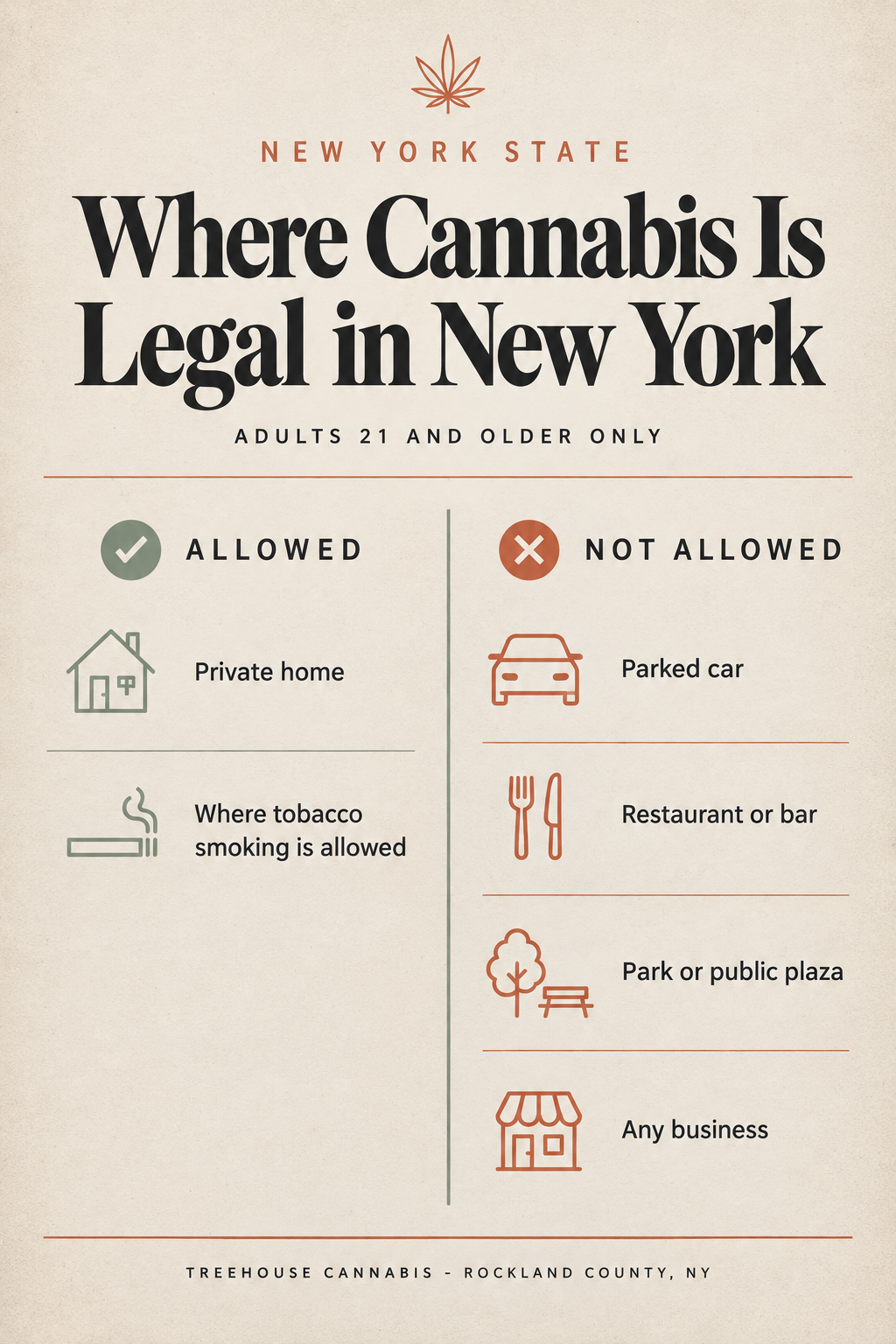
Adults 21 and older in New York may smoke or vape cannabis only where tobacco smoking is allowed. It is illegal in motor vehicles even when parked, and illegal in restaurants, parks, event spaces, and any business - dispensaries included - with civil summonses and fines for violations[1].
The possession frame matters for hosts planning a gathering. Outside the home, the limit is three ounces of cannabis and 24 grams of concentrate. At home, the storage cap is five pounds, and that is a storage allowance, not an invitation to host a distribution event[1].
The law narrows quickly once you leave private property:
- Legal: private homes, and places where tobacco smoking is already allowed
- Illegal: motor vehicles, even parked and even with the engine off
- Illegal: restaurants, parks, event spaces, and any business, dispensaries included
- Possession limits: three ounces of flower and 24 grams of concentrate outside the home
- Home storage limit: five pounds, which is a storage cap, not a hosting invitation
- A lease, landlord, or building rule can be stricter than state law
| Location | Legal for adults 21+? | What the host should do |
|---|---|---|
| Private home, owner permits it | Yes | Say where, and keep it away from non-consumers |
| Parked car | No | Walk inside; do not treat the car as a private room |
| Restaurant, bar, event space | No | Step outside to a spot where tobacco smoking is allowed |
| Park or public plaza | No | Leave it for later |
| Any business, including a dispensary | No | Purchase only; consumption happens elsewhere |
A private home is the one place a host actually controls the rules, and even there a lease, a landlord, or a co-op board can prohibit smoking outright. A balcony, a shared hallway, or a stairwell is not the private indoor space people assume it is. Keeping something easy on hand for the indoor part of the evening helps - Pre Ground Flower is a low-fuss format for guests who would rather not grind anything, and it keeps the mess out of someone else's kitchen.
How do you host a cannabis-friendly gathering that non-consumers will actually enjoy?
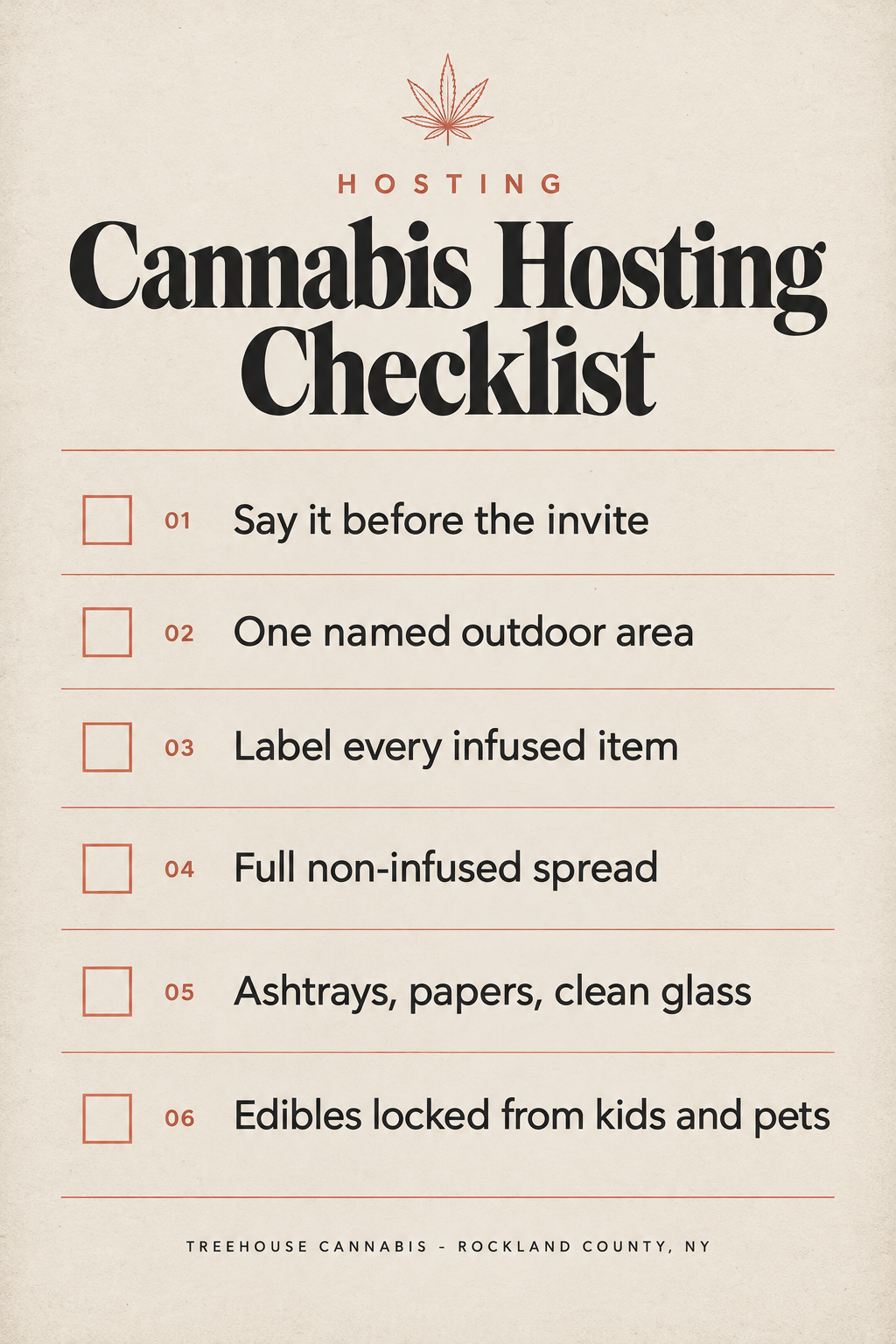
A host has four duties: say the policy before the invite, name one area, label everything infused, and stock a full non-infused spread.
Each one exists for a specific reason. Guests who hear the policy in advance can decide whether they want to come instead of managing the discovery at the door. A named area gives non-consumers a smoke-free room and a clear boundary rather than a vague hope. Labels let a guest choose knowingly. And a real non-infused spread means abstaining guests are hosted rather than tolerated.
Hosting practice from event organizers and etiquette experts lines up with that: rolling stations, grinders, ashtrays, papers, and clean glassware are part of hosting well, and clear instructions about whether and where smoking is acceptable are treated as basic cannabis etiquette, not an optional extra[7]. Nobody at a mixed party wants to sit in a cloud of smoke while working out whether the cloud is welcome.
Ventilation is where hosts most often talk themselves into a bad plan. Ventilation and filtration can reduce indoor smoke, but they are not likely to eliminate the harmful substances in it, and prohibiting smoking inside or near buildings and enclosed spaces is the only way to remove exposure[2]. State guidance is blunter: there is no safe level of secondhand smoke exposure, and cannabis smoke should not be allowed indoors[3].
The six duties, in the order they come up:
- State the policy in the invitation, not at the door
- Name one area - outdoor or otherwise - and keep it to that area
- Label every infused food and drink, and keep them separate from the rest
- Stock a full non-infused spread, not a token option
- Provide ashtrays, papers, a grinder, and clean glassware
- Empty the ashtrays and clear the area before guests leave
| Host move | Why it matters |
|---|---|
| Policy in the invite | Guests can decide before they arrive instead of managing it in the moment |
| One named area | Non-consumers get a smoke-free room and a clear boundary |
| Labels on infused items | Guests choose knowingly instead of finding out later |
| Non-infused spread | Abstaining guests are hosted rather than tolerated |
Two smaller pieces of hosting that people remember: a lighter that works, and a plan for the neighbors. If you are stocking the setup yourself, Black | Slim Pen 510 Vape Battery covers most of what a rolling station needs, and a tray keeps ash off someone else's table. If you want the shared option to be simple, Infused Pre_rolls is a format you can hand over already portioned, which removes the rolling circle entirely.
How do you keep edibles, kids, and pets safe during a gathering?
Infused food is medication, not a snack bowl, and it gets handled the same way: labeled, closed, and out of reach.
The scale of the risk is not hypothetical. National poison control centers logged 10,448 single-substance THC edible exposure cases between January 2021 and May 2022, 77 percent of them involving people 19 or younger and 65 percent classified as unintentional[4]. The FDA advises keeping these products out of reach of children and calling 1-800-222-1222 if a child consumes one[4].
Edibles are also the form most likely to be over-served by accident, because they take longer to produce effects and guests reach for a second serving before the first has landed[8]. That is a hosting problem, not a guest problem: the person who set out an unlabeled plate is the one who created the ambiguity. If you are choosing what to bring, Edibles is the category where packaging and labeling do the most work, and keeping the original package intact is the whole safety system.
The practical rules:
- Keep infused items in their original labeled packaging, closed
- Store them out of reach and out of sight, not on the serving table
- Never put an unlabeled infused item on a shared plate
- Tell guests plainly which items are infused before the food comes out
- Keep THC edibles away from pets, especially chocolate
- Call 1-800-222-1222 if a child eats an infused product
| Handled well | Handled badly |
|---|---|
| Labeled package, stored closed | Unlabeled squares on a shared platter |
| Guests told before they eat | Guest discovers it after the fact |
| Leftovers go home or get locked away | Leftovers stay out on the counter |
| Child exposure means a poison-control call | Child exposure gets watched and hoped about |
Leftovers deserve their own line, because that is where most accidents happen after the party ends. Send them home with their owner, or lock them away, and never leave infused food sitting in a guest-accessible kitchen overnight. Old Fashioned Lemonade Shot | 100mg belongs in a cabinet, not on a counter.
How do you handle smoke, neighbors, and the drive home?
Smoke goes outside and away from doors, windows, and vents; shared hallways are not private; and anyone who consumed does not drive.
On smoke, the evidence is one-sided. Secondhand cannabis smoke contains many of the same toxic and cancer-causing chemicals found in tobacco smoke, some in higher amounts, and keeping it out of enclosed spaces is the only way to eliminate exposure[2]. In an unventilated room, non-smokers exposed to secondhand cannabis smoke had detectable THC in blood and urine, reported feeling the effects, and were somewhat less coordinated, while ventilation made those effects much less likely[3]. It is not an overreaction to ask a guest to step outside; it is the only version of the request that actually works.
On neighbors, timing is the whole conversation. Drift travels through vents, shared walls, and door gaps, so a five-minute word about when and where beats a complaint filed with the building. On the drive home, cannabis impairs reaction time, lane position, and coordination[9], which means the plan gets built before anyone consumes - not negotiated at 1 a.m. with someone insisting they are fine.
The three boundaries:
- Smoke outside and away from doors, windows, and vents
- Do not treat a hallway, stairwell, or balcony as private space
- Assume drift travels through shared walls and ductwork
- Plan the ride home before anyone consumes, not after
- Never drive after consuming - impairment shows up in reaction time and lane position
- Offer a couch or a rideshare rather than a warning
| Boundary | The polite version | Why it is not optional |
|---|---|---|
| Indoor smoke | Step outside, away from doorways and vents | There is no safe level of secondhand smoke exposure |
| Shared building | Ask about timing and keep it away from common areas | Drift reaches neighbors through walls and vents |
| Drive home | Rideshare, designated driver, or stay over | Cannabis impairs reaction time and coordination |
If you are buying flower to bring along, Whole Flower Flower is the most flexible thing to carry, because it can be shared, stored, or saved for later without spoiling the evening.
Planning the next gathering - or restocking what you bring to one? Treehouse Cannabis serves adults 21 and older in Rockland County, New York, with lab-tested flower, pre-rolls, edibles, and the accessories that make hosting easier. Staff will walk you through the label, the form, and the packaging so you can describe what you are sharing accurately, and our education library covers the rest of the ground rules.
What do people most often ask about cannabis etiquette?
The questions below cover the situations readers ask about most: offering to share, declining without awkwardness, passing a joint, what to bring, and how to keep edibles away from kids and pets.
Skip to a question:
- What are the basic rules of cannabis etiquette?
- Is it rude to smoke cannabis at someone else's house without asking?
- Do you pass a joint to the left or the right when sharing?
- How much cannabis should I bring to a gathering?
- How do you decline cannabis without making it awkward?
- Where can you legally smoke or vape cannabis in New York?
- How do you host a cannabis-friendly party without making non-consumers uncomfortable?
- How should edibles be handled at a gathering with kids or pets around?
What are the basic rules of cannabis etiquette?
Ask before lighting up, offer without pressuring, say what you are sharing so guests can judge potency, keep smoke away from people who did not opt in, and leave the space cleaner than you found it. Cannabis etiquette is mostly ordinary hosting courtesy applied to a product that is inhaled, shared, and legally restricted to adults 21 and older.
Is it rude to smoke cannabis at someone else's house without asking?
Yes. Etiquette experts put asking first for a reason: the host sets the rules for their own home, and guests may include non-consumers, children, or pets. A simple 'do you mind if I step outside?' costs nothing and avoids making someone else manage your smoke.
Do you pass a joint to the left or the right when sharing?
The common convention is pass to the left and take one or two draws before handing it on. Whoever rolled the joint typically lights it first, while a packed bowl is often passed unlit to the right. The direction matters less than not hogging it and not handing over a wet or clogged mouthpiece.
How much cannabis should I bring to a gathering?
Bring enough to contribute rather than enough to carry the party, and ask the host what is welcome before you arrive. A small shareable amount plus your own papers or a clean piece is usually plenty. Never leave a host holding your leftovers without asking first.
How do you decline cannabis without making it awkward?
A short, friendly 'no thanks, I'm good' is a complete answer and does not require a reason. Hosts should offer once and then drop it; repeated offers turn hospitality into pressure. Having a non-infused drink or snack in your hand also ends the conversation faster than any explanation.
Where can you legally smoke or vape cannabis in New York?
New York allows adults 21 and older to smoke or vape cannabis wherever tobacco smoking is permitted, except in motor vehicles even when parked, and it is illegal in restaurants, parks, event spaces, and any business, including dispensaries. Violations can bring a civil summons and fine under state and local smoke-free air rules.
How do you host a cannabis-friendly party without making non-consumers uncomfortable?
Say up front whether cannabis is part of the event, designate one clearly described outdoor or well-ventilated area, label every infused item, and keep a full set of non-infused food and drinks. Guests who do not consume should be able to enjoy the party without standing in smoke or second-guessing what is on the table.
How should edibles be handled at a gathering with kids or pets around?
Treat infused food like medication: keep it in its original labeled packaging, out of reach and out of sight, and never set it out unlabeled on a shared table. The FDA logged more than 10,000 THC edible exposure cases in a 17-month window, most involving people 19 or younger, and advises calling 1-800-222-1222 if a child eats one.
Sources
- NYC Health (New York City Department of Health and Mental Hygiene) — New York adults 21 and older may possess up to three ounces of cannabis and 24 g
- U.S. Environmental Protection Agency (EPA) — Secondhand marijuana smoke contains many of the same toxic and cancer-causing ch
- Learn About Cannabis (Washington State cannabis education program) — In an unventilated room, nonsmokers exposed to secondhand cannabis smoke had det
- U.S. Food and Drug Administration (FDA) — National poison control centers logged 10,448 single-substance exposure cases in
- Fortune — Etiquette expert Lizzie Post, co-president of the Emily Post Institute and autho
- Leafly — Lizzie Post frames cannabis as an inherently social activity that belongs in the
- Leafly — Hosting guidance from event organizers and etiquette experts includes providing
- National Institute on Drug Abuse (NIDA), National Institutes of Health — Edibles typically take longer to produce effects, which can lead people to consu
- Substance Abuse and Mental Health Services Administration (SAMHSA) — Approximately 1 in 10 people who use marijuana will become addicted, rising to 1
About Treehouse Cannabis
Treehouse Cannabis is a licensed adult-use dispensary in Rockland County, New York, serving customers 21 and older across Rockland, Orange, and Westchester Counties. Our team answers questions about form, onset, labeling, and safe storage every day, and we would rather explain a product twice than have a guest guess.
Cannabis is for adults 21 and older. Keep all cannabis products out of reach of children and pets. Do not drive after consuming cannabis. Nothing in this article is medical advice, and no dosage is recommended here.

Shop our products

Shop All

Deals

Flower

Pre-rolls

Vaporizers

Edibles
Drinks

Concentrates

Tinctures

Topicals

CBD

Pet CBD

Accessories