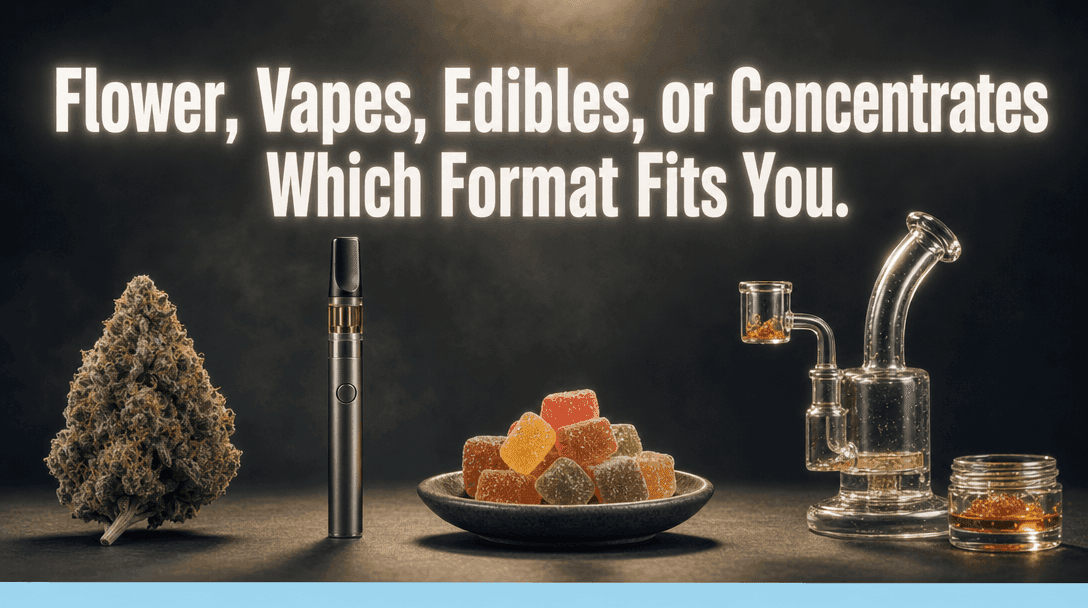
Flower, Vapes, Edibles, or Concentrates: Which Format Fits You?
Flower, Vapes, Edibles, or Concentrates: Which Format Fits You?
Cannabis consumption methods come in four main formats — flower, vapes, edibles, and concentrates — each of which routes THC through the body in a different way. The right format depends on whether the priority is fast onset, long duration, high potency, or discretion. Inhaled methods like flower and vapes act within minutes; edibles trade timing for hours of coverage; concentrates win on potency per session.
What Are the Main Cannabis Consumption Methods?
Four formats dominate today's adult-use cannabis market, and each one routes THC through the body in a different way. Cannabis flower is the dried plant, typically smoked in a pipe, joint, or one-hitter.
Vapes and vaporizers heat cannabis oil into a breathable aerosol using a cartridge, disposable pen, or dry-herb device. Edibles are food and drinks such as gummies, chocolates, beverages, and baked goods infused with THC or CBD.
Concentrates are high-potency extracts like wax, shatter, rosin, and hash oil, consumed by dabbing with a rig or through a concentrate vaporizer.
According to the CDC, the most common cannabis consumption methods include smoking, vaping, dabbing, and consuming edibles. Products with high THC concentration or delayed-onset formats like edibles can produce unpredictable effects and increase the risk of overconsumption [2].
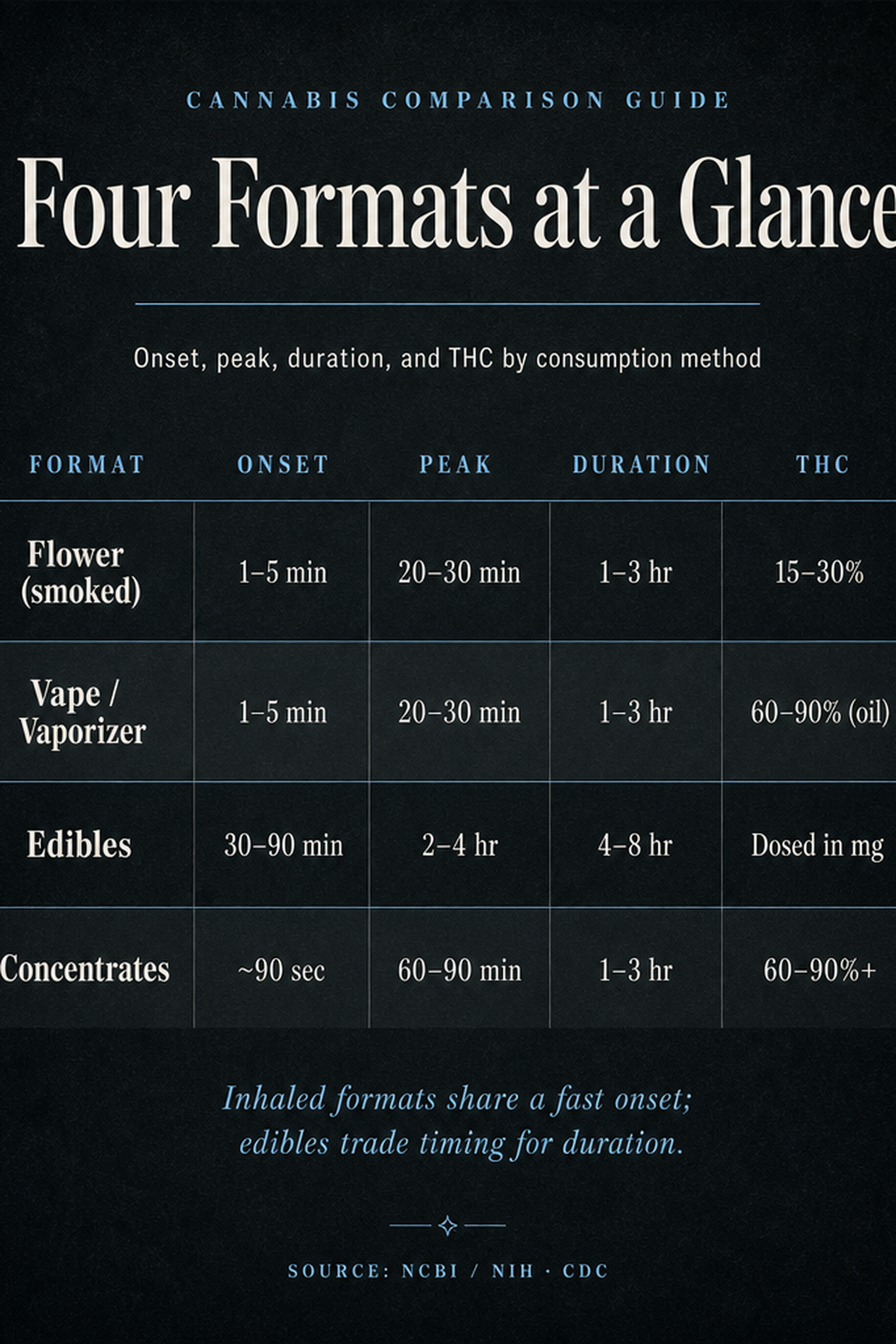
The four formats at a glance:
- Flower — dried cannabis plant, smoked or vaporized; onset in 1–5 minutes
- Vapes — heated cannabis oil in cartridges, disposables, or dry-herb devices; onset in 1–5 minutes
- Edibles — infused food and drinks; onset in 30–90 minutes, lasting 4–8 hours
- Concentrates — wax, shatter, rosin, hash oil; onset in roughly 90 seconds via dabbing
The differences between formats come down to four variables: how quickly effects begin, how long they last, how potent each dose is, and how visible or smelly the experience is. Once a customer knows which variable matters most for the situation, the format choice becomes a quick mental model instead of a guessing game.
How Does Cannabis Flower Compare to Vapes?
Flower and vapes both deliver THC through the lungs, so they share a fast onset of one to five minutes and a peak high around 20 to 30 minutes after consumption. The difference between the two is the delivery mechanism.
Flower is burned at a high temperature and produces visible smoke along with combustion byproducts like benzene and toluene. Vape cartridges and disposable pens heat cannabis oil into an aerosol without burning the plant material [7].
Research suggests vaporizing carries a gentler respiratory profile than smoking. A 2022 cross-sectional study published through NCBI/NIH found vaporizer users were 40 percent less likely to report respiratory symptoms such as cough, phlegm, and chest tightness than people who smoked cannabis flower [4].
Vapes also win on discretion. They produce less visible vapor, less lingering odor, and a pocketable form factor that fits in a jacket pocket. Flower still wins on ritual, full-spectrum flavor, and price per milligram of THC, which matters for adults who prefer the traditional method and want a familiar experience.
Flower vs. vapes at a glance:
| Attribute | Flower (smoked) | Vape / Vaporizer |
|---|---|---|
| Onset | 1–5 min | 1–5 min |
| Peak high | 20–30 min | 20–30 min |
| Duration | 1–3 hr | 1–3 hr |
| Visible smoke / vapor | Heavy smoke | Light vapor |
| Combustion byproducts | Yes (benzene, toluene) | No |
| Respiratory symptom risk (NCBI/NIH 2022) | Baseline | 40% lower than smoking |
| Discretion | Low | High |
| Ritual / flavor | High | Lower |
For shoppers browsing the Flower category at a licensed dispensary, an approachable entry point like Out The Office • Flower • 70g gives a familiar flower format with a balanced profile worth starting with. Readers who want to dig deeper into strain selection can also check out The Top Cannabis Strains: A Connoisseur's Guide to Premium Selection for a closer look at how genetics shape the experience.
How flower and vapes compare, step by step:
- Same onset window: both flower and vapes deliver first effects within 1–5 minutes
- Same peak timing: both formats peak around 20–30 minutes after consumption
- Different mechanics: flower is burned at high heat; vapes heat oil without combustion
- Different byproducts: combustion produces benzene and toluene; vaporization does not
- Different respiratory profile: NCBI/NIH 2022 study found vapor users 40% less likely to report respiratory symptoms
- Different discretion: vapes produce light vapor with less odor than visible flower smoke
- Different ritual: flower keeps the traditional bowl/joint ritual; vapes trade that for portability
Why Do Cannabis Edibles Take Longer to Kick In and Last Longer?
Edibles route THC through the digestive system and liver instead of the lungs, which changes both the timing and the character of the high. First effects typically take 30 to 90 minutes to appear, and the peak high lands around two to four hours after ingestion, with the experience often lasting four to eight hours in total [3].
The longer, stronger effect has a metabolic explanation. The liver converts delta-9-THC into 11-hydroxy-THC, a metabolite that is significantly more psychoactive than delta-9 itself and crosses the blood-brain barrier more easily [8].
Oral bioavailability is only four to twelve percent, so a smaller fraction of the dose actually reaches the bloodstream. Even so, the resulting high feels stronger because of the 11-hydroxy metabolite [1].
Why edibles take longer and feel stronger:
- Liver metabolism: THC becomes 11-hydroxy-THC, which crosses the blood-brain barrier more easily
- Slow absorption: digestion and liver processing push first effects out 30–90 minutes
- Long tail: effects last 4–8 hours because the metabolite clears the body slowly
- Lower bioavailability per mg: only 4–12% of an oral dose reaches the bloodstream
- Per-milligram punch: the metabolite is more psychoactive, so each mg feels stronger
This is why most regulators and clinicians recommend a starting edible dose of 2.5 mg THC or less, with a wait of at least two hours before taking more. For adults thinking about timing an edible around physical activity, the longer onset window changes the planning math entirely. Readers curious about that angle can see how it plays out in Edibles and Exercise: A Guide to Working Out with Weed.
Are Cannabis Concentrates Stronger Than Flower?
Concentrates are meaningfully stronger than flower on a per-gram basis. Cannabis flower typically tests at fifteen to thirty percent THC, while concentrates such as wax, shatter, rosin, and hash oil generally range from sixty to ninety percent THC, and sometimes higher [6].
Concentrates are consumed by inhalation through a water pipe, often called dabbing, or a specialized concentrate vaporizer. This route produces the fastest onset of any common cannabis method, typically within 90 seconds, and the shortest peak window of 60 to 90 minutes [5].
The format suits experienced adults who want a short, controlled, high-potency session, but the dose-per-inhale math is unforgiving for new customers. A single inhalation from a concentrate pen can deliver more THC than an entire joint, which is why concentrates are almost never recommended as a starting format.
Concentrate vs. flower at a glance:
| Attribute | Flower | Concentrates |
|---|---|---|
| Typical THC range | 15–30% | 60–90%+ |
| Onset | 1–5 min | ~90 sec |
| Peak high | 20–30 min | 60–90 min |
| Duration | 1–3 hr | 1–3 hr |
| Consumption method | Pipe, joint, vape | Dab rig, concentrate pen |
| Best for | Ritual, full-spectrum flavor, lower-cost sessions | Experienced consumers, short high-potency sessions |
| Beginner suitability | Acceptable at low THC | Not recommended |
Tolerance, dosing discipline, and proper equipment such as a temperature-controlled rig or dab pen all matter before stepping into concentrates. For a fuller breakdown of potency ranges, hardware, and consumption mechanics, the Cannabis Concentrates 101 guide walks through the format in more detail.
How concentrates stack up against flower, step by step:
- Higher per-gram THC: flower tests at 15–30% THC; concentrates test at 60–90%+ THC
- Faster onset: dabbing produces first effects in roughly 90 seconds vs. flower's 1–5 minutes
- Shorter peak window: concentrates peak at 60–90 minutes vs. flower's 20–30 minutes
- Same total duration: both formats typically last 1–3 hours
- Different equipment: flower uses a pipe, joint, or dry-herb vape; concentrates use a dab rig or concentrate pen
- Different tolerance bar: concentrates require established tolerance + proper equipment
- Different beginner fit: flower is acceptable at low THC; concentrates are not recommended for beginners
Which Cannabis Format Fits Your Goals?
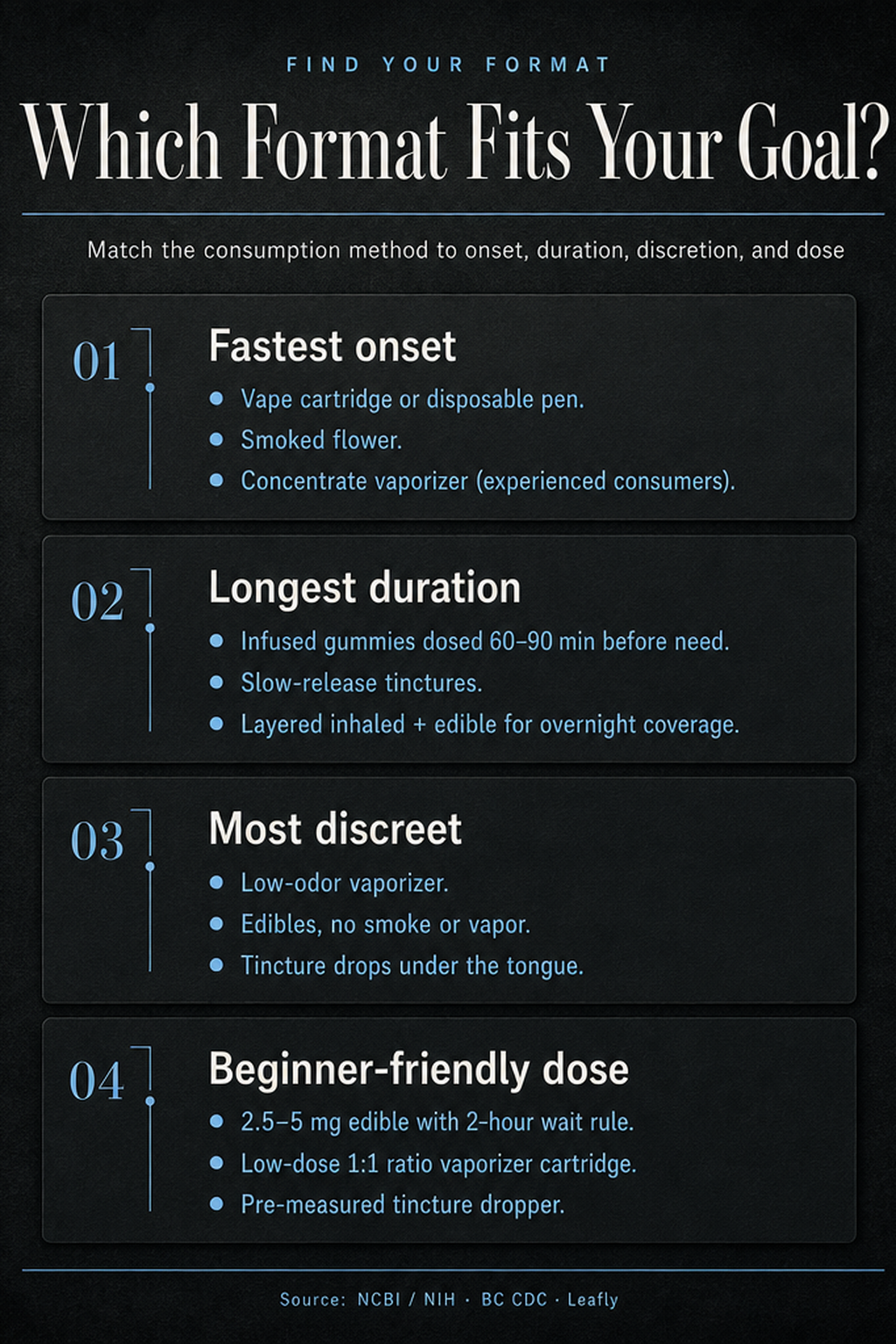
Choosing a format is easiest when the goal is clear. Want fast onset for sleep onset or acute relief? Go with flower or a vape, where the one to five minute onset lines up with the moment relief is actually needed.
Want long-lasting coverage for sleep maintenance, a movie night, or sustained relief? An edible dosed 60 to 90 minutes before the experience is more reliable than chasing another inhalation session every two hours.
Maximum discretion in shared housing or on the go points toward vapes and low-dose edibles, which produce the lowest visibility and odor of any format. Maximum potency per session, with tolerance and proper equipment, points toward concentrates, though that route is rarely the right answer for new consumers.
A slower, gentler introduction usually starts with low-dose edibles in the 2.5 to 5 mg THC range or a balanced THC:CBD vape cartridge. The CDC notes that high-THC products and delayed-onset formats like edibles can produce unpredictable effects, which makes matching the format to the goal a safety consideration as well as a preference one [2].
Match the format to the goal:
- Fastest onset (sleep onset, acute relief) → vape cartridge or smoked flower
- Longest duration (sleep maintenance, sustained relief) → edible dosed 60–90 minutes before need
- Most discreet (shared housing, on the go) → low-odor vape or edible
- Highest potency per session (tolerance + equipment) → concentrate dab or pen
- Most beginner-friendly → 2.5–5 mg edible with the 2-hour wait rule, or a balanced THC:CBD vape
Inhaled formats like flower and vapes peak quickly and fade in a few hours. Edibles trade that timing for a much longer arc [3].
How Should New Consumers Pick Their First Cannabis Format?
New consumers get the most predictable results from a format that has a long runway before effects peak, so the dose can be adjusted before the high becomes uncomfortable. Edibles technically fit that bill since they have a long onset and are easy to dose in milligrams, but the 30 to 90 minute wait is too easy to misread as "not enough."
Re-dosing into an overwhelming experience is a common mistake for first-time customers, which is why most clinicians and regulators recommend starting at 2.5 mg or less and waiting the full two hours.
A low-dose THC vape cartridge or a balanced THC:CBD product in a 1:1 or 2:1 ratio gives the same control advantage with a faster feedback loop. A useful rule of thumb is to start with a single inhalation or a 2.5 mg edible, wait at least 15 to 30 minutes for inhaled formats or two hours for edibles, and only re-dose once the first wave has fully landed.
The CDC emphasizes that adults considering cannabis for the first time should start with low-THC products, avoid mixing formats in the same sitting, and understand that delayed-onset products like edibles increase the risk of overconsumption [2].
First-time format checklist:
- Start low: 2.5 mg edible, or one short inhalation from a low-dose vape
- Wait long: 15–30 minutes for inhaled formats, 2 hours for edibles
- One format per sitting: avoid mixing inhaled and edible in the same session
- Pick the feedback loop that matches the format: vapes for fast titration, edibles for slow steady coverage
- Skip concentrates until tolerance and equipment are in place | Ask a budtender at a licensed adult-use dispensary for beginner-friendly options in any of the four formats
Budtenders at a licensed adult-use dispensary can walk new customers through beginner-friendly options in any of the four formats.
Sources
- National Center for Biotechnology Information (NCBI/NIH) — Oral bioavailability of THC is only 4% to 12%, while inhaled cannabis achieves f
- Centers for Disease Control and Prevention (CDC) — The most common cannabis consumption methods include smoking, vaping, dabbing (i
- National Center for Biotechnology Information (NCBI/NIH) — Inhaled THC reaches the brain within minutes and peaks in 20 to 30 minutes, whil
- National Center for Biotechnology Information (NCBI/NIH) — Vaporizing cannabis avoids producing carcinogenic combustion byproducts like ben
- National Center for Biotechnology Information (NCBI/NIH) — Cannabis concentrates are typically consumed via inhalation using a water pipe o
- Washington State Liquor and Cannabis Board (LCB) — Cannabis flower typically ranges from about 15% to 30% THC, while concentrates s
- Leafly — Vape cartridges and disposable pens heat cannabis oil into vapor rather than bur
- Leafly — Edibles convert delta-9-THC in the liver to 11-hydroxy-THC, a metabolite that is
About Treehouse Cannabis
Treehouse Cannabis is an adult-use dispensary serving customers 21 and older in Rockland County, New York. Our budtenders help customers across Rockland, Orange, and Westchester Counties compare flower, vapes, edibles, and concentrates to find the format that fits their goals. Cannabis is for adults 21 and older. Keep all cannabis products locked and out of reach of children and pets. Do not drive or operate machinery after consuming cannabis, and do not mix cannabis with alcohol or other substances. If you are pregnant, nursing, or taking medication, talk to a clinician before use. Treehouse Cannabis serves adult-use customers 21 and older in accordance with New York State law.
Shop our products

Shop All
Flower
Pre-rolls
Vaporizers
Edibles
Drinks
Concentrates
Tinctures

Topicals
CBD

Pet CBD
Accessories