Why Licensed Cannabis Lab Testing Matters in New York
Why Licensed Cannabis Lab Testing Matters in New York
New York cannabis lab testing is a condition of holding a license, not a brand's marketing choice, and it covers every final product form sold in a regulated dispensary: flower, pre-rolls, edibles, concentrates, vapes, tinctures, and topicals. Each tested batch produces a certificate of analysis that a customer can actually check.
What comes out the other end is a certificate of analysis tied to one specific batch, which is the reason a customer can check a package instead of trusting a label. Compliance is not the same thing as marketing, and the state's system is built so those two never have to be the same.
Why Does New York Require Lab Testing for Cannabis?
New York requires cannabis lab testing because the testing requirement lives inside the license itself, not inside a brand's quality promise. Under 9 NYCRR 130.22, any testing submitted by a sampling firm must be performed by a permitted cannabis laboratory using Office-approved methods [6]. A producer that skips testing is not making a marketing choice. It is operating outside the regulated market entirely.
The laboratory side of the system is deliberately narrow. The Office of Cannabis Management publishes the laboratories holding an OCM cannabis laboratory permit, along with the specific analyte groups each one is approved to run [1]. A lab cannot quietly add a new panel to its offering without that approval showing up on the state list.
Permitted labs also carry obligations that have nothing to do with the particular sample in front of them:
- They must maintain a documented quality system
- They must take part in proficiency testing
- They must submit to periodic regulatory audits
- They must run only the analyte groups they are approved for
Coverage is the other half of the rule. OCM states that every cannabis product form must be tested, with no exceptions [4]. There is no category of regulated product that reaches a shelf on the strength of the producer's own word, and there is no small-batch or limited-release carve-out that turns testing into an optional step.
What testing is not matters just as much. A passing result does not certify a product as safe in any absolute sense, and it is not a medical endorsement. It documents that a batch was measured against the state's limits and landed inside them, which is a narrower claim than the language that sometimes surrounds it on a package or a menu board.
For the customer, the payoff is simple. Testing means you never have to take a brand's word for what is in the package, because a state-permitted laboratory already put a number on it. That is a different thing from a claim printed on packaging, and it is why the results are published rather than summarized. Where you may legally consume the product is a separate question, and Where Can You Legally Use Cannabis in New York? walks through the places New York allows it.
What Does New York Test Cannabis For?
New York cannabis lab testing covers cannabinoid potency, pesticides, heavy metals, mycotoxins, microbiological contaminants including salmonella and E. coli, residual solvents, terpenes, moisture content, water activity, and filth or foreign material. Which panels apply depends on the product form, and the state publishes a pass limit for each analyte rather than a general standard [2].
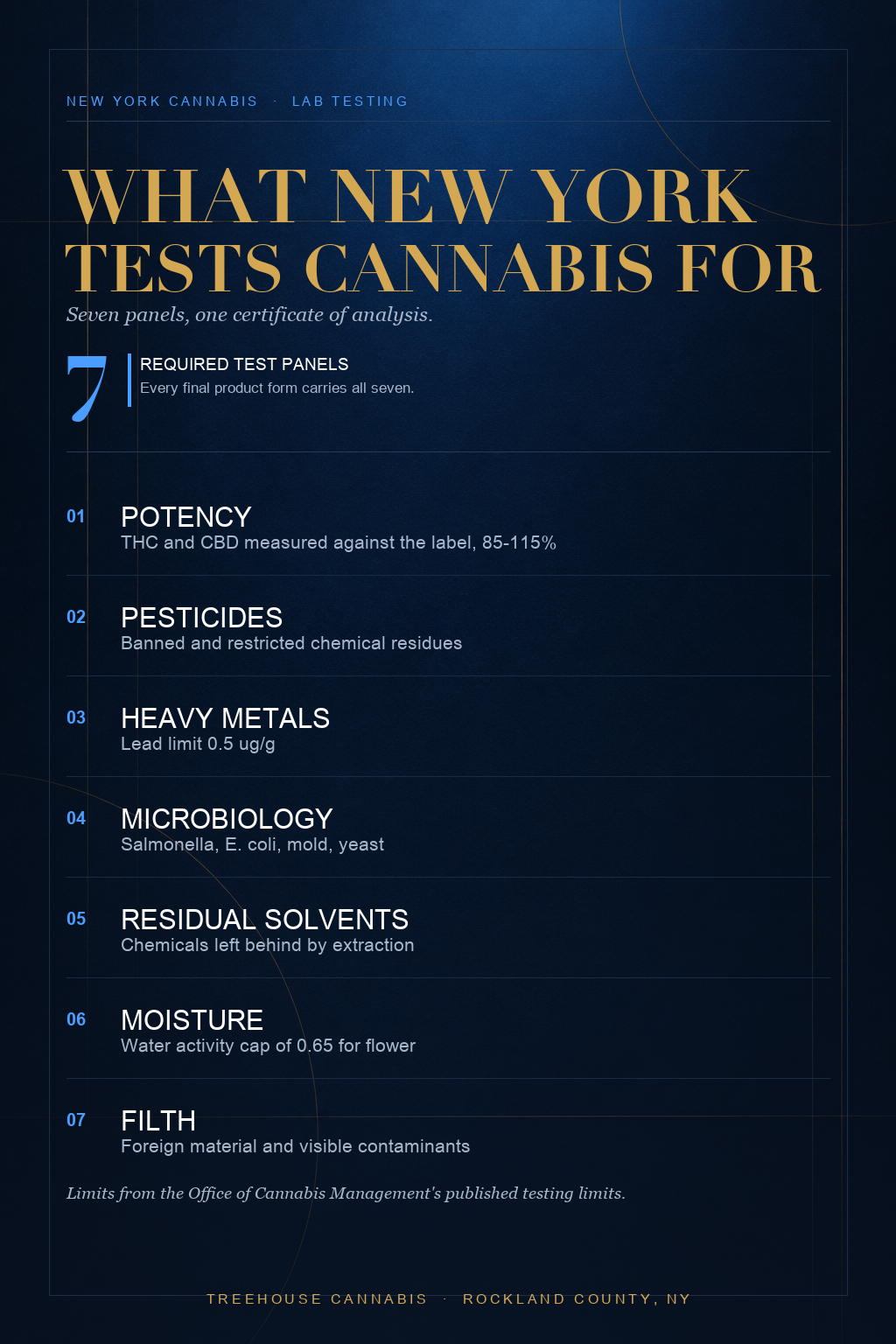
Potency gets checked twice, once for accuracy and once for consistency across the batch. The labeled value must land inside 85 to 115 percent of the tested result, and no single sample may deviate more than 25 percent from the lot mean. That second number is what separates a real potency test from a single lucky flower.
The contaminant panels are the ones customers rarely read and probably should:
- Pesticides, covering banned and restricted chemical residues
- Heavy metals, with lead capped at 0.5 ug/g for both oral and inhalation routes and arsenic at 0.200 ug/g for inhalation
- Mycotoxins, the mold-derived compounds that can develop in poorly stored material
- Microbiology, including salmonella, E. coli, mold, and yeast
Residual solvents and terpenes make up the middle of the panel. Solvent testing matters most for concentrates and vapes, where extraction chemistry is part of the manufacturing process. Terpene testing documents the aromatic profile rather than a safety threshold, which is useful context but not a pass or fail question in the same sense.
Physical quality closes it out. Moisture content and water activity are measured because both drive how flower ages and whether it becomes a hospitable place for microbial growth. Water activity for flower products, including pre-rolls, kief, and solventless hash, cannot exceed 0.65. Filth and foreign material testing covers the unglamorous end of the list: stems, grit, and anything that should not be in a package at all.
A quick reference to the limits that come up most often:
| Test | What it checks | Published limit |
|---|---|---|
| Potency | Labeled THC and CBD against the tested value | 85 to 115 percent |
| Homogeneity | Spread of potency across samples in the lot | Within 25 percent of lot mean |
| Heavy metals | Lead, arsenic, and related elements | Lead 0.5 ug/g; arsenic 0.200 ug/g (inhalation) |
| Microbiology | Salmonella, E. coli, mold, yeast | Pass or fail per analyte |
| Water activity | Moisture available for microbial growth | 0.65 maximum for flower products |
| Filth | Foreign material and visible contaminants | Pass or fail |
None of these numbers are universal across states, and they are not a health standard in the medical sense. They are the limits New York set, and a passing result means the batch landed under them. Testing rules also sit inside a broader set of obligations that includes possession limits and retail rules, and New York Cannabis Laws in 2026: What's Legal, What's Restricted, What Changed is the wide-angle version of that picture if you want the full framework before drilling into lab results.
Two related housekeeping points are worth separating from testing itself. How much cannabis a person may legally possess is governed by its own set of limits, which How Much Cannabis Can You Legally Possess in New York? breaks down, and those limits apply regardless of what any CoA says about a batch.
How Does the Sampling and Testing Chain Work in New York?
The chain runs in a fixed order, and the order is the part that makes the result meaningful. An approved independent sampling firm collects the sample, a permitted laboratory runs the panel, and the results attach to that specific lot rather than to the brand in general [3].
- Step 1: an approved independent sampling firm collects the sample at the licensed premises
- Step 2: the sample goes to a laboratory holding an OCM cannabis laboratory permit
- Step 3: the lab tests using Office-approved methods and reports pass or fail for each analyte
- Step 4: the results attach to that lot, and the licensee must retain a representative sample
Independent sampling became mandatory on July 1, 2023 [3]. The separation is the whole point. A laboratory cannot send its own staff to sample its own client's product, which removes the obvious conflict of interest in a system where the producer is paying for the test.
Retention is the quiet backstop. Because the licensee keeps a representative sample of the tested lot, a result can be re-examined later instead of disappearing into a filing cabinet. Retesting is not a do-over either. It requires OCM approval, so a licensee cannot simply run the panel again until it gets an answer it prefers.
Capacity is worth understanding, because it explains why the system moves the way it does. OCM cannabis testing runs through a small pool of independent permitted laboratories, and the Cannabis Control Board renewed nine cannabis laboratory permits in March 2026 [9]. That is a short list relative to the number of licensed producers and retailers in the state.
The same certificate follows the product regardless of who ends up buying it. A customer comparing lower-potency options, a group covered in more detail in How Seniors Are Using Cannabis in New York, is reading the same document as a daily flower buyer, because the panel is attached to the batch and not to the shopper.
How Do You Read a New York Cannabis COA?
A NY cannabis COA is the laboratory report for a specific batch. It lists what the batch was tested for, what the lab measured, and whether each result passed. In New York, every regulated product carries a QR code or link that resolves to the CoA for the exact batch in your hand [5], which is what makes the document useful rather than decorative.
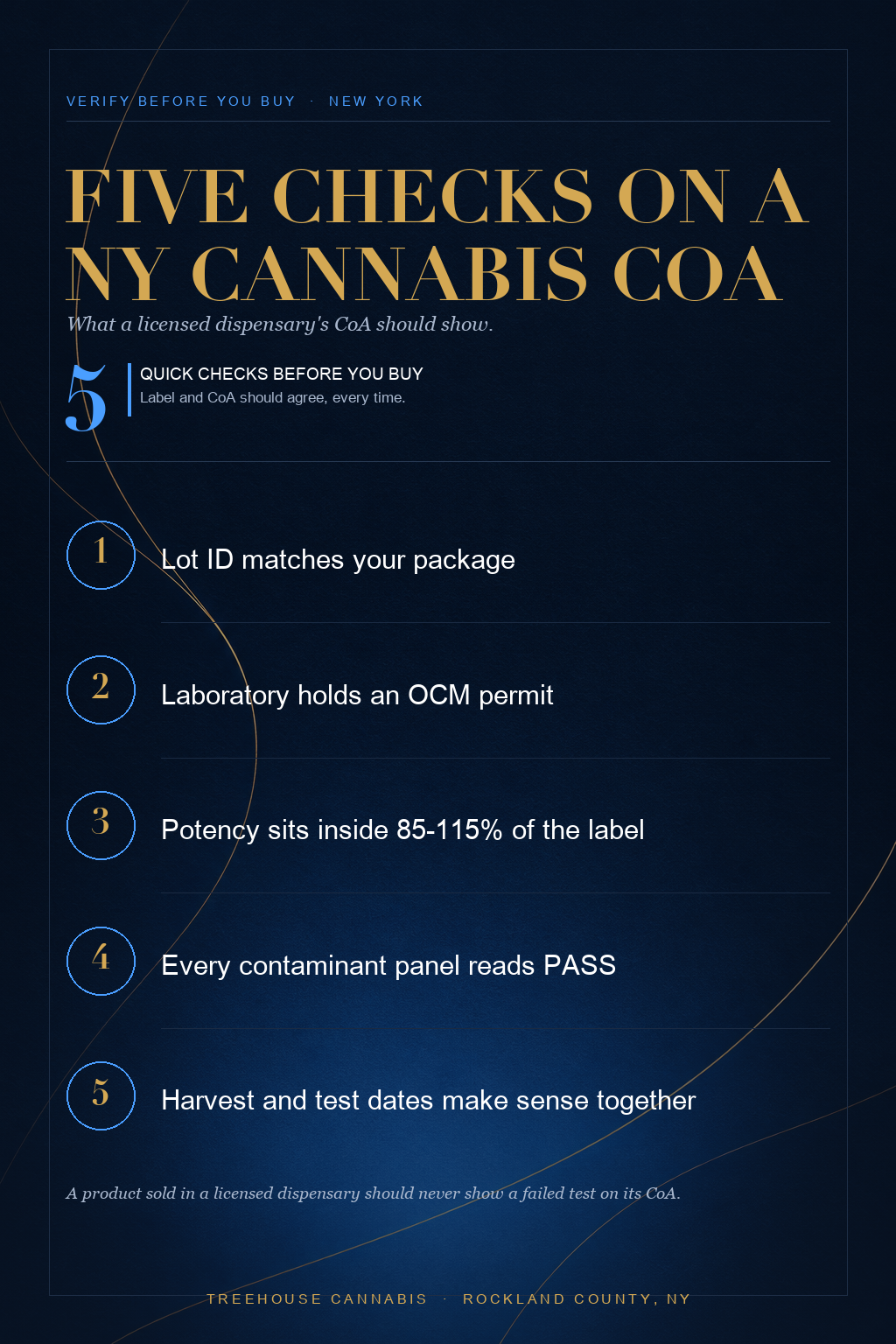
Reading one takes about a minute if you know the five checks:
- Confirm the lot or batch ID on the CoA matches the package you are holding
- Confirm the laboratory name appears on the state's permitted list
- Compare the labeled potency to the tested value and confirm it sits inside 85 to 115 percent
- Read each contaminant panel as pass or fail, not as a score to interpret
- Check that the harvest or production date and the test date line up with the product in front of you
The potency comparison looks different depending on what you bought. Flower and other inhalables report THC and CBD as percentages, so the label and the lab result are directly comparable. A package of Peach x Oishii Live Resin Gummies | 10 pk reports milligrams per serving and per package instead, which means the number on the label is a dose-per-unit figure rather than a percentage [2]. Comparing the two formats as if they were the same measurement is the most common reading mistake.
The contaminant panels are simpler than they look. Each analyte is pass or fail against the state limit, and a product sold in a regulated dispensary should never show a failed test on its CoA [4]. If you see one, the package should not be on that shelf in the first place.
The five checks apply to every category on the floor. A value option like Small Buds Flower carries the same document as a top-shelf NY Diesel | Flower | 28g package, because the requirement attaches to the product form and not to the price. Once the checks become habit, the CoA stops looking like paperwork and starts working like a label with evidence behind it.
What Happens When a Cannabis Product Fails a Test?
A failed lot does not automatically become waste, but it also does not get to move forward untouched. New York allows remediation or repurposing for some failures, and any remediated material must then be resampled and retested before it can proceed [3].
- Remediation or repurposing is permitted for certain failures
- Remediated material must be resampled and retested
- Retesting requires OCM approval and is not an automatic do-over
- Lots that fail contaminant testing and cannot be remediated are destroyed
That last point is what makes the rest of the system enforceable. Without a destruction requirement, a lab result would be advisory: a producer could fail a panel, warehouse the lot, and wait for a friendlier outcome. The disposition rule closes that path, and it applies to contaminant failures that remediation cannot fix.
Retesting deserves a note of its own, because it is the step most often misunderstood. Retesting is not a second opinion a licensee can buy. It requires OCM approval, and the reason has to be something other than disliking the number that came back.
The contaminant limits in the previous section are what the disposition rule actually enforces [2]. A lot that clears the potency panel but fails on a microbial or heavy metal result is in exactly the position the destruction requirement was written for.
For customers, the practical takeaway is that the compliant side of the shelf is the only side where this enforcement exists at all. To see what that looks like in practice, browse Flower and pull up the CoA on any package that interests you. The document is the difference between a product that was checked and one that merely claims to have been.
How Does Unlicensed Cannabis Compare on Testing?
Unlicensed cannabis is not tested, because testing is a condition of holding a New York license. Products sold at unlicensed storefronts, bodegas, and delivery services sit outside the system entirely: no sampling firm, no permitted laboratory, no certificate of analysis, and no disposition rule if something goes wrong.
Here is how the two channels differ on the parts that matter:
| Requirement | Licensed dispensary | Unlicensed seller |
|---|---|---|
| Sample collection | Approved independent sampling firm | No requirement |
| Laboratory | OCM-permitted lab using approved methods | No requirement |
| Certificate of analysis | Issued per batch and scannable at the shelf | Not issued |
| Failed-lot disposition | Remediation with retest, or destruction | No rule applies |
| State verification | Dispenser verification tool and storefront sign | Nothing to verify |
The available third-party data on that gap is limited but pointed. A 2022 analysis tested 40 products purchased from 20 unlicensed New York City storefronts and found that about 40 percent failed at least one test required of legal cannabis products [8]. Detected contaminants in that sample included E. coli, salmonella, pesticides, and heavy metals.
What that study actually establishes:
- 40 products were purchased from 20 unlicensed New York City storefronts
- About 40 percent failed at least one test required of legal cannabis
- Detected contaminants included E. coli, salmonella, pesticides, and heavy metals
- The figure is a snapshot of that sample, not a statewide failure rate
That figure is a snapshot of 40 products from 20 shops, not a statewide failure rate, and it should be read that way. What it does establish is that the contaminants the regulated panel screens for are the ones that actually show up when nobody is screening.
Consumer awareness trails the system. A survey of 195 New York cannabis consumers found that most did not recognize the state's required label symbols, about 49.7 percent did not know how often they viewed a certificate of analysis, and 13.8 percent reported declining a product because it had no CoA [7]. In other words, a meaningful share of buyers are already treating the absence of a CoA as a reason to walk away.
Verification is the cheap fix for all of that. OCM maintains a dispenser verification tool, every licensed shop posts a matching verification sign, and the universal symbol appears on every regulated product [5]. Scanning the sign's QR code confirms the shop is on the state's licensed list, which takes a few seconds and settles the question.
The gap follows the product form as closely as it follows the storefront. An untested pre-roll and a tested one are visually identical, so the difference has to come from where you buy, and the state-tested versions are the ones listed under Pre_rolls.
What Does a COA Not Tell You?
A CoA confirms what is in a batch and that the batch cleared the state's contaminant limits. It does not tell you whether that product suits your tolerance, your experience level, or the effect you are looking for [4].
- It confirms the batch and its pass status, not your personal fit
- A potency percentage is not the same thing as a serving size
- Product form changes how the same potency behaves
- The CoA is a starting point, not a recommendation
Potency is the number that gets quoted most and understood least. Two products can both read 24 percent THC and land very differently, because the form, the serving, and the delivery method all shape the experience. A jar of Granddaddy Purple | Live Resin Badder | 1g and a flower sample are not interchangeable at the same percentage, and treating the lab number as a dosing guide misreads what the document is for.
The consumer research supports that caution. Even among people who look at CoAs, familiarity with the label system is uneven [7], which is a reason to read the document slowly the first few times rather than skim it for a big number.
The honest framing is that a CoA answers a narrow, important question: was this exact batch tested, and did it pass? Everything after that is a choice about form and serving, which is where a conversation at the counter beats a number on a screen. None of it is a reason to skip the package, though. The licensed channel is still the only one where the batch was tested at all, and it is where even a novelty item like Smoke S'more Weed with you greeting Card w/ One Hitter comes from.
Every product on the shelf at Treehouse Cannabis comes with a certificate of analysis you can pull up in the store, so you can check the batch instead of taking our word for it. Visit us in Rockland County to shop flower, ayrloom | Lychee Dream Infused Pre-Roll | 5 Pack | 3g, edibles, and concentrates that cleared the state's testing limits, and bring your questions about COAs with you. Customers in Orange and Westchester County are welcome to make the trip or call ahead before you drive over.
Frequently Asked Questions
What does New York test cannabis for?
New York requires testing for cannabinoid potency, pesticides, heavy metals, mycotoxins, microbiological contaminants including salmonella and E. coli, residual solvents, terpenes, moisture content, water activity, and filth or foreign material. Which panels apply depends on the product form, and every final product type must be tested before sale. [2] [6]
What is a NY cannabis COA?
A certificate of analysis is the laboratory report showing what a specific batch was tested for and whether each result passed. In New York, every regulated product carries a QR code or link to its CoA, so customers can review potency and contaminant results for the exact batch they are holding. [4] [5]
Who does the testing in New York?
Independent laboratories holding an OCM cannabis laboratory permit. Samples must be collected by an approved sampling firm, a rule that became mandatory on July 1, 2023. Lab staff cannot sample their own clients' product, which keeps the chain of custody separate from the business being tested. [3] [1]
What happens if a cannabis product fails a test?
The licensee can attempt to remediate or repurpose the lot, which then has to be resampled and retested. Retesting is not allowed simply because a licensee dislikes the result. Any lot that fails contaminant testing and cannot be remediated must be destroyed under state regulations. [3] [2]
How close does the label have to match the lab result?
For adult-use products, the labeled potency must fall within 85 to 115 percent of the tested value. Flower and other inhalables report THC and CBD as percentages, while edibles report milligrams per serving and per package, so the comparison looks different depending on what you bought. [2]
Is unlicensed cannabis tested?
No. Testing is a condition of holding a New York license, so products sold at unlicensed storefronts, bodegas, or delivery services skip the entire system. A 2022 third-party analysis of 40 products from 20 unlicensed New York City shops found about 40 percent failed at least one test required of legal cannabis. [8] [3]
Where can I find a licensed dispensary near me?
OCM publishes a dispensary location verification tool and every licensed shop posts a matching verification sign in its storefront. Scanning that sign's QR code confirms the shop appears on the state's licensed list, which is worth doing once before you become a regular. [5]
Does a COA guarantee the product is right for me?
No. A CoA confirms what is in the batch and that it cleared contaminant limits, not that the product suits your tolerance or experience. Potency, product form, and serving size still drive how a product affects you, which is why the CoA is a starting point rather than a recommendation. [4] [7]
Sources
- New York State Office of Cannabis Management — Lists the laboratories holding an OCM cannabis laboratory permit and the specifi
- New York State Office of Cannabis Management — Sets the required analytes and pass limits for New York cannabis testing, includ
- New York State Office of Cannabis Management — Explains the mechanics of the New York testing system: independent sampling firm
- New York State Office of Cannabis Management — Defines what a New York certificate of analysis contains, explains that every ca
- New York State Office of Cannabis Management — Describes the consumer-facing verification chain in New York: a dispenser verifi
- Cornell Law School, Legal Information Institute — Is the operative regulation requiring that all testing submitted by a sampling f
- Kruger, Schlueter, Felicione and Kruger, Psychoactives (MDPI), University at Buffalo — Survey of 195 New York cannabis consumers found most did not recognize the state
- New York Medical Cannabis Industry Association — Third-party testing of 40 products purchased from 20 unlicensed New York City st
- New York State Cannabis Control Board — Shows that the Cannabis Control Board renewed nine cannabis laboratory permits i
About Treehouse Cannabis
Treehouse Cannabis publishes adult-use education for customers in Rockland County, New York, and Orange and Westchester County shoppers who make the trip. Nothing here is medical advice, and a lab result is not a recommendation about what to use.
Cannabis is for adults 21 and older. Keep all cannabis products out of reach of children and pets. Do not drive or operate machinery after use. This article is for educational purposes only and is not medical advice. Cannabis affects people differently, and potency, product form, and serving size all matter more than a single lab number.

Shop our products

Shop All

Deals

Flower

Pre-rolls
Vaporizers

Edibles
Drinks

Concentrates
Tinctures

Topicals
CBD

Pet CBD

Accessories