CBD-Dominant vs THC-Dominant Flower: Which to Choose
CBD-Dominant vs THC-Dominant Flower: Which to Choose
The CBD flower vs THC flower difference is one number on the package: which cannabinoid leads the potency panel. A CBD-dominant flower carries CBD as its main cannabinoid with THC kept low. A THC-dominant flower reverses that, with high total THC and almost no CBD.
Both are cannabis flower from the same plant, so what you are actually choosing between is the ratio printed on the potency panel, and that ratio is what separates a subdued session from an intoxicating one. In controlled studies using legal-market flower, a 24% THC chemovar produced a stronger reported high along with more paranoia and anxiety, while a 1% THC, 23% CBD chemovar produced far lower ratings on all three.
The rest of this guide works through what each type does in studies rather than in anecdotes, whether CBD actually blunts THC, how high-CBD flower differs from hemp, and how to read a New York label before you commit to a package.
What Is the Difference Between CBD-Dominant and THC-Dominant Flower?
The difference is the cannabinoid ratio, not the plant. Both products are dried flower from Cannabis sativa, and "dominant" simply names whichever cannabinoid leads the potency panel.
CBD-dominant flower lists CBD as its largest cannabinoid with THC held low. THC-dominant flower does the opposite. Neither term describes a separate species, and neither maps onto indica versus sativa.
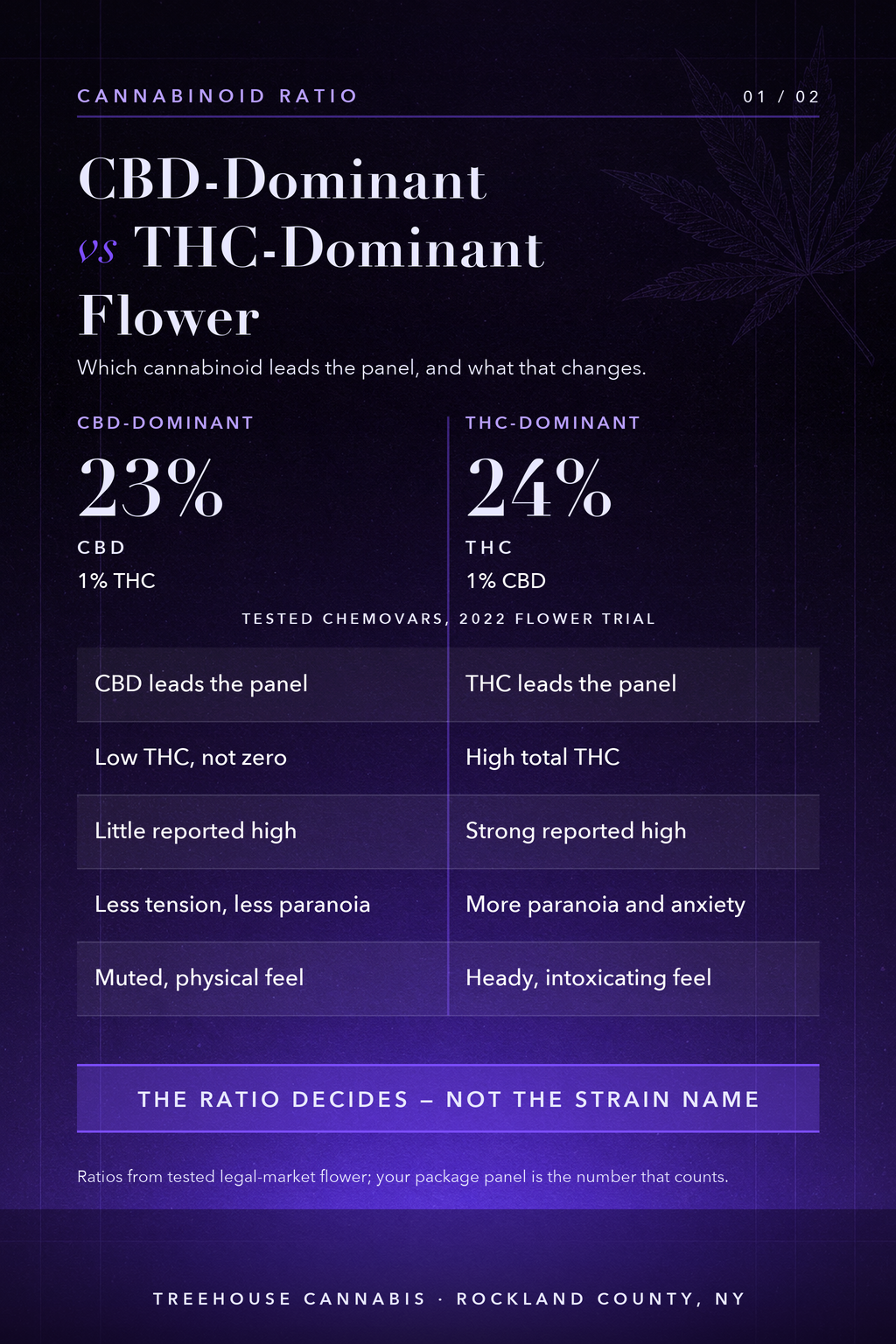
A 159-person study of regular cannabis users put real numbers on the three chemovars it tested:
- The THC-dominant flower tested at 24% THC and 1% CBD
- The balanced flower tested at 9% THC and 10% CBD
- The CBD-dominant flower tested at 1% THC and 23% CBD
Those three ratios are the clearest picture available of what the categories mean on a shelf, and they show why the middle option matters as much as the two extremes [1].
Low THC is not the same as no THC. The CBD-dominant chemovar in that study still contained 1% THC, and plasma testing confirmed participants in that group had measurable THC in their blood, just less than the high-THC group. Calling a product "THC-free" because CBD leads the panel misreads the lab report.
New York adds a second layer that makes the panel worth trusting. Cannabis products processed for retail sale must contain not less than 85% and not more than 115% of the total THC, CBD, or other phytocannabinoid and terpene content listed on the label and reflected on the certificate of analysis, and flower is named explicitly as a covered category [10]. That is a regulated tolerance around a tested value, not a marketing claim, which is why the printed ratio is the number to compare.
If you want the underlying biology before the shopping advice, CBD vs THC: The Science Behind the Two Most-Discussed Cannabinoids covers how the two cannabinoids interact with the endocannabinoid system.
| Feature | CBD-dominant flower | THC-dominant flower |
|---|---|---|
| Leads the potency panel | CBD | THC |
| THC content | Low, but rarely zero | High total THC |
| Reported high | Minimal to mild | Strong |
| Reported paranoia and anxiety | Lower ratings in studies | Higher ratings in studies |
| Typical tested example | 1% THC, 23% CBD | 24% THC, 1% CBD |
Compare the printed ratio rather than the strain name or the jar design. Two packages with the same cultivar name can land at very different cannabinoid levels, and the panel is the only part of the package that has to survive a lab check.
Does CBD Flower Get You High?
Usually far less than THC-dominant flower, but not zero. That distinction matters, because "CBD does not get you high" is the most repeated claim in this category and the controlled research does not fully support it.
- The 159-person flower study found much lower subjective high, drug liking and elation on the CBD-dominant side
- The 18-person trial still recorded discriminable drug effects and a heart-rate increase from CBD-dominant cannabis
- No cognitive or psychomotor impairment was measured in that trial, which is not a driving-safety finding
- Concentrate research found the same lower-intoxication pattern
- Low-intoxicating is the right word; non-intoxicating is not
The head-to-head comparison comes from the 159-person flower study. Participants using the CBD-dominant chemovar at 1% THC and 23% CBD reported far lower subjective high, drug liking, and elation than the group using 24% THC flower [1]. On the measures that describe intoxication, the gap was large rather than marginal.
The qualifier comes from a separate controlled trial with 18 infrequent cannabis users. Vaporized CBD-dominant cannabis delivering 100 mg CBD and 3.7 mg THC still produced discriminable subjective drug effects compared with placebo, and it raised heart rate [3]. Peak whole-blood CBD in that condition reached roughly 181 ng/mL. People noticed something.
That same trial is often cited as reassurance, and it should not be. It detected no measurable cognitive or psychomotor impairment in any dosing condition, which is a narrow laboratory finding, not a statement about driving. A short battery of computer tasks in a lab does not model a road, a tired driver, or an unexpected situation. Treat it as evidence that the impairment signal was small in 18 people, nothing more.
Concentrate research found the same pattern. Recreational users randomly assigned to THC-dominant versus CBD-dominant legal-market concentrates showed higher intoxication, drug effect, and drug-liking ratings with THC, while the CBD-dominant group reported immediate decreases in tension and anxiety with no paranoia spike [5]. That study used concentrates rather than flower, so the potency and route differ, but the direction of the result matches the flower data.
If you are still working out what CBD is as a compound, What Is CBD? A Clear Guide to Cannabidiol starts there, and How THC and CBD Work explains how THC and CBD behave once they reach the bloodstream. Both are useful context for reading the intensity claims on a package with a little skepticism.
What Does CBD-Dominant Flower Actually Feel Like?
Users describe it as muted and physical rather than heady: little euphoria, less mental rush, and more of a settled body feeling.
That description comes from self-report scales in controlled studies, not from product marketing, so it is worth being precise about what was measured and in whom.
The largest flower dataset here is a four-week study of 258 adults with anxiety symptoms plus 42 non-using controls. CBD-dominant flower at under 1% THC and 24% CBD was associated with a DASS anxiety score about 1.03 points lower than THC-dominant flower after accounting for how often people used [4]. Acute use of the CBD-dominant flower was also associated with lower tension and paranoia scores than both the THC-dominant and the balanced flower. Those are group-level scale scores, not a clinical outcome, and not a prediction about any individual package.
The concentrate study adds a time dimension. The CBD-dominant group reported immediate decreases in tension and anxiety relative to how they felt before use, and no paranoia spike. The THC-dominant group's paranoia rose right after use and returned to baseline within an hour [5]. Inhaled effects arrive fast, and so does the come-down on the measures researchers tracked.
A third trial helps explain why the CBD effect is inconsistent across people. In 26 healthy recreational users, vaporized THC plus CBD produced significantly less state anxiety than THC alone, but the size of that difference depended on baseline anxiety: when baseline anxiety was low, CBD appeared to counteract THC-induced anxiety completely, and when baseline anxiety was high it did not [2]. Same chemovar, different starting point, different result.
Here is the shape of the reported experience:
- Subdued rather than heady, with little euphoria and less mental rush
- Lower tension and paranoia ratings than THC-dominant flower in the 258-person study
- Anxiety scores about 1.03 points lower than THC-dominant use over four weeks, after adjusting for frequency
- No paranoia spike in the concentrate comparison, while THC's paranoia rose and eased within an hour
- A CBD effect that appears larger in people starting from a lower anxiety baseline
Ratios vary by product, so a study result describes the chemovar that was tested rather than every CBD-dominant package on a shelf. Intensity also drifts with tolerance and with format, which Why THC Tolerance Feels Different for Flower, Edibles, Vapes, and Concentrates breaks down across flower, edibles, vapes, and concentrates.
Does CBD Cancel Out THC?
Not reliably, and the literature points in two directions at once. Anyone who tells you CBD switches THC off is quoting a hypothesis, not a settled finding.
The broadest summary is a systematic review of 16 studies covering 466 participants, 10 of which were rated at low risk of bias. It found that CBD reduced some acute THC effects in several studies, including intense anxiety and psychosis-like effects, but the influence was inconsistent across studies and outcomes [6]. Doses, routes, and THC to CBD ratios varied enough that no clear dose-response pattern emerged. Mixed results in both directions is the honest reading of that review.
The counterweight is a five-way crossover trial in 37 healthy volunteers. At 450 mg of oral CBD taken with 9 mg of oral THC, CBD did not blunt the effect at all: reported feeling high rose 60.5%, THC blood exposure rose 2.18-fold, and the 11-OH-THC metabolite rose 6.24-fold compared with THC alone [7]. Doses of 10 mg and 30 mg did not differ significantly from THC on its own.
That result gets misread constantly, so the caveats belong right next to it. It used oral dosing, not inhaled flower, and it used a CBD dose far above what a single CBD-dominant joint delivers. It also measured a high-dose pharmacokinetic interaction, not a smoking equivalence.
Nothing in it says CBD flower makes a THC joint stronger. What it does say is that "CBD blunts THC" is not a rule that holds at every dose.
The practical version for a package:
- A 16-study review found CBD reduced some THC effects in some studies, inconsistently
- No clear dose pattern emerged across the heterogeneous doses, routes, and ratios tested
- At 450 mg oral CBD with THC, feeling high rose 60.5% and THC exposure rose 2.18-fold
- At 10 mg and 30 mg oral CBD, results did not differ significantly from THC alone
- The high-dose finding is oral, so it is not a smoking-equivalence result
What that leaves you with is a ratio that works as a rough guide to intensity, not a switch that turns THC off. A 1% THC, 23% CBD flower is a low-intensity product because it carries little THC, and that is the whole mechanism worth relying on.
Is High-CBD Low-THC Flower the Same as Hemp Flower?
No. Hemp is a legal category defined by a THC ceiling of 0.3% total THC on a dry-weight basis, not by how much CBD a plant carries.
That ceiling applies regardless of whether the material is high in CBD or nearly empty of it.
The compliance data on hemp makes the ceiling concrete. Across 14 hemp cultivars grown and sampled weekly over three seasons, total CBD peaked near 16% and total THC near 0.6% in late September to early October, giving a CBD to THC ratio around 20 to 1 in compliant material [9]. Plant-to-plant variation within the same cultivar was wide, which is part of why hemp testing happens at all.
Contrast that with the dispensary flower used in research. The CBD-dominant chemovars in the flower studies tested at roughly 23% to 24% CBD with about 1% THC [1]. That is a different plant, bred and tested for a different market, sitting well above the hemp CBD ceiling on the cannabinoid that matters to a customer comparing panels.
There is a middle case that shows how blurry the line gets in practice. The 18-person trial's CBD-dominant cannabis condition delivered 3.7 mg THC from a vaporized dose [3]. That sits above the 0.3% hemp definition and far below typical THC-dominant flower. It is a low-THC cannabis product that is not hemp and not a high-THC product either.
| Hemp flower | Dispensary CBD-dominant flower | |
|---|---|---|
| Legal definition | At or below 0.3% total THC on a dry-weight basis | Sold under state adult-use rules |
| Typical tested CBD | Near 16% at peak in a three-season field trial | 23% to 24% in the flower studies |
| Typical tested THC | Near 0.6% at peak in the same trial | About 1% |
| What the number describes | A legal THC ceiling | A cannabinoid ratio |
Where the two concepts actually part ways:
- Hemp is a legal threshold at 0.3% total THC on a dry-weight basis
- Compliant hemp cultivars peaked near 16% CBD and 0.6% THC in a three-season field trial
- Dispensary CBD-dominant flower in research tested near 23% to 24% CBD with about 1% THC
- The 3.7 mg THC delivered in one trial sits above the hemp line and well below THC-dominant flower
- High-CBD low-THC describes a ratio; hemp describes a legal limit
Both can be true of one product without the two categories being interchangeable. If you are shopping the regulated side, Flower is where the cannabis flower sits, and the panels there are the ones held to New York's labeling tolerance.
How Do You Read a New York Flower Label and Certificate of Analysis?
Start at the potency panel. Total THC and total CBD sit next to each other there, and that pairing answers the only question this article is about: which cannabinoid leads, and by how much.
Then work outward in a fixed order rather than reading the package like a poster.
- Find total THC and total CBD on the potency panel before anything else
- Note which cannabinoid leads the ratio and by roughly what margin
- Match the batch or lot number on the package to the certificate of analysis behind the QR code
- Scan the terpene panel last, since it describes aroma and not intensity
- Check the package or harvest date, because flower changes with time
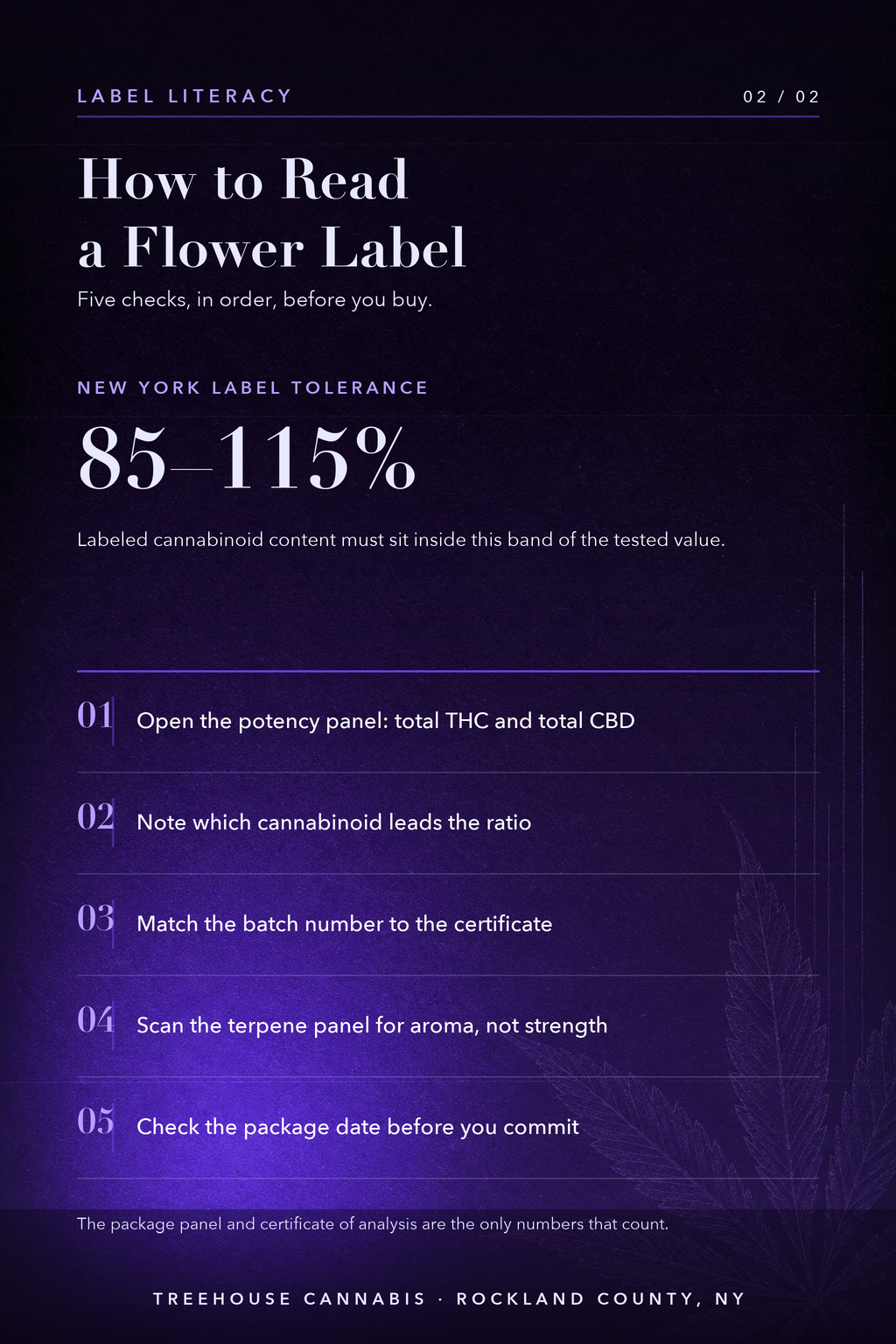
The New York rule is what makes step one worth doing. Cannabis products processed for retail sale must contain not less than 85% and not more than 115% of the total THC, CBD, or other phytocannabinoid and terpene content listed on the label and reflected on the certificate of analysis, and flower is covered by that requirement [10]. The label is a regulated claim tied to a lab result for that batch.
Check anyway, because independent testing shows labels and reality can drift apart. Of 277 products bought from 52 Colorado dispensaries, 96.0% of 99 concentrate products landed within 15% of their labeled THC, but only 56.7% of 178 flower products did, and observed potency ran lower than labeled across both categories [8]. Flower is a biological product measured in samples, so some spread is expected.
Those percentages describe Colorado purchases made between November 2022 and October 2023. They are evidence that flower labeling varies, not a claim about New York compliance rates, and they are not a reason to distrust a specific package in front of you. They are a reason to pull the certificate instead of guessing.
- Potency panel first: total THC beside total CBD
- Batch or lot number matched to the certificate of analysis
- New York requires labeled cannabinoid content within 85% to 115% of the tested value
- Only 56.7% of tested flower products landed within 15% of labeled THC, versus 96.0% of concentrates
- Observed flower potency ran lower than labeled, so the panel is the claim and the certificate is the check
Format matters here too. Value-priced formats such as Small Buds Flower carry the same labeling obligations as full-size flower, so the same five steps apply whether the buds are large or small.
Two packages can also look identical and still carry opposite ratios, which is why the panel matters more than the packaging. A jar of NY Diesel | Flower | 28g and a CBD-dominant flower sitting in the same case can land at very different total THC numbers, and only the printed panel tells them apart.
Which Should You Choose: CBD-Dominant or THC-Dominant Flower?
Match the ratio to the occasion rather than picking a permanent side. The evidence supports a fairly clean split, plus a middle option that gets overlooked.
| If the goal is | Choose | What the studies showed |
|---|---|---|
| A subdued, non-heady session | CBD-dominant flower | Much less reported high, drug liking and elation, with lower tension and paranoia ratings |
| Positive effects with less of the sharp edge | Balanced flower, around 9% THC and 10% CBD | Similar positive effects to THC-dominant flower with significantly less paranoia and anxiety |
| The full intoxicating effect | THC-dominant flower | Stronger reported high, along with more reported paranoia and anxiety |
If the goal is a subdued, non-heady session, CBD-dominant flower is the lower-intensity option in every study reviewed here. It produced much less reported high, drug liking, and elation than the 24% THC chemovar, and its tension and paranoia ratings were lower in both the flower and concentrate research [1] [5].
If the goal is the full intoxicating effect, THC-dominant flower is that product. It also carried more reported paranoia and anxiety in the same research, and that trade-off is the honest description of the choice rather than a reason to avoid either one.
The middle option deserves more attention than it gets. In the 159-person study, the balanced 9% THC and 10% CBD flower produced similar positive effects to the THC-dominant flower with significantly less paranoia and anxiety [1]. If you want the positive side of the experience without the sharpest edge, ratio-shopping is more useful than choosing a side.
A few practical checks before you commit:
- Confirm which cannabinoid leads the panel, not which one the name suggests
- Compare the ratio rather than the strain name or the package design
- Pull the certificate of analysis for the batch in front of you
- Remember that inhaled effects were assessed within minutes in these studies
- Treat the choice as situational, since a single lab session does not describe long-term patterns
There is no permanent answer to give here, and there should not be. Tolerance, format, setting, and the ratio itself all shift what a package delivers, and the research describes group averages in specific chemovars. What transfers is the habit: read the panel, check the batch, and decide from the numbers rather than the label art. How to Choose Between THC, CBD, and Balanced Products walks through the same decision from a broader angle if you want a second frame, and a familiar high-THC cultivar such as Purple Lemon Haze | Flower | 3.5G is a straightforward point of comparison on the other side of the ratio.
If you want to compare ratios in person, the flower case at Treehouse Cannabis in Rockland County is organized so you can read the potency panel before anything else, and staff can pull the certificate of analysis for the batch in front of you. Ask to see a CBD-dominant flower and a THC-dominant flower side by side and compare total THC and total CBD on the packages. Customers in Orange and Westchester County are welcome to make the trip or call ahead with a question about a specific batch.
Frequently Asked Questions
What is the difference between CBD-dominant and THC-dominant flower?
The difference is the cannabinoid ratio printed on the package. THC-dominant flower carries high total THC and almost no CBD; CBD-dominant flower reverses that, making CBD the main cannabinoid and keeping THC low. Both are cannabis flower from the same plant species, so the potency panel and the certificate of analysis are what actually separate them, not the strain name.
Does CBD flower get you high?
Usually far less than THC-dominant flower, but not zero. In the 159-person study, people using CBD-dominant flower at 1% THC and 23% CBD reported much lower subjective high, drug liking and elation than people using 24% THC flower. Vaporized CBD-dominant cannabis still produced noticeable subjective drug effects and a heart-rate increase in a controlled trial with 18 infrequent users.
What does CBD-dominant flower feel like?
Users in controlled studies describe it as muted and physical rather than heady: little euphoria, less mental rush, and more of a settled body feeling. CBD-dominant use was associated with lower tension and paranoia ratings than THC-dominant flower, and over four weeks it tracked with self-reported anxiety scores about 1.03 points lower after adjusting for frequency of use.
Is high-CBD low-THC flower the same as hemp flower?
No. Hemp is a legal category defined by a THC ceiling of 0.3% total THC on a dry-weight basis, not by how much CBD a plant carries. Compliant hemp cultivars in a three-season field trial peaked near 16% CBD with THC around 0.6%, while the CBD-dominant flower used in dispensary research tested near 23% to 24% CBD. Different plants, bred and tested for different markets.
Does CBD cancel out THC?
Not reliably. A systematic review of 16 studies and 466 participants found CBD reduced some acute THC effects in some studies, but inconsistently, with no clear dose pattern. At high doses the opposite has been measured: 450 mg of oral CBD with THC raised THC blood exposure 2.18-fold and increased reported feeling high by 60.5%. Treat the claim that CBD blunts THC as a maybe, not a rule.
Why do two flowers labeled CBD-dominant feel so different?
Ratio, dose and testing. Two products can both call themselves CBD-dominant while one sits near 1% THC and another runs higher, and inhaled dose depends on how much a person actually uses. Label accuracy also varies: independent testing found only 56.7% of flower products landed within 15% of labeled THC, so the certificate of analysis for the batch is the number to check.
How do I read a New York flower label to compare CBD and THC?
Start with the potency panel, where total THC and total CBD sit side by side, rather than the strain name or the package design. New York requires labeled cannabinoid content to fall between 85% and 115% of the concentration reflected on the certificate of analysis, so the printed numbers are a regulated claim tied to a lab result for that batch.
Should a first-time customer pick CBD-dominant or THC-dominant flower?
It depends on the occasion rather than on a permanent preference. CBD-dominant flower is the lower-intensity option in controlled studies, with much less reported high, drug liking and paranoia. THC-dominant flower is the stronger, more intoxicating choice and carried more reported paranoia and anxiety in the same research. Inhaled effects arrived within minutes in the flower studies either way.
Sources
- Addiction Biology (Society for the Study of Addiction); NIH PubMed Central — In 159 regular cannabis users randomly assigned to three legal-market flower che
- Psychopharmacology (Springer); NIH PubMed Central — In 26 healthy recreational users, vaporized THC-dominant cannabis (13.75 mg THC)
- Drug and Alcohol Dependence (Elsevier); NIH PubMed Central author manuscript — In 18 infrequent cannabis users, vaporized CBD-dominant cannabis containing 100
- Cannabis and Cannabinoid Research; NIH PubMed Central — Across 258 cannabis-using adults with anxiety symptoms plus 42 non-using control
- Scientific Reports (Nature Portfolio); NIH PubMed Central — Recreational users randomly assigned to THC-dominant versus CBD-dominant legal-m
- Neuroscience and Biobehavioral Reviews (Elsevier); open-access author manuscript via UCL Discovery — Across 16 studies and 466 participants, CBD reduced some acute effects of THC in
- Clinical Pharmacology and Therapeutics (ASCPT/Wiley); NIH PubMed — In 37 healthy volunteers given oral THC 9 mg with 0, 10, 30 or 450 mg CBD, the 4
- Scientific Reports (Nature Portfolio); NIH PubMed Central — Of 277 products bought from 52 Colorado dispensaries, 96.0% of concentrate produ
- Plants (MDPI); The Connecticut Agricultural Experiment Station; NIH PubMed Central — Across 14 hemp cultivars grown and sampled weekly over 2020-2022, CBD and THC bo
- New York State Office of Cannabis Management regulations, Title 9 NYCRR Part 123; hosted by Cornell Legal Information Institute — New York requires cannabis products processed for retail sale to contain not les
About Treehouse Cannabis
Treehouse Cannabis publishes adult-use education for customers in Rockland County, New York, and for Orange and Westchester County shoppers who make the trip. Nothing here is medical advice, and a potency panel is not a recommendation about what to use.
Cannabis is for adults 21 and older. Keep all cannabis products out of reach of children and pets. Do not drive or operate machinery after use. This article is for educational purposes only and is not medical advice. Cannabis affects people differently, and cannabinoid ratio, product form, and how much you use all matter more than a single number on a package.
Shop our products

Shop All

Deals
Flower
Pre-rolls
Vaporizers
Edibles
Drinks

Concentrates
Tinctures

Topicals
CBD

Pet CBD

Accessories