
They're technically the same plant — so why does the law treat them differently?
Hemp vs Marijuana: The Real Difference
Hemp vs Marijuana: The Real Difference
Hemp and marijuana are both varieties of Cannabis sativa — the same plant species, just cultivated differently Healthline. The legal and chemical distinctions between them have shaped everything from federal policy to what you can find at your local Rockland County dispensary. This guide breaks down the science, the law, and what it means for every cannabis consumer.
Are Hemp and Marijuana the Same Plant Species?
Hemp and marijuana share the same botanical roots as Cannabis sativa, but centuries of selective cultivation have pulled them in very different directions Encyclopedia Britannica.
Key differences that set these cultivars apart:
- Growth structure: Hemp cultivars were bred for industrial fiber, seeds, and later CBD extraction — plants grown tall with minimal branching. Marijuana cultivars were bred for potency, grown bushier to maximize flower production
- Trichome production: Drug-type cannabis (marijuana) has been selectively propagated for genetically dominant THC-producing glandular trichomes. Hemp cultivars produce far fewer of these trichomes and those they do produce are dominated by CBD-producing structures Elsevier (Forensic Chemistry)
- Chemical composition: Both contain the same 540+ chemical substances found in the cannabis plant, including cannabinoids, terpenes, and flavonoids National Center for Complementary and Integrative Health (NIH)
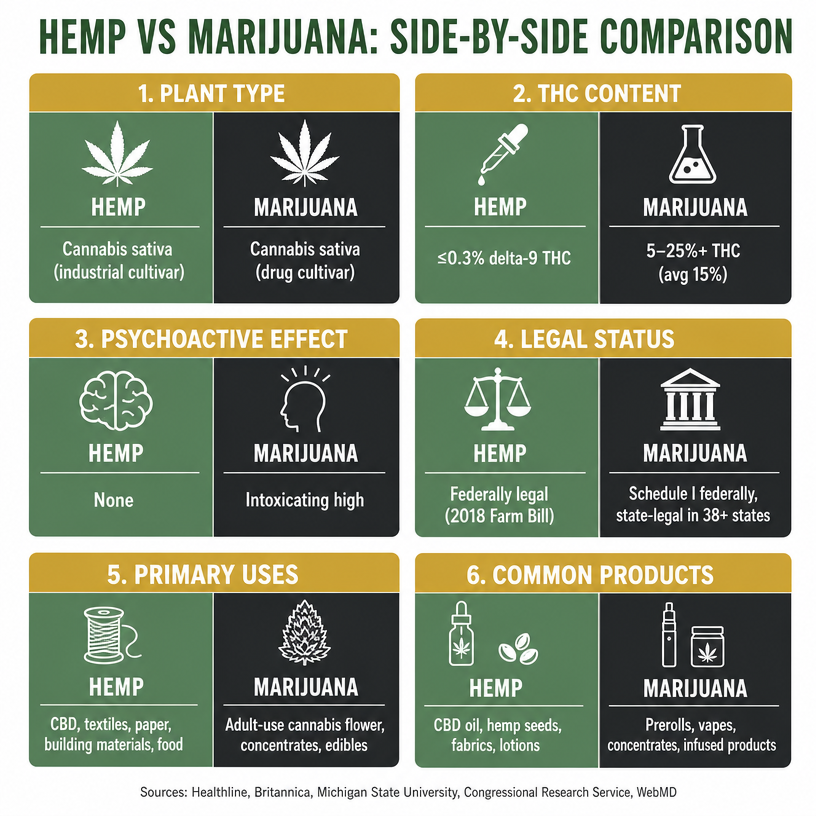
- Potency range: Modern marijuana strains commonly test between 15% and 25% THC, with some concentrates reaching 80–90%. Hemp maxes out at 0.3% THC by law
The key difference lies in trichomes — the tiny crystal-like structures on cannabis flowers that produce cannabinoids. Hemp and marijuana are different cultivars of the same species, each cultivated for distinct purposes Elsevier (Forensic Chemistry).
What THC Level Defines Hemp vs Marijuana?
The 0.3% THC threshold is the legal and scientific dividing line between hemp and marijuana Congressional Research Service. This is not an arbitrary number — it is a strict, measurable standard that determines classification under federal law.
The following comparison summarizes the potency difference:
| Metric | Hemp | Marijuana |
|---|---|---|
| Delta-9 THC by dry weight | ≤0.3% | 5–25%+ (avg 15%) |
| THCA content | Very low | Significant |
| Psychoactive effect | None | Intoxicating |
| Federal legal status | Legal (2018 Farm Bill) | Schedule I controlled substance |
Marijuana refers to any cannabis with substantially higher psychoactive THC content. Today's average marijuana strains test at approximately 15% THC — a dramatic rise from roughly 4% in the mid-1990s WebMD. This increase in potency is the result of decades of targeted breeding programs designed to produce more potent flower.
The 0.3% threshold also captures total THC potential through THCA, a non-psychoactive precursor that converts to THC when heated. A November 2025 amendment to the hemp definition further broadened the classification to include total THC including THCA and synthetic cannabinoids Congressional Research Service.
Can You Get High from Hemp?
No. Hemp's THC content of 0.3% or less is pharmacologically insufficient to produce any psychoactive high. This is not a matter of dosage — it is a structural chemical limitation Michigan State University.
When you consume hemp-derived CBD products, you experience the cannabinoid's calming and balancing effects without any intoxication. This is precisely why hemp-derived CBD products have become a fixture in wellness routines across the country.
Key points about hemp's non-intoxicating profile:
- Hemp delivers the plant's beneficial compounds — including terpenes and other non-psychoactive cannabinoids — without the high
- For consumers in Rockland County exploring cannabis for relaxation or general wellness, hemp-derived CBD offers a distinct starting point from marijuana products National Center for Complementary and Integrative Health (NIH)
- Hemp's chemical structure lacks sufficient THC to activate the brain's CB1 receptors, which is what produces the cannabis high
What Are the Legal Differences Between Hemp and Marijuana in the US?
The legal split between hemp and marijuana is one of the most consequential distinctions in American drug policy Congressional Research Service. Understanding this difference is a foundational step for any consumer navigating the cannabis landscape.
The federal framework:
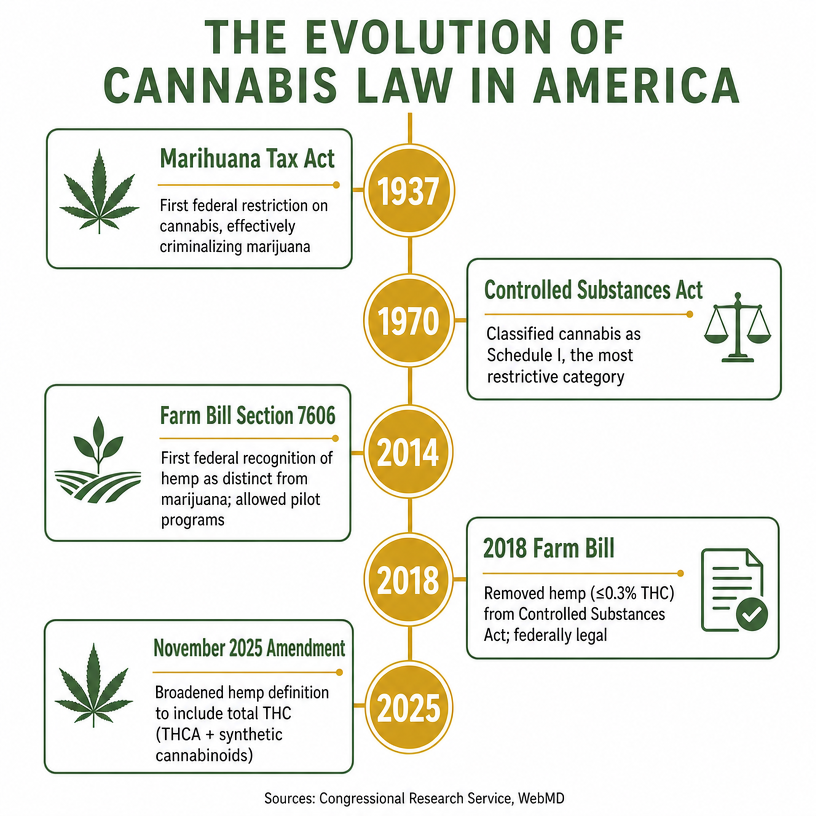
- Hemp was federally legalized by the 2018 Farm Bill, which removed it from the Controlled Substances Act entirely. This opened the door for hemp-derived CBD, textiles, paper, building materials, and a growing list of consumer products
- Marijuana remains a Schedule I controlled substance at the federal level — the same category as heroin and LSD — despite having wide state-level support. As of 2023, 38 states and territories have enacted medical marijuana programs, and adult-use legalization has spread to more than 20 states
- At the local level, Rockland County dispensaries operate under New York State's recreational cannabis framework, offering licensed adult-use marijuana products to customers 21 and older
This creates a patchwork where marijuana policy can shift dramatically depending on which side of a state line you stand.
What Products Come from Hemp vs Marijuana?
Hemp is one of the most versatile industrial crops on the planet. Beyond CBD extracts, hemp seeds are used in food products and body care items, while hemp fiber goes into textiles, paper, and even building materials like hempcrete Healthline.
Hemp's many uses include:
- CBD oils and tinctures for wellness support
- Hemp seeds and hemp seed oil for nutrition
- Textiles, paper, and bio-based building materials
- Body care products and topicals
Marijuana is cultivated specifically for its psychoactive and therapeutic potential. The adult-use cannabis market — including the products available at Rockland County dispensaries — centers on dried flower, prerolls, concentrates, vapes, and infused edibles.
Key product differences:
- Hemp produces high-CBD, low-THC chemistry. Marijuana strains can be bred anywhere from balanced CBD:THC ratios to THC-dominant cultivars with minimal CBD National Center for Complementary and Integrative Health (NIH)
- Both plants produce CBD, but their ratios differ dramatically. Modern marijuana breeding has produced an extraordinary range of strain profiles, with different combinations of THC, CBD, and terpenes tailored to produce distinct effects
Is CBD Flower the Same as Marijuana?
No — CBD flower and marijuana are chemically distinct despite sharing the same botanical origin Michigan State University. CBD flower is harvested from hemp cultivars engineered for high CBD and trace THC content, meaning it produces no high when consumed.
The comparison between CBD flower and marijuana:
- CBD flower can be smoked or vaporized like marijuana, and some consumers prefer it for its aromatic terpenes and calming properties without intoxication
- The legal distinction is equally clear: CBD flower falls under hemp's federal legal framework, while marijuana — with its higher THC content — remains subject to state-level regulation Elsevier (Forensic Chemistry)
- Both methods of consumption deliver cannabinoids into the bloodstream rapidly through inhalation, but the subjective experience is fundamentally different
FAQ
Are hemp and marijuana the same plant species?
Yes — both hemp and marijuana are varieties of Cannabis sativa. The difference is legal and chemical, not biological. Hemp is defined by its low THC content (≤0.3%), while marijuana refers to cannabis bred for higher psychoactive THC Healthline.
What THC level defines hemp vs marijuana?
Under the 2018 Farm Bill, hemp is cannabis with ≤0.3% delta-9 THC by dry weight. Marijuana is any cannabis with substantially higher THC — modern strains commonly test at 15–25% THC or more Congressional Research Service.
Can you get high from hemp?
No. Hemp's THC content of 0.3% or less is far too low to produce any psychoactive high. This is the fundamental distinction that makes hemp-derived CBD products suitable for daily wellness use without intoxication Michigan State University.
What are the legal differences between hemp and marijuana in the US?
Hemp was federally legalized by the 2018 Farm Bill and removed from the controlled substances list. Marijuana remains a Schedule I substance federally, though state-level legalization is widespread — 38 states and territories have medical marijuana programs as of 2023 Congressional Research Service.
What products come from hemp vs marijuana?
Hemp yields CBD oils, textiles, paper, building materials, food seeds, and body care products. Marijuana produces recreational cannabis products: dried flower, prerolls, concentrates, vapes, and edibles — the selection you'll find at any Rockland County dispensary Healthline.
Sources
- Healthline — Hemp and cannabis plants are the same species; the legal distinction comes down
- Encyclopedia Britannica — Hemp and marijuana are varieties of the same species, Cannabis sativa — hemp cul
- Elsevier (Forensic Chemistry) — Marijuana and hemp are different cultivars of Cannabis sativa; trichomes in gene
- National Center for Complementary and Integrative Health (NIH) — Cannabis contains ~540 chemical substances including THC (psychoactive) and CBD
- Michigan State University — Both hemp and marijuana belong to the species Cannabis sativa; hemp contains ≤0.
- Congressional Research Service — The 2018 Farm Bill defined hemp as cannabis with delta-9 THC ≤0.3% by dry weight
- WebMD — CBD and THC share the same molecular formula (C₂₁H₃₀O₂) but have different atom
About Treehouse Cannabis
Treehouse Cannabis is a licensed adult-use dispensary in Rockland County, New York. We offer a curated selection of premium cannabis products including flower, prerolls, concentrates, and edibles — all tested and compliant with New York State regulations. Must be 21+ to purchase.
This content is for educational purposes only and does not constitute medical advice.
Shop our products

Shop All
Flower
Pre-rolls
Vaporizers

Edibles
Drinks
Concentrates
Tinctures

Topicals
CBD

Pet CBD
Accessories