
From OG Kush to Girl Scout Cookies, these are the strains that built the modern cannabis landscape.
OG Classic Cannabis Strains: The Genetics That Started It All
OG Classic Cannabis Strains: The Genetics That Started It All
These OG classic cannabis strains — OG Kush, Girl Scout Cookies, Blue Dream, and Sour Diesel — built the genetic templates, terpene profiles, and breeding philosophies that still define what consumers look for at dispensaries today, including here in Rockland County.
What Made OG Kush the Most Influential Cannabis Strain of the Modern Era?
OG Kush stands as the single most important cannabis genetics of the modern era, creating the hybrid vigor and fuel-terpene template that virtually every elite strain since has borrowed from. OG Kush originated in the early 1990s when Matt 'Bubba' Berger grew it in Florida and only 1 of 5 cuttings survived the journey to Los Angeles, where Josh D preserved and popularized it — eventually fetching $8,000 per pound wholesale in 2001, more valuable than gold at the time. Leafly
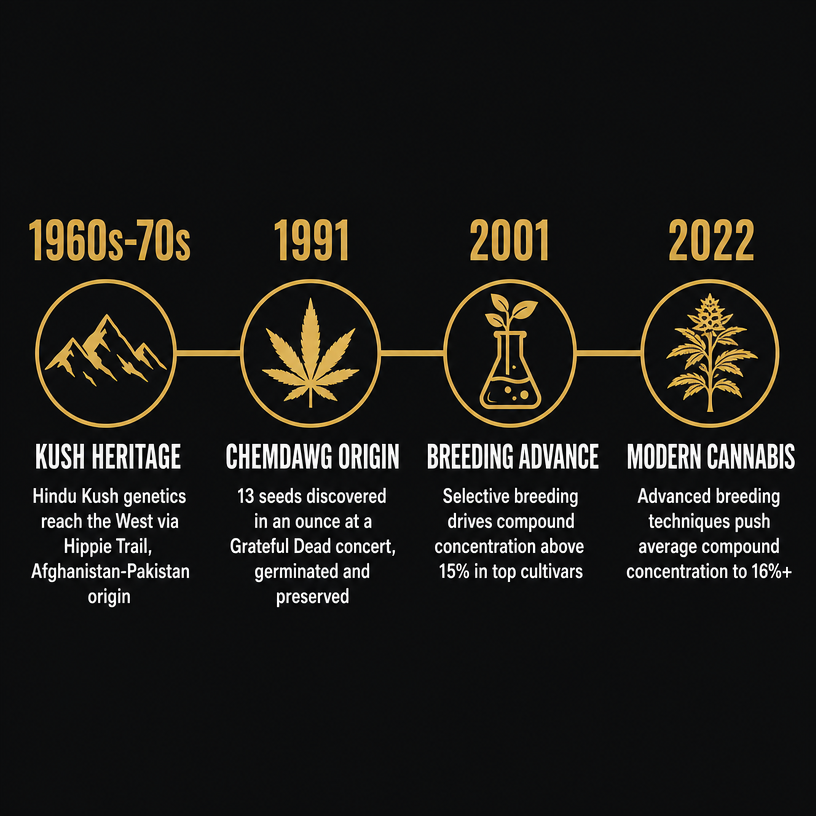
The strain was created from a cross between Hindu Kush and Chemdawg, with Chemdawg's origins tracing to a Grateful Dead concert in 1991 where a grower discovered 13 seeds in an ounce of weed. Cali Terpenes The Chemdawg parent brought that sharp, fuel-like aroma, while Hindu Kush contributed the dense, resin-coated buds and deeply relaxing effects that made OG Kush immediately distinctive.
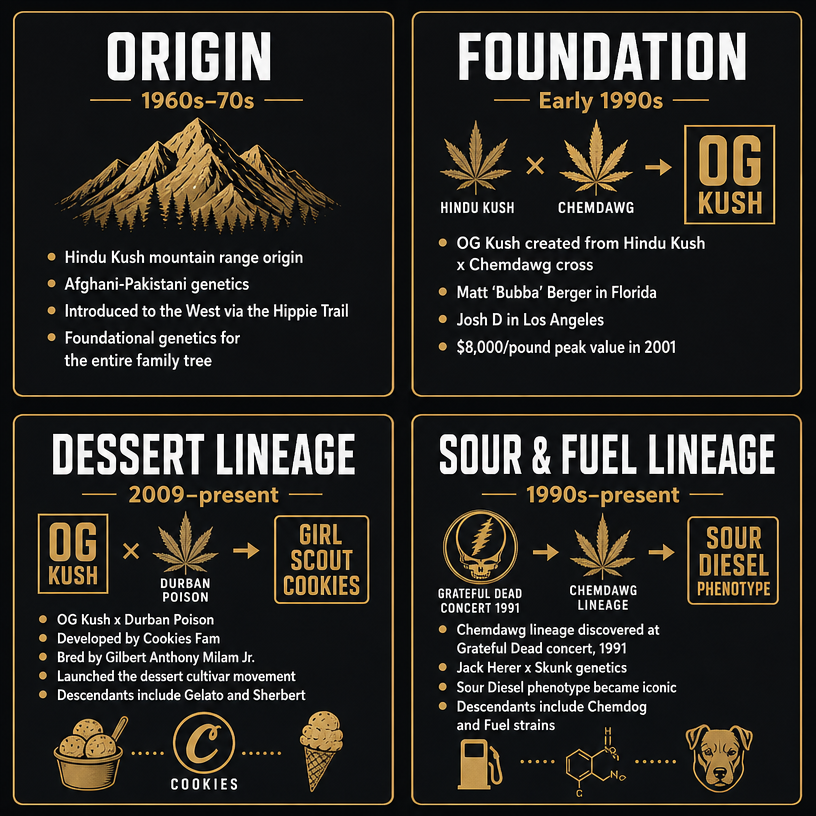
Once established in Los Angeles, OG Kush became the foundational genetic backbone for modern hybrids. Hashtag Cannabis Every major Cookies strain, most Gelato variations, Wedding Cake, Sherbet, and Runtz all trace their lineage back to OG Kush. Its influence is so pervasive that virtually any strain with "Kush" in its name carries some direct or indirect piece of that original Los Angeles genetic pool.
Key characteristics of OG Kush:
- Aroma: Fuel, citrus, pine — the "OG" aromatic signature
- Effects: Balanced hybrid with relaxation and mental clarity
- Genetics: Hindu Kush x Chemdawg
- Era: Early 1990s, Los Angeles
What Is the Genetic Lineage Behind Girl Scout Cookies and Why Did It Launch a Strain Revolution?
Girl Scout Cookies (OG Kush x Durban Poison) launched the dessert strain movement when it appeared on the West Coast around 2009, proving that flavor and branding could be as powerful as potency in cannabis breeding. Hashtag Cannabis Created by Gilbert Anthony Milam Jr and the Cookies Fam group, GSC became the parent to legendary descendants including Thin Mints, Sunset Sherbet, and Gelato — cementing its place as one of the most influential cannabis genetics ever bred. Royal Queen Seeds
The strain's breakthrough was combining the structural rigor and resin production of OG Kush with Durban Poison's sweet, herbal, almost vanilla-like terpene profile. The result was a plant that not only delivered strong effects but tasted like nothing that had come before — dessert, cookie, dough, with visible purple hues and an unmistakably sweet smoke.
GSC's success proved a critical lesson for the emerging legal market: consumers cared as much about flavor and experience as THC numbers. Breeders took notice, and the entire industry pivoted toward dessert genetics and strain branding in the years that followed.
Girl Scout Cookies family highlights:
- Thin Mints: GSC x Durban Poison — minty, chocolate, couch-lock
- Sunset Sherbet: GSC x Pink Panties — fruity, skunky, relaxing
- Gelato: GSC x Sunny Lemon — dessert, citrus, high THC
- Recognition: Multiple Cannabis Cup wins, global household name
How Did Blue Dream Become the Most Popular Strain in America?
Blue Dream — a cross of Blueberry (indica) and Haze (sativa) — rose to dominance by delivering the best of both worlds: relaxed body effects from its indica heritage and gentle cerebral stimulation from its sativa side. Originating in Santa Cruz, California, it became America's most popular strain by being approachable enough for beginners yet complex enough for experienced consumers seeking balanced effects.
The Blueberry parent gave Blue Dream its signature blueberry aroma and deep grape-purple coloring, while the Haze genetics contributed the uplifting, creative mental energy that kept consumers functional during the day. At Rockland County dispensaries and across the country, Blue Dream became the go-to recommendation for customers moving from high-THC products toward something more manageable and versatile.
Blue Dream profile:
- Cross: Blueberry x Haze
- Aroma: Blueberry, floral, light sweetness
- Effects: Balanced — relaxed body, clear mind
- Best for: Daytime use, creativity, social situations
Why Did Sour Diesel Define a Generation of East Coast Cannabis Consumers?
Sour Diesel — believed to be a Chemdog sister plant originating from a Grateful Dead concert in 1991 where a grower discovered 13 seeds in an ounce of weed — became the defining strain of East Coast cannabis culture. Cali Terpenes Its sharp, fuel-like aroma and energizing, creative high influenced a generation of consumers who prized its daytime functionality and distinctive diesel profile over the sedating indica effects common at the time.
Unlike the heavy, sedating indicas that dominated the early 1990s market, Sour Diesel offered something rare: genuine energy and mental clarity without the crash. For working people, creatives, and anyone who needed to remain functional while consuming cannabis, Sour Diesel was a revelation. Its popularity on the East Coast (where it became known simply as "Sour D") cemented the East Coast sativa preference that still shapes regional market preferences today.
Sour Diesel characteristics:
- Aroma: Diesel, citrus, sharp chemical
- Effects: Energizing, cerebral, creative — no couch lock
- Origins: Chemdog sister plant, early 1990s East Coast
- Cultural impact: Defined East Coast sativa preference for decades
How Has Cannabis THC Potency Evolved From 4% to 16% Average?
Cannabis THC potency has risen dramatically from approximately 4% in 1995 to 16.14% in 2022 according to DEA-seized sample analysis collected by NIDA — a more than 4x increase over 27 years. National Institute on Drug Abuse (NIDA) This evolution was driven by selective breeding techniques refined through the classic strain era, indoor cultivation advances, and consumer demand for stronger effects, transforming everything from growing methods to consumption habits across Rockland County and beyond.
The classic strains covered here — OG Kush, Girl Scout Cookies, Blue Dream, Sour Diesel — all emerged during the period when THC concentrations were beginning their long climb upward. As breeders selected for higher THC plants generation after generation, the genetics that produced 10-12% THC in the 1990s became the foundation for strains regularly exceeding 20-25% THC today.
This potency evolution changed consumer behavior. Lower-potency cannabis from the 1980s and early 1990s was consumed primarily via joints and blunts — methods that diluted THC through combustion. Modern high-THC cannabis encouraged the development of precision consumption methods: vaporizers, concentrates, carefully dosed edibles, and micro-dosing strategies that allow consumers to reach their desired effect without overconsuming.
THC potency milestones:
- 1995: ~4% average (flower)
- 2000s: 8-12% common for premium strains
- 2010s: 15-20% typical for high-THC products
- 2022: 16.14% average across all DEA-seized samples
Why Do OG Genetics Still Matter to Today's Cannabis Consumers?
OG genetics remain the foundation of modern cannabis breeding because they established the terpene profiles, effect balancing, and hybrid vigor that consumers expect today. From OG Kush descendants like Gelato and Wedding Cake to Cookies family hybrids dominating dispensary shelves, the genetics Matt Berger and Josh D preserved in a Los Angeles basement in the 1990s still power the majority of today's most sought-after strains at Treehouse Cannabis.
What made these strains so influential was not just their individual quality but their versatility as breeding parents. OG Kush's Chemdawg-dominant fuel aroma became a flavor template. Girl Scout Cookies' dessert genetics showed that branding and experience could be as valuable as raw THC. Blue Dream proved the market wanted balance, not just extremes. Sour Diesel demonstrated that energizing sativas had lasting appeal beyond novelty.
Modern breeding builds on this foundation. Today's most popular strains — whether Wedding Cake, Gelato, Runtz, or GMO — all descend from the genetic lineages these classic strains established. A customer shopping at a Rockland County dispensary in 2024 is, in a very real sense, shopping from the family tree that OG Kush, Girl Scout Cookies, and Sour Diesel planted three decades ago.
The OG family tree, simplified:
- Kush line: OG Kush → Girl Scout Cookies → Thin Mints, Sherbet, Gelato
- Diesel line: Sour Diesel → NYC Diesel, Sour Cherry, Chemdawg 91
- Haze line: Blue Dream → Blueberry, Haze → countless modern hybrids
Frequently Asked Questions
What makes a cannabis strain a "classic"?
A classic cannabis strain is one that fundamentally shaped the industry — either by pioneering a genetic lineage still used today, establishing a terpene profile that became a template for breeding, or achieving cultural dominance that transcended regional markets. OG Kush, Sour Diesel, and Girl Scout Cookies all qualify by these measures.
What is the origin of OG Kush?
OG Kush originated in the early 1990s when Matt 'Bubba' Berger grew it in Florida and only 1 of 5 cuttings survived the journey to Los Angeles, where Josh D preserved and popularized it. It was created from a cross between Hindu Kush and Chemdawg, with Chemdawg's origins tracing to a Grateful Dead concert in 1991 where a grower discovered 13 seeds in an ounce of weed.
What strains descended from OG Kush genetics?
OG Kush became the genetic backbone for most modern hybrids including Girl Scout Cookies, Gelato, Sherbet, Runtz, and Wedding Cake. Its Kush heritage spread through virtually every elite strain bred on the West Coast, making it the most influential cannabis genetics of the modern era.
How has cannabis THC potency changed over time?
Average cannabis THC potency rose from approximately 4% in 1995 to 16.14% in 2022 according to DEA seizure data analyzed by NIDA — a more than 4x increase. This was driven by selective breeding, indoor cultivation advances, and consumer demand for stronger effects, fundamentally transforming growing methods and consumption habits.
Which classic strains defined modern cannabis breeding?
OG Kush defined the hybrid vigor and fuel-terpene template; Girl Scout Cookies launched the dessert strain revolution; Blue Dream proved balanced hybrids could achieve mass appeal; and Sour Diesel established the energizing sativa profile that still dominates East Coast markets. Together, these strains established the genetic foundations still used today.
Sources
- Leafly — OG Kush originated in the early 1990s when Matt 'Bubba' Berger grew it in Florid
- Cali Terpenes — OG Kush was created from a cross between Hindu Kush and Chemdawg, with Chemdawgo
- Hashtag Cannabis — OG Kush became the foundational genetic backbone for modern hybrids, and Girl Sc
- Royal Queen Seeds — The Kush family traces to the Hindu Kush mountain range (Afghanistan/Pakistan bo
- National Institute on Drug Abuse (NIDA) — Cannabis THC potency has risen dramatically from approximately 4% in 1995 to 16.
Treehouse Cannabis is a licensed adult-use dispensary in Rockland County, New York. Must be 21+ to purchase. This content is for informational purposes only and is not medical advice.
About Treehouse Cannabis
Treehouse Cannabis is Rockland County's destination for premium adult-use cannabis products. Located in Nyack, Treehouse offers a curated selection of flower, concentrates, edibles, and accessories to suit every experience level. Whether you're a longtime enthusiast or exploring cannabis for the first time, our knowledgeable team is here to help you find the right product. Visit us at treehousecannabis.com.
Must be 21+ to enter. Valid ID required.


Shop our products

Shop All

Flower

Pre-rolls
Vaporizers

Edibles
Drinks

Concentrates

Tinctures

Topicals

CBD

Pet CBD

Accessories