
What Is THCV? The Minor Cannabinoid With Big Effects
What Is THCV? The Minor Cannabinoid With Big Effects
THCV (tetrahydrocannabivarin) is a minor cannabinoid produced in small but meaningful amounts by certain cannabis cultivars, and at typical product doses it does not produce the intoxicating high THC is known for. Current peer-reviewed research points to clearer, more energizing effects and a handful of metabolic and behavioral signals that genuinely set THCV apart from its more famous cousin.
Chemically, THCV is a propyl analogue of THC — the two molecules share the same core ring structure, but THCV carries a three-carbon side chain where THC carries a five-carbon one [7]. That small structural difference is enough to flip THCV's behavior at the body's cannabinoid receptors, which is why researchers and adult-use customers have started paying close attention.
What Is THCV and How Does It Work in the Body?
THCV is one of more than 100 cannabinoids produced by Cannabis sativa, but it appears at meaningful levels in only a handful of cultivars — most notably certain African landrace sativas. At typical doses, THCV acts as a CB1 receptor antagonist and a CB2 receptor partial agonist, which is the opposite of THC's profile [1]. THC turns CB1 "on" and produces the classic cannabis high; THCV blocks that signal.
The CB1 antagonism is the foundation for the four effect areas covered below, and it is what keeps THCV pharmacologically active without being intoxicating at normal product doses [2]. The quick-reference snapshot for an adult-use customer:
- Naturally occurring in Cannabis sativa, with meaningful levels only in certain chemotypes
- Propyl analogue of THC — same core ring, three-carbon side chain instead of five
- CB1 antagonist and CB2 partial agonist at typical doses, the inverse of THC
- Non-intoxicating at normal product doses (flower, vapes, most edibles)
- Most concentrated in African landrace sativas such as Durban Poison and Doug's Varin
The mechanism matters because most customers do not interact with cannabis at the receptor level. The practical question is whether a product will feel different from a standard THC-rich option. For an everyday example of how dose and timing change a cannabis experience, see You’re Not Lazy—Your Edible Just Peaked at the Wrong Time.
The way THCV-rich products show up on dispensary shelves in New York today is mostly through specialty flower and vape SKUs, plus a small but growing list of infused edibles. One example on the Treehouse menu is a 1:0.5 THC:THCV sativa gummy formulated specifically for energizing, daytime use: Green Crack | Sativa - Lights On | THCV Energy Gummies | THC: 100mg THCV: 50mg. For customers who would rather inhale, the vaporizer category is where most THCV-forward extracts currently live: Honeycrisp • T-pro Disposable Vape • 2G.
How Is THCV Different From THC?
The cleanest way to think about THCV vs THC is as a modulator rather than a copy. The two molecules look similar enough to fit some of the same receptors, but they push those receptors in opposite directions at typical doses. THC binds and activates CB1, producing the well-known psychoactive high; THCV binds CB1 and blocks THC from doing the same
In practical terms, the two break apart along three axes customers notice fastest:
- Receptor action — THCV blocks the CB1 receptor; THC activates it.
- Psychoactivity — THCV is largely non-intoxicating at typical product doses; THC is intoxicating.
- Appetite — THCV suppresses appetite and boosts satiety; THC stimulates the munchies. [1].
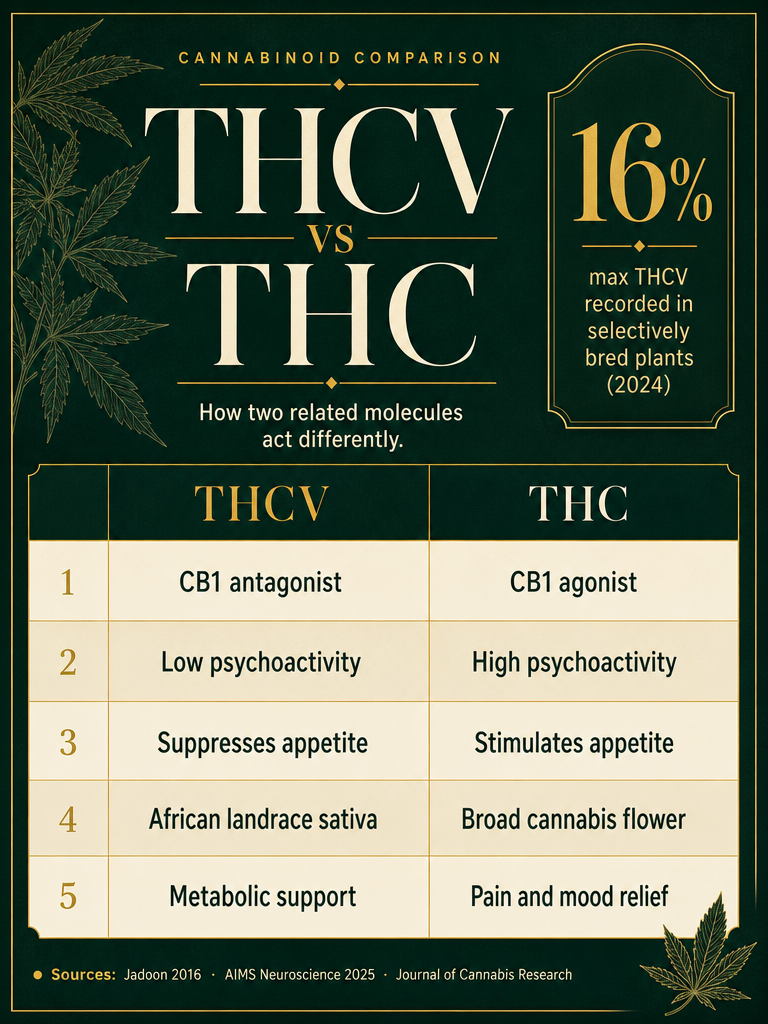
That mechanism produces three downstream differences customers actually notice, and they line up neatly in a side-by-side comparison:
| Attribute | THCV | THC |
|---|---|---|
| Receptor at typical doses | CB1 antagonist | CB1 agonist |
| Psychoactivity at typical doses | Non-intoxicating | Intoxicating |
| Appetite effect | Suppresses; increases satiety | Stimulates the munchies |
| Energy and clarity | Clear-headed, energizing | Sedating for many users |
| Best-evidenced potential benefit | Metabolic and glycemic support | Pain and mood relief |
The appetite and psychoactive differences in the table are consistent across animal models and small human studies [7] [8]. Customer-facing writeups of THCV-rich strains frequently describe a more clear-headed, energizing experience than comparable THC products, which fits the CB1-antagonist profile [7].
For a deeper comparison of how different cannabis product formats handle dose and onset — and where THCV fits into that picture — see THC Beverages: A Buyer’s Guide to Dosing, Onset, and Effects.
Where customers feel the THCV vs THC difference most directly is in flower. Most broad-spectrum cannabis flower delivers negligible THCV, so the cultivars that do carry meaningful THCV — Durban Poison and its descendants — feel different on the shelf and in the jar: Blackberry Kush | Flower | 28g.
What Effects and Potential Benefits Does THCV Have?
The peer-reviewed evidence on THCV is still early-stage, but four effect areas keep showing up across animal studies, small human pilot trials, and receptor pharmacology work. None of these is an FDA-approved medical claim, and adult-use customers should treat them as research signals rather than guarantees.
- Appetite suppression and satiety. Rodent studies and pooled human data report reduced food intake and increased satiety signals with THCV [2].
- Glycemic control and pancreatic β-cell function. A 2016 randomized pilot in type 2 diabetes patients found that 5 mg of purified THCV twice daily for 13 weeks significantly decreased fasting plasma glucose and improved pancreatic β-cell function, adiponectin, and apolipoprotein A [4].
- Attenuation of THC's effects. A 2016 placebo-controlled crossover study showed that 10 mg oral THCV per day for five days significantly reduced THC-induced heart-rate increase and cognitive impairment in healthy volunteers [3].
- Antipsychotic and anticonvulsant signals. Preclinical work has shown THCV activates the serotonin 5-HT1A receptor, producing antipsychotic-like effects in rodent models through a pathway distinct from its CB1/CB2 activity [6].
The appetite and metabolic effects are the ones getting the most consumer attention right now, in part because they line up with the "diet weed" nickname Healthline and other consumer-health outlets have popularized [8]. Customers interested in the broader wellness framing of cannabis and cannabinoids can find more context in Treehouse's longer read at An Exploration of Potential Health Benefits.
Animal-model work provides the mechanistic backbone for the human trials. A 2013 study in Nutrition & Diabetes showed THCV improved insulin sensitivity and restored glucose tolerance in two mouse models of obesity, while also reducing liver fat and body-weight gain — the kind of preclinical signal that motivates human pilot trials in metabolic disease [5].
Does THCV Actually Work for Appetite and Weight Management?
Yes, modestly — animal studies and small human trials point to a real but limited appetite-suppression signal that does not yet justify calling THCV a weight-loss treatment. Three threads of evidence separate signal from hype.
- Animal models consistently show reduced food intake and improved insulin sensitivity. THCV reduces food intake, increases satiety, and improves insulin sensitivity in obese mouse models [5].
- The Jadoon 2016 type 2 diabetes trial is the cleanest published human study. It found fasting glucose, β-cell function, and adiponectin improvements at 5 mg of purified THCV twice daily over 13 weeks [4].
- Pooled human appetite data shows a small but real signal. A 2025 review reports mean hunger NRS scores moving from 5.4 at baseline to 5.0 on THCV, suggesting a measurable but not dramatic reduction in subjective hunger [2].
- Early 2024 observational strips data reported weight-loss outcomes. Phylos and similar consumer-research efforts have reported weight-loss outcomes with THCV/CBD strip products, though those studies are observational rather than randomized [8].
The honest summary: THCV is a promising research cannabinoid for metabolic support, but it is not an FDA-approved weight-loss treatment, and the "diet weed" label outruns the published evidence. Customers exploring THCV for appetite-related reasons should treat it as one input among several, not a substitute for medical guidance on weight management.
If a customer is already shopping in the THCV-forward edible category, a multi-cannabinoid gummie like Passion Pop Party Animal 10:4:3:2 THC/THCV/CBG | Live Resin Gummie Rope | 100mg is a useful example of how brands are starting to combine THCV with THC, CBG, and live-resin terpenes in a single product. The 10:4:3:2 THC:THCV:CBG ratio on that kind of edible is a reasonable template for what to look for on a label.
Where Does THCV Come From and Which Cannabis Products Contain the Most?
THCV is a propyl analogue of THC, meaning the plant produces it through a slightly different biosynthetic pathway than the one that yields THC. That pathway is most active in certain Cannabis sativa chemotypes — especially landrace sativas originating in southern and central Africa. Durban Poison is the most recognizable natural source, but Doug's Varin and Pineapple Purps are also frequently cited as naturally THCV-rich cultivars [7].
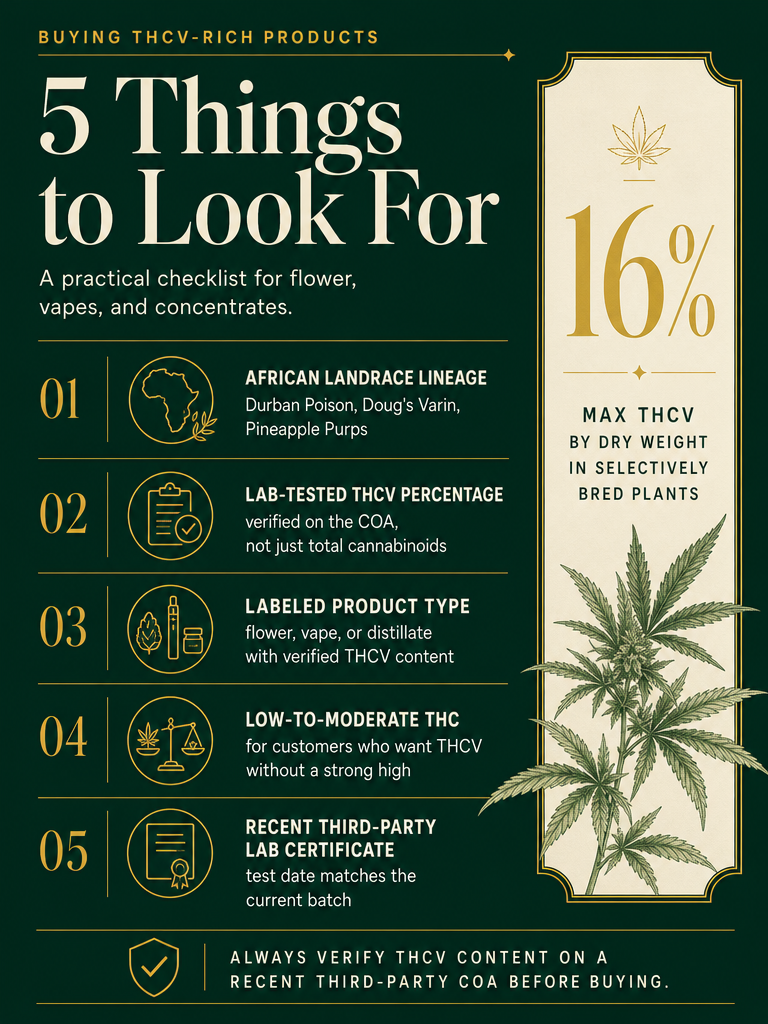
Modern selective breeding has pushed THCV content higher than the landrace baseline. Some selectively bred cultivars now report THCV levels approaching 16 percent of dry weight, an order of magnitude higher than the trace THCV found in most broad-spectrum flower [7].
For customers, the practical question is what to look for on a dispensary shelf. Three signals help separate genuinely THCV-rich products from marketing:
- A strain lineage tied to African landrace sativas — Durban Poison, Doug's Varin, Pineapple Purps, or modern descendants of those genetics.
- A lab-tested THCV percentage on the certificate of analysis (COA), not just total cannabinoids. Trace THCV will not deliver the effects the section above describes.
- A recent test date that matches the batch on the shelf. THCV percentages degrade over time like any other cannabinoid, and old COAs overstate current content.
For a full sweep of what's currently available in the flower category at Treehouse, including any THCV-forward sativa drops, the live menu is at Flower.
Will THCV Get You High and How Does It Interact With THC?
No, not at typical cannabis-product doses — at the amounts found in most flower, vapes, and edibles, THCV does not produce an intoxicating high on its own. The CB1 antagonism that defines THCV at low doses is the same mechanism that makes it non-intoxicating at those doses [7]. At much higher doses, THCV can flip to behaving as a weak CB1 agonist and produce mild THC-like effects, but the threshold for that flip is well above what most products deliver [7].
The interaction story is more interesting than the on-its-own story. Because THCV blocks the same receptor THC activates, it can blunt some of THC's effects when the two are taken together. The cleanest published evidence is the 2016 placebo-controlled crossover trial in healthy male volunteers: 10 mg oral THCV per day for five days significantly reduced the heart-rate increase and cognitive impairment that THC normally produces [3].
That result is one of the reasons THCV gets called a "THC modulator" in the consumer press. It does not erase THC's effects, but it can soften them. For customers building tolerance to THC and looking to recalibrate, the larger tolerance question is worth its own read at Can You Build THC Tolerance?.
Two practical caveats matter here, and they are easy to summarize:
- The crossover trial used purified oral THCV at a research dose, not a typical inhaled or edible product dose, so the magnitude of the modulation in everyday use is still an open question.
- Modulation cuts both ways — a customer who actually wants THC's effects may find that adding THCV reduces the experience they were after.
Is THCV Legal and Is It Safe?
Yes in US adult-use states, where THCV falls under the same regulated cannabis rules as THC and is sold through licensed dispensaries alongside other lab-tested cannabinoids. Hemp-derived THCV sits in a federal legal gray zone the 2018 Farm Bill does not clearly authorize, and isolated THCV products are typically handled case by case. Customers buying THCV-specific products should check current state and federal rules before ordering online.
On safety, the published human trials cited above are reassuring in the short term. Purified THCV at 5 mg twice daily for 13 weeks in the Jadoon 2016 type 2 diabetes pilot did not produce serious adverse events [4], and 10 mg oral THCV per day for five days in the crossover THC-interaction study was similarly well tolerated [3]. Broader reviews of THCV's pharmacology consistently describe it as having a favorable short-term safety profile at research doses, though they flag the usual caveat: long-term data in large populations is still limited [1] [2].
For adult-use customers, the practical safety and legal summary is short:
- State legality — regulated like THC in US adult-use states; sold through licensed dispensaries with full lab certificates.
- Federal legality — hemp-derived THCV sits in a legal gray zone the 2018 Farm Bill does not clearly authorize.
- Short-term safety — no serious adverse events in published human pilots at research doses.
- Long-term safety — limited data in large populations; not a substitute for medical care.
The bottom line for adult-use customers is that THCV behaves pharmacologically distinct from THC, is non-intoxicating at typical product doses, and shows real — but early-stage — research signals around appetite, glycemic control, and THC modulation. None of those signals is an approved medical claim, and THCV is not a substitute for medical care. Customers managing diabetes, weight, or any other health condition should talk to a clinician before treating THCV as a therapeutic option.
Frequently Asked Questions
What is THCV and how is it different from THC?
THCV (tetrahydrocannabivarin) is a naturally occurring minor cannabinoid in Cannabis sativa. It shares THC's core molecular structure but acts as a CB1 receptor antagonist at normal doses rather than a CB1 agonist, so it does not produce the intoxicating high THC is known for. Early research points to appetite suppression and improved metabolic markers rather than THC's appetite stimulation.
Will THCV get you high?
At typical cannabis-product doses, THCV does not act as a CB1 agonist, so it is largely non-intoxicating on its own. At very high doses THCV can behave as a weak CB1 agonist and produce mild THC-like effects, but the threshold is far above what most flower, vape, or edible products deliver.
What effects and potential benefits does THCV have?
Research in cells, rodents, and small human studies suggests four main effects: appetite suppression and weight-management potential, improved fasting glucose and pancreatic beta-cell function in type 2 diabetes, attenuation of THC-induced intoxication at CB1, and possible antipsychotic and anticonvulsant activity through 5-HT1A and other receptors.
Where does THCV come from in the cannabis plant?
THCV is a propyl analogue of THC produced by certain Cannabis sativa chemotypes, especially landrace sativas originating in southern and central Africa. Classic African landrace cultivars such as Durban Poison are the most recognizable natural sources, and modern breeders have selectively produced chemotypes with THCV levels reaching around 16 percent of dry weight.
Is THCV legal?
In US adult-use states, THCV falls under the same regulated cannabis rules as THC. Federally, THCV derived from hemp is treated case-by-case: most isolated THCV products sit in a legal gray zone, and the 2018 Farm Bill does not clearly legalize them. Always check current state and federal rules before purchasing THCV-specific products.
Does THCV actually work for weight loss?
Animal studies consistently show THCV reduces food intake, increases satiety, and improves insulin sensitivity. In humans, the Jadoon 2016 trial showed glycemic and β-cell improvements in type 2 diabetes patients, and early 2024 observational data reports weight loss with THCV/CBD strips. THCV is a promising research cannabinoid for metabolic support, but it is not an FDA-approved weight-loss treatment.
What cannabis products contain the most THCV?
Look for flower and vapes from THCV-rich cultivars like Durban Poison, Doug's Varin, Pineapple Purps, or other African-landrace-derived sativas, and for extracts or distillates labeled with verified THCV percentages. Most broad-spectrum cannabis products contain only trace THCV, so check third-party lab certificates (COAs) to confirm the actual THCV content.
How does THCV interact with THC?
Because THCV acts as a CB1 antagonist at typical doses, it can blunt some of THC's intoxicating and appetite-stimulating effects. A 2016 placebo-controlled human crossover study found that five days of 10 mg oral THCV significantly reduced THC-induced heart-rate increase and cognitive impairment, which is why some people describe THCV as a THC modulator.
Sources
- Journal of Cannabis Research (BMC/Springer Nature) — Open-access scientific review establishing that THCV is a minor cannabinoid with
- AIMS Press (AIMS Neuroscience) — Peer-reviewed 2025 mini-review summarizing THCV's CB1 antagonism, CB2 partial ag
- Journal of Psychopharmacology (SAGE Publications) — Pilot human crossover trial showing 10 mg oral THCV for five days significantly
- Diabetes Care (American Diabetes Association) — Foundational randomized trial in type 2 diabetes patients finding that purified
- Nutrition & Diabetes (Nature Publishing Group) — Animal study demonstrating that THCV improved insulin sensitivity and restored g
- British Journal of Pharmacology (Wiley) — Preclinical pharmacology paper showing THCV activates the serotonin 5-HT1A recep
- Leafly — Trusted consumer-facing explainer covering THCV's molecular similarity to THC, i
- Healthline — Consumer health explainer synthesizing the Jadoon 2016 trial and 2024 Phylos obs
About Treehouse Cannabis
Treehouse Cannabis is an adult-use dispensary serving Rockland, Orange, and Westchester Counties in New York. The store focuses on lab-tested flower, vapes, edibles, and pre-rolls, with budtenders trained to help customers understand cannabinoid content, dosing, and product formats. This article is for adults 21 and over and is part of Treehouse's ongoing customer-education series on minor cannabinoids like THCV.
This content is for adults 21 and over. Cannabis is for adult use only — do not operate a vehicle or machinery under the influence, and keep all cannabis products out of reach of children and pets. Effects vary by individual; start low and go slow. This article is educational and does not constitute medical advice.
Cannabis is for adults 21 and older. Keep out of reach of children and pets. Do not drive or operate machinery while using cannabis. If you are pregnant, breastfeeding, or taking medication, consult a licensed clinician before use. Effects may vary by individual; start low and go slow.

Shop our products

Shop All

Deals
Flower

Pre-rolls
Vaporizers

Edibles
Drinks

Concentrates
Tinctures

Topicals
CBD

Pet CBD
Accessories