
What Is CBN and Does It Actually Help With Sleep?
What Is CBN and Does It Actually Help With Sleep?
CBN shows cautiously promising evidence for sleep maintenance, especially reducing nighttime awakenings. In the largest randomized controlled trial to date (2024, N=293), 20 mg of CBN significantly reduced nighttime awakenings and overall sleep disturbance versus placebo, but did not reliably shorten how long it takes to fall asleep. Current evidence positions CBN for sleep as a possibly useful sleep-maintenance aid rather than a guaranteed sedative.
Cannabinol, almost always shortened to CBN, is one of the more than 100 cannabinoids the cannabis plant produces. CBN is a mildly psychoactive phytocannabinoid that acts as a low-affinity partial agonist at both CB1 and CB2 receptors of the endocannabinoid system, which makes it pharmacologically related to THC but mechanistically much weaker [6]. Unlike THC and CBD, CBN is not really something the plant makes in any meaningful amount when it is alive and freshly harvested.
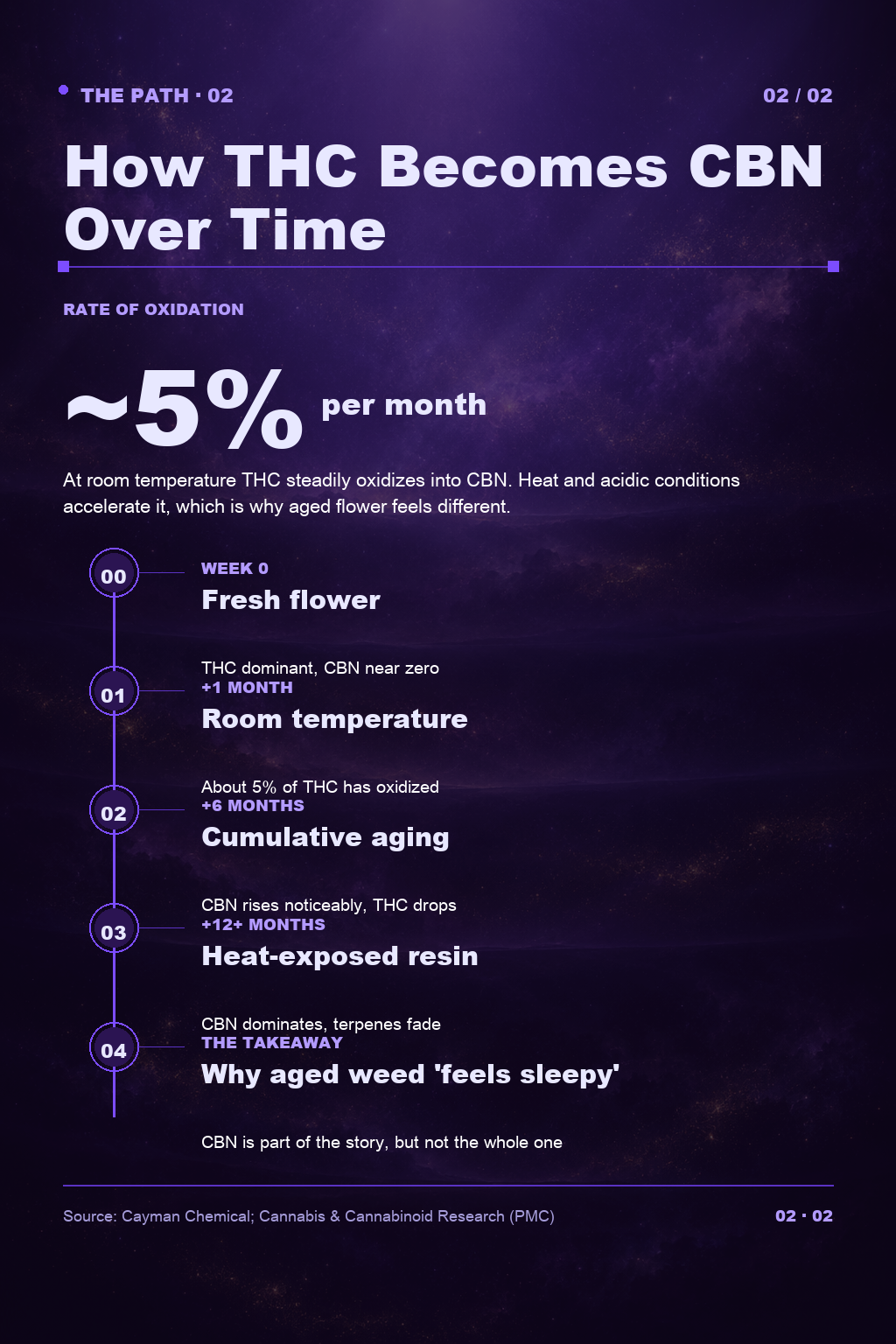
CBN is a degradative product of delta-9-THC, formed primarily by oxidative degradation of THC over time, with the rate of THC-to-CBN conversion increasing sharply at higher storage temperatures and acidic conditions [7]. If you have ever opened a jar of very old flower and noticed it felt heavier, slightly harsher, and somehow duller than what you remember, that change is mostly THC turning into CBN. Delta-9-THC oxidation occurs at a rate of up to about 5% per month at room temperature, with CBN being the principal oxidative degradation product [8]. Storage temperature and pH are the dominant variables in how much CBN accumulates, which is why a sealed jar in a closet and a sun-baked car trunk produce very different end products even when they started identical.
CBN is real, pharmacologically active, and worth taking seriously. It is just not the mythical "sleep molecule" the cannabis wellness industry has spent the last few years selling it as.
What Is CBN and How Is It Different From CBD and THC?
CBN sits between CBD and THC in almost every way that matters for someone trying to think clearly about a sleep label. CBD is non-intoxicating, binds CB1 and CB2 receptors only weakly, and acts primarily through non-receptor pathways. THC is the high-affinity CB1 partial agonist responsible for the intoxicating "high" most people associate with cannabis. CBN is a low-affinity partial agonist at the same CB1 and CB2 receptors THC targets, but it binds so much more weakly that its psychoactive punch at typical doses is mild [6]. In practical terms, CBN alone is unlikely to leave you noticeably impaired at the milligram doses most sleep products contain, while still behaving more like THC than like CBD at the receptor level.
A few specific differences are worth keeping straight, especially when staring at a sleep label:
- Source in the plant: CBD and THC are both directly produced by the cannabis plant in meaningful quantities; CBN is mostly produced after harvest, as THC oxidizes and breaks down [8].
- Intoxication at typical doses: THC produces a clear "high"; CBD produces none; CBN produces a mild psychoactive effect that most users do not notice at sleep-product doses.
- Receptor action: THC is a high-affinity CB1 partial agonist; CBD binds CB1 and CB2 only weakly; CBN is a low-affinity partial agonist at both CB1 and CB2.
- Drug-test risk: THC produces a positive test; CBD isolate is generally safe; CBN risk depends on the source (isolated or broad-spectrum CBN is the safer choice).
- Cost on the shelf: THC and CBD products are widely available and competitively priced; CBN extracts usually come from aged flower or chemical conversion, so CBN products are often noticeably more expensive than equivalent CBD products.
That is why high-CBN flower is rare on dispensary shelves, why CBN extracts tend to come from aged flower or from chemical conversion rather than from fresh material, and why the flavor of a CBN distillate, by itself, gives you very little information about what the original strain was. By the time THC has become CBN, most of the original terpene fingerprint has usually faded too, so CBN products rarely taste like a recognizable cannabis cultivar.
Does CBN Actually Help You Sleep?
The honest answer is that the evidence is thin but moving in a cautiously promising direction. The largest randomized, placebo-controlled trial to date was a 2024 study that enrolled 293 adults. In a modified intent-to-treat analysis, 20 mg of CBN significantly reduced nighttime awakenings and overall sleep disturbance compared with placebo, with no impact on daytime fatigue, but onset latency and wake after sleep onset were not significantly changed, and the subjective sleep quality result was a nonsignificant trend (OR 2.26, p=0.082) [2]. Adding CBD to the same dose did not augment the effect, which is a useful piece of information on its own, given how often CBN and CBD are stacked together in sleep products.
The fair summary of what the current evidence actually shows:
- Sleep maintenance: the strongest signal — 20 mg of CBN significantly reduced nighttime awakenings in the 2024 RCT [2].
- Sleep onset: no significant change in latency to fall asleep in the 2024 RCT [2].
- Subjective sleep quality: trended in the right direction but did not reach significance (p=0.082) [2].
- Animal data: CBN and its active metabolite 11-OH-CBN increased total sleep in a rat insomnia model in a manner comparable to zolpidem [3].
- Next-day function: no measurable impact on daytime fatigue in the 2024 RCT [2].
- Higher-dose evidence: pending — the CUPID trial is now testing 30 mg and 300 mg in adults with clinician-diagnosed insomnia disorder [4].
The animal evidence lines up reasonably well. In a 2024 rat model of insomnia, CBN and its active metabolite 11-OH-CBN increased total sleep in a manner comparable to zolpidem, with CB1-receptor-mediated mechanisms, providing the first objective preclinical evidence that CBN can modify sleep architecture rather than just produce a subjective sense of drowsiness [3]. The CUPID trial, a registered randomized, double-blind, placebo-controlled, three-arm cross-over study, is now testing single fixed oral doses of 30 mg and 300 mg of CBN isolate in adults with clinician-diagnosed insomnia disorder (ISI ≥15), with primary outcomes on sleep continuity and next-day function [4]. CUPID will not report results for a while, but it is the trial most likely to settle whether the 2024 result holds up at higher doses and in patients with real insomnia rather than generally healthy adults with mild sleep complaints.
The fair summary, pulling all of that together, is that CBN looks more promising for staying asleep than for falling asleep, and human evidence is still catching up to the marketing claims [1]. Our earlier explainer on CBN for Sleep: What to Know covers the older pre-2024 research in plain language, and the broader evidence base on cannabis and sleep is summarized in our Cannabis and Sleep Quality: What Actually Works (and What Doesn't) guide.
CBN vs CBD for Sleep: Which One Should You Choose?
CBN and CBD are both non-intoxicating compared to THC, but they work through different mechanisms and produce noticeably different sleep profiles. CBD is non-psychoactive, has mixed dose-dependent effects on sleep (moderate-to-high doses may help, low doses can be alerting), and is supported by a larger body of research on anxiety-related sleep complaints. CBN is mildly psychoactive, binds directly (if weakly) to the same CB1 and CB2 receptors THC does, and the limited clinical evidence points to a possible edge on nighttime awakenings and overall sleep disturbance [6].
The practical shortlist when choosing between them for sleep:
- Pick CBN if your main issue is staying asleep through the night, you already tolerate cannabis products, and you are not subject to drug testing.
- Pick CBD if your main issue is falling asleep, anxiety is a meaningful driver of your sleep complaints, or you want a milder and better-studied option that is unlikely to show up on a drug test.
- Pick a CBN + CBD combo if you want both mechanisms covered, you have already tried either alone and saw partial results, and you are buying from a brand with a published COA showing both cannabinoids at the labeled doses.
- Skip both if you are pregnant, nursing, taking sedating prescription sleep medication, or trying to fall asleep on a night when you absolutely must be sharp the next morning.
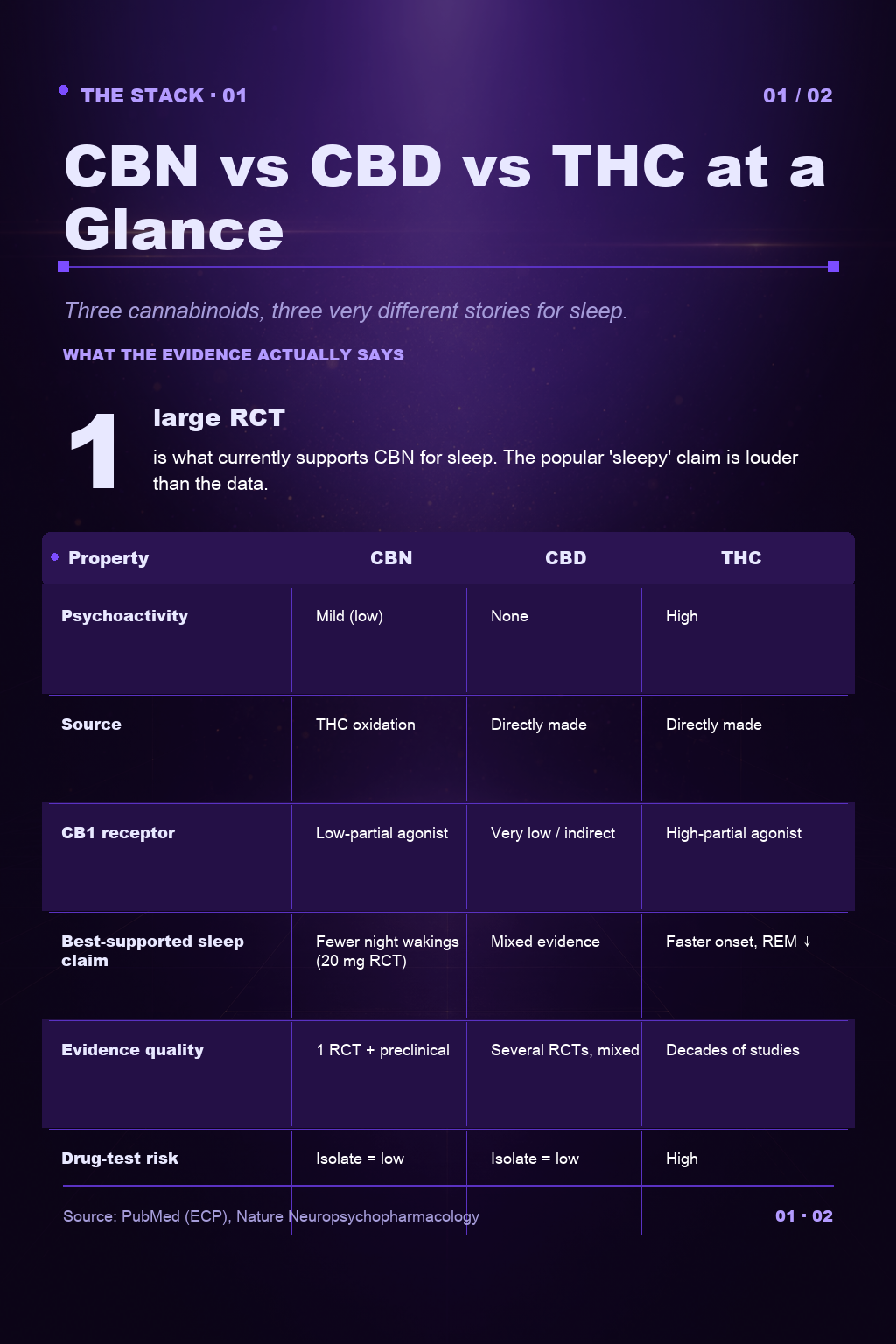
| Property | CBN | CBD | THC |
|---|---|---|---|
| Psychoactivity at typical sleep-product doses | Mild | None | High |
| Where it comes from in the plant | THC oxidation product (mainly after harvest) | Directly produced in meaningful quantities | Directly produced in large quantities |
| CB1 receptor action | Low-affinity partial agonist | Very low / primarily non-receptor pathways | High-affinity partial agonist |
| Best-supported sleep claim from current evidence | Fewer nighttime awakenings (20 mg RCT, 2024) | Mixed; moderate-to-high doses may help | Faster sleep onset, REM suppression |
| Strongest evidence quality | 1 large RCT + 1 preclinical | Multiple RCTs, mixed results | Decades of studies, polysomnography |
| Drug-test risk | Depends on source (isolate safest) | Low (isolate) | High |
| Typical shelf price vs equivalent CBD | Often noticeably higher | Baseline | Varies |
A useful framing comes from the Sleep Foundation's 2024 review, which concluded that there is insufficient high-quality research to determine whether CBN improves sleep, and that early 1970s and 1980s studies found little standalone effect from CBN, although participants did report greater drowsiness when CBN was taken together with THC [5]. That is an honest summary, and it cuts against the "CBN is the new melatonin" framing that some wellness brands still lean on. For a head-to-head breakdown of the two molecules, including what changes when you stack them, our guide to CBN vs CBD: What Is the Difference? goes through the mechanism, the evidence, and the practical buying implications in more detail.
If you want a single rule of thumb for now, current evidence more often supports CBD for general sleep quality and CBN for sleep maintenance, but the responsible move for most people is to think of them as complementary rather than competing. Many of the highest-rated sleep products on the market today use both, usually with melatonin and a few supporting terpenes, and the clinical evidence so far does not strongly support the idea that adding CBD on top of CBN boosts the effect [2]. A more productive question than "CBN or CBD?" is usually "which problem am I actually trying to solve, falling asleep, staying asleep, or both, and what does the rest of my evening look like." For a broader look at how different cannabinoids interact with sleep architecture, Cannabis and Lucid Dreaming: What Happens When You Smoke Before Bed explores the REM-suppression side of the equation, and You Can't Dream on Weed: The Science of REM Suppression and What Happens After a T-Break covers what happens to dreaming during and after a tolerance break.
How Does CBN Work in the Body?
Mechanistically, CBN is not a mystery. It binds to the same endocannabinoid receptors THC does, just with a much weaker grip. CBN is a low-affinity partial agonist at both CB1 receptors (concentrated in the brain and central nervous system) and CB2 receptors (concentrated in immune tissue), which is why its effects are subtle compared to THC's [6]. That partial activation matters more than it sounds: it means CBN nudges the endocannabinoid system in the same general direction as THC without pushing it hard, so the subjective effect at typical doses is closer to "barely noticeable" than to "impaired."
Where CBN gets more interesting is what happens after you swallow it. In a 2024 rat model of insomnia, CBN and its active liver metabolite 11-OH-CBN increased total sleep time in a manner comparable to zolpidem, with biphasic effects that began with REM suppression before increasing REM later in the sleep period [3]. The 11-OH-CBN metabolite is more potent at CB1 than CBN itself, which is one reason oral CBN may behave differently from inhaled CBN, and is one reason researchers believe a meaningful share of CBN's sleep-relevant activity may be coming from what CBN becomes in the liver rather than from CBN directly.
Beyond the endocannabinoid system, the honest answer is that the picture is still being filled in. Researchers believe additional non-cannabinoid pathways, still being mapped, probably contribute to the perceived sleep benefits, which would help explain why low-affinity CB1 binding alone does not seem to fully account for the effects reported in animal models [3].
What CBN does at the receptor level, in plain terms:
- CB1 receptors (brain and CNS): partial activation only, much weaker than THC [6].
- CB2 receptors (immune tissue): partial activation only, much weaker than THC [6].
- 11-OH-CBN metabolite: formed in the liver after oral dosing, more potent at CB1 than CBN itself, and thought to drive a meaningful share of oral CBN's effects [3].
- Subjective effect at typical doses: closer to "barely noticeable" than to "impaired" because the partial activation is so weak.
- Non-cannabinoid pathways: researchers believe additional pathways (still being mapped) contribute to the perceived sleep benefits [3].
The practical takeaway for someone reading a sleep label is that CBN is pharmacologically real, not a homeopathic trace, but it is also not a heavy-handed switch the way THC is. Its effects are subtle, dose-dependent, and probably mediated by both the endocannabinoid system and pathways that have not been fully characterized yet.
How Much CBN Should You Take for Sleep?
There is no FDA-established dose for CBN because it is not an approved drug, and the only well-controlled clinical sleep trial to date used 20 mg of an isolated CBN oil taken about 60 minutes before bed [2]. That single data point is the closest thing to a starting anchor the evidence base offers right now, and it is worth holding onto for orientation. Most consumer CBN products on the market today contain between 5 mg and 30 mg per serving, with the highest-dose sleep gummies sometimes reaching 50 mg of CBN or more in combination products. The CUPID trial is now testing 30 mg and 300 mg to find out whether higher doses meaningfully outperform the 20 mg that worked in 2024 [4].
A reasonable starting protocol based on the available evidence:
- Take the lowest labeled dose on the product label, on a night when you do not need to be sharp the next morning.
- Time it 60 to 90 minutes before bed to match how the 2024 RCT was administered [2].
- Do not stack a CBN product on top of an already intoxicating amount of THC until you know how CBN affects you personally — CBN amplifies the intoxicating effects of THC when taken together.
- If you take prescription medications, especially anything metabolized by the cytochrome P450 system, talk to a healthcare professional before adding CBN, because cannabinoids can alter the metabolism of a meaningful list of common drugs.
Will CBN Make You Feel High and Is It Safe Every Night?
CBN alone is considered only mildly psychoactive. Most users report no meaningful "high" at typical doses, though it can amplify the intoxicating effects of THC when taken together [5]. In the 2024 RCT, 20 mg taken nightly was well-tolerated for the duration of the trial with no impact on daytime fatigue, but that study ran only a few weeks and the long-term safety of nightly use is unknown [2]. CBN is not known to produce the same kind of physical dependence as THC, though tolerance and rebound effects have not been well characterized in humans, so the responsible default for now is to assume that nightly use over months could change the picture in ways the short trial did not measure.
Safety considerations worth flagging before nightly dosing:
- Drug testing: many CBN products are derived from THC-rich hemp or cannabis and can contain trace THC that builds up with regular use; isolated or broad-spectrum CBN is the safer choice, and "THC-free" claims are worth verifying through the certificate of analysis rather than the marketing copy.
- Pregnancy and chronic conditions: if you are pregnant, trying to be active, or managing a chronic condition alongside sleep complaints, the safer move is to talk to a clinician rather than to self-experiment, because most of the published evidence is in generally healthy adults and does not address pregnancy, liver disease, or pediatric use at all.
- Prescription interactions: CBN can alter the metabolism of a meaningful list of common drugs via the cytochrome P450 system, especially anything metabolized by CYP3A4 and CYP2C19, so a medication review with a clinician is worth doing before nightly use.
- Tolerance and rebound: long-term nightly use has not been studied; rotating nights off and pairing CBN with non-cannabis sleep habits produces more durable results than nightly use alone.
The honest sleep-hygiene framing is that rotating nights off CBN, paired with consistent non-cannabis sleep habits, will produce more durable results than nightly use alone. For readers thinking about adding a minor cannabinoid to an existing evening routine, What Is THCV? The Minor Cannabinoid With Big Effects is a useful companion piece on the broader minor-cannabinoid landscape.
Where Does CBN Fit Next to Other Sleep Aids, and How Should You Shop For It?
Looking at CBN next to other minor cannabinoids and next to more familiar sleep aids sharpens the canny use case for CBN. Melatonin is better studied and cheaper, but it works on a different mechanism (circadian signaling rather than the endocannabinoid system) and does not help everyone. THC reliably shortens sleep onset but suppresses REM and can leave residual impairment. CBD has a larger evidence base than CBN but mixed effects at low doses. CBN looks most useful as a sleep-maintenance aid for someone who already tolerates cannabis well, is not drug-tested, and wants to avoid the heavier intoxicating load that comes with THC.
A practical buying checklist, since the CBN product market is unregulated and inconsistent:
- Verify with a COA: look for a recent third-party certificate of analysis that confirms both the CBN potency on the label and that residual THC is below the limit you need.
- Pick the right spectrum: prefer "CBN isolate" or "broad-spectrum" formulations to minimize trace THC, or full-spectrum if you actually want the small amount of THC and the terpene entourage along for the ride.
- Skip the cure-claims: avoid products that make explicit therapeutic claims about curing insomnia, since those are not legally permitted for CBN supplements and are usually a signal that the marketing has outrun the evidence.
- Match the dose to the problem: start at 5–20 mg for general sleep maintenance, per the only well-controlled human trial [2], and only go higher once you know how CBN affects you personally.
- Time it right: take it 60 to 90 minutes before bed, on a night when you do not need to be sharp the next morning, until you know how it affects you personally.
If you are shopping the Edibles shelf for a CBN sleep gummy specifically, our store carries third-party-tested options, and our budtenders can talk through the difference between a 10 mg CBN gummy and a 30 mg CBN-plus-melatonin combo, and help you match the product to the kind of sleep problem you actually have. For a deeper look at the terpene side of the equation, The Cannabis Terpene Wheel: A Visual Guide to Every Common Terpene is a useful companion when you are staring at a label full of unfamiliar ingredient names.
What Are the Most Common Questions People Have About CBN and Sleep?
Quick reference: the questions below are the ones our budtenders actually hear at the counter, organized so you can scan to the one you care about.
- Does CBN actually help you sleep?
- Is CBN the "sleepy cannabinoid" I keep hearing about?
- What is the difference between CBN and CBD for sleep?
- How much CBN should I take for sleep?
- Will CBN make me feel high?
- Is CBN safe to take every night?
- How does CBN actually work in the body?
- Why is CBN so expensive compared to CBD?
Does CBN actually help you sleep?
Evidence is thin but cautiously promising. The largest placebo-controlled study to date (2024, N=293) found that 20 mg of CBN significantly reduced nighttime awakenings and overall sleep disturbance, although it did not significantly shorten the time it takes to fall asleep, and subjective sleep quality was a nonsignificant trend (OR 2.26, p=0.082) [2]. A 2024 rat study showed CBN increased total sleep in a manner comparable to zolpidem [3]. The fair summary is that CBN looks more promising for staying asleep than for falling asleep, and human evidence is still catching up to the marketing.
Is CBN the "sleepy cannabinoid" I keep hearing about?
That reputation is largely folklore. The "sleepy cannabinoid" label traces back to a 2017 industry report from Steep Hill Labs that was never peer-reviewed, and to the observation that older cannabis flower seemed more sedating. We now know aged flower accumulates CBN as THC oxidizes at roughly 5% per month at room temperature, but the sleepy feeling is more plausibly explained by THC breakdown products and by other compounds like myrcene and other terpenes, not by CBN on its own [8].
What is the difference between CBN and CBD for sleep?
Both are cannabinoids, but they work through different mechanisms. CBD is non-intoxicating, acts mainly through non-receptor pathways, and has mixed dose-dependent effects on sleep (moderate-to-high doses may help, low doses can be alerting). CBN is mildly psychoactive, is a low-affinity partial agonist at CB1 and CB2 receptors, and is the oxidation product of THC [6]. Current evidence more often supports CBD for general sleep quality and CBN for nighttime awakenings, but both are still being studied.
How much CBN should I take for sleep?
There is no FDA-established dose for CBN. The only well-controlled clinical trial used 20 mg of an isolated CBN oil about an hour before bed [2]. Most consumer CBN products contain between 5 mg and 30 mg per serving. A reasonable starting protocol is the lowest labeled dose, taken 60 to 90 minutes before bed, on a night when you do not need to be sharp the next morning, and without stacking it on top of high-THC products until you know how it affects you personally.
Will CBN make me feel high?
CBN is considered only mildly psychoactive. Most users report no meaningful "high" at typical doses, though it can amplify the intoxicating effects of THC when taken together [5]. If you are drug-tested, many CBN products are derived from THC-rich hemp or cannabis and can contain trace THC that may accumulate with regular use; opt for CBN labeled as isolated or broad-spectrum if avoiding THC is important.
Is CBN safe to take every night?
The 2024 RCT found that 20 mg CBN nightly was well-tolerated for the study period with no impact on daytime fatigue, but the trial only ran for a few weeks and long-term nightly use has not been studied [2]. CBN is not known to produce the same kind of physical dependence as THC, though tolerance and rebound effects are not well characterized. Rotating nights off and pairing CBN with consistent non-cannabis sleep habits produces more durable results than relying on it every night.
How does CBN actually work in the body?
CBN is a low-affinity partial agonist at CB1 and CB2 receptors, the same receptors THC binds to, but with much weaker attachment [6]. Its active liver metabolite, 11-OH-CBN, is more potent and is thought to drive some of CBN's effects [3]. Because CBN only weakly activates these receptors, its effect on sleep is likely subtler and more dose-dependent than THC's, and it may also influence sleep through non-cannabinoid pathways that are still being mapped out.
Why is CBN so expensive compared to CBD?
CBN is rarer in fresh cannabis because it is mainly a degradation product of THC rather than something the plant produces in large quantities. Producing isolated CBN at scale requires either aging harvested flower under controlled conditions or chemically converting CBD or THC, both more labor- and equipment-intensive than extracting CBD directly from hemp [7]. That scarcity, plus lower production volumes, is what keeps CBN gummies and tinctures priced above equivalent CBD products.
Sources
- National Library of Medicine (PMC) — CBN is a degradative product of delta-9-THC, not a primary phytocannabinoid, and
- PubMed / Experimental and Clinical Psychopharmacology — In a modified intent-to-treat analysis (N=293), 20 mg CBN showed a nonsignifican
- Nature / Neuropsychopharmacology — In a rat model of insomnia, CBN (and its active metabolite 11-OH-CBN) increased
- BMJ Open (PMC mirror) — The CUPID trial protocol describes a randomized, double-blind, placebo-controlle
- Sleep Foundation — There is insufficient high-quality research to determine whether CBN improves sl
- Wikipedia (cannabinoid pharmacology summary) — CBN is a mildly psychoactive phytocannabinoid that acts as a low-affinity partia
- Cannabis and Cannabinoid Research (PMC) — CBN is formed primarily by oxidative degradation of THC, with the rate of THC-to
- Cayman Chemical (technical brief) — Delta-9-THC oxidation occurs at a rate of up to about 5% per month at room tempe
About Treehouse Cannabis
Treehouse Cannabis is an adult-use dispensary in Nanuet, NY, serving Rockland County and the surrounding Hudson Valley. We publish plain-language guides on cannabinoids, terpenes, dosing, and the practical side of buying legal cannabis in New York — written for adults 21 and older who want the evidence laid out without the marketing fluff.
Cannabis is for adults 21 and older. Keep all cannabis products, including CBN sleep products, locked and out of the reach of children and pets. The effects described in this article come from clinical research on generally healthy adults and may not apply if you take prescription medications, are pregnant or nursing, or have a chronic medical condition; talk to a healthcare professional before adding CBN to your routine. Do not drive or operate machinery after taking CBN, especially in combination with THC or alcohol. All product availability, dosing, and lab results discussed here are accurate as of the time of writing and may change as the Treehouse Cannabis menu evolves.

Shop our products

Shop All

Deals

Flower

Pre-rolls
Vaporizers

Edibles

Drinks

Concentrates

Tinctures

Topicals

CBD

Pet CBD

Accessories