
What Is CBG? Meet the 'Mother Cannabinoid' Behind All the Others
What Is CBG? Meet the 'Mother Cannabinoid' Behind All the Others
CBG, or cannabigerol, is a generally non-intoxicating cannabinoid found in cannabis. The "mother cannabinoid" nickname more precisely describes CBGA, its acidic precursor, which the plant uses to make several major cannabinoid acids. Heating can convert CBGA into CBG; separate enzyme-driven pathways lead toward THC and CBD. [2]
That distinction matters: "behind all the others" is shorthand, not a literal claim that every cannabinoid comes from neutral CBG. It describes a branching process inside the plant, not something that happens when a person consumes CBG.
For customers, the other important distinction is between an ingredient and a finished product. CBG itself is generally described as non-intoxicating, but a product featuring CBG can also contain intoxicating THC. Understanding the chemistry helps make sense of the label without turning a cannabinoid name into a promise about the experience. [3]
What is CBG, or cannabigerol?
CBG is a naturally occurring cannabis compound called cannabigerol. It belongs to the cannabinoid family, but it is not a strain name, a terpene or a description of how a product will feel. [2]
The abbreviations become easier to follow when each has a specific job:
- CBG means cannabigerol, the neutral cannabinoid.
- CBGA means cannabigerolic acid, its acidic counterpart.
- A cannabinoid name identifies a compound, not a complete product formulation.
"Neutral" here is a chemistry term distinguishing CBG from its acid form; it does not mean inactive or risk-free. Likewise, "non-intoxicating" does not establish that a substance has no biological activity. [3]
Terpenes are a separate part of the vocabulary used to describe cannabis. For that distinction, The Cannabis Terpene Wheel: A Visual Guide to Every Common Terpene provides a companion guide rather than another name for CBG.
CBG is also not the only cannabinoid outside the familiar THC-and-CBD conversation. For another example, What Is THCV? The Minor Cannabinoid With Big Effects explores THCV; its properties should not be assumed to apply to CBG simply because both receive the "minor cannabinoid" label.
Why is CBGA called the mother cannabinoid?
CBGA earns the "mother cannabinoid" nickname because plant enzymes use it to produce several major cannabinoid acids, including THCA, CBDA and CBCA. Neutral CBG is a related branch, not the starting point for every cannabinoid. [5]
The pathway begins upstream of CBGA. Olivetolic acid and geranyl diphosphate are building blocks used to form CBGA; different enzymes can then direct that intermediate toward different cannabinoid acids. Experimental reconstruction of cannabinoid biosynthesis in yeast has helped demonstrate these chemical steps. [1]
Two processes need to stay separate. Enzymes carry out the branching conversions into other cannabinoid acids, while decarboxylation removes carbon dioxide from an acidic cannabinoid, often through heating. [2]
The CBGA family tree can be read as four routes:
- CBGA becomes THCA through the action of THCA synthase; THCA can then decarboxylate into THC.
- CBGA becomes CBDA through the action of CBDA synthase; CBDA can then decarboxylate into CBD.
- CBGA becomes CBCA through the action of CBCA synthase; CBCA can then decarboxylate into CBC.
- CBGA can itself decarboxylate into CBG, without first becoming one of those other cannabinoid acids.
These routes describe plant chemistry and subsequent chemical changes, not interchangeable effects after consumption. [1] [2]
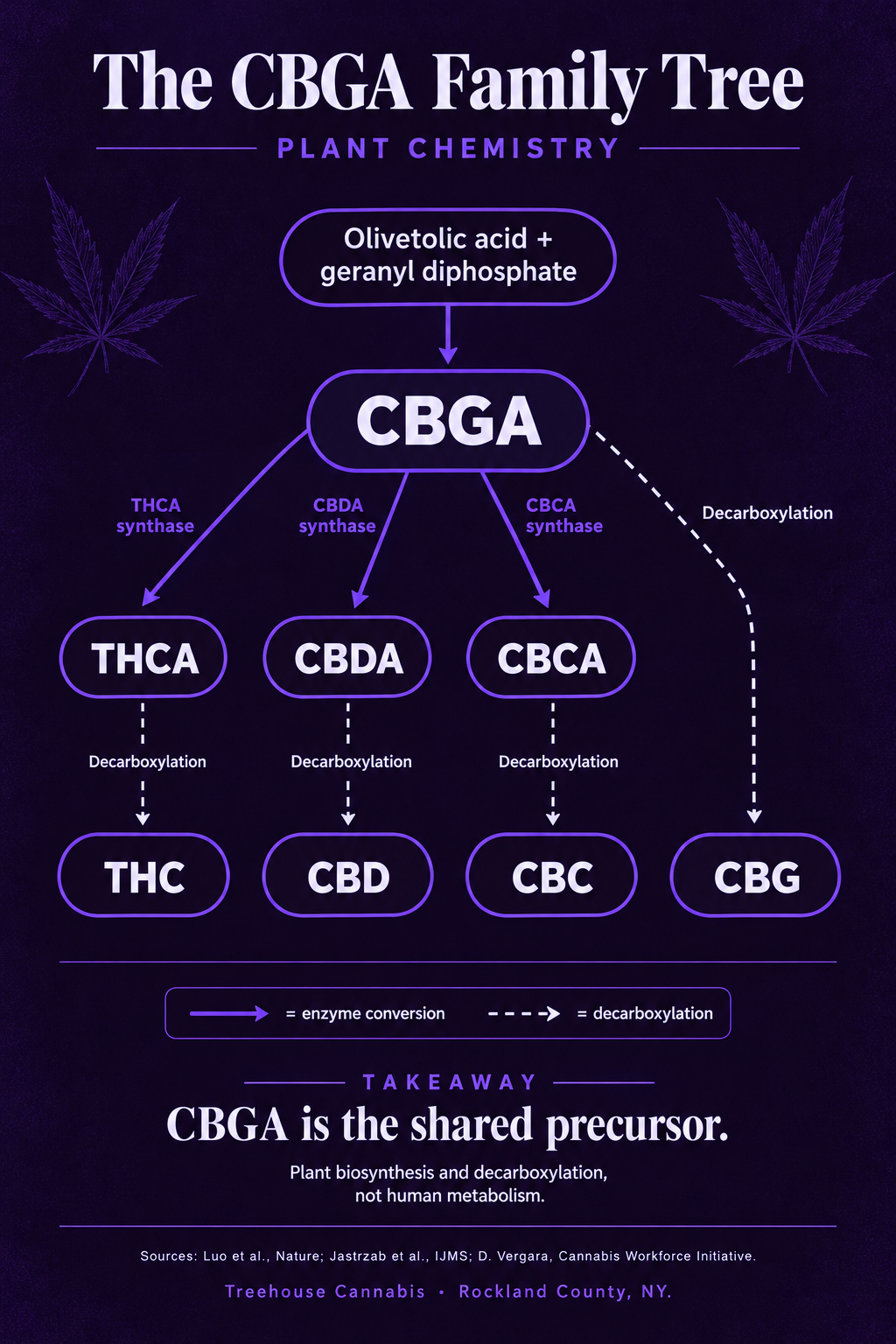
The useful takeaway is not that CBG "turns into everything." It is that CBGA occupies a central branching point. Consuming CBG does not recreate the plant's enzyme-driven production of THCA, and the nickname is not evidence that CBG turns into THC in people.
How does CBG compare with CBD and THC?
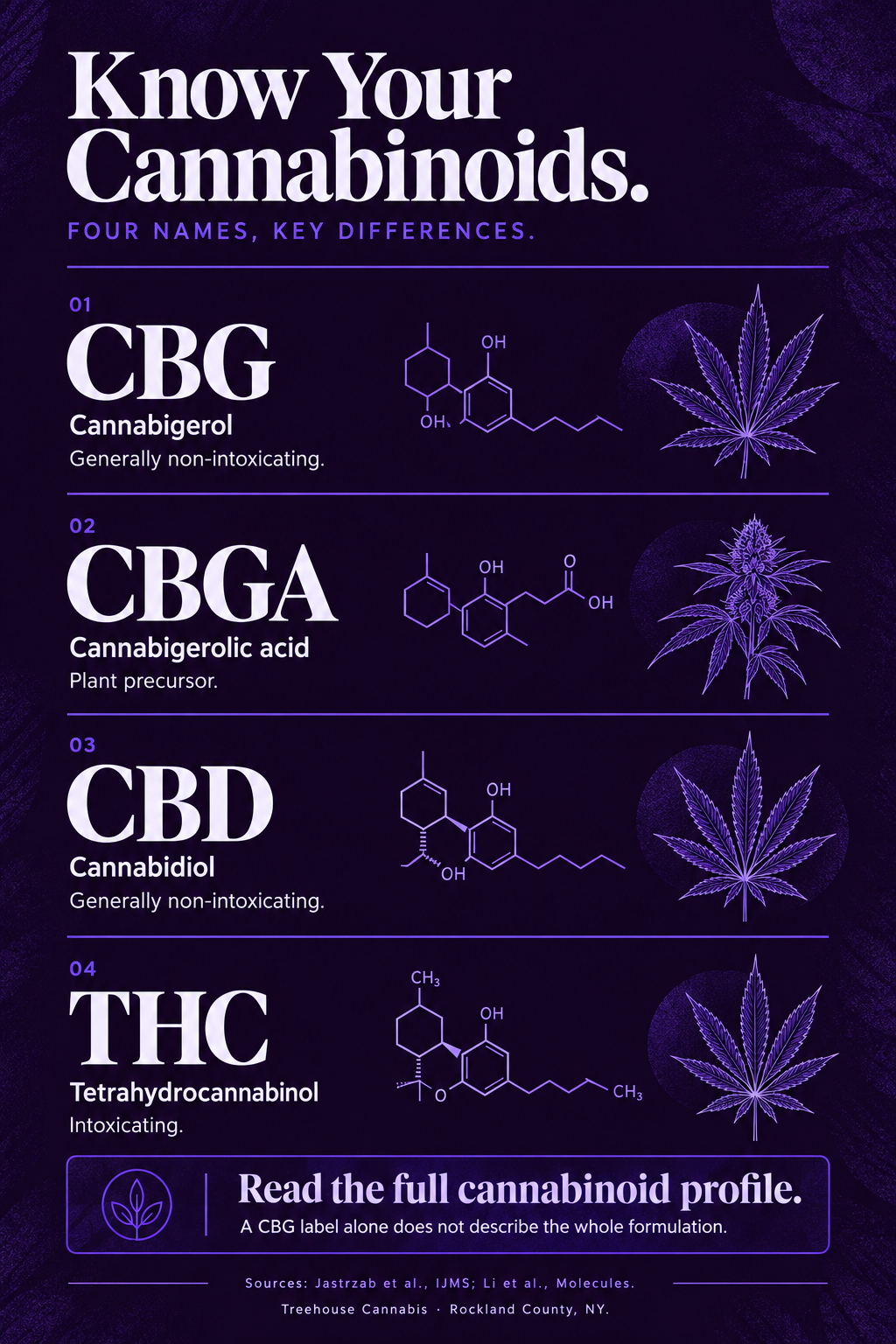
CBG, CBD and THC are distinct cannabinoids, not different strengths of the same ingredient. CBG and CBD are generally considered non-intoxicating, while THC is intoxicating; CBGA is best understood here as a precursor in the plant's biosynthetic pathway. [2] [3]
| Compound | Full name | Pathway role or acidic precursor | Intoxication context |
|---|---|---|---|
| CBG | Cannabigerol | Forms when CBGA decarboxylates | Generally non-intoxicating |
| CBGA | Cannabigerolic acid | Precursor to several major cannabinoid acids; can also decarboxylate into CBG | Its plant-pathway role is not a consumer-effects guarantee |
| CBD | Cannabidiol | Forms when CBDA decarboxylates | Generally non-intoxicating |
| THC | Tetrahydrocannabinol | Forms when THCA decarboxylates | Intoxicating |
The table summarizes chemical relationships and broad distinctions, not a ranking of benefits or suitability. Shared origins do not make CBG and CBD identical, and they do not establish that the compounds produce the same experience. [2] [3]
Three distinctions are worth keeping:
- CBG and CBD are different molecules, despite their similar abbreviations.
- CBGA is an acidic precursor, not an alternative spelling of CBG.
- THC in a mixed formulation changes the intoxication question, even when CBG is prominent on the label.
For a closer look at the first comparison, see CBG vs CBD: How the Cannabinoids Compare. For the broader THC-and-CBD distinction, CBD vs THC: The Science Behind the Two Most-Discussed Cannabinoids adds context without making CBG a substitute for either compound.
Plant ancestry is also separate from how compounds interact with the body. How THC and CBD Work covers that next layer of the conversation.
Does CBG get you high, and what do CBG effects claims mean?
CBG itself is generally considered non-intoxicating and is not associated with the characteristic THC high. That does not make every CBG-labeled product non-intoxicating: a finished formulation may include THC alongside it. [3]
A concrete label example is 1:1:1 CBG:THC:CBD Recover Releaf Gummy - Pear Apple | 100mg: the supplied product name identifies CBG, THC and CBD together. The presence of CBG does not erase the THC component, and the product name is not evidence of a guaranteed recovery effect.
When interpreting a CBG claim:
- Read the complete cannabinoid information, not just the highlighted ingredient.
- Check whether THC is listed rather than assuming CBG means THC-free.
- Separate a named compound from marketing descriptions such as "focus" or "energy."
- Treat a promised experience as a claim, not a predictable outcome.
The distinction between non-intoxicating and biologically inactive is important. Research into CBG's molecular activity does not justify presenting it as inert, universally safe or guaranteed to produce a particular mood. [3]
A small human study reported no evidence of subjective drug effects or measured impairment under its specific acute testing conditions. That finding is narrower than saying CBG cannot affect anyone, and it does not establish the safety of every CBG-containing product. [4]
What does research actually establish about CBG?
Research provides a clearer account of CBG's chemical origins than of predictable consumer effects. Plant biosynthesis experiments, laboratory studies and small human trials answer different questions; none should be presented as interchangeable evidence. [1] [3]
The 2019 biosynthesis work demonstrated cannabinoid production pathways in engineered yeast. That helps explain how CBGA connects to downstream cannabinoid acids, but it was not a trial of people consuming CBG. [1]
The 2024 human study used a placebo-controlled crossover design in a small sample of healthy adults, with testing conducted remotely in a field setting. It examined acute effects, not long-term outcomes or every formulation sold under a CBG label. [4]
A practical evidence checklist is:
- Plant chemistry research explains how compounds form, not how every customer will feel.
- Laboratory findings can identify questions worth studying without proving human benefits.
- Small, short-term human trials do not establish long-term safety.
- Results from one tested formulation cannot automatically be assigned to another.
For that reason, CBG is better introduced through its chemistry and the limits of current evidence than through a list of promised benefits. Reviews describe ongoing research, not a settled set of effects that a retailer can guarantee. [3]
For background on the body's own signaling system, The Endocannabinoid System: What Science Says About How Cannabis Works in Your Body is a useful companion. Understanding that system provides context, but it is not proof that a particular CBG product will deliver a particular result.
How can adults read CBG product labels without the hype?
Adults can read CBG labels more clearly by identifying the compound, checking the full formulation and separating product information from effect claims. A prominent CBG callout is one piece of information, not a summary of everything inside.
A useful label-reading sequence is:
- Identify whether the listing refers to CBG, CBGA or a combination of cannabinoids.
- Review the complete cannabinoid information, including any THC.
- Check available product-specific testing information rather than inferring composition from a category name.
- Distinguish ingredient facts from words that suggest a guaranteed experience.
- Confirm the current listing rather than assuming a previously viewed product remains available.
A category such as Small Buds Flower describes a flower format, not verified CBG content. Bud size alone is not a substitute for cannabinoid information, and a category listing should not be read as a CBG-specific recommendation.
For adults 21 and older in Rockland County, Treehouse Cannabis's current menu offers a starting point for reviewing individual listings. Availability changes; the useful question is what the specific product information establishes, not whether the packaging uses the newest cannabinoid buzzword.
What are the common questions about CBG?
The most common CBG questions concern its name, its relationship to CBGA and whether it causes intoxication. These short answers keep the plant pathway separate from claims about finished products.
- CBG and CBGA are related but distinct compounds.
- The "mother" nickname describes CBGA's role in plant chemistry.
- A CBG label alone does not establish that a formulation is non-intoxicating.
What is CBG?
CBG stands for cannabigerol, a naturally occurring cannabinoid in cannabis. It is generally described as non-intoxicating, unlike THC. Its acidic counterpart, CBGA, occupies a central position in the plant's cannabinoid-making pathway. CBG and CBGA are related compounds, but they are not interchangeable names for the same molecule. [2] [3]
Why is CBG called the mother cannabinoid?
The nickname more precisely describes CBGA, the acidic precursor related to CBG. Plant enzymes convert CBGA into THCA, CBDA and CBCA, which can become THC, CBD and CBC through decarboxylation. Calling neutral CBG itself the parent of every cannabinoid overstates and oversimplifies this chemistry. [5]
Does CBG get you high?
CBG itself is generally considered non-intoxicating and is not associated with the characteristic THC high. That does not mean every CBG-labeled product is non-intoxicating: a formulation may also contain THC. Check the complete cannabinoid profile rather than assuming the highlighted ingredient describes the entire product. [3]
What is the difference between CBG and CBGA?
CBGA means cannabigerolic acid, while CBG means cannabigerol. CBGA has an additional carboxyl group and serves as a starting material for several major cannabinoid acids. When CBGA undergoes decarboxylation, often through heating, it loses carbon dioxide and becomes CBG. This differs from the plant's enzyme-driven branching pathway. [2]
How is CBG different from CBD?
CBG and CBD are distinct cannabinoids that are generally considered non-intoxicating. Their chemical pathways differ: CBG forms when CBGA decarboxylates, while CBD forms when CBDA decarboxylates. The plant can make CBDA from CBGA using enzymes. This shared ancestry does not make the compounds identical or establish identical effects. [2] [3]
Does CBG turn into THC in your body?
The mother-cannabinoid nickname describes chemistry in the cannabis plant, not a claim that consuming CBG turns it into THC in people. In the plant, enzymes act on CBGA to form THCA; decarboxylation then produces THC. Neutral CBG is a separate branch, not a consumer shortcut to making THC. [1] [5]
Are CBG benefits proven in humans?
Human evidence remains limited compared with the broad claims often attached to CBG products. A small placebo-controlled study has examined short-term effects in healthy adults, but that does not establish treatment benefits, long-term safety or predictable results across products. Laboratory findings should not be presented as proven human outcomes. [3] [4]
Sources
- Nature; Luo et al. — Experimental reconstruction of cannabinoid biosynthesis demonstrates formation o
- International Journal of Molecular Sciences; Jastrzab et al.; archived by NLM — CBGA is a central cannabinoid biosynthetic intermediate, while CBG is formed thr
- Molecules; Li et al.; archived by NLM — CBG is generally described as non-intoxicating, and its molecular activity and t
- Scientific Reports; Cuttler et al. — A small placebo-controlled crossover study in healthy adults found no evidence o
- Cannabis Workforce Initiative; Dr. Daniela Vergara — The nickname 'mother cannabinoid' refers most precisely to CBGA because THCA, CB
About Treehouse Cannabis
- Treehouse Cannabis serves adult-use customers in Rockland County, New York.
- Its educational articles explain cannabis terminology while keeping ingredient facts separate from unsupported product promises.
Cannabis is for adults 21 and older. Keep all cannabis products out of reach of children and pets. This article is for educational purposes only and is not medical advice.
Shop our products

Shop All

Deals

Flower

Pre-rolls

Vaporizers

Edibles

Drinks

Concentrates

Tinctures

Topicals

CBD

Pet CBD

Accessories