The Complete Cannabis Glossary: 50+ Terms Every New York Consumer Should Know
The Complete Cannabis Glossary: 50+ Terms Every New York Consumer Should Know
New York's adult-use cannabis market is growing fast — and walking into a dispensary for the first time can feel like learning a new language. From "preroll" to "terpene profile" to "live rosin," the average new customer encounters dozens of unfamiliar terms in a single visit. This glossary breaks down 50+ cannabis terms every Rockland County consumer should know, organized by category so you can quickly find what you need.
What Are the Different Types of Cannabis?
Cannabis falls into three main plant types: indica, sativa, and hybrid. Understanding these categories helps Rockland County consumers choose products that match their desired experience at dispensaries like Treehouse Cannabis. Leafly
Each type produces different effects:
- Indica — Historically associated with relaxing, body-focused effects. Generally considered more sedating.
- Sativa — Historically associated with uplifting, energizing effects. Generally considered more cerebral and creative.
- Hybrid — A blend of indica and sativa genetics. Most dispensary products are hybrids, bred to combine specific effects from both.
The effect of any cannabis product depends more on the specific cannabinoid and terpene profile than the indica/sativa label alone. NIH
Indica vs. Sativa vs. Hybrid: Key Differences
| Plant Type | Associated Effects | Growth Characteristics | Common Use |
|---|---|---|---|
| Indica | Relaxing, body-focused | Short, bushy plants | Evening use |
| Sativa | Uplifting, cerebral | Tall, thin plants | Daytime use |
| Hybrid | Balanced or leaning | Varies by parent genetics | Anytime |
What Are Cannabinoids and What Do They Do?
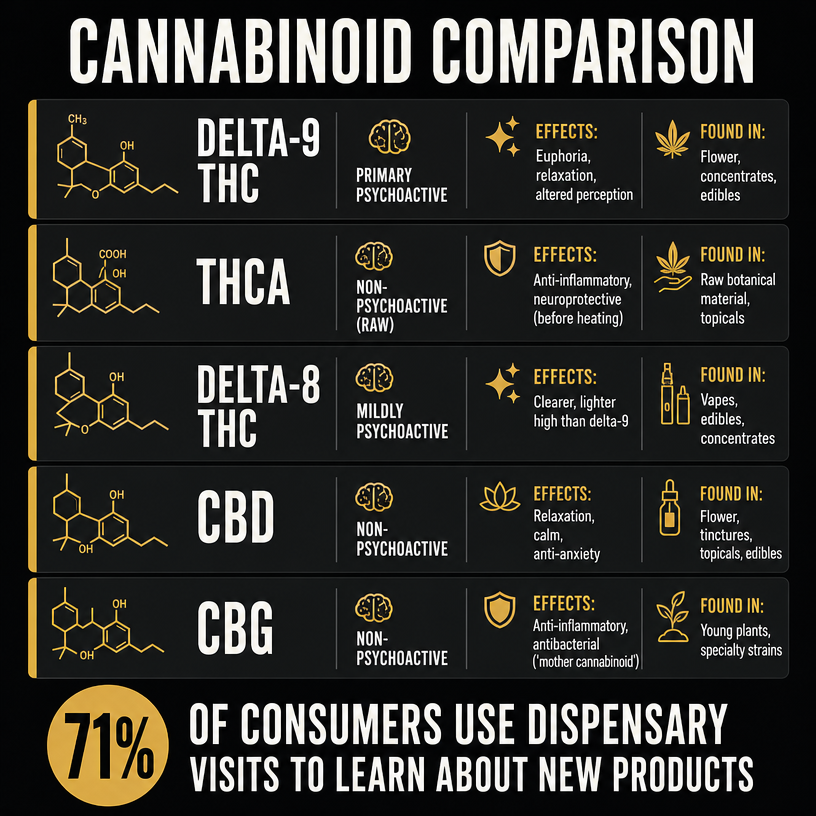
Cannabinoids are the chemical compounds in cannabis that produce its effects. THC is the primary psychoactive compound that creates the high, while CBD is non-psychoactive and associated with calm and relaxation. The cannabis plant contains dozens of other cannabinoids including THCa, CBG, and Delta-8 THC, each with distinct properties. NIH
Here's how the major cannabinoids compare:
Common Cannabinoids
- Delta-9 THC — The primary psychoactive compound in cannabis. Most potency labels refer to delta-9 THC percentage.
- THCa — Tetrahydrocannabinolic acid. The raw, non-psychoactive precursor to THC. When heated, it converts to intoxicating THC.
- Delta-8 THC — A mildly psychoactive cannabinoid found in trace amounts. Produces a lighter, clearer high than delta-9.
- CBD (Cannabidiol) — Non-psychoactive. Associated with relaxation and calm. Does not produce a high.
- CBG (Cannabigerol) — Often called the "mother cannabinoid" because it's the precursor to THC, CBD, and other cannabinoids.
What Are the Different Ways to Consume Cannabis?
Cannabis can be consumed by smoking, vaporizing, oral ingestion, or topical application. Each method affects onset time, duration, and intensity differently. Leafly
Smoking produces immediate effects within minutes. Vaporizing also works quickly but is gentler on the lungs. Edibles take 30-90 minutes to kick in due to first-pass liver metabolism but last significantly longer. Topicals are applied to the skin and are non-psychoactive.
Smoking Methods
- Joint — Hand-rolled cannabis cigarette, the most common method. Rolled with papers, sometimes with a filter tip.
- Blunt — Cannabis rolled in a hollowed-out cigar wrapper. Holds more cannabis and burns slower.
- Bong — Water pipe that filters and cools smoke before inhalation.
- Bubbler — Small handheld water pipe. Combines convenience of a pipe with water filtration.
- Pipe — Small, hand-held smoking device. Smoke drawn directly through the stem.
Vaporizing Methods
- Vape Cartridge — Pre-filled container of cannabis oil attached to a battery. Heats oil to produce vapor without combustion.
- Dry Herb Vaporizer — Heats ground cannabis flower to vaporization without burning. Produces cleaner vapor and is more efficient.
Oral and Topical Methods
- Edible — Food or beverage infused with cannabis. Metabolized through the liver, producing delayed but longer-lasting effects.
- Tincture — Liquid cannabis extract delivered under the tongue (sublingually) for faster absorption than edibles.
- Topical — Product applied directly to the skin — lotions, balms. Non-psychoactive; used for localized application.
- Transdermal Patch — Adhesive patch delivering cannabinoids through the skin. Produces slow, steady release over several hours.
Smoking vs. Vaporizing vs. Edibles
| Method | Onset Time | Duration | Notes |
|---|---|---|---|
| Smoking | 2-5 minutes | 2-3 hours | Immediate effects |
| Vaporizing | 2-5 minutes | 2-3 hours | Gentler on lungs |
| Edibles | 30-90 minutes | 6-8+ hours | Longer, more intense |
| Tincture | 15-45 minutes | 4-6 hours | Sublingual absorption |
| Topical | Varies | Varies | Non-psychoactive |
What Is the Science Behind Cannabis?
The cannabis plant contains aromatic compounds called terpenes that produce distinct flavors and aromas, plus influence effects through the entourage effect — the theory that cannabinoids and terpenes work synergistically. Trichomes are the resin glands containing THC, CBD, and terpenes, while the endocannabinoid system (CB1 and CB2 receptors) is the body's native network that interacts with cannabis compounds. NIH
The cannabis plant is surprisingly complex. Beyond cannabinoids, it contains terpenes, flavonoids, and other compounds that all contribute to the final experience. Understanding these basics helps consumers make more informed choices.
Cannabis Plant Anatomy
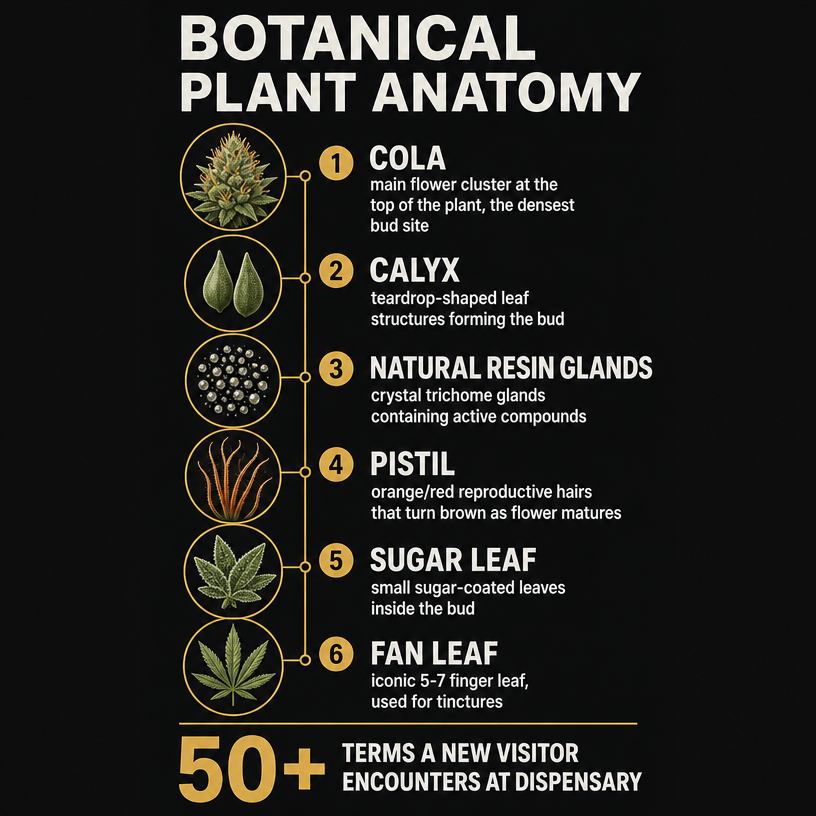
The key parts of the cannabis plant:
- Trichomes — Tiny crystal-like resin glands on cannabis flower. Contain THC, CBD, terpenes — the source of potency.
- Calyx — Teardrop-shaped leaf structures forming on the bud. Where trichomes are most concentrated.
- Pistil — Orange/red hair-like strands on a cannabis bud. The plant's reproductive organs; turn brown as flower matures.
- Sugar Leaf — Small leaves inside the bud, trimmed after harvest. Often used for hash or prerolls.
- Cola — Main flower cluster at the top of the plant. Where buds are most dense.
- Fan Leaf — Large iconic cannabis leaves with 5-7 fingers. Not very potent; used for tinctures.
Key Science Terms
- Terpene — Aromatic compound producing distinct smells and flavors. Also influences effects.
- Terpene Profile — The specific combination and concentration of terpenes in a product. Like a flavor fingerprint.
- Flavonoid — Plant compounds responsible for color and flavor. Cannabis contains flavonoids called "cannaflavins."
- Endocannabinoid System (ECS) — The body's native network of receptors (CB1 and CB2) that interact with cannabis cannabinoids. Helps regulate mood, appetite, sleep, and pain.
- CB1 Receptor — Receptor in the brain and nervous system that THC binds to, producing psychoactive effects.
- CB2 Receptor — Receptor found primarily in the immune system. CBD binds to CB2 receptors.
- Bioavailability — How much of a substance enters your bloodstream. Smoking has ~30% bioavailability; edibles ~4-12%.
- First-Pass Metabolism — The liver filtering substances from the digestive system. Why edibles take longer and feel stronger.
- Decarboxylation — Heating cannabis to convert THCa into intoxicating THC. Raw cannabis does not get you high without this step.
- Entourage Effect — The theory that cannabinoids and terpenes work together synergistically, producing different effects than any single compound alone.
- Potency — Concentration of active cannabinoids (usually THC), expressed as a percentage (flower) or mg (edibles/concentrates).
What Are Concentrates and Extracts?
Concentrates are cannabis products with significantly higher THC than flower, made by extracting cannabinoids from plant material. Solvent-based extracts use chemicals like butane or CO2, while solventless options use only heat and pressure. Leafly
Types of Concentrates
- Rosin — Solventless concentrate made by pressing cannabis flower with heat and pressure. No chemicals used.
- Live Rosin — Solventless concentrate made from fresh-frozen cannabis. Prized for clean, full-spectrum flavor.
- Live Resin — Concentrate made from fresh-frozen plants (never dried). Preserves the full terpene profile.
- Hash / Hashish — One of the oldest concentrates. Pressed or sieved trichomes formed into a solid block.
- Bubble Hash — Hash made using ice water and filtration bags to separate trichome heads from plant material.
- Distillate — Highly refined oil isolating a single cannabinoid (usually THC or CBD) into nearly pure concentrate.
- Wax — Soft, crumbly BHO concentrate with waxy texture. Made using butane extraction.
- Shatter — Brittle, glass-like BHO concentrate. Among the highest-potency products available.
- Badder / Batter — Creamy, cake-batter-textured concentrate with smoother consistency.
- Crumble — Dry, crumbly concentrate with high terpene content.
- Oil — Liquid concentrate, often used in vape cartridges or ingested directly.
What Are the Common Terms Every Cannabis Consumer Should Know?
Beyond product types, cannabis has its own vocabulary. Here are the essential terms to know before visiting a dispensary in Rockland County. New York State
Flower and Plant Terms
- Flower — Dried, cured buds of the cannabis plant. The most traditional and widely available form.
- Nug — Slang for a bud; a single piece of dried cannabis flower.
- Shake — Small pieces of flower that fall off larger buds, usually from handling.
- Kief — Loose powdery trichome crystals collecting at the bottom of a grinder. Much more potent by weight.
- Sinsemilla — Seedless cannabis flower from unpollinated female plants. Higher potency than seeded flower.
- Phenotype — The physical expression of a plant's genetics — how it looks, smells, and smokes.
- Genotype — The genetic code of a cannabis plant — its inherited DNA blueprint.
- Cultivar — Shorthand for "cultivated variety." Essentially synonymous with "strain" in scientific contexts.
- Landrace Strain — A pure, indigenous cannabis variety that has never been crossbred.
- Heirloom Strain — A landrace variety cultivated outside its native region but kept genetically pure.
- Cannabis Ruderalis — A lesser-known third cannabis species, low in THC, used for hardy agronomic traits.
Product and Consumption Terms
- Preroll — Pre-rolled joint sold ready-to-smoke at a dispensary.
- Concentrate — Any cannabis product with THC significantly higher than flower.
- Extract — A type of concentrate made using a solvent (CO2, butane, or alcohol).
- Grinder — Handheld device with teeth that shred cannabis flower. Most have 2-3 chambers to collect kief.
- Dabbing — High-temperature method of consuming concentrates. A small amount is placed on a heated surface and the vapor is inhaled.
- Cola — Main flower cluster at the top of the plant. Where buds are most dense.
- Pistil — Orange/red hair-like strands on a cannabis bud. Turn brown as the flower matures.
- Sugar Leaf — Small leaves inside the bud, often used for hash or prerolls.
- Fan Leaf — Large iconic cannabis leaves with 5-7 fingers. Not very potent.
Dosing and Consumption Terms
- Dose / Dosing — The amount of cannabis consumed at one time. Finding your dose is key — start low, go slow, especially with edibles.
- Microdose — Taking a very small amount for subtle effects without intoxication. Popular for daytime use.
- Tolerance — Reduced sensitivity after regular use, requiring larger doses for the same effects.
- Tolerance Break (T-Break) — Period of abstinence allowing the endocannabinoid system to reset and lower tolerance.
- Stash — Slang for your personal cannabis supply.
- Storage — Proper cannabis storage means: airtight container, cool dark place, moderate humidity. Poor storage degrades potency and flavor.
Cultivation and Processing Terms
- Cure / Curing — Post-harvest process of slowly drying cannabis in controlled conditions. Develops flavor, aroma, and smooth smoking.
- Burp — During curing, briefly opening sealed containers to release built-up moisture and gas.
- Harvest — When cannabis plants are cut down and the flowering phase ends. Timing affects final potency and effects.
- Flush — Giving plants plain water before harvest to remove excess nutrients. Prevents chemical taste.
- Hermaphrodite — A cannabis plant developing both male and female flowers. Usually unwanted — can pollinate and seed up a crop.
- Boveda Pack — Two-way humidity control pack maintaining optimal 58-62% relative humidity in storage.
- Lab Test / COA — Certificate of Analysis. A third-party lab report showing cannabinoid profile, terpene profile, and contaminant screening.
How Does New York's Cannabis Legalization Affect Me?
New York's Cannabis Control Board regulates dispensaries and product sales statewide. Adult-use cannabis is legal in New York for consumers 21 and older, with dispensaries operating under state regulation. Treehouse Cannabis in Rockland County offers lab-tested products with clear labeling, so consumers know exactly what they are purchasing — no guessing about potency or contents. New York State
Key Legal Terms for NY Consumers
- Regulate / Regulation — Legal framework overseeing cannabis production and sales. In NY, the Cannabis Control Board regulates dispensaries.
- Perennial — A plant that regrows year after year. Cannabis is technically an annual — it completes its life cycle in one season and dies.
- COA (Certificate of Analysis) — Required lab report showing potency and safety screening.
Ready to put your new cannabis vocabulary to work? Visit Treehouse Cannabis in Rockland County for lab-tested flower, concentrates, edibles, and vaporizers — all clearly labeled, all adult-use legal.
Frequently Asked Questions
What is the difference between indica and sativa?
Indica strains are historically associated with relaxing, body-focused effects that may help with unwind and relaxation. Sativa strains tend to produce more uplifting, cerebral effects associated with creativity and energy. Most dispensary products are hybrid strains that combine genetics from both types.
What does THCa mean and how is it different from THC?
THCa (tetrahydrocannabinolic acid) is the raw, non-psychoactive precursor to THC. When cannabis is heated through smoking, vaping, or cooking, THCa converts to intoxicating THC. Raw cannabis flower will not get you high — decarboxylation is required first.
How long do edible effects last compared to smoking?
Smoking produces effects within 2-5 minutes that peak around 30 minutes and fade within 2-3 hours. Edibles take 30-90 minutes to kick in due to first-pass liver metabolism, but effects peak at 2-3 hours and can last 6-8 hours or longer. Starting with a low dose (5mg or less) and waiting is recommended.
What is the entourage effect?
The entourage effect is the theory that cannabinoids like THC and CBD work better together than in isolation, with terpenes and other compounds enhancing or modulating the overall effect. This is why whole-plant extracts with full spectrum profiles may produce different effects than isolated cannabinoids taken alone.
What should I look for on a cannabis lab test (COA)?
A Certificate of Analysis (COA) shows the cannabinoid profile (THC, CBD, and other cannabinoid percentages), terpene profile, and screening for contaminants like pesticides, heavy metals, and residual solvents. Checking the COA before purchasing verifies the product's potency and safety.
What are the main methods for consuming cannabis?
The main methods include smoking (joints, blunts, pipes, bongs), vaporizing (dry herb vapes, vape cartridges), oral ingestion (edibles, tinctures), and topical application (lotions, patches). Each method produces different onset times and duration of effects.
What are terpenes and why do they matter?
Terpenes are aromatic compounds in cannabis that produce distinct smells and flavors like citrus, pine, or berry. Beyond aroma, terpenes influence the effects of each strain through the entourage effect — working alongside cannabinoids to modulate the overall experience.
Sources
- Leafly — Cannabis Glossary
- New York State Cannabis Information
- NIH — Cannabis Phytochemistry Research
Treehouse Cannabis is a licensed adult-use dispensary in Rockland County, New York. Must be 21+ to purchase. This content is for informational purposes only and is not medical advice.
About Treehouse Cannabis
Treehouse Cannabis is Rockland County's premier adult-use dispensary, offering a carefully curated selection of premium cannabis products including flower, concentrates, edibles, and more. Our knowledgeable team is dedicated to helping both new and experienced consumers find the right products for their needs in a welcoming, judgment-free environment. Visit us at treehousecannabis.com to learn more about our current selection and special offers.
Shop our products

Shop All
Flower
Pre-rolls
Vaporizers

Edibles
Drinks
Concentrates
Tinctures

Topicals
CBD

Pet CBD
Accessories