

Our hand-picked selection of the greatest cannabis-themed films ever made — from 1978 to today
Top 10 Stoner Movies: Classics Every Cannabis Lover Should Watch
Top 10 Stoner Movies: Classics Every Cannabis Lover Should Watch
From Cheech & Chong to Pineapple Express, these are the films that defined cannabis culture on screen — our hand-picked selection of the greatest stoner movies ever made, from 1978 to today. Whether you're building your watch list for a smoke session or just want to understand why these films matter, Treehouse's team has pulled together the essential canon.
Our Top 10
Here's our ranking of the 10 best stoner movies — from the genre-defining original to the modern classics:
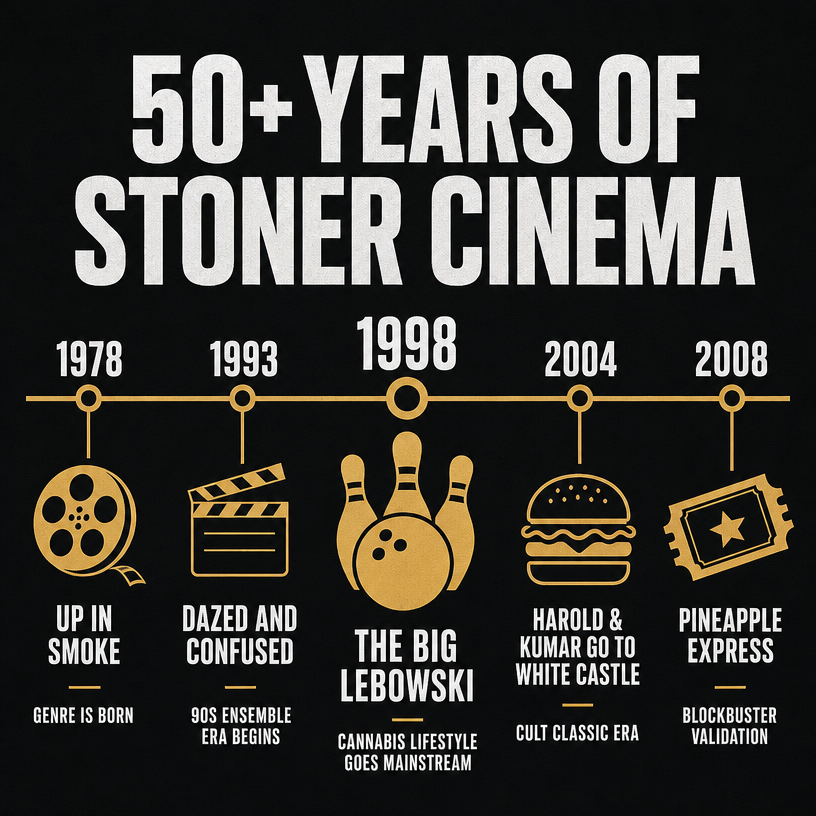
- Up in Smoke (1978) — The one that started it all. Cheech & Chong's debut invented every convention the genre runs on.
- Dazed and Confused (1993) — The definitive '90s entry. Ensemble, nostalgic, and endlessly quotable.
- The Big Lebowski (1998) — The Dude abides, and so does cannabis culture's most iconic character.
- Friday (1995) — Urban comedy perfection. Single day, single location, maximum chemistry.
- Harold & Kumar Go to White Castle (2004) — The weed montage that launched a franchise. Neil Patrick Harris' cameo alone earns this a spot.
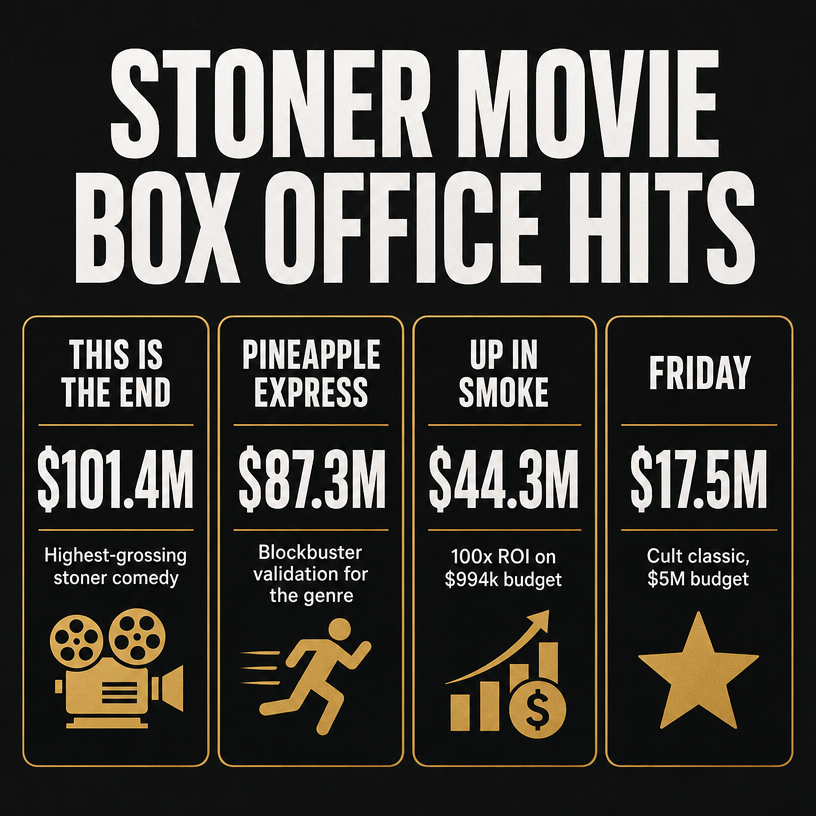
- Pineapple Express (2008) — When stoner comedy met action blockbuster. $87M doesn't lie.
- Half Baked (1998) — Dave Chappelle's breakout. Still the most quoted film on this list.
- Superbad (2007) — Teen comedy with the legendary McLovin fake-ID subplot. 88% on Rotten Tomatoes.
- Detroit Rock City (1999) — Four Kiss fans, one road trip, enough cannabis-fueled heart to balance the chaos.
- Jay and Silent Bob Strike Back (2001) — Kevin Smith's weed-obsessed duo get their definitive showcase.
What Makes a Movie a 'Stoner Classic'?
A stoner movie is a comedy where recreational cannabis use drives the plot and defines the characters — not just a film with weed somewhere in the background. The genre, born with Cheech & Chong's Up in Smoke in 1978, centers on cannabis culture as a lifestyle, with the "running out of weed" panic becoming a defining trope. Wikipedia These films are less about the high and more about the attitude: laid-back, self-aware, and unapologetically in on the joke.
The defining traits of a stoner classic:
- The running-out-of-weed plot — the central panic that drives most genre entries
- Two burnout protagonists with undeniable chemistry
- The smoke session as social ritual — cannabis as a way to bond, not just consume
- Self-aware humor that doesn't moralize or preach
What separates a true stoner film from a regular comedy with cannabis in it is the degree to which the plant shapes every decision, every relationship, and every punchline. These films treat cannabis culture with affection rather than shame — and that's why they resonate.
Why is Up in Smoke (1978) Considered the Original Stoner Comedy?
Up in Smoke earned $104 million on a $994k budget — a 100x return — and was recently added to the National Film Registry, cementing its place as one of the most important films in American cinema. It established every convention the genre follows: two burnout protagonists, a road trip structure, and the eternal panic of running out of weed. Cheech Marin and Tommy Chong's chemistry turned cannabis comedy into a cultural phenomenon that still influences films today.
What Up in Smoke got right:
- Two fully committed burnout characters — not stereotypes, but people
- The road trip structure that lets cannabis culture breathe across different settings
- No moralizing — cannabis is treated as a normal part of life, not a problem
- Physical comedy rooted in character rather than cheap jokes
It launched Cheech & Chong as icons and proved that cannabis-focused comedy had mass commercial appeal. Without Up in Smoke, there is no Dazed and Confused, no Pineapple Express, no Harold & Kumar.
Why is Dazed and Confused (1993) the Definitive '90s Stoner Film?
Dazed and Confused holds a 94% Tomatometer score (Certified Fresh) and captured cannabis culture as a normal part of social life rather than a punchline. Rotten Tomatoes Richard Linklater's ensemble film about the last day of high school in 1976 established the "smoke session as social ritual" trope — where getting high is less about the substance and more about the company. It influenced every teen comedy that followed.
Why Dazed and Confused still matters:
- Ensemble cast that captures every type of high school personality
- Cannabis as a social lubricant — present, normalized, unremarkable
- Historical setting (1976) gives the film a timeless quality
- No moral arc — nobody learns anything about cannabis; it's just there
Where Up in Smoke built the template, Dazed and Confused refined it. It showed that a stoner film could be about more than just two guys on a road trip — it could be about an entire culture in a single night.
What Makes The Big Lebowski (1998) a Stoner Icon?
The Dude abides — and so does cannabis culture's most enduring character. The Big Lebowski holds 79% on Rotten Tomatoes, but the score doesn't capture its real impact: "The Dude" became shorthand for a cannabis lifestyle. Rotten Tomatoes His laid-back philosophy, bowling obsession, and White Russian habit defined what a cannabis-friendly life looks like in popular culture. No other film has that specific combination of zen and slacker energy.
Why The Dude endures:
- Jeffrey Lebowski — the definitive cannabis-friendly protagonist in popular culture
- "The Dude abides" — a philosophy, not just a tagline
- Cannabis is ambient — it's part of the atmosphere, not the plot engine
- More quotable moments per minute than any other film on this list
The Big Lebowski proved that a stoner film could work as a crime caper, a meditation on life, and a buddy comedy all at once. It's the genre's chameleon.
Which Modern Stoner Comedies Should You Watch?
The 2000s brought stoner comedy into the mainstream without losing its roots. Harold & Kumar Go to White Castle (2004) gave us the iconic weed montage and Neil Patrick Harris' scene-stealing cameo. Pineapple Express (2008) proved the genre had wide box office appeal, earning $87M by blending stoner comedy with action. CelebStoner.com Superbad (2007) brought the sensibility to teen films with the legendary McLovin fake-ID subplot.
The modern era by the numbers:
- Pineapple Express — $87.3M box office CelebStoner.com
- Superbad — 88% on Rotten Tomatoes Rotten Tomatoes
- Harold & Kumar Go to White Castle — spawned two sequels and a cult following
What set these apart from earlier entries:
- Higher production values and mainstream casting
- Action-comedy hybrid format (Pineapple Express especially)
- Wider demographic appeal — these films worked for audiences beyond cannabis users
- Self-referential humor that plays on genre expectations
The modern era proved that stoner comedy could compete at the box office and with critics simultaneously — genre credibility with mainstream success.
What Other Stoner Films Are Worth Watching?
Beyond the obvious picks, stoner cinema has real depth. Friday (1995) brought cannabis culture to urban comedy with a single-day LA story that grossed $17M on a $5M budget. Half Baked (1998) gave Dave Chappelle his breakout role with an unapologetic celebration of cannabis culture. Detroit Rock City (1999) sent four underage Kiss fans on a road trip with enough cannabis-fueled humor to balance genuine heart. Jay and Silent Bob Strike Back (2001) turned the View Askewniverse's weed-obsessed duo into their own movie.
Five more essential watches:
- Friday (1995) — $17M on $5M budget; the single-day structure is a masterclass in minimalism
- Half Baked (1998) — Dave Chappelle's breakout; still the most quoted stoner film ever made
- Detroit Rock City (1999) — road trip comedy with heart; the cannabis humor is organic, not forced
- Jay and Silent Bob Strike Back (2001) — Kevin Smith rewards his fans with the duo's definitive outing
- Superbad (2007) — the McLovin fake-ID subplot alone earns a spot on any list
The Evolution of Stoner Cinema: A 50-Year Story
The stoner film genre has shaped cannabis culture since the 1970s, moving from counterculture artifact to mainstream entertainment. Wikipedia From Cheech & Chong's road trip template to the ensemble comedies of the 90s to the action-comedy hybrids of the 2000s, the genre has never stopped evolving — even as its core audience has remained consistent.
How the genre changed over five decades:
- 1978–1990: The Template Era — Up in Smoke established every convention; imitators followed
- 1993–1999: The Ensemble Era — Dazed and Confused showed the genre could capture a moment in time
- 2000–2009: The Mainstream Era — Pineapple Express proved big budgets and stoner comedy could coexist
- 2010–present: The Streaming Era — on-demand viewing has kept the classics alive and created new audiences
What hasn't changed: the fundamental appeal of watching characters navigate life with cannabis as their compass. The genre is ultimately about perspective — and keeping things mellow when everything else is chaos.
Frequently Asked Questions
What defines a stoner movie?
A stoner movie is a comedy where recreational cannabis use drives the plot and defines the characters. The genre, established by Cheech & Chong in 1978, centers on cannabis culture as a lifestyle rather than just a plot device. Key traits include the "running out of weed" panic, laid-back protagonists, and self-aware humor that doesn't moralize about cannabis.
What are the all-time best stoner films?
The canonical stoner films include Up in Smoke (1978), Dazed and Confused (1993), Friday (1995), The Big Lebowski (1998), Half Baked (1998), Detroit Rock City (1999), Jay and Silent Bob Strike Back (2001), Harold & Kumar Go to White Castle (2004), Superbad (2007), and Pineapple Express (2008). Each defined the genre at different points — from the original template to the 90s ensemble era to modern mainstream hits.
Why is Dazed and Confused considered a classic?
Dazed and Confused holds a 93% Rotten Tomatoes score and captured cannabis culture as a normal social ritual rather than a punchline. Richard Linklater's ensemble film about the last day of high school in 1976 influenced every teen comedy that followed and remains the most influential stoner film of the 90s.
What was the first stoner comedy blockbuster?
Up in Smoke (1978) was the first stoner comedy to achieve blockbuster status — earning $104 million on a $994k budget, a 100x return. It launched Cheech & Chong as cultural icons and established every convention the genre follows. It was recently added to the National Film Registry, cementing its status as a defining film of the genre.
Sources
- Wikipedia — Stoner film
- Rolling Stone — 10 Best Stoner Movies of All Time
- Rotten Tomatoes — Essential Stoner Movies
- CelebStoner.com — Top 22 Grossing Stoner Movies of All Time
Treehouse Cannabis is a licensed adult-use dispensary in Rockland County, New York. Must be 21+ to purchase. This content is for informational purposes only and is not medical advice.
About Treehouse Cannabis
Treehouse Cannabis is Rockland County's premier adult-use dispensary, offering a carefully curated selection of premium cannabis products including flower, concentrates, edibles, and more. Our knowledgeable team is dedicated to helping both new and experienced consumers find the right products for their needs in a welcoming, judgment-free environment. Visit us at treehousecannabis.com to learn more about our current selection and special offers.


Shop our products

Shop All

Deals

Flower

Pre-rolls

Vaporizers

Edibles
Drinks

Concentrates

Tinctures

Topicals

CBD

Pet CBD

Accessories