
A timeline of how cannabis went from essential agriculture to federal prohibition — and back again
USA Cannabis History: From Colonial Cash Crop to Controlled Substance
USA Cannabis History: From Colonial Cash Crop to Controlled Substance
A timeline of how cannabis went from essential agriculture to federal prohibition — and back again.
The United States grew hemp for rope, sails, paper, and fabric for over 200 years — farmers in colonial Virginia were once legally required to cultivate it. By the 1970s, the same plant was classified as a Schedule I controlled substance subject to the harshest criminal penalties. This stark reversal was driven not by science or public health, but by media hysteria, racial prejudice, and economic self-interest — and America is now slowly undoing it. PBS Frontline
Why Was Hemp a Critical Crop in Colonial America?
Hemp was one of the most valuable agricultural commodities in early America, serving as the backbone of the nation's maritime and industrial infrastructure before cotton or synthetic fibers existed.
Colonial farmers in Virginia and other regions were legally obligated to grow hemp, and the plant was considered essential for producing rope, sails, and sturdy fabric for the growing nation. The stalk fibers from the cannabis plant provided unmatched durability for rope and canvas in an era before synthetic materials. Paper production also relied heavily on hemp pulp — the Gutenberg Bible and many colonial-era documents were printed on hemp paper. PBS Frontline
Key uses of colonial hemp:
- Rope and rigging for ships powering America's naval and commercial fleet
- Sails for merchant and military vessels
- Paper for newspapers, books, and government documents
- Fabric for work clothing, canvas, and industrial applications
George Washington cultivated hemp at Mount Vernon, and Thomas Jefferson called it "a necessary staple for the independence of America." The plant was so vital that early American law treated it as a strategic resource — not a drug.
How Did the Mexican Revolution Reshape America's View of Cannabis?
Cannabis had been used medicinally in the U.S. since the 1850s, appearing in pharmacies and medical journals as a treatment for various ailments. But beginning in 1910, a wave of immigration from the Mexican Revolution brought a new practice: smoking cannabis for relaxation and recreation. Organization of American Historians (OAH)
This was fundamentally different from the medicinal tinctures Americans had used. American media quickly linked the new immigrant communities to crime, violence, and moral decay — framing cannabis not as medicine but as a dangerous foreign vice.
The plant's name was deliberately changed to "marihuana" — a Spanish term designed to make the plant sound exotic and threatening to American ears. This rebranding distanced cannabis from its familiar medical reputation and attached it to anxieties about immigration and cultural change. Organization of American Historians (OAH)
Key events in the early prohibition shift:
- 1910 — Mexican Revolution triggers immigration wave; American media links cannabis use to violent crime
- 1913 — California becomes the first state to restrict cannabis possession
- By 1931 — 29 states had already restricted cannabis before any federal law existed Organization of American Historians (OAH)
State-level bans accelerated through the 1920s, driven more by xenophobia than evidence. Cannabis regulation in the U.S. began at the state level in the early 20th century — all states had some form of restriction by the mid-1930s. Wikipedia
Who Was Harry Anslinger and How Did He Engineer Cannabis Prohibition?
In 1930, Harry Anslinger was appointed the first head of the newly formed Federal Bureau of Narcotics. He would become the architect of American cannabis prohibition — and he wielded media power with calculated precision.
Anslinger's campaign relied on fabricated stories of cannabis-induced violence, rape, and insanity. He specifically targeted Black Americans and Mexican communities in his propaganda, claiming the drug made Black men " hypersexual" and likely to assault white women. He exploited the racial prejudices of Congress and the press to build political support. Organization of American Historians (OAH)
Anslinger's primary tool was his network of contacts at Hearst newspapers — the largest newspaper chain in America. Through these papers, he published sensational "reefer madness" stories with fabricated details designed to create moral panic.
Many of these stories bore no relationship to actual events but were effective at shaping public perception. When researchers like Dr. William Woodworth at the U.S. Public Health Service told him the actual health risks were minimal, Anslinger dismissed them and doubled down on propaganda.
What Was the Marihuana Tax Act of 1937 and How Did It Outlaw Cannabis?
The Marihuana Tax Act of 1937 did not explicitly ban cannabis — instead, it imposed a crushing financial burden that made the plant economically impossible to handle legally.
The Act required anyone cultivating, selling, or possessing cannabis to register with the federal government and pay an astronomical tax — up to $2,000 per ounce in certain circumstances, an enormous sum in the Depression era. Failure to pay carried criminal penalties including prison time. Wikipedia
The Act passed with virtually no Congressional hearings on the actual effects of the drug. Anslinger lobbied intensively, and newspaper magnate William Randolph Hearst — who had massive financial interests in timber (for paper) and a stake in alcohol Prohibition repeal — supported prohibition because hemp paper would destroy his timber investments.
How the Tax Act worked:
- Required registration and payment of steep taxes on all cannabis handling
- Transfer of cannabis without paying the tax was a criminal offense
- Made legal cultivation, sale, and possession financially untenable
- Passed with no meaningful scientific review of cannabis effects Wikipedia
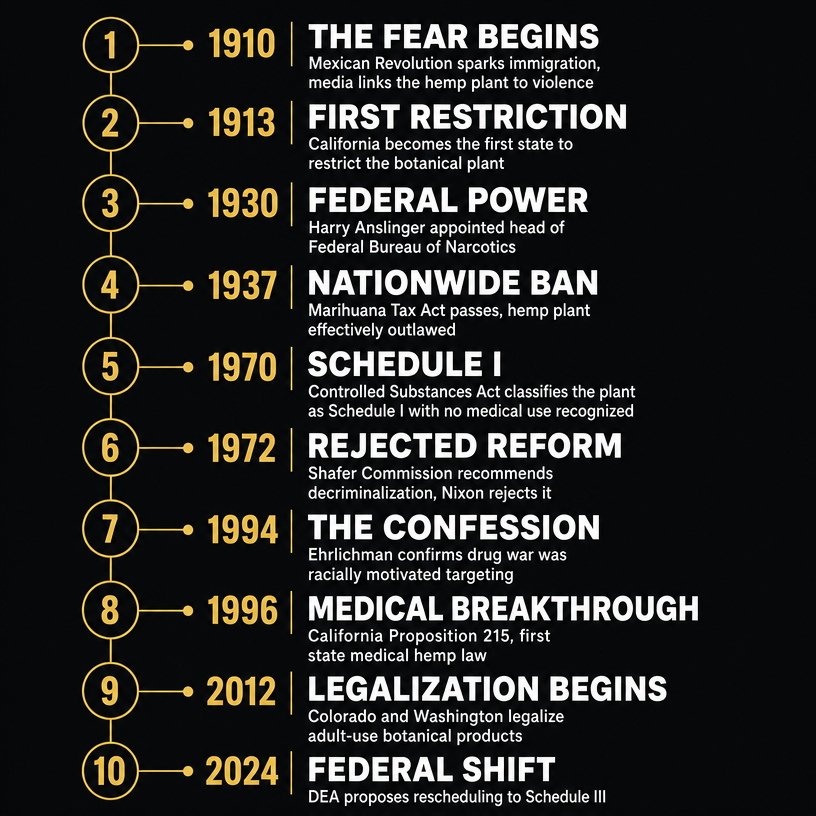
The first national regulation of cannabis was the Marihuana Tax Act of 1937 — effectively criminalizing marijuana nationwide through a financial stranglehold rather than an explicit ban. PBS Frontline
How Did the War on Drugs Unfairly Target Communities of Color?
Despite the Shafer Commission — appointed by Nixon himself — recommending cannabis decriminalization in 1972, Nixon rejected the recommendation and escalated prohibition through the Controlled Substances Act of 1970, which classified cannabis as a Schedule I drug: the most restrictive category, reserved for substances with high abuse potential and no accepted medical use. Wikipedia
Nixon's domestic policy chief John Ehrlichman later admitted in a 1994 interview that the war on drugs was deliberately designed to target Black Americans and anti-war activists — by associating hippies with marijuana and Black people with heroin, then criminalizing both groups heavily. Equal Justice Initiative (EJI)
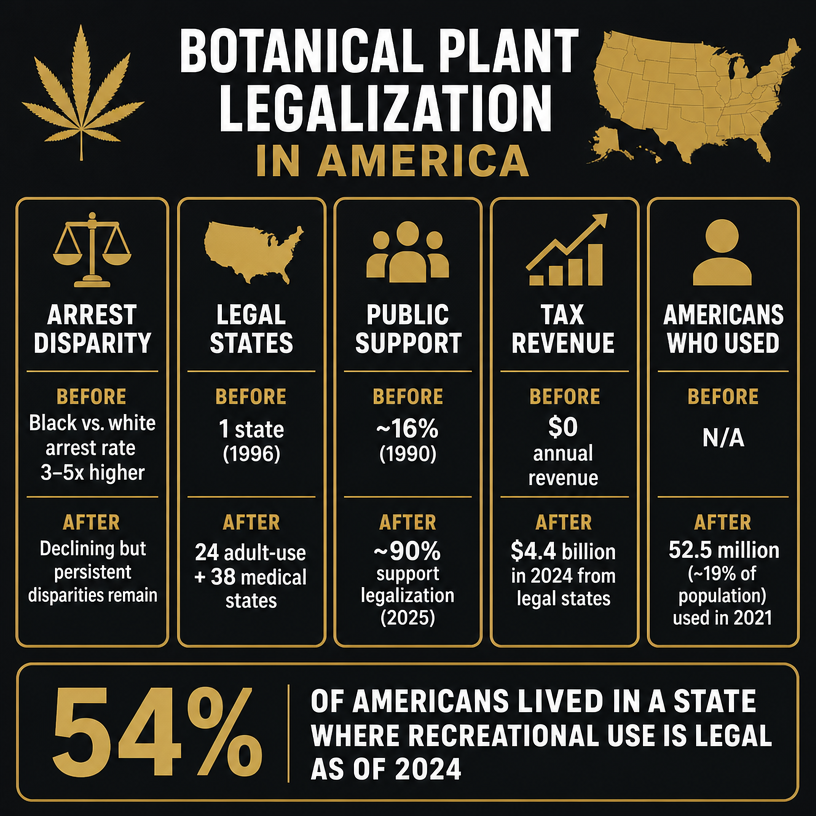
The racial disparity was staggering and deliberate. Despite equivalent usage rates between Black and white Americans, Black Americans were arrested for cannabis possession at 3 to 5 times the rate of white Americans for decades. Equal Justice Initiative (EJI)
The impact of racially disparate enforcement:
- Mass incarceration of Black and Latino communities for non-violent cannabis offenses
- Loss of voting rights for millions of formerly incarcerated individuals
- Generational wealth destruction through criminal records blocking employment and housing
- No evidence of differential usage — only differential enforcement Equal Justice Initiative (EJI)
This policy design was documented and deliberate. The war on drugs did not emerge from concerns about public health or scientific evidence — it emerged from political calculations to criminalize communities that were politically inconvenient.
When Did States Begin Legalizing Marijuana and Where Is Legalization Heading?
California's Proposition 215 in 1996 — the Compassionate Use Act — became the first state-level medical marijuana ballot initiative in the United States, passed with 55.58% of the vote. Wikipedia It marked the beginning of a state-by-state rebellion against federal prohibition that has reshaped American cannabis policy.
California's move was controversial at the time but quickly proved influential. By 2025, 38 states have some form of medical marijuana program and 24 states have legalized adult-use cannabis — representing a majority of Americans living in legal-weed states. Public support for legalizing marijuana in some form reached approximately 90% by 2025. Wikipedia
The trajectory has been consistent: each election cycle brings more states into the legal column. Colorado and Washington legalized adult-use in 2012; by 2024, the majority of Americans lived in states with some form of legal cannabis. Tax revenue from legal adult-use sales in 2024 exceeded $4.4 billion — a figure that demonstrates the economic transformation legalization has created.
In 2024, the DEA proposed rescheduling cannabis from Schedule I to Schedule III — a historic shift that would acknowledge accepted medical use and reduce the criminal stigma. While full federal legalization remains unresolved, the direction is clear.
Key milestones in the legalization trajectory:
- 1996 — California Proposition 215: first state medical marijuana law
- 2012 — Colorado and Washington: first adult-use legalization
- 2024 — DEA proposes rescheduling cannabis to Schedule III
- 2025 — 24 states with adult-use cannabis, 38 with medical programs
FAQ
When was marijuana made illegal in the United States?
Marijuana was effectively banned nationwide with the passage of the Marihuana Tax Act of 1937, which imposed prohibitive taxes and regulations that made legal cannabis impossible. It was formally classified as a Schedule I controlled substance with the Controlled Substances Act of 1970, outlawing it for any use at the federal level. Wikipedia
What was the Marihuana Tax Act of 1937 and how did it work?
The Marihuana Tax Act of 1937 banned cannabis by requiring anyone handling the plant to register and pay an astronomical tax — effectively pricing it out of legal existence. It was not a direct prohibition but a financial stranglehold that made cultivation, sale, and possession legally and economically untenable. Wikipedia
How did Harry Anslinger influence marijuana prohibition?
Harry Anslinger, the first head of the Federal Bureau of Narcotics, orchestrated a nationwide propaganda campaign falsely linking cannabis to violence and insanity, particularly targeting communities of color and immigrants. He used newspaper contacts to publish sensational "reefer madness" stories and successfully lobbied Congress to pass the 1937 Marihuana Tax Act. Organization of American Historians (OAH)
Why were communities of color disproportionately targeted by drug laws?
Nixon's own domestic policy chief confirmed the war on drugs was designed to target Black Americans and anti-war activists. Law enforcement consistently enforced cannabis laws against Black and Latino communities at 3 to 5 times the rate of white Americans despite equivalent usage rates — a disparity driven by deliberate policy design, not actual consumption patterns. Equal Justice Initiative (EJI)
When did states begin legalizing marijuana for medical use?
California became the first state to legalize medical marijuana with Proposition 215 in 1996. This sparked a wave of state-level legalization — by 2025, 38 states have medical marijuana programs and 24 states have legalized adult-use cannabis, representing a majority of Americans living in legal-weed states. Wikipedia
Sources
- Wikipedia — Cannabis regulation in the U.S. began at the state level in the early 20th centu
- PBS Frontline — Hemp was cultivated in colonial America for rope, sails, and clothing; the 1937
- Organization of American Historians (OAH) — Drug regulation in America originated in the late 19th century at the state leve
- Equal Justice Initiative (EJI) — Nixon's domestic policy chief John Ehrlichman admitted in a 1994 interview that
- Wikipedia — California's Proposition 215 (Compassionate Use Act of 1996) became the first st
About Treehouse Cannabis
Treehouse Cannabis is a licensed adult-use dispensary in Rockland County, New York. Must be 21+ to purchase. Shop our curated selection of premium cannabis flower and more at treehousecannabis.com.
This content is for educational purposes only and does not constitute medical advice.

Shop our products

Shop All

Flower

Pre-rolls
Vaporizers

Edibles
Drinks

Concentrates
Tinctures

Topicals

CBD

Pet CBD

Accessories