
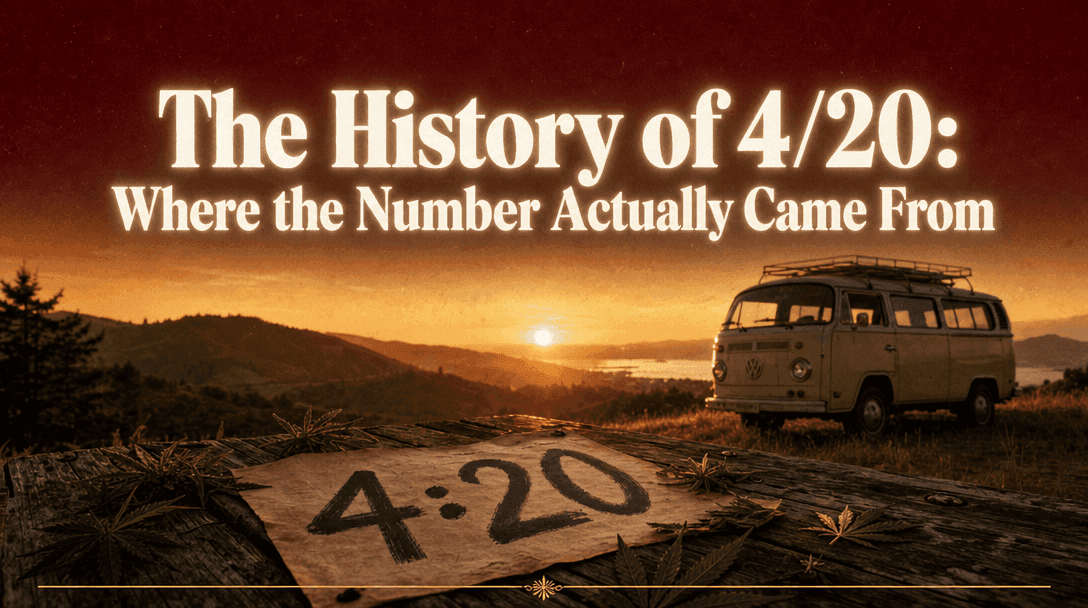
The History of 4/20: Where the Number Actually Came From
The History of 4/20: Where the Number Actually Came From
4/20 is shorthand for cannabis and the date April 20 — the day cannabis culture gathers each year for an unofficial holiday. The number started life as a private 4:20 p.m. meeting time used by five San Rafael High School students in fall 1971, then slipped into the wider world through Grateful Dead tour culture in the 1970s and 1980s. Today it lives in dispensary menus, social-media hashtags, and legalization rallies from coast to coast — including the adult-use shelves right here in Rockland, Orange, and Westchester Counties.
What Does 4/20 Actually Mean in Cannabis Culture?
In modern usage, "4/20" means two things at once. It's a slang term for cannabis consumption — lighting up "at 4:20" — and it's the date April 20, when cannabis culture gathers each year for an annual celebration. The phrase has been in print in High Times since 1991, entered the Oxford English Dictionary in 2017, and now shows up in dispensary deals, music festival lineups, and rally signage across the country [1].
Worth knowing alongside this story: The History and Evolution of Cannabis Laws in the U.S., which traces how cannabis law actually evolved in the U.S. decade by decade. If you're planning to mark the day yourself, our The Ultimate 4/20 Guide covers the adult-use side — what to stock, how to pace yourself, and where to find events locally.
Today, "4/20" works as four overlapping signals at once:
- A time of day — 4:20 p.m., the private meeting time five San Rafael High School friends picked in fall 1971
- A date on the calendar — April 20, the annual gathering day for dispensaries, festivals, and rallies
- A slang verb — "let's 420," used as shorthand for cannabis consumption itself
- A cultural brand — printed in High Times since 1991 and added to the Oxford English Dictionary in 2017
The number itself, though, was never a marketing term. It started life as a quiet in-joke among five teenagers at San Rafael High School in Marin County, California, in the fall of 1971. The five — Steve Capper, Dave Reddix, Jeffrey Noel, Larry Schwartz, and Mark Gravich — gave themselves a group name and a meeting time, and "4:20" stuck as the way to refer to both [2].
Who Coined 4/20?
The five teenagers called themselves the Waldos, after a wall they liked to lean against between classes. Every school day that fall, they would meet at 4:20 p.m. by the statue of Louis Pasteur outside the school, then drive out to a Point Reyes National Seashore clearing where a coastguard had allegedly abandoned a cannabis grow. The grow was never found, but the meeting time became their shorthand — and a code they could use in front of parents and teachers without raising eyebrows [4].
The Waldos aren't a folk story. All five are still alive, still on good terms, and have given interviews and depositions about the timeline. Their handwritten notes and yearbook inscriptions from 1971 are the documents the Oxford English Dictionary cited in 2017 when it added "420" as an entry. In other words, the origin of 4/20 has the same paper trail as any other bit of pop-cultural etymology — except the paper trail starts with five teenagers trying not to get caught 420 comes and goes. The culture stays..
Key pieces of the Waldos origin story:
- The five Waldos — Steve Capper, Dave Reddix, Jeffrey Noel, Larry Schwartz, and Mark Gravich
- The Louis Pasteur statue — their daily 4:20 p.m. meeting spot outside San Rafael High School
- The Point Reyes clearing — the destination they hoped held an abandoned cannabis grow
- The code itself — "4:20," usable in front of parents and teachers without raising eyebrows
- The 1971 paper trail — handwritten notes and yearbook inscriptions later cited by the OED
Is the Police Code Theory About 420 True?
No — and the official California code book proves it. California Penal Code section 420 covers "obstructing entry on public land" and similar property offenses, not cannabis. The statute has nothing to do with marijuana, and no state in the country has ever used 420 as a police radio code for cannabis [5].
So where did the rumor start? A flyer handed out at a Grateful Dead show in December 1990 repeated the police-code claim as part of an invitation to "meet at 4:20 on 4/20." High Times printed the flyer in May 1991, the rumor escaped into the wider cannabis world, and the Waldos spent the next decade quietly correcting the record [3]. The myth has stuck around because it sounds authoritative, and because a real statute with the right number is more satisfying than a high school meeting time Cannabis and Music Culture: From Jazz Clubs to Modern Festivals.
Myths about the police-code claim, sorted:
- California Penal Code 420 — covers "obstructing entry on public land," not cannabis
- The 1990 Dead show flyer — popularized the police-code claim, not the penal code itself
- High Times' May 1991 article — repeated the myth before correcting it in December 1998
- The Waldos' documents and interviews — the actual paper trail behind the origin
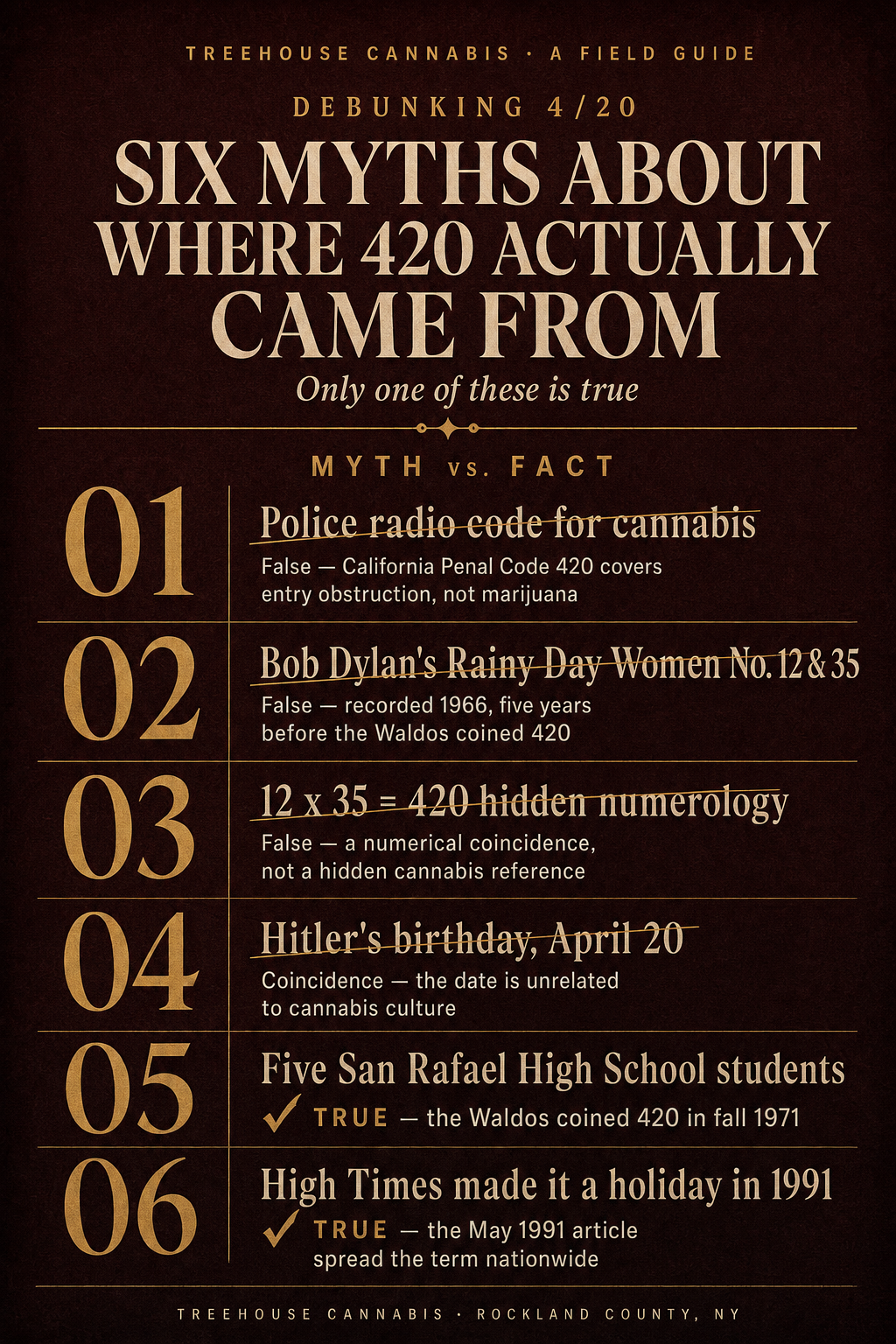
How Did 420 Spread From Five High Schoolers to Deadheads Nationwide?
The Waldos had an in: Dave Reddix's older brother, Patrick Reddix, was close friends with Grateful Dead bassist Phil Lesh. When Lesh and the rest of the Dead's road crew came through Marin County, the Waldos got access to backstage hangouts, tour buses, and sound checks. The Dead's crew picked up "4:20" the way any group picks up a useful private code, and started using it on tour [1].
By the late 1970s, the term had spread across the Grateful Dead's national road network — roadies, taper sections, parking-lot tailgates, all of it. The Dead were touring roughly half the year, and their fanbase carried the term into nearly every state. By the early 1980s, "4/20" was a known handshake among Deadheads long before it appeared in print anywhere [2].
How the term traveled, in order:
- Patrick Reddix — Waldo Dave Reddix's older brother, friend of Phil Lesh
- Backstage access — Waldos entered the Dead's road crew world through Lesh
- Tour bus adoption — roadies, taper sections, and parking-lot tailgates picked up "4:20"
- Late 1970s spread — the term traveled with the Dead's national touring schedule
- Pre-print handshake — "4/20" was a known term long before it appeared in print
What Did High Times Do With 420 in 1991?
In December 1990, a flyer circulated at a Grateful Dead show in Oakland. It invited people to "meet at 4:20 on 4/20" for a smoke-in. High Times reporter Steven Bloom was handed a copy, and in May 1991 the magazine ran a short piece about the flyer and the term. That article was the first time "4/20" appeared in a national cannabis publication [3].
For the next seven years, High Times used the term in event coverage without saying where it came from. Then in December 1998, the magazine ran a longer story crediting the Waldos as originators — based on documents and interviews the group had been collecting. By the time Wikipedia and mainstream newspapers picked the story up in the 2000s, the Waldos origin was already established among the people who followed the magazine [1].
High Times milestones for 4/20:
- December 1990 — flyer at a Grateful Dead show in Oakland inviting people to "meet at 4:20 on 4/20"
- May 1991 — Steven Bloom publishes the flyer, the first national cannabis article using "4/20"
- December 1998 — High Times credits the Waldos by name, based on documents and interviews
- 2000s onward — Wikipedia, mainstream newspapers, and the Oxford English Dictionary (2017) adopt the Waldos origin
For adult customers walking into a dispensary today — looking for a fresh eighth of flower, a pre-roll, or an edible to share on 4/20 — the term has traveled an unusual road: from a high school statue in Marin County, through twenty years of Dead tour buses, into the pages of a national magazine, and out onto the menu boards of legal shops Whole Flower Flower.
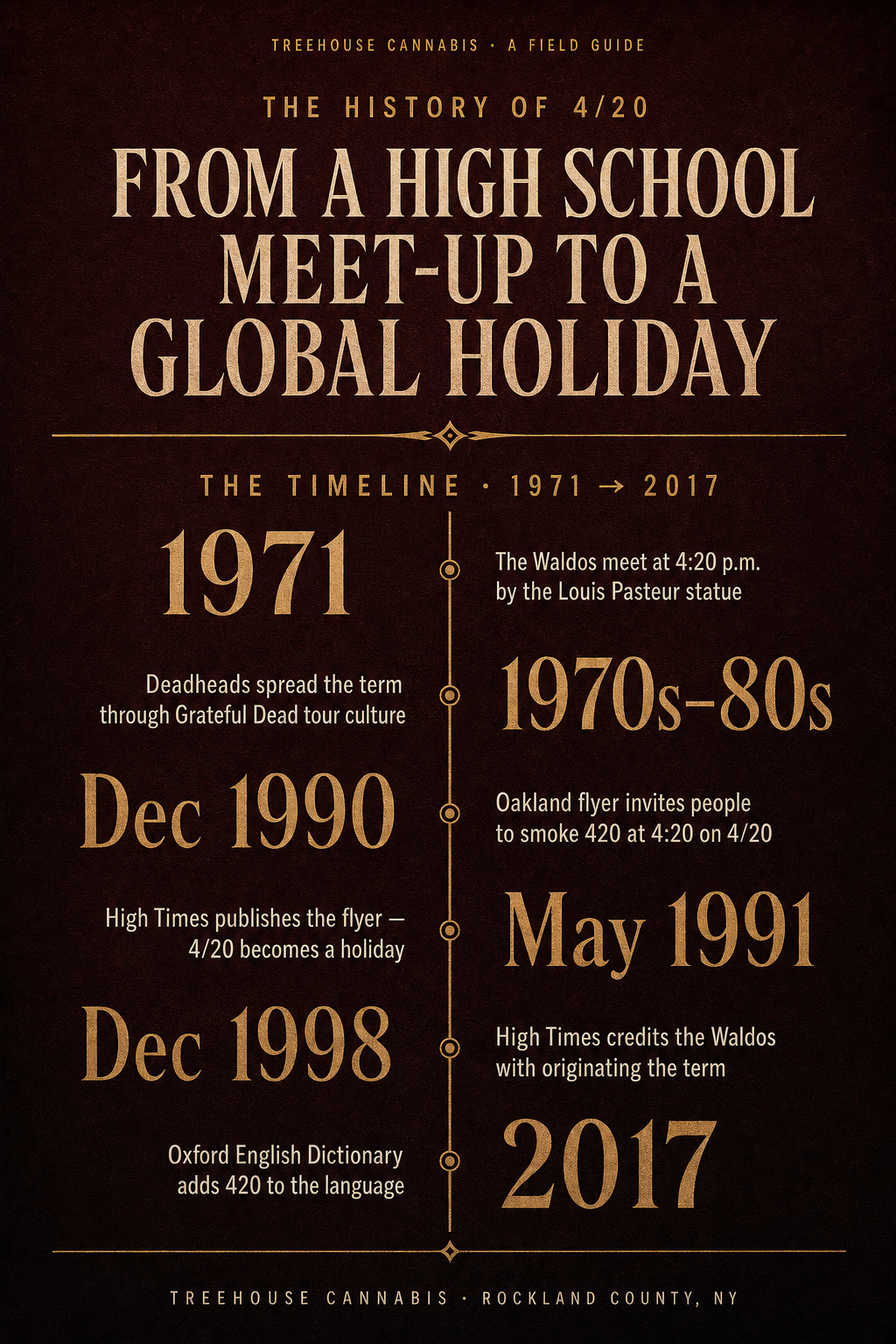
Did Bob Dylan's Rainy Day Women No. 12 & 35 Invent 420?
The "12 × 35 = 420" math is real, but it doesn't go anywhere. Bob Dylan recorded "Rainy Day Women No. 12 & 35" in early 1966, released it on the album Blonde on Blonde in June of that year, and the song is about conformity and Biblical stoning imagery — not cannabis. The title numbers refer to the number of people stoned in the Biblical story of the woman caught in adultery, multiplied by something of Dylan's choosing [6].
The Waldos coined 420 in fall 1971, five years after the song came out. The two can't be causally connected, and Dylan himself has never said the song is about marijuana [7]. The "12 × 35 = 420" theory is a coincidence that sounds deliberate in a stoned head, and that's exactly why it's been hard to kill — like the police-code myth, it rewards people who already want to believe it.
Facts about the song, sorted:
- Recording date — early 1966, released on Blonde on Blonde in June 1966
- Actual subject — conformity and Biblical stoning imagery, not cannabis
- Title numbers — 12 and 35 refer to the people stoned in the woman-caught-in-adultery story
- Dylan himself — has never said the song is about marijuana
- Timeline gap — five years separate the song (1966) from the Waldos' coinage (fall 1971)
That said, the song has had a long afterlife in cannabis culture for its own reasons. The chorus is famously easy to sing along to, the brass arrangement feels celebratory, and "everybody must get stoned" reads differently after a few hours at a Grateful Dead show. The song is one of many 1960s counterculture touchstones cannabis culture has claimed for its own — but it isn't where 420 came from Pre Ground Flower.
How Did 4/20 Become Both a Celebration and a Protest?
By the 2000s, 4/20 had outgrown its private origins and become a day with two registers. On one side: dispensary deals, music festival lineups, smoke-outs in public parks, and gatherings of adult customers across Rockland, Orange, and Westchester Counties stocking up on products like . On the other side: rallies calling for federal legalization, criminal-justice reform, and an end to cannabis-related incarceration. Hempfest founder Vivian McPeak described the modern 4/20 as "half celebration, half call to action," and that framing has held for two decades [2].
For adult-use customers, the day now means both things at once. The same dispensary trip that picks up an eighth and a pre-roll also funds, indirectly, the political infrastructure of legalization — taxes, advocacy groups, and the state-licensed market that replaces the legacy one. If you want a product that captures the dual meaning of the day — celebration in the bag, history in the can — there's a steady 70-gram option for adult customers planning a longer session Out The Office • Flower • 70g.
Two registers of modern 4/20:
- Celebration side — dispensary deals, music festival lineups, public-park smoke-outs, shared pre-rolls
- Protest side — rallies for federal legalization, criminal-justice reform, and an end to cannabis incarceration
- Tax-funded advocacy — dispensary sales fund the political infrastructure of the legal market
- Vivian McPeak's framing — "half celebration, half call to action," holding for two decades
That's the through-line of 4/20 from 1971 to today: a private code that kept getting bigger. Five teenagers meeting at a statue, then a Deadhead handshake, then a magazine article, then a national holiday, then a movement, then a normal afternoon at a legal dispensary in the lower Hudson Valley.
Curious about celebrating 4/20 the right way? Treehouse Cannabis curates a rotating menu of flower, pre-rolls, and edibles for adult customers across Rockland, Orange, and Westchester Counties. Browse the menu online or stop in to talk strains with our team.
Cannabis is for adults 21 and older. Keep all cannabis products out of the reach of children and pets. This article is intended for educational purposes only and is not legal, medical, or financial advice. Please consume responsibly and in accordance with New York State law.
Sources
- Wikipedia — Documents the consensus origin of 4/20 as a 1971 code-word coined by five San Ra
- PBS NewsHour (Associated Press) — AP/PBS news report confirming the Waldos origin story, the 1990 Deadhead flyer,
- High Times — High Times' own published timeline crediting its 1991 article for popularizing t
- The Waldos (official) — Official self-told account from the originators describing themselves as five Sa
- California Legislative Information — Official text of California Penal Code section 420 showing it covers obstruction
- Wikipedia — Documents that Bob Dylan's 1966 single is about conformity and Biblical stoning
- Songfacts — Songfacts entry reinforcing that Dylan never connected the song to marijuana and

Shop our products

Shop All
Flower

Pre-rolls
Vaporizers

Edibles
Drinks

Concentrates
Tinctures

Topicals
CBD

Pet CBD

Accessories