
How to Shop for Cannabis Without Chasing THC Percentage
How to Shop for Cannabis Without Chasing THC Percentage
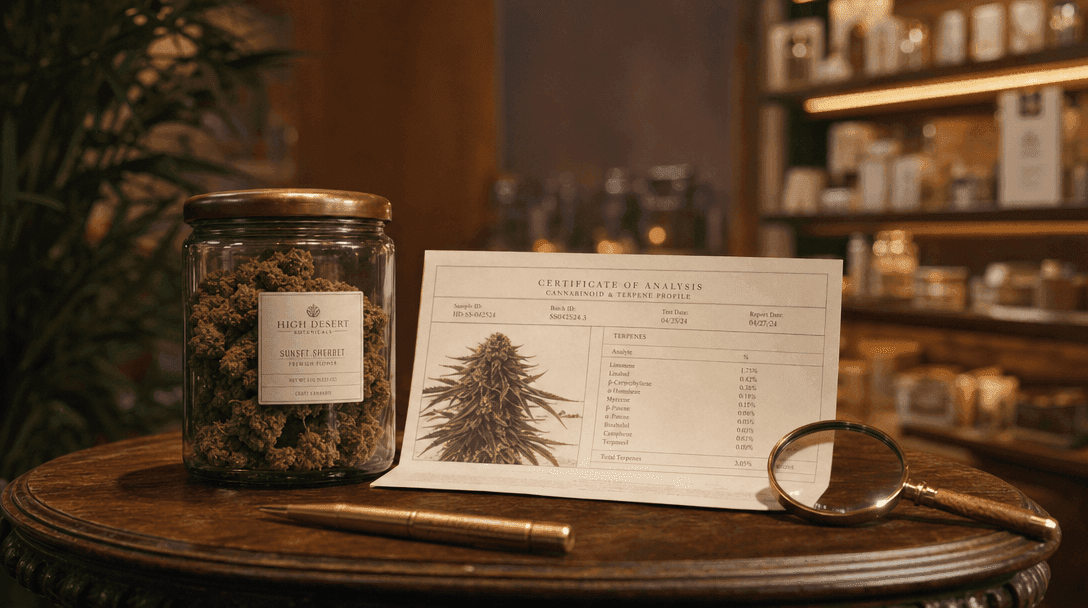
To shop for cannabis without chasing THC percentage, focus on the full chemical profile — cannabinoid panel, top three terpenes by percentage, harvest date, and the producer's certificate of analysis — instead of the single number on the jar. Research shows the printed THC percentage is a poor proxy for both the experience in the jar and the contents themselves.
Average U.S. cannabis potency has climbed sharply over a single generation. ElSohly et al. analyzed seized samples and found mean THC rose from roughly 4% in the late 1990s to over 12% by 2012, with samples above 12% THC growing from under 3% to over 47% of the tested supply [8]. Numbers have only gone up since. That shift has trained shoppers to equate "stronger" with "better," and producers have every incentive to print the highest number their lab test produced.
A higher printed THC percentage is a marketing claim, not a guarantee of a stronger experience. The rest of this article explains why the rest of the label matters more, and how to use it.
Does a Higher THC Percentage Mean Better Cannabis?
No, not reliably. Researchers at the University of Colorado Boulder found that smoking high-potency concentrates raised peak blood THC to roughly 1,016 µg/L — about 2.7 times the peak from flower — yet self-reported intoxication did not climb in proportion [3]. The leading explanation is that CB1 receptors become saturated. Once those receptors are filled, more THC simply has nowhere to land.
That is the THC ceiling effect in plain terms. After a certain dose, additional THC produces diminishing subjective returns, and for some users the only thing that scales is side effects like anxiety or grogginess. Two products labeled 18% and 28% THC can feel closer than the numbers suggest, especially when freshness, terpenes, and individual tolerance differ.
- The THC ceiling caps subjective effects once CB1 receptors saturate, so the strongest number is not the strongest feeling.
- Side effects like anxiety and grogginess often scale faster than the high itself above a moderate dose.
- Two products at different THC percentages can feel similar once freshness, terpene profile, and personal tolerance are equalized.
If you want a deeper look at the potency myth specifically, the Treehouse guide Is High THC Percentage Really Better? Debunking the Potency Myth walks through the receptor science in more detail. For a practical way to frame the choice — especially if you are buying for someone who cares more about the experience than the number — the roundup of Valentine's Day Cannabis Gifts: Thoughtful Ideas for Every Cannabis Lover shows how thoughtful buyers pick by effect rather than potency.
The takeaway is simple: chasing the highest number on the shelf is chasing a label, not a feeling.
How Accurate Are Cannabis THC Labels?
Often not, especially for flower. A 2025 CU Boulder secret-shopper audit tested 277 products from 52 Colorado dispensaries and found that 44% of flower fell outside the state's 15% THC-labeling accuracy threshold — and most of those over-reported potency [1]. Concentrates did much better, landing within the accuracy band about 96% of the time.
A separate study in Nature Scientific Reports measured observed versus labeled THC directly. Mean labeled flower was 22.5% THC, but mean observed content was 20.8%. Some products were off by 8 percentage points — one sample labeled 24% actually contained about 16% [2].
- Flower labels miss the state's 15% accuracy band about 44% of the time, and most of those errors overstate potency.
- Concentrate labels are far more reliable — about 96% land within the accuracy band in the same 2025 audit.
- The largest individual gap was 8 percentage points; one flower labeled 24% tested at roughly 16% in a Nature Scientific Reports study.
A printed THC number is closer to a marketing claim than a measurement. It often reflects a small, top-of-crop sample tested by the grower, not the eighth on the shelf. That is why pairings of THC with other cannabinoids matter. The Treehouse guide How to Choose the Right THC:CBD Ratio for Your Needs breaks down how adding CBD, CBG, or CBN shifts the effect profile, often more than another two percentage points of THC would.
What Are Terpenes and Why Do They Matter?
Terpenes are the aromatic compounds that give plants their smell. Limonene gives lemons their citrus brightness, linalool gives lavender its floral calm, and pinene gives pine needles their sharp, fresh scent. Cannabis produces many of the same terpenes, and the same compounds that shape a citrus grove or a forest also shape the cannabis experience [4].
These compounds are not just aroma. A 2021 University of Arizona study showed that four common cannabis terpenes — alpha-humulene, geraniol, linalool, and beta-pinene — activated the CB1 receptor on their own in mouse models and amplified the pain-relief effect of a cannabinoid agonist without increasing side effects [5]. A 2024 double-blinded crossover trial from Johns Hopkins and the University of Colorado found that d-limonene, a common cannabis terpene, significantly reduced the anxiety THC alone can produce [7]. That is early clinical support for the so-called entourage effect — the idea that cannabinoids and terpenes work together to produce effects different from any single compound.
If you want a clearer picture of how the THC on the label translates to what your body actually feels, the Treehouse guide THCA vs THC: What's Actually in Your Weed? (2026 Guide) explains the relationship between the two and why numbers alone can mislead.
Below is a quick reference for the seven most common cannabis terpenes and the effects they tend to produce.
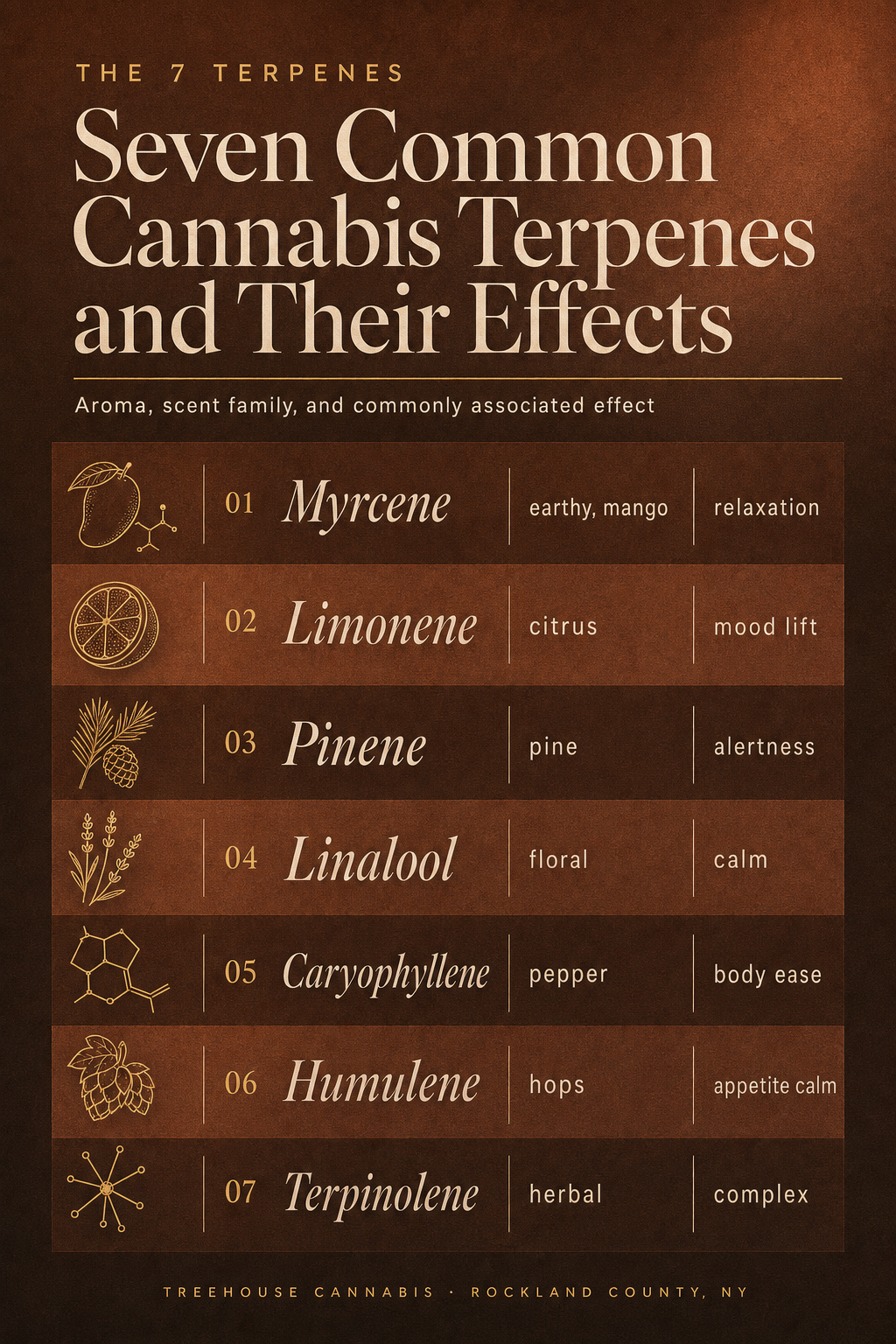
- Myrcene — earthy, mango — relaxation
- Limonene — citrus — mood lift
- Pinene — pine — alertness
- Linalool — floral — calm
- Caryophyllene — pepper — body ease
- Humulene — hops — appetite calm
- Terpinolene — herbal — complex
Is the Indica vs. Sativa Distinction Real?
Largely cultural, not chemical. National Geographic reported in 2024 that chemical analysis of tens of thousands of commercial cannabis samples found indica and sativa labels poorly predicted actual cannabinoid or terpene chemistry [6]. Two strains with the same name from different growers can have wildly different profiles, and two strains with different names can test nearly identical.
Effects track far better with lab-tested terpene and cannabinoid percentages than with the strain name on the jar. Treat indica and sativa as a flavor hint, not a chemistry report.
| What the label promises | What the chemistry actually shows |
|---|---|
| Indica = relaxing, body-heavy, nighttime | No consistent cannabinoid or terpene pattern tied to the "indica" label across tested samples |
| Sativa = energizing, cerebral, daytime | No consistent cannabinoid or terpene pattern tied to the "sativa" label across tested samples |
| Same strain name, same effect | Identically named strains from different growers routinely test with different terpene and cannabinoid profiles |
| Different strain names, different effects | Strains with different names routinely test chemically near-identical |
- Two strains labeled "indica" from different growers can have completely different chemical profiles.
- The most reliable predictor of effect is the lab-tested terpene and cannabinoid panel, not the strain name.
- Use indica/sativa as a starting flavor hint, then verify with the actual lab data.
What Should You Look at on a Cannabis Label Besides THC?
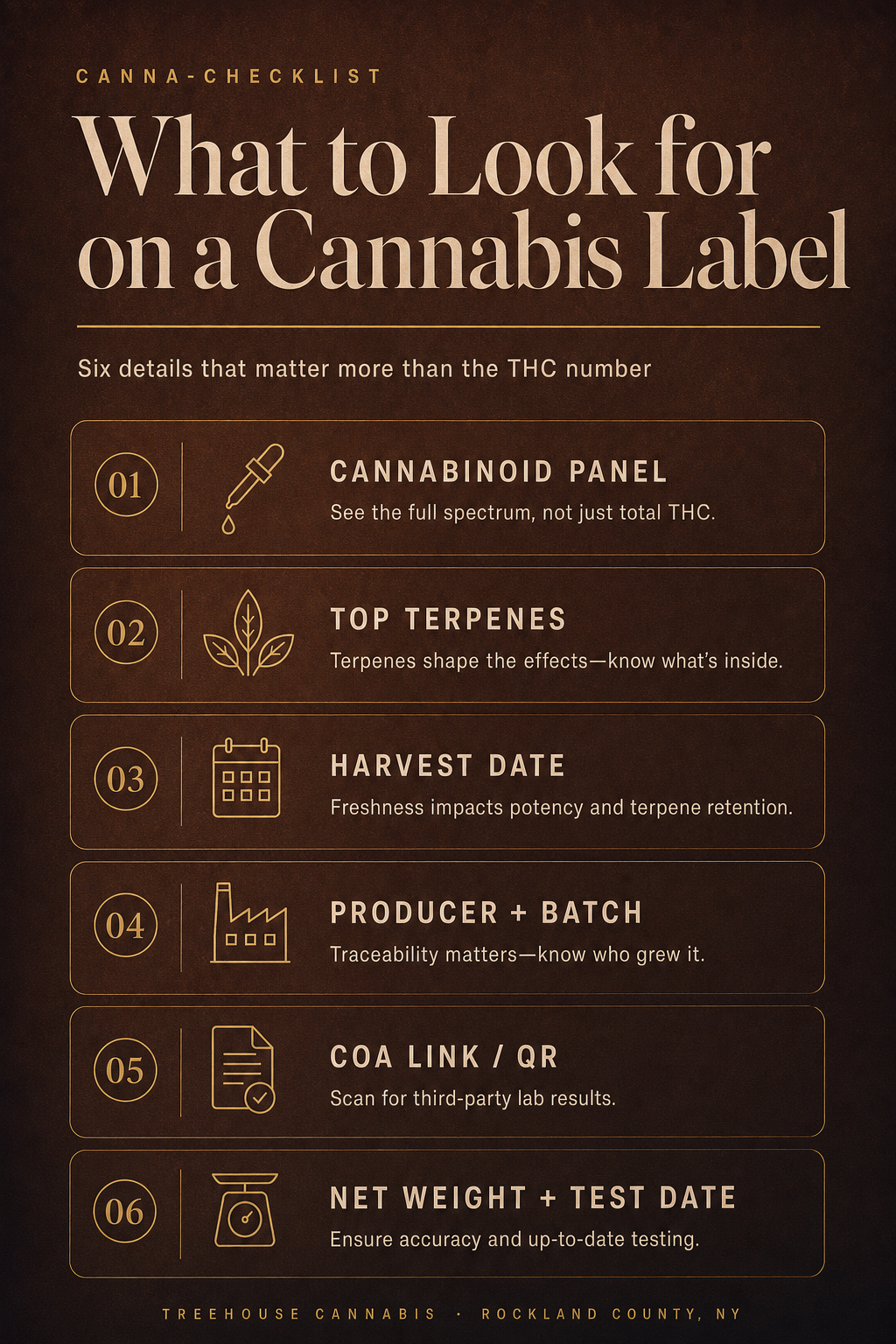
A label that only reports THC is doing you a disservice. Here is a checklist of what actually matters when you compare two eighths at the counter.
- Full cannabinoid panel — THC, CBD, CBG, CBN, THCA — not just one number
- Top three terpenes by percentage
- Harvest or package date, since monoterpenes evaporate quickly after harvest
- Producer name and batch or lot number
- Certificate of analysis (COA) link or QR code
- Net weight and test result date
Older flower with the same labeled THC will smell flatter and feel less vibrant than a fresh batch because those volatile monoterpenes are gone. Lab-tested THC content also degrades slowly when flower is exposed to heat, light, and oxygen, so package date matters as much as the printed percentage.
A good starting point for browsing products that publish the full panel is the Treehouse Flower menu, where every eighth lists the complete cannabinoid and terpene profile, harvest date, and the producer's certificate of analysis.
How Should You Talk to a Budtender About Effects?
Lead with the experience you want, not the number. A useful script goes like this: tell the budtender the effect you are after — relaxed, focused, creative, social, sleepy — and ask them to match by terpene top-three rather than by THC percentage. Then ask about harvest date and freshness.
For beginners, most cannabis educators recommend starting in the 10–18% THC range for flower, paired with a terpene profile that matches the desired effect. Limonene or pinene for daytime clarity, myrcene or linalool for evening wind-down. The right dose matters more than the right percentage — start low, wait, and increase gradually rather than picking the highest jar on the menu.
- Start with the desired effect (relaxed, focused, creative, social, sleepy), not a potency target.
- Ask for the top three terpenes by percentage and let the budtender match the profile to your goal.
- Confirm harvest or package date and ask for the certificate of analysis if it is not on the label.
- Begin in the 10–18% THC range for flower, paired with a goal-aligned terpene profile.
A few small habits help the conversation go well. Have a goal in mind before you reach the counter. Ask to see the lab panel, not just the menu number. Keep an open mind about products in the middle of the THC range, where the most balanced terpene profiles often live. And if you are setting up a routine at home, a quality grinder makes a real difference — the Treehouse "THC" Metal Grinder | Large 2' h x 2.5' w keeps flower broken down evenly so the effect is more consistent from bowl to bowl.
The Treehouse Cannabis menu in Rockland County lists the full lab data on every product, and the budtenders walk through the label with you so you leave with the right product for the experience you actually want.
Frequently Asked Questions
Does a higher THC percentage mean better cannabis? Not necessarily. Research from the University of Colorado found that high-potency concentrates raised blood THC more than twice as high as flower without producing proportionally greater intoxication, suggesting a receptor-saturation ceiling. Terpene profile, freshness, and cannabinoid balance shape the actual experience more than a single THC number on the label.
What should I look at on a cannabis label besides THC? Look at the full cannabinoid panel (THC, CBD, CBG, CBN, THCA), the top three terpenes by percentage, the harvest or package date, and the producer's certificate of analysis. A 2025 CU Boulder study found 44% of flower products were mislabeled for THC, so secondary metrics give you a more honest read on what you are buying.
What is the entourage effect in cannabis? The entourage effect is the theory that cannabinoids and terpenes work together to produce effects different from any single compound in isolation. A 2021 University of Arizona study found cannabis terpenes activated CB1 receptors on their own, and a 2024 Johns Hopkins trial showed d-limonene reduced anxiety when paired with THC — early clinical support.
Is the difference between indica and sativa real? Largely cultural, not chemical. National Geographic reported in 2024 that analysis of over 90,000 commercial cannabis samples showed indica and sativa labels poorly predicted actual cannabinoid or terpene content. Effects track far better with terpene profile and total cannabinoid composition than with the strain name.
Are cannabis THC labels accurate? Often not, especially for flower. A 2025 CU Boulder study secret-shopping 52 Colorado dispensaries found 44% of flower products were outside the state's 15% accuracy threshold for THC labeling, and most of those over-reported potency. Concentrate labels were accurate about 96% of the time in the same study.
What is a good THC percentage for a beginner? Most cannabis educators and dispensary staff recommend starting in the 10–18% THC range for flower, paired with a terpene profile that matches the desired effect — limonene or pinene for daytime, myrcene or linalool for evening. The right dose matters more than the percentage; start low and increase gradually.
Which terpene should I look for if I want to relax? Myrcene, linalool, and beta-caryophyllene are the terpenes most commonly associated with calming, body-relaxed effects in cannabis. Linalool gives lavender its floral scent, myrcene is also found in mangoes and hops, and caryophyllene — also in black pepper — is the only terpene known to bind directly to the CB2 receptor.
Why does older flower feel less potent even at the same THC percentage? Monoterpenes — the lighter, more volatile aroma compounds like limonene and pinene — evaporate quickly after harvest, so a six-month-old eighth with the same labeled THC will smell and feel flatter than a fresh one. Lab-tested THC content also degrades slowly when flower is stored poorly (heat, light, oxygen), so package date matters as much as the printed percentage.
Sources
- University of Colorado Boulder — A 2025 CU Boulder secret-shopper audit of 277 products from 52 Colorado dispensa
- Nature Scientific Reports — Giordano et al. measured observed vs labeled THC in Colorado dispensary products
- University of Colorado Boulder — A 2020 CU Boulder study found that while high-potency concentrates raised blood
- Leafly — Leafly's terpene reference documents the most common cannabis terpenes (myrcene,
- University of Arizona Health Sciences — LaVigne et al. (2021) showed in mouse models that four cannabis terpenes (alpha-
- National Geographic — National Geographic reports that chemical analysis of tens of thousands of comme
- Drexel University Cannabis Research Institute — A 2024 double-blinded, placebo-controlled crossover study from Johns Hopkins and
- National Library of Medicine (NCBI/PMC) — ElSohly et al. analyzed seized cannabis samples and showed mean THC climbed from
About Treehouse Cannabis
Treehouse Cannabis is an adult-use dispensary serving Rockland County, Orange County, and Westchester County in New York. Every flower eighth on the menu lists the complete cannabinoid and terpene panel, harvest date, and the producer's certificate of analysis so customers can shop by effect rather than by chasing the highest number on the label. Our budtenders walk through the label with you so you leave with the right product for the experience you actually want.
Cannabis is for adults 21 and older. Keep all cannabis products out of the reach of children and pets. The content in this article is for informational purposes only and is not intended as medical advice. Please consume responsibly and in accordance with applicable laws.
Shop our products

Shop All

Flower

Pre-rolls
Vaporizers

Edibles
Drinks

Concentrates
Tinctures

Topicals

CBD

Pet CBD

Accessories