
What Actually Happens When You Mix Alcohol and Cannabis?
What Actually Happens When You Mix Alcohol and Cannabis?
Cannabis and alcohol interaction is one of the most commonly discussed topics among both new and experienced consumers. When these two substances enter your system at the same time, the effects are not simply the sum of each — they multiply in ways that science is only beginning to fully understand. If you've ever wondered what actually happens when you mix them, the answer involves your liver, your brain, and a phenomenon researchers call SAM: simultaneous alcohol and cannabis use.
At Treehouse Cannabis, our team has fielded countless questions from Rockland County, Orange County, and Westchester County customers about how these substances interact. This guide breaks down the science so you can make informed decisions.
How Alcohol and Cannabis Interact in Your Body
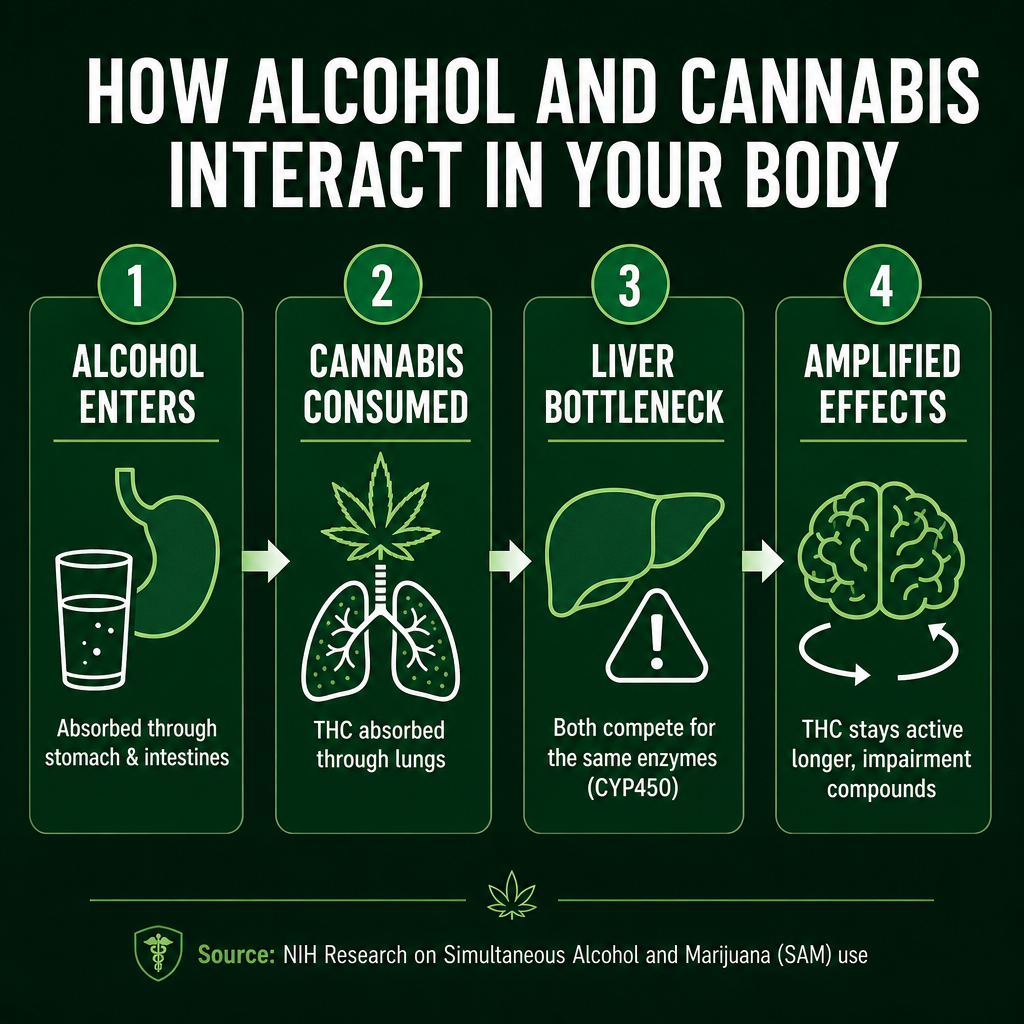
The cannabis and alcohol interaction begins the moment both substances enter your bloodstream. Alcohol is absorbed through the stomach and intestines, while THC from cannabis is absorbed through the lungs or digestive tract depending on how you consume it. Both compounds then travel to the liver, where the real competition begins.
Your liver processes alcohol and THC using some of the same enzymatic pathways. When both substances are present simultaneously, they compete for the same liver enzymes — primarily the cytochrome P450 system. This competition means that alcohol slows the breakdown of THC, causing the high from cannabis to last longer and feel more intense. Research published in NIH/PMC confirms that simultaneous use produces amplified subjective drug effects, increasing impairment beyond what either substance causes on its own.
This is not just a matter of feeling more intoxicated. The slower metabolism of THC in the presence of alcohol means that critical cognitive functions — decision-making, reaction time, short-term memory — remain impaired for a longer window. For customers in New York exploring cannabis, understanding this interaction is especially relevant given the rapid expansion of adult-use dispensaries across Rockland County, Orange County, and Westchester County.
Cross-Fading: More Than Just Being Extra High
The term "cross-fading" describes the unique subjective state that occurs when you are simultaneously intoxicated by alcohol and cannabis. Users consistently report that being drunk and high at the same time feels qualitatively different from being intoxicated by either substance alone. It is not merely "more of the same" — it is a distinct interaction that researchers have documented in clinical settings.
Cross-fading effects include heightened dizziness, more pronounced changes in time perception, and a sense of disconnection that many describe as feeling "unmoored." Alcohol acts as a vasodilator, expanding blood vessels and increasing heart rate, while cannabis can cause its own cardiovascular effects. When combined, these circulatory changes amplify feelings of lightheadedness and nausea that neither substance typically produces on its own.
According to NIH research, simultaneous use of marijuana and alcohol affects people cognitively, perceptually, and on motor impairment measures in ways that increase risky behaviors. Penn State researchers have similarly noted that the combination produces greater impairment than either drug alone across multiple domains. For anyone in New York experimenting with cannabis, recognizing that cross-fading represents a distinct physiological state — not just a stronger version of being high — is an important first step toward safer choices.
Motor Skills, Cognition, and Driving Impairment
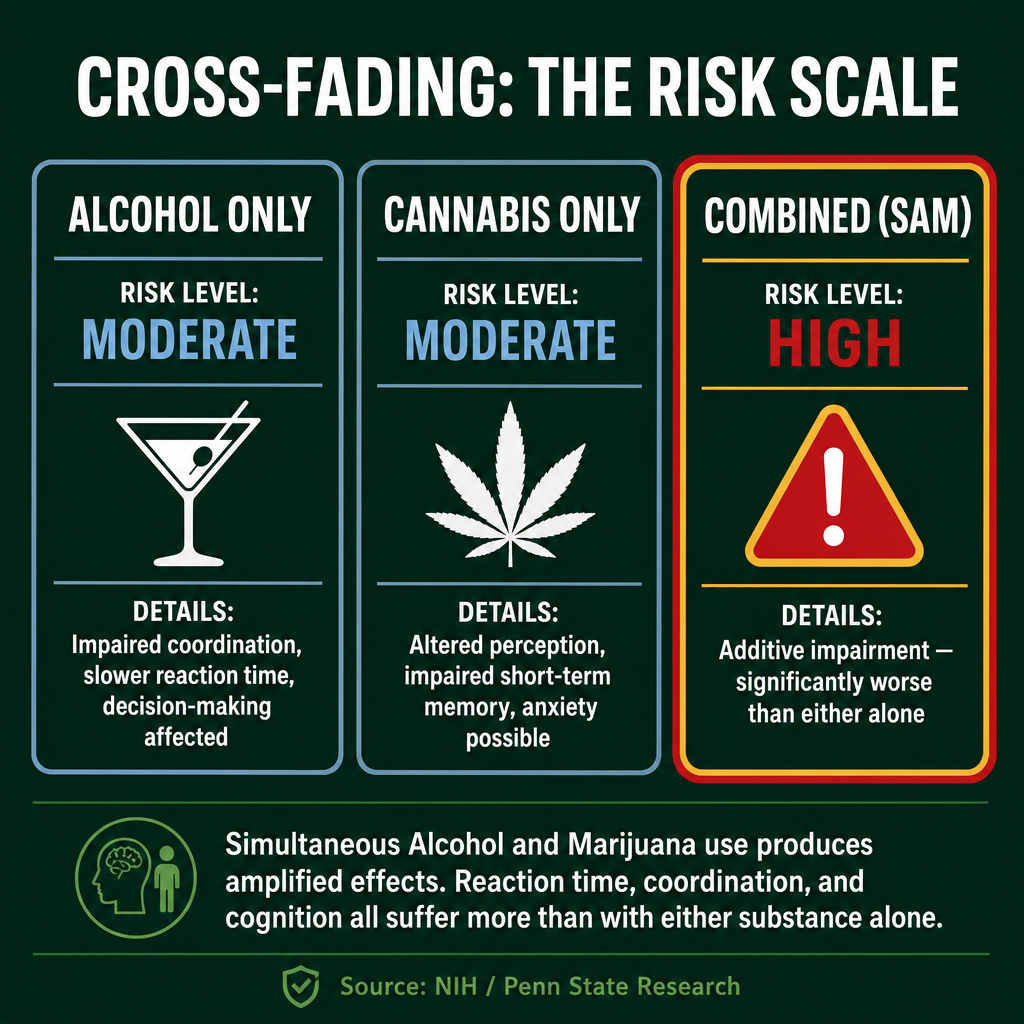
Perhaps the most serious concern with mixing cannabis and alcohol is the compounded impairment to motor skills and cognitive function. When you examine the research on weed and alcohol effects separately, each substance already carries significant warnings about operating machinery or driving. When combined, the impairment is additive — not merely the sum of two moderate impairments, but a meaningfully more dangerous state.
Studies from NIH and Penn State consistently show that simultaneous use produces worse outcomes for reaction time, lane maintenance, divided attention, and working memory than either substance used alone. Reaction time slows further. Coordination suffers more. Decision-making under pressure becomes more erratic. These are precisely the skills you need when operating a vehicle, and the data shows the combination makes driving particularly hazardous.
Research published in PubMed (2022) specifically documents the additive effects of alcohol and cannabis on driving-related skills. The combination impairs cognition in ways that exceed what either substance would cause independently. For customers who consume cannabis in Rockland County, Orange County, or Westchester County and may later drive, this research underscores a clear message: the safest approach is to separate these substances entirely, or skip one entirely if you have any driving obligations.
Does Mixing Actually Give You a Worse Hangover?
Many people who have experienced a rough morning after a night of mixing cannabis and alcohol report that the hangover feels worse than what either substance would produce alone. Research now confirms this is not just perception — there is a real physiological basis for more intense hangovers from simultaneous use.
NIH research links simultaneous alcohol and cannabis use to more frequent and intense hangovers both directly and indirectly. Directly, the combined physiological stress of processing two substances strains the body's recovery systems. The liver, already working to metabolize alcohol, is also tasked with breaking down THC metabolites, prolonging the inflammatory stress response that underlies hangovers.
Indirectly, cannabis use in social drinking settings often leads to heavier overall alcohol consumption. The logic is behavioral: people who are already drinking may feel that cannabis "takes the edge off" alcohol, leading them to drink more than they otherwise would. This indirect pathway means that simultaneous use often results in higher blood alcohol levels than intended, which naturally produces worse hangovers. For New York cannabis consumers who also drink socially, recognizing this pattern can help inform more intentional choices about when and how much of each substance to consume.
Practical Guidance: If You Do Combine Them
For those who choose to combine cannabis and alcohol despite the known risks, a harm-reduction approach can at least minimize the worst outcomes. These suggestions are not an endorsement of simultaneous use — they are practical guidance based on what the research shows.
Start low and go slow. If you are going to mix, begin with a very low dose of cannabis. Alcohol already amplifies the absorption and longevity of THC, so starting with your normal dose in a drinking context can lead to unexpected intensity. Wait at least thirty minutes before considering any additional cannabis consumption.
Hydrate aggressively. Both alcohol and cannabis cause dehydration, and their combination accelerates fluid loss. Drinking water between alcoholic drinks and having water readily available during cannabis consumption helps mitigate one of the primary contributors to next-morning misery.
Consider the order of consumption. Research suggests that drinking alcohol first tends to lead to heavier overall consumption, which increases risks across the board. If you are going to consume both, waiting until you have felt the initial effects of alcohol before introducing cannabis may help you gauge your tolerance more accurately and avoid overconsumption.
Never drive. This one is non-negotiable. The additive impairment from combined cannabis and alcohol use makes driving especially dangerous. If you have consumed both substances, arrange alternative transportation. This applies whether you are in Rockland County, Orange County, Westchester County, or anywhere in New York.
Know your limits and have a plan. Before you start, decide what your boundaries are and stick to them. The compounding effects of SAM make it easy to lose track of how much you have had of either substance. Setting a firm drink limit and cannabis dose limit before you begin is one of the most effective harm-reduction strategies available.
Frequently Asked Questions
What happens when you mix alcohol and cannabis at the same time?
Simultaneous alcohol and cannabis use (SAM) produces amplified effects — research shows impairment is greater than either substance alone. THC metabolism slows in the presence of alcohol, prolonging the high while both substances compound cognitive and motor impairment.
Is it safer to drink first or smoke first before combining?
Research suggests drinking first may lead to heavier overall consumption, increasing risks. If combining, waiting until alcohol effects are felt before cannabis, and starting with a low dose, can help manage overall exposure — but the safest option is not to combine.
How does cross-fading affect driving ability?
Studies show additive impairment on driving skills when alcohol and cannabis are combined. Reaction time, lane maintenance, and divided attention all suffer more than with either substance alone — making driving after SAM use particularly dangerous.
Does mixing cannabis and alcohol cause worse hangovers?
Yes, according to NIH research. Simultaneous use is associated with more frequent hangovers both directly — through combined physiological stress — and indirectly, because cannabis use often leads to heavier drinking patterns.
What's the difference between simultaneous and sequential use?
Simultaneous use (SAM) means consuming both at once, producing amplified effects. Sequential use means spacing them out — but residual alcohol in your system still interacts with cannabis. Neither eliminates the risks; timing only slightly modifies the intensity.
Sources
- NIH / PMC - Simultaneous Alcohol and Cannabis Use and Subjective Effects
- NIH / PubMed - Co-use of Alcohol and Cannabis and Associated Problems
- NIH / PubMed - Simultaneous Alcohol and Cannabis Use and Hangovers
- NIH / PubMed - Additive Effects of Alcohol and Cannabis on Driving Skills
- Penn State University - Marijuana and Alcohol Combined Impairment
This content is for educational purposes only and does not constitute medical advice. Treehouse Cannabis is a licensed adult-use dispensary. Must be 21+ to purchase.
Shop our products

Shop All

Flower

Pre-rolls
Vaporizers

Edibles
Drinks

Concentrates
Tinctures

Topicals

CBD

Pet CBD

Accessories