
CBD vs THC: The Science Behind the Two Most-Discussed Cannabinoids
CBD vs THC: The Science Behind the Two Most-Discussed Cannabinoids
If you've walked into a New York dispensary and felt overwhelmed by the sheer variety of products labeled "CBD," "THC," or "balanced ratio," you're not alone. At Treehouse Cannabis, we've helped thousands of customers from Rockland County, Orange County, and Westchester County navigate exactly this confusion. The science behind these two dominant cannabinoids is fascinating — and understanding it can transform how you shop for cannabis in New York.
What Is the Endocannabinoid System?
Before diving into CBD vs THC, it helps to understand where these compounds work in the body. The endocannabinoid system (ECS) is a vast network of receptors and signaling molecules that regulate mood, pain, appetite, memory, and immune response. Discovered by researchers in the 1990s, it operates throughout the brain, nervous system, and peripheral organs.
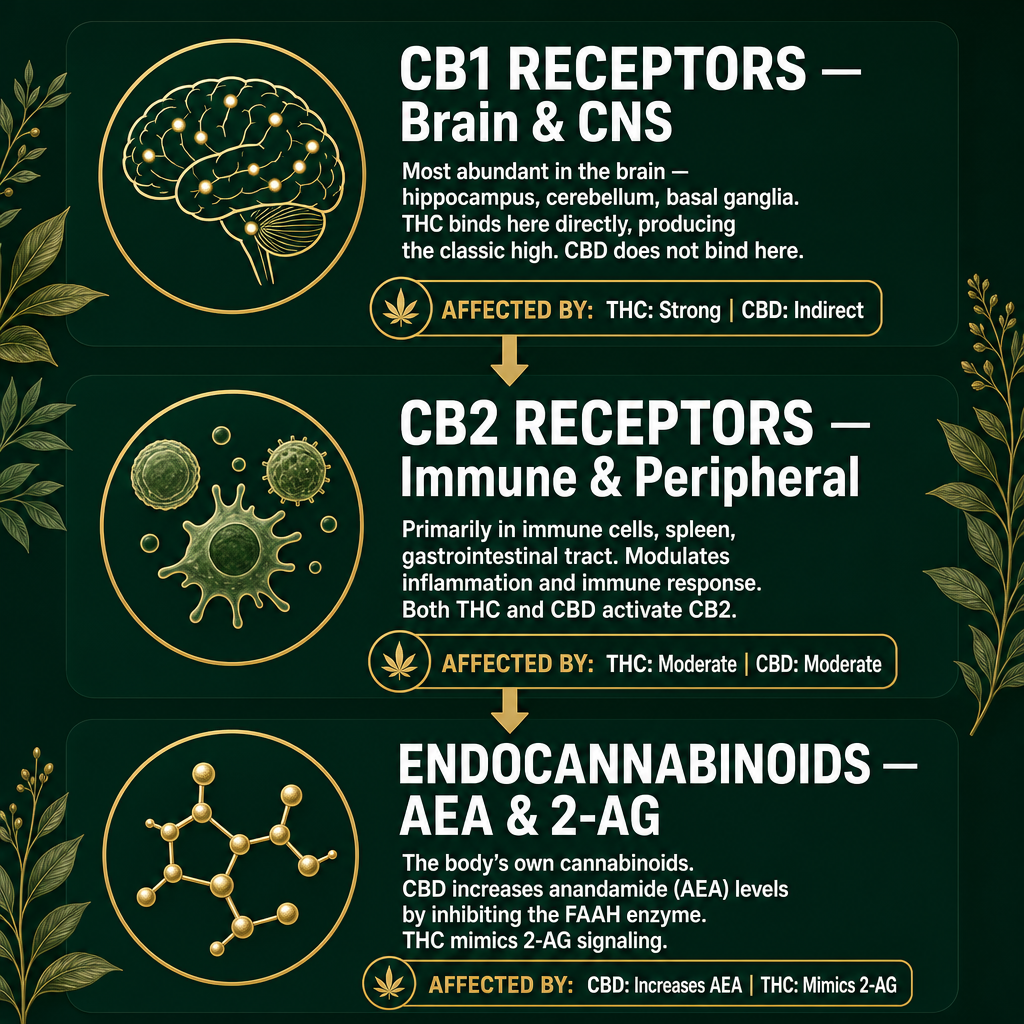
Two primary receptors dominate the system: CB1 receptors, which are most concentrated in the brain and central nervous system, and CB2 receptors, which are primarily found in immune tissues and the gastrointestinal tract. The body produces its own cannabinoids — anandamide and 2-AG — that bind to these receptors naturally.
Plant cannabinoids from cannabis interact with this native system in different ways. THC binds directly to CB1 receptors, mimicking anandamide and producing strong psychoactive effects. CBD, by contrast, has negligible CB1 affinity and instead modulates how the ECS functions — influencing the receptors indirectly and increasing levels of the body's own cannabinoids. Understanding this fundamental difference is the key to understanding everything that follows. Harvard Health Publishing provides an excellent overview of how CB1 and CB2 receptors regulate different biological processes.
CBD vs THC: The Molecular Difference
Structurally, CBD and THC are nearly identical — both are composed of 21 carbon atoms, 30 hydrogen atoms, and 2 oxygen atoms. What separates them comes down to a single difference in their three-dimensional arrangement of atoms. That minor structural variance changes everything about how each molecule interacts with your receptors.
THC binds strongly and directly to CB1 receptors in the brain, which produces the characteristic "high" — altered perception, euphoria, and changes in mood and memory. CBD was first isolated in 1942, while THC was identified in 1964. Despite decades more time to study CBD, researchers are still uncovering new mechanisms of action.
What makes CBD particularly interesting is its non-psychotropic nature. Because it does not bind meaningfully to CB1 receptors, CBD produces no intoxication. Instead, it acts as a modulator of the endocannabinoid system, influencing receptor activity without directly activating it. Research published in PMC confirms the structural and mechanistic distinction between these two most abundant cannabis compounds.
The Benefits and Research Behind CBD
CBD has become a dominant force in the wellness industry — and the research is beginning to catch up with the hype. Epidiolex, an FDA-approved CBD medication, treats severe seizure disorders including Lennox-Gastaut and Dravet syndromes. That FDA approval represents a significant milestone for the cannabinoid.
Research into CBD's broader applications is active and growing. Studies suggest CBD may help reduce anxiety, support sleep quality, and modulate inflammatory responses. A peer-reviewed article in PMC discusses CBD's localized, activity-dependent effects on endocannabinoid signaling, suggesting its benefits may be most pronounced in areas of the body with high receptor activity.
A common misconception worth addressing: "non-psychoactive" does not mean "inactive." CBD absolutely produces effects on brain chemistry — it increases anandamide levels by inhibiting the FAAH enzyme that breaks it down, influences serotonin receptors, and works through multiple non-ECS pathways. What it does not produce is intoxication. At Treehouse Cannabis, we offer a wide selection of CBD products including oils, capsules, and topicals — all suitable for customers seeking wellness support without impairment.
The Effects and Research Behind THC
THC is the cannabinoid responsible for the classic cannabis experience — and for good reason. When THC binds to CB1 receptors in the hippocampus, cerebellum, and basal ganglia, it triggers a cascade of neurotransmitter changes that produce euphoria, altered time perception, increased appetite, and relaxation. These effects are dose-dependent, meaning the same compound can produce very different experiences at different quantities.
The therapeutic applications of THC are supported by substantial clinical evidence. NIH research confirms that cannabis-based therapies have demonstrated effectiveness for chronic pain, multiple sclerosis spasticity, and chemotherapy-induced nausea. Dronabinol and Marinol — both THC-based medications — are FDA-approved for appetite stimulation and nausea control.
At moderate doses, THC can reduce pain, promote relaxation, and ease nausea. At higher doses, effects become more pronounced and may include impaired short-term memory, dry mouth, and altered sensory perception. Understanding your tolerance and starting with a low dose is strongly suggested — particularly for customers new to THC products in New York.
Can CBD Offset or Balance THC's High?
The question of whether CBD moderates THC's effects is one of the most discussed topics in cannabis science. The short answer: the research is nuanced, but the concept has real backing.
The "entourage effect" — the theory that cannabis compounds work better together than in isolation — suggests CBD may smooth out some of THC's rougher edges. Some studies indicate CBD can reduce anxiety or paranoia that some people experience with high-THC products. Other research shows balanced THC:CBD ratios tend to produce more functional, clear-headed experiences compared to THC-only products.
A PMC article examining the interaction between these cannabinoids notes that CBD modulates THC's activity through several mechanisms, including influencing how quickly THC is metabolized. That said, CBD is not a reliable "off switch" for THC intoxication, and customers should not rely on it as such. What the research does support is that balanced products offer a different — and for many people, preferable — experience profile.
Which Cannabinoid Is Right for You?
Choosing between CBD and THC depends entirely on what you're looking for. Consider your goals: are you seeking relaxation and wellness support without intoxication? CBD-dominant products are likely your best starting point. Looking for stronger effects, mood elevation, or appetite support? THC-dominant products may be more suitable.
Product type matters too. Flower provides rapid onset when smoked or vaporized. Tinctures placed under the tongue offer precise dosing with relatively fast absorption. Edibles produce long-lasting effects but take longer to onset. Topicals provide localized effects without any psychoactive experience.
At Treehouse Cannabis, our team in Rockland County, Orange County, and Westchester County can help you explore products suited to your needs. Whether you're interested in a CBD tincture for daily wellness, a balanced tincture for evening relaxation, or premium flower with your preferred THC content, we carry a curated selection to serve New York customers responsibly.
CBD vs THC: Key Takeaways
Understanding the difference between CBD and THC starts with the endocannabinoid system — your body's native network of receptors that both compounds interact with. THC binds directly to CB1 receptors producing psychoactivity; CBD modulates the system without producing a high.
CBD shows strong research backing for seizure disorders, anxiety, and inflammation. THC is clinically supported for chronic pain, nausea, and appetite stimulation. Both are available at licensed New York dispensaries in a range of product formats.
If you're new to cannabis or prefer a functional experience without intoxication, start with CBD-dominant products. If you have some experience and want stronger effects, explore THC products — and consider balanced THC:CBD ratios for a smoother experience. Our team at Treehouse Cannabis is here to answer your questions and help you find the right product for your goals.
Frequently Asked Questions
What is the difference between CBD and THC at the molecular level?
CBD and THC have nearly identical chemical formulas but different three-dimensional structures. THC binds strongly to CB1 receptors in the brain producing psychoactive effects, while CBD has very low CB1 affinity and acts as a modulator instead. This structural difference explains all the functional differences between the two compounds.
How do CBD and THC interact with the endocannabinoid system?
THC directly activates CB1 and CB2 receptors, mimicking the body's own endocannabinoids and producing strong psychoactive and therapeutic effects. CBD does not bind well to CB1 receptors; instead it modulates endocannabinoid signaling, increases anandamide levels, and works through multiple non-ECS pathways to influence the system indirectly.
Which cannabinoid is better for anxiety or pain?
Both show promise but work differently. CBD has stronger research backing for anxiety reduction and anti-inflammatory effects without intoxication. THC can effectively reduce pain and nausea but produces psychoactive effects. Many consumers prefer CBD-dominant products for daytime anxiety management, while THC products may suit evening use or more severe pain conditions.
Is CBD non-psychoactive and does it counteract THC's high?
CBD is non-impairing but not technically "non-psychoactive" — it does produce measurable effects on brain chemistry. Research suggests CBD can reduce some unwanted THC effects like paranoia or anxiety, and balanced THC:CBD ratios are commonly preferred for a more functional experience. It is not a reliable "off switch" for THC intoxication.
What does the research say about CBD and THC's therapeutic potential?
Clinical trials support cannabis-based therapies for chronic pain, multiple sclerosis spasticity, and chemotherapy-induced nausea. The FDA has approved CBD-based Epidiolex for seizures and THC-based medications for appetite stimulation. Research is ongoing for anxiety, PTSD, sleep, and inflammatory conditions — but larger human trials are still needed to confirm many preliminary findings.
Sources
- NIH / PMC — The Endocannabinoid System: A Looking Glass Into Cannabis
- Harvard Health — The Endocannabinoid System: Essential and Mysterious
- NIH / PMC — History of Cannabis and Cannabinoids
- NIH / PMC — CBD: A New Look at the Endocannabinoid System
- NIH / NCBI — Therapeutic Applications of Cannabis-Based Therapies
This content is for educational purposes only and does not constitute medical advice. Treehouse Cannabis is a licensed adult-use dispensary. Must be 21+ to purchase.
Shop our products

Shop All
Flower

Pre-rolls
Vaporizers

Edibles
Drinks

Concentrates
Tinctures

Topicals
CBD

Pet CBD

Accessories