
Hemp Flower: The Legal Loophole That's Blurring the Lines
Hemp Flower: The Legal Loophole That's Blurring the Lines
Walk into a hemp shop in New York today and you might see something that looks identical to marijuana — same buds, same smell, same curly texture — but it's sold legally, no medical card required. That's hemp flower, and it represents one of the most consequential legal grey areas in American cannabis policy right now. The 2018 Farm Bill opened a door that regulators are only now scrambling to close.
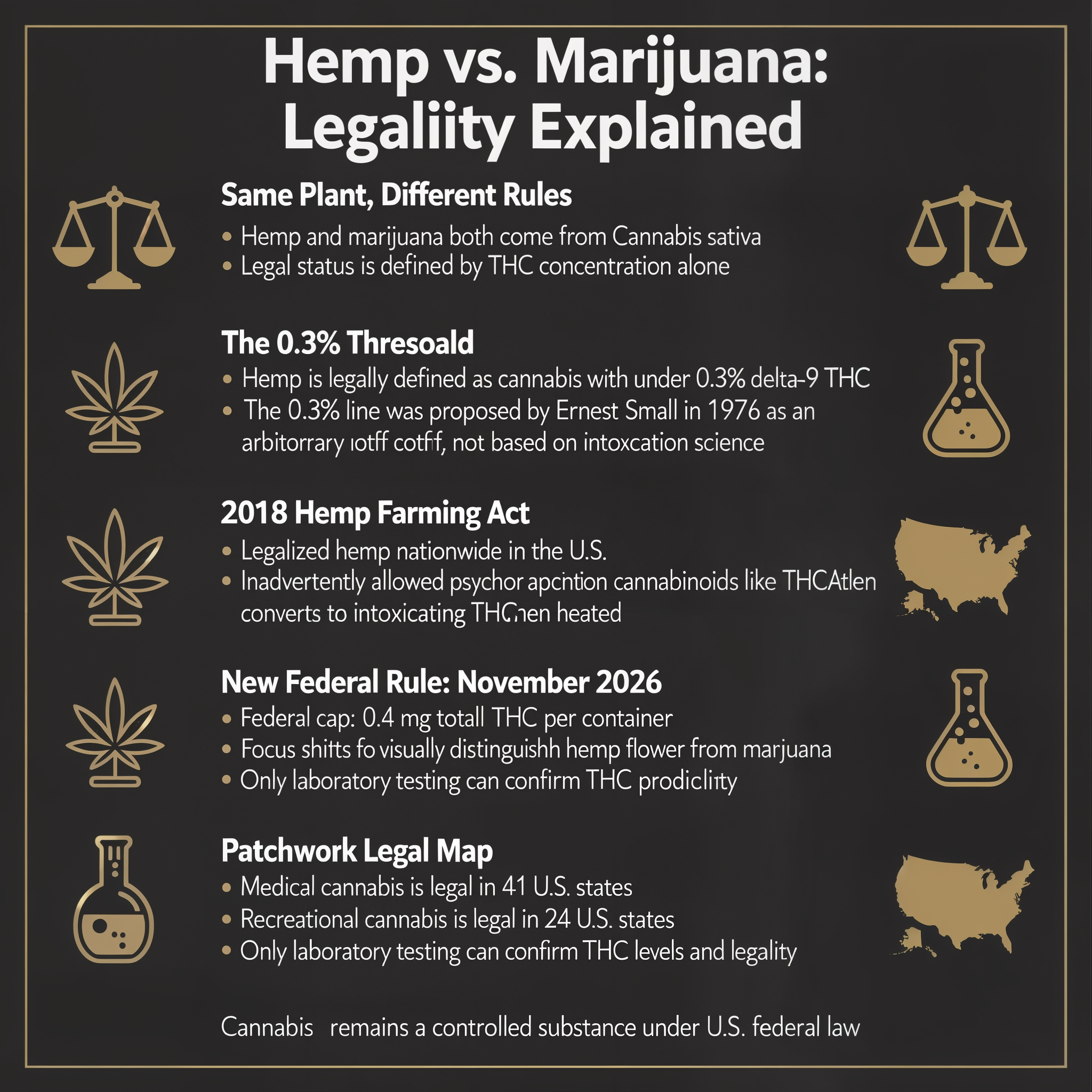
Hemp flower is the raw, smokable bud of the Cannabis sativa plant bred to test below 0.3% delta-9 THC by dry weight. It looks, smells, and smokes like marijuana — because botanically, it is marijuana. The only difference is chemistry, not botany. Both are the same species; the 0.3% line was an arbitrary threshold proposed by researcher Ernest Small in 1976, not a science-based boundary rooted in intoxication potential.
What Is Hemp Flower, Exactly?
Hemp flower enters the bloodstream the same way as traditional cannabis products — through inhalation. At Treehouse Cannabis, we've helped thousands of New York customers understand exactly what they're purchasing and how it works. The bud structure, trichome density, and aroma profile of high-quality hemp flower are indistinguishable from top-shelf marijuana.
The plant produces dozens of cannabinoids, but delta-9 THC is the only one the federal government currently uses to draw the legal line. Everything below that threshold is hemp; everything above it is marijuana. This means two genetically identical plants could test differently depending on their THC content — one lands in a dispensary, the other in a grey-market shop, and no one can tell them apart by appearance alone.
Hemp vs. Marijuana: The Same Plant, Different Laws
The 2018 Hemp Farming Act didn't create a new kind of plant — it reclassified an existing one. Cannabis sativa is one species, regulated into two categories by a single number: 0.3% delta-9 THC. Hemp is defined as anything at or below that threshold. Marijuana is anything above it.
This creates a fundamental contradiction. Despite identical appearance, these two categories live under completely different legal regimes — hemp is federally legal, marijuana remains a controlled substance at the federal level. For cannabis consumers in New York, where adult-use cannabis is legal at the state level, this distinction matters enormously. You can walk into a licensed dispensary in Westchester County and purchase products with confidence in what's on the label. But the hemp flower grey market operates on a different set of rules entirely, and the product you bring home may carry legal ambiguity you never intended.
The 0.3% threshold itself has no pharmacological basis. Ernest Small, the Canadian researcher who proposed it, later acknowledged it was a pragmatic cutoff rather than a meaningful scientific boundary. A plant testing at 0.29% delta-9 THC and one testing at 0.31% are functionally equivalent — but one is legal hemp and one is not.
The THCA Loophole — How Hemp Flower Gets You High
Here is where the loophole gets interesting. Raw THCA — tetrahydrocannabinolic acid — is non-psychoactive. In its raw form, it does not produce a high. A hemp flower could test below 0.3% delta-9 THC and still contain substantial THCA reserves. Lab results would call it legal hemp.
But apply heat — smoking, vaping, even cooking — and THCA instantly converts to delta-9 THC through a process called decarboxylation. That conversion is instantaneous and complete. The hemp flower you purchased legally produces the same intoxicating effects as marijuana once you light it up.
THCA flower exploits this conversion window deliberately. It enters the body as a technically compliant product but produces the same experience as traditional cannabis. Police cannot visually distinguish the two; field tests read inconclusive; only laboratory testing confirms the actual THC content after decarboxylation. This ambiguity is not incidental — it is the product's entire value proposition.
Can Police Tell Hemp Flower from Marijuana?
The short answer is no. Without lab testing, hemp flower and marijuana are visually and chemically identical to the naked eye. Officers in Rockland County, Orange County, and across New York encounter what appears to be marijuana during traffic stops and searches, but the paperwork describes it as legal hemp. The burden falls on consumers to navigate a product that looks illicit even when it may be compliant.
This creates a practical enforcement nightmare. An officer cannot confiscate what might be legal hemp based on appearance alone — but they also cannot ignore what appears to be a controlled substance. The result is legal uncertainty that falls heaviest on everyday consumers, not large-scale operators.
When you visit a licensed adult-use dispensary in New York, the products you purchase have been tested by state-accredited laboratories, labeled with cannabinoid profiles, and tracked from seed to sale. Grey market hemp flower skips all of that — no testing requirements, no labeling standards, no accountability.
November 2026: The Loophole Is Closing
Regulators have caught on. A new federal law taking effect November 2026 shifts the legal definition from plant-based THC content to final product limits of 0.4mg total THC per container. This closes the THCA loophole definitively. Products will now be evaluated by what they contain after processing, not what the raw flower tests like before heating.
Under the new framework, any hemp product — including smokable flower — that exceeds 0.4mg total THC per container becomes a regulated cannabis product subject to the same oversight as traditional marijuana. This effectively ends the THCA workaround that has allowed psychoactive hemp products to circulate outside state-licensed channels.
Hemp dispensaries across New York, including those in Westchester County and surrounding areas, are already adapting their inventory strategies ahead of the transition. The grey market window is closing — and the industry is moving toward the same testing, labeling, and sourcing standards that licensed dispensaries have maintained all along.
Will Hemp Flower Show Up on a Drug Test?
Yes. Standard drug tests screen for THC metabolites, not the source of the THC. THCA flower converts to THC upon heating — that THC enters your bloodstream and will register on a test. There is no legal distinction that protects hemp flower users from workplace or probation testing.
This is a critical risk factor for anyone subject to testing who uses hemp flower products, regardless of their legal status at purchase. A product labeled as legal hemp that produces the same psychoactive effects as marijuana will produce the same metabolites on a urinalysis, blood panel, or hair follicle test. If your employment depends on passing a drug screen, hemp flower carries the same risk as any other cannabis product.
For customers in New York who want to avoid this ambiguity, purchasing from a licensed dispensary means you know exactly what is in every product you buy — and you have recourse if the label is wrong. That traceability matters.
Frequently Asked Questions
Is hemp flower actually legal?
Under current federal law, yes — hemp flower with delta-9 THC below 0.3% is legal. But the THCA loophole means some hemp flower products will produce intoxicating effects. A new federal law taking effect November 2026 closes this gap by limiting final product THC to 0.4mg per container, regardless of how the product started.
What's the difference between hemp flower and marijuana?
Botanically, none — they are the same plant species (Cannabis sativa). The legal difference is the THC concentration: hemp is defined as below 0.3% delta-9 THC, marijuana is anything above that. Appearance, smell, and effects are identical; only laboratory testing distinguishes them.
What is THCA and why is it in a legal grey area?
THCA (tetrahydrocannabinolic acid) is the raw, non-psychoactive precursor to THC. In its raw form it can test below the 0.3% legal threshold for hemp. But heat it — through smoking or vaping — and it instantly converts to intoxicating THC. THCA flower exploits this: legally purchased, functionally equivalent to marijuana once consumed.
Can police tell hemp flower from marijuana?
No. Without lab testing, the two are indistinguishable to the naked eye or field test. Police encounter what looks exactly like marijuana but face legal ambiguity when lab results have not yet confirmed THC levels. This creates real risk for consumers even when the product is technically compliant.
What happens to hemp flower after the November 2026 farm bill changes?
The new federal law shifts from plant-level THC testing to per-container limits of 0.4mg total THC. This effectively ends the THCA loophole — products will be judged by what is in the final package, not what the flower tested like before heating. Hemp dispensaries are already restructuring inventory ahead of the transition.
Will hemp flower show up on a drug test?
Yes. Standard drug tests detect THC metabolites regardless of the source. THCA converts to THC when heated and enters your bloodstream identically to marijuana-derived THC. There is no legal exemption that protects hemp flower users from testing — if you are subject to testing, hemp flower carries the same risk as marijuana.
Ready to explore compliant cannabis options in New York? Treehouse Cannabis offers a curated selection of tested, regulated products — no grey market ambiguity, just quality you can trust. Visit us at your nearest location in Rockland County or Orange County.
Sources
- Wikipedia - Hemp Loophole
- NPR - Hemp, Marijuana, and the Farm Bill
- Fresh Bros - Hemp Flower vs. Marijuana Legal Guide
- Healthline - Hemp vs. Marijuana
- Wikipedia - Legality of Cannabis by U.S. Jurisdiction
This content is for educational purposes only and does not constitute medical advice. Treehouse Cannabis is a licensed adult-use dispensary. Must be 21+ to purchase.
Shop our products

Shop All
Flower
Pre-rolls
Vaporizers
Edibles
Drinks
Concentrates
Tinctures

Topicals
CBD

Pet CBD
Accessories