
Cannabis and Alcohol Alternatives: Why Some Adults Are Switching
Cannabis and Alcohol Alternatives: Why Some Adults Are Switching
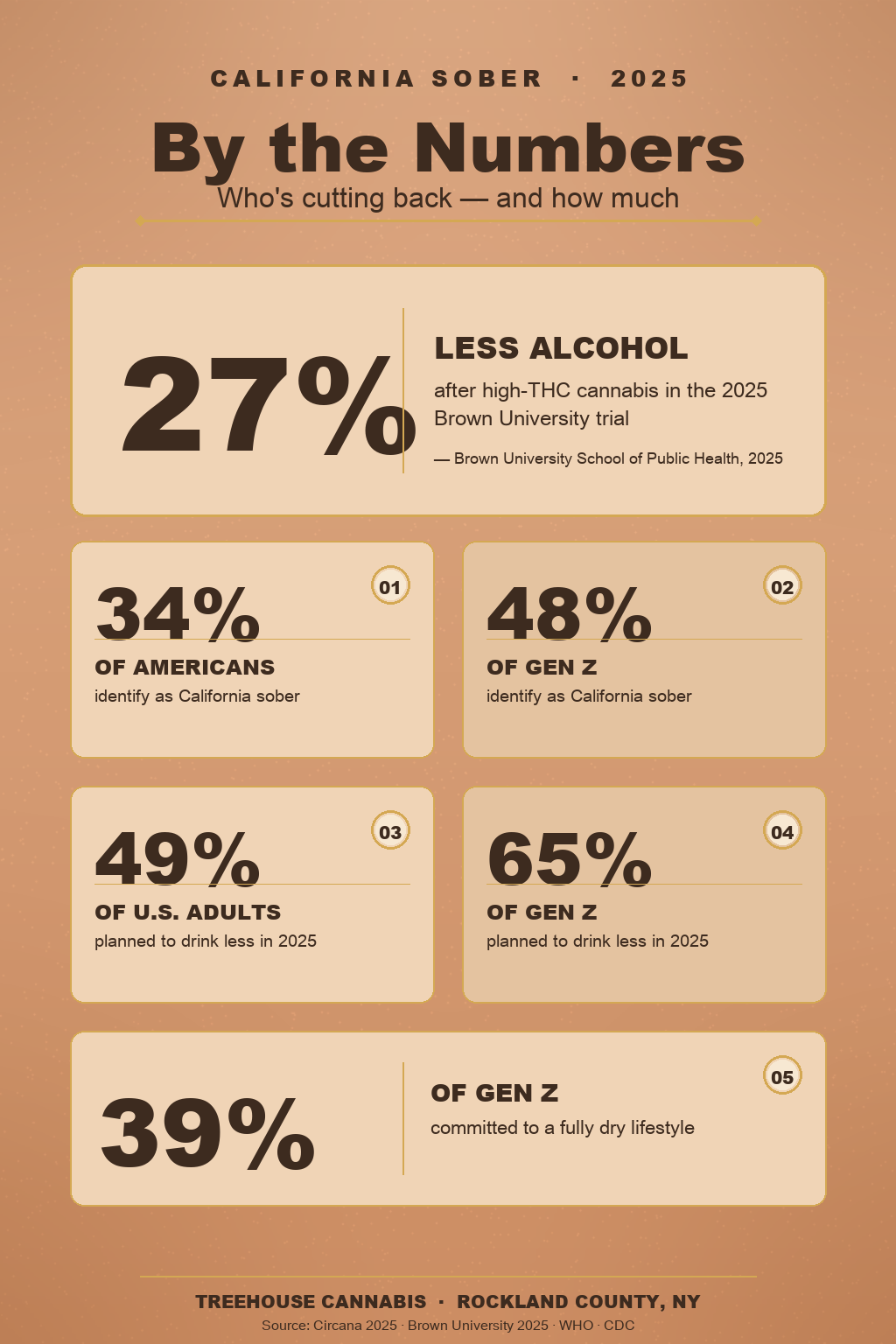
Some adults are switching from alcohol to cannabis as a cannabis alcohol alternative because new 2025 research shows cannabis can reduce short-term alcohol intake, while 49% of U.S. adults plan to drink less in 2025 according to Circana. A Brown University randomized, placebo-controlled trial found that adults who smoked 7.2% THC cannabis drank about 27% less alcohol than when given a placebo, supporting the substitution behavior that defines the "California sober" lifestyle.
What Does It Mean to Be 'California Sober'?
California sober describes an adult lifestyle in which a person abstains from alcohol or significantly cuts back while continuing to use cannabis. The term went mainstream after Demi Lovato described adopting it following her 2018 near-fatal overdose, and Circana's 2025 market survey found that 34% of Americans now identify with the label — including 48% of Gen Z adults [8].
A harm-reduction analysis in the peer-reviewed literature documented the same substitution pattern long before the phrase entered the popular vocabulary: a majority of surveyed cannabis users reported substituting cannabis for alcohol and other substances, which is the behavior modern "Cali sober" consumers describe when they say they no longer drink at parties [6].
Key signals that define the California sober identity in 2025:
- 34% of Americans identify with the label, rising to 48% among Gen Z adults.
- 49% of U.S. adults plan to drink less alcohol in 2025, and 30% took part in Dry January.
- 65% of Gen Z plan to drink less in 2025, with 39% committing to a fully dry lifestyle.
The phrase is a cultural shorthand, not a medical protocol. It is also not a recommendation for anyone with alcohol use disorder — for adults dealing with alcohol dependency, clinical treatment and supervised detox are the appropriate path. For adults who simply want to drink less without giving up the social rituals built around a drink, California sober offers a frame that has gone from fringe to familiar in just a few years.
Does Cannabis Actually Reduce How Much Alcohol Adults Drink?
The strongest evidence so far comes from a 2025 randomized, placebo-controlled trial at Brown University, which found that adults who smoked cannabis with 7.2% THC drank about 27% less alcohol over a two-hour period than when they were given a placebo. A lower 3.1% THC dose still produced a roughly 19% reduction in drinking [1].
The Brown researchers framed this as laboratory support for the substitution effect that already drives the "California sober" conversation, while cautioning that a short-term lab finding does not yet support recommending cannabis as a clinical substitute for heavy drinking.
Headline findings from the 2025 Brown substitution trial and follow-up surveys:
- 7.2% THC cannabis produced a 27% drop in alcohol intake over two hours versus placebo.
- 3.1% THC cannabis produced a 19% drop in alcohol intake over the same window.
- A majority of surveyed cannabis users reported substituting cannabis for alcohol [6].
- A 2024 large-sample survey reinforced the pattern with high rates of self-reported substitution [9].
For adults curious about the practical mechanics of the switch, the Treehouse Cannabis guide to Cannabis Use For Beginners covers how dosing, set, and setting differ from a typical evening with alcohol, and is a useful starting point if cannabis has only ever been someone else's habit before now.
How Do THC-Infused Drinks Compare to Alcohol?
THC-infused drinks use specially formulated cannabinoids that absorb faster than traditional edibles, but doses vary widely — anywhere from 2 mg to 200 mg per container — and remain less predictable than a standard beer or cocktail [2].
For adults who already know exactly how a gin and tonic will feel, that dose variability is the central trade-off: cannabis beverages can match the social ritual of a drink without alcohol's next-day effects, but they require more experimentation to dose safely.
Practical points adults commonly weigh when comparing the two:
- Onset: THC drinks typically kick in within 10–30 minutes; alcohol follows a similar window that swings with food intake and body composition.
- Dose variability: a single THC beverage may contain anywhere from 2 mg to 200 mg of THC, while a standard alcoholic drink is regulated to roughly 14 g of pure ethanol.
- Predictability: alcohol's effect curve is well known to most adults; THC drink effects vary more by individual tolerance and product formulation.
- Next-day effect: moderate THC doses rarely produce a hangover, while alcohol is widely linked to disrupted sleep, dehydration, and morning-after fog.
- Long-term risk: alcohol is a WHO Group 1 carcinogen with well-documented liver and cardiovascular harms; cannabis carries dependency and anxiety risks at high doses but a less settled long-term picture.
- New York availability: THC drinks are sold only at licensed adult-use dispensaries, while alcohol is widely available at grocery and liquor stores.
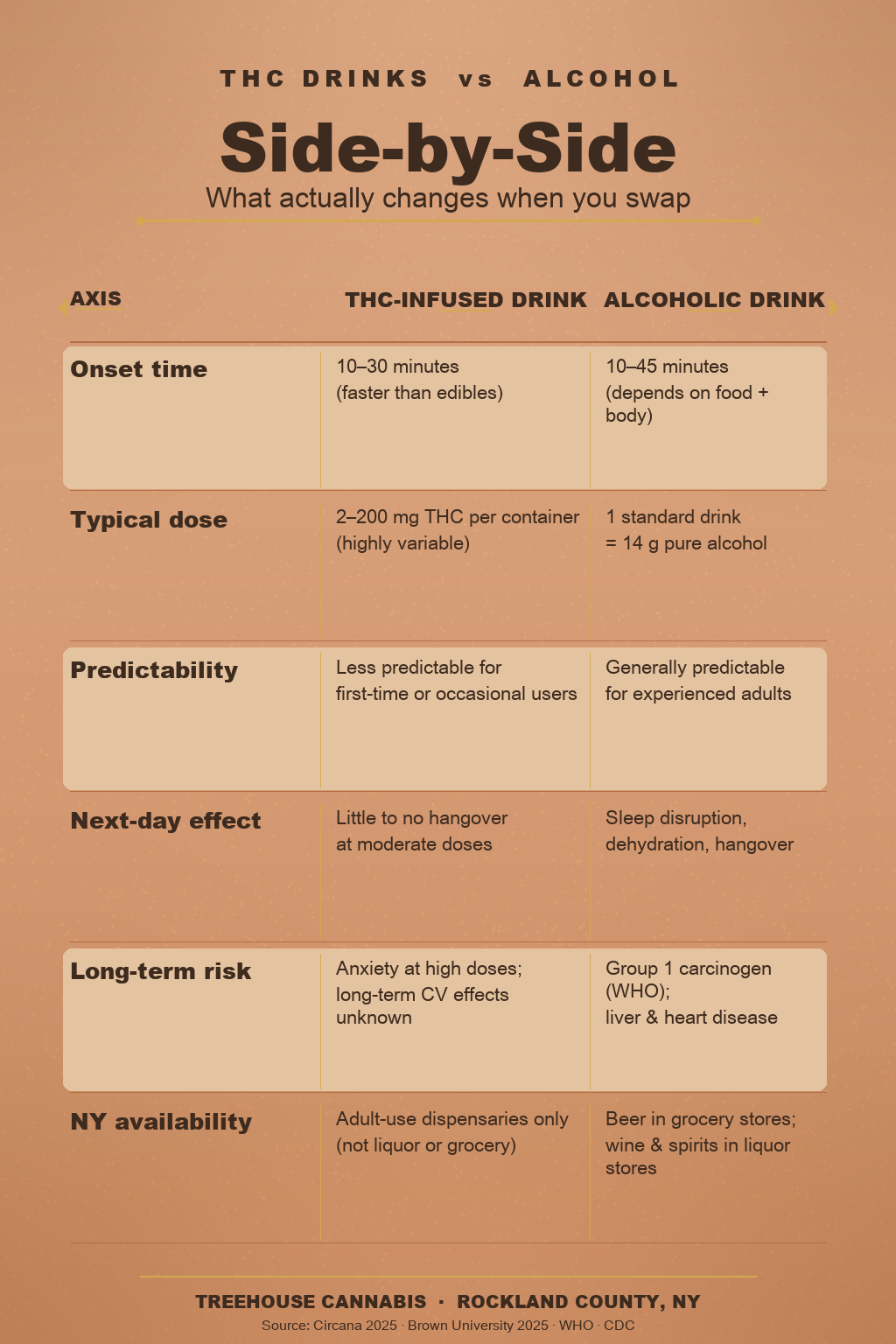
Side-by-side comparison of THC drinks and alcohol at a glance:
| Axis | THC drink | Alcohol |
|---|---|---|
| Onset time | 10–30 minutes (faster than edibles) | 10–45 minutes depending on food and body weight |
| Typical dose range | 2–200 mg THC per container (highly variable) | One standard drink = 14 g of pure alcohol |
| Predictability of effect | Less predictable for first-time or occasional users | Generally predictable for experienced adults |
| Next-day effect | Little to no hangover at moderate doses | Sleep disruption, dehydration, and hangover common |
| Long-term health risk | Anxiety at high doses, unknown long-term cardiovascular effects | Group 1 carcinogen (WHO), liver and cardiovascular disease |
| Legal sale in New York | Licensed adult-use dispensaries only (not liquor or grocery) | Licensed liquor and grocery stores statewide |
A 2024 peer-reviewed critical review of cannabis-infused beverages also flagged pulse-rate increases and reported anxiety in occasional or non-users of THC drinks, which is one reason first-timers at any licensed New York dispensary — including Treehouse Cannabis in Rockland County — should start low and go slow [5].
For adults specifically exploring cannabis beverages as a swap, the Treehouse Cannabis roundup of Exploring the Best Cannabis-Infused Drinks in New York offers a useful sense of what is currently on adult-use shelves in New York, how formats differ, and where the dose variability actually shows up in practice.
What Are the Long-Term Health Risks of Alcohol That Adults Are Trying to Avoid?
The World Health Organization classifies alcohol as a Group 1 carcinogen causally linked to at least seven types of cancer and states that no level of consumption is risk-free [3].
CDC data make the cumulative toll concrete: annual U.S. deaths from excessive alcohol use rose about 27% among males (from 94,362 to 119,606) and about 35% among females (from 43,565 to 58,701) between 2016–2017 and 2020–2021 [4].
Cumulative harms that drive adults to consider cutting back:
- Cancer risk: alcohol is a Group 1 carcinogen linked to at least seven cancer types.
- Liver disease: alcohol stresses the liver with every drink, compounding over years of use.
- Sleep disruption: alcohol fragments sleep architecture and reduces restorative rest.
- Cardiovascular disease: alcohol contributes to elevated blood pressure and heart risk.
- Rising mortality: CDC data show U.S. deaths from excessive drinking up sharply since 2016.
Beyond cancer risk, alcohol affects the liver, disrupts sleep architecture, and contributes to cardiovascular disease — a stack of cumulative harms that helps explain why nearly half of U.S. adults planned to drink less in 2025, per Circana [8].
Sleep disruption alone is one of the more underappreciated drivers of the substitution trend — adults who cut back on alcohol frequently report deeper, more restorative sleep within weeks, which can quickly become a more compelling reason to keep drinking less than any single health statistic.
Is Cannabis Risk-Free as an Alcohol Alternative?
No. Cannabis carries its own risks, including potential dependency, anxiety at high doses, and unknown long-term cardiovascular effects. The same 2024 critical review in PMC that documented THC beverage variability also found that cannabis-infused drinks can raise pulse rate and anxiety in occasional or non-users [5], and the Brown authors specifically stress that cannabis should not be recommended as a therapeutic substitute for anyone with alcohol use disorder.
Key cannabis-side risks adults should weigh before making the switch:
- Dependency: regular heavy cannabis use carries a real risk of cannabis use disorder.
- Anxiety: high THC doses can trigger acute anxiety, especially in occasional users.
- Cardiovascular uncertainty: long-term cardiovascular effects of regular cannabis use are still being studied.
- Drug interactions: cannabis can interact with prescription medications — adults on other drugs should consult a clinician.
Adults weighing the switch should also keep context in mind. Older adults curious about cannabis often approach it primarily through a wellness lens — the Treehouse Cannabis piece on How Seniors Are Using Cannabis in New York covers how seniors in New York are using cannabis for sleep, pain, and overall wellness, and most of those same cautions about dose and drug interactions apply just as much to adults using cannabis as a social alternative.
For the substitution itself, the practical entry points are usually a low-dose edible format or a controlled beverage. Adults curious about slow, session-friendly formats can browse Edibles and products like Wild berry x Shishkaberry Live Resin | Gummies | 10 Pack | 100mg to get a sense of how those categories are typically dosed at retail.
The broader market context reinforces the personal choice. Harvard Gazette coverage of U.S. drinking rates falling to a 96-year low credits Dry January and the sober-curious movement for a measurable shift in behavior [7], which is useful context for adults exploring cannabis as an alcohol alternative — but it is also a reminder that any adult-use substance should be approached with the same caution as alcohol, not as a clean swap.
Frequently Asked Questions
What does it mean to be 'California sober'? California sober describes a lifestyle in which an adult abstains from alcohol or significantly cuts back while continuing to use cannabis. The term went mainstream after Demi Lovato described adopting it following her 2018 near-fatal overdose, and Circana's 2025 survey found 34% of Americans now identify with the label, including 48% of Gen Z.
Does cannabis actually reduce how much alcohol someone drinks? A 2025 Brown University randomized, placebo-controlled trial found that adults who smoked cannabis with 7.2% THC drank about 27% less alcohol over a two-hour period than when given a placebo, and the 3.1% THC dose reduced drinking by about 19%. The researchers cautioned this is a short-term lab finding and does not yet support recommending cannabis as a clinical substitute for heavy drinking.
How do THC-infused drinks compare to alcohol in the body? THC drinks use specially formulated cannabinoids that absorb faster than traditional edibles, but doses vary widely (2 to 200 mg per container) and effects are less predictable than alcohol. Harvard Health notes that for adults familiar with how a beer or gin and tonic will feel, cannabis beverages can take more experimentation to dose safely.
What are the long-term health risks of alcohol that people are trying to avoid? The WHO classifies alcohol as a Group 1 carcinogen linked to at least seven types of cancer, and CDC data show annual U.S. deaths from excessive alcohol use have risen sharply since 2016. Alcohol also affects the liver, disrupts sleep architecture, and contributes to cardiovascular disease.
Is cannabis risk-free as an alcohol substitute? No. Cannabis carries its own risks, including potential dependency, anxiety at high doses, and unknown long-term cardiovascular effects. A 2024 critical review in PMC found that THC beverages can raise pulse rate and anxiety in occasional users, and the Brown authors stress cannabis should not be recommended as a therapeutic substitute for anyone with alcohol use disorder.
Why are young adults leading the shift away from alcohol? Circana's 2025 survey reports that 65% of Gen Z plan to drink less in 2025 and 39% intend to live fully dry, with 58% of Gen Z citing mental health as a reason. Three in five Gen Z adults drink rarely or not at all, and 38% have expressed interest in cannabis-infused beverages as an alcohol alternative.
Can THC drinks be purchased legally in New York? Yes. THC-infused beverages are legal in New York and sold through licensed adult-use cannabis dispensaries, but they are not yet sold in standard liquor or grocery stores. Recent New York legislation has proposed expanding sales to licensed liquor retailers, though that pathway is still developing.
How much money can switching from alcohol to cannabis actually save? Industry estimates suggest an adult who spends $50–$100 per week on drinks can save roughly $2,600–$5,200 annually by eliminating alcohol, though cannabis spending varies by frequency and product type. Circana found that over half of Americans are drinking less specifically to save money.
This article is intended for adults 21 and older in New York. Cannabis is for adults 21 and older; keep all cannabis products locked and out of reach of children and pets. Do not drive or operate machinery while impaired by cannabis or alcohol, and never combine the two. If you are pregnant, breastfeeding, or taking medication, speak with a licensed clinician before using cannabis. Treehouse Cannabis serves adult-use customers at its Rockland County dispensary in accordance with New York State law.
Sources
- Brown University School of Public Health — A 2025 randomized, placebo-controlled trial at Brown University found that adult
- Harvard Health Publishing — Harvard Health explains that cannabis-infused beverages are absorbed faster than
- World Health Organization (WHO) — WHO states that alcohol is a Group 1 carcinogen and that no level of consumption
- Centers for Disease Control and Prevention (CDC) — CDC reports that annual U.S. deaths from excessive alcohol use rose about 27% am
- PubMed Central / National Library of Medicine (PMC) — A peer-reviewed review finds that THC beverages can raise pulse rate and anxiety
- PubMed Central / National Library of Medicine (PMC) — A frequently cited harm-reduction analysis found that a majority of surveyed can
- Harvard Gazette — Harvard Gazette reports that Dry January participation and the broader sober-cur
- Circana — Circana's 2025 market research found that 49% of U.S. adults plan to drink less
- PubMed Central / National Library of Medicine (PMC) — A 2024 large-sample survey study found high rates of self-reported substitution
About Treehouse Cannabis
Treehouse Cannabis is an adult-use dispensary serving Rockland County, Orange County, and Westchester County from its location in Spring Valley, New York. The store carries a curated rotation of premium flower, pre-rolls, vapes, edibles, concentrates, and THC-infused beverages for adults 21 and older. Treehouse focuses on education-first retail, helping customers understand dosing, terpene profiles, and the differences between formats so adults can make informed choices about cannabis — including, for some, as an alternative to alcohol. The team publishes regular blog content covering New York cannabis law, consumption methods, and product education for adults navigating the legal adult-use market.
Shop our products

Shop All

Flower

Pre-rolls
Vaporizers

Edibles
Drinks

Concentrates
Tinctures

Topicals
CBD

Pet CBD

Accessories