Hash vs Kief: What Is the Difference?
Hash vs Kief: What Is the Difference?
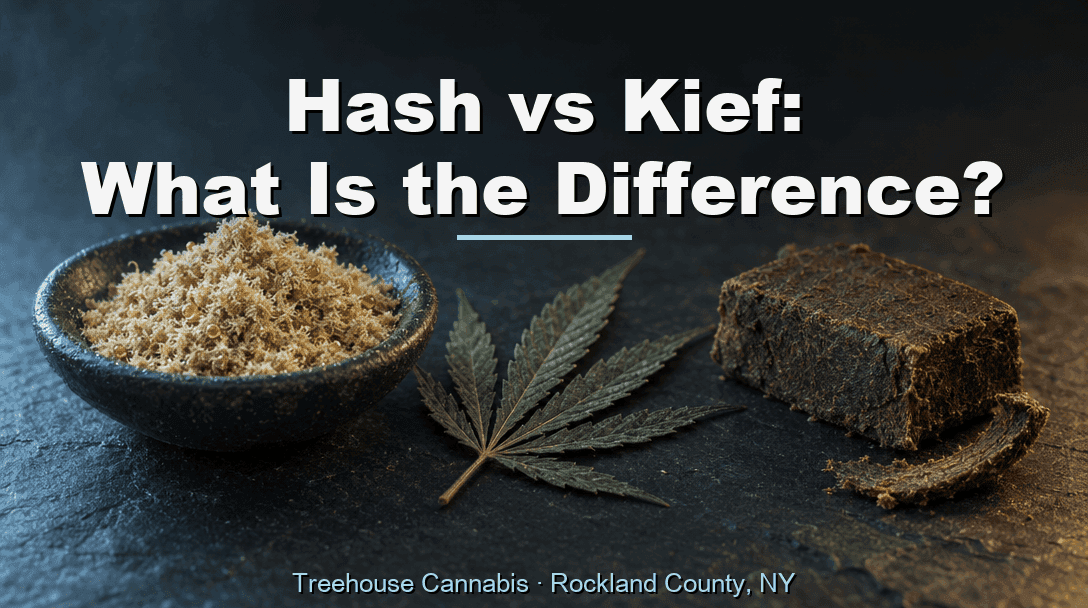
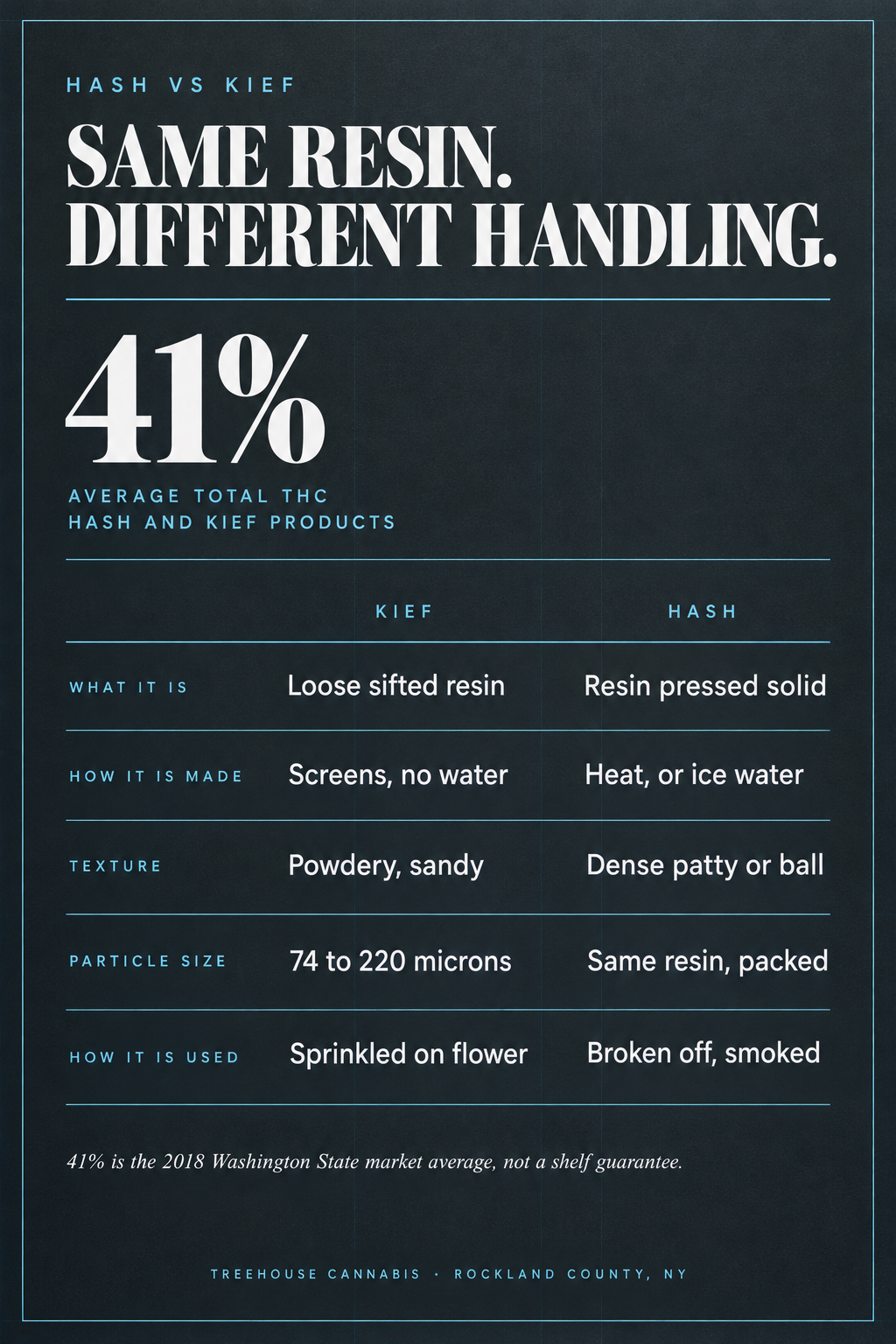
Hash vs kief comes down to handling, not potency. Kief is loose, sifted cannabis resin — trichome heads plus fine plant dust — that collects on a screen, in a grinder, or on a trim tray. Hash is that same resin consolidated with heat and pressure, or washed in ice water, until it holds as a block, patty, or ball.
What follows is what each one is actually made of, how the production routes differ, whether pressing changes potency, why pressed hash smells different from the flower it came from, and how to handle and store both. The numbers come from federal reference material, peer-reviewed plant science, and market data rather than from package copy.
What Is the Difference Between Hash and Kief?
Kief is the raw material and hash is the finished, compacted form — same starting resin, different handling, which is why the two share a starting point but not a texture.
That one decision, leave it loose or pack it together, explains everything else in the comparison. It sets the texture, the burn, how long the aroma holds, and how fast the material degrades.
The definitions come from process, not from folklore. Federal reference material describes concentrates as products made by removing trichomes and other plant material from the plant, and lists dry processing, dry ice processing, water-based processing, pressure with heat, and solvent methods as the main routes [1]. A consumer reference frames hash the same way — a solventless extract made by removing trichomes through physical manipulation and temperature change, with dry-sift and bubble production as the two standard paths [5].
| Kief | Hash | |
|---|---|---|
| What it is | Loose sifted resin plus fine plant dust | Resin consolidated into a solid |
| How it is made | Screens, agitation, and gravity — no water, no press | Pressed with heat, or washed in ice water and dried |
| Texture | Powdery and sandy, clumps under pressure | Dense patty, block, or ball |
| Heat involved? | No | Yes on the press route; only drying heat on the ice water route |
| How it is typically used | Sprinkled over flower or layered into a joint | Broken off and smoked, or dabbed if full melt |
A few points worth holding onto:
- Kief is loose resin glands and plant dust that collect on screens, in grinders, or on trim trays — no pressing, no water.
- Hash is that same resin consolidated into a block, patty, or ball by pressing with heat or washing with ice water.
- The relationship is one of sequence: kief comes first, hash is what you get when someone consolidates it.
- Federal reference material lists five main concentrate routes, and kief, finger hash, bubble hash, and heat-pressed hash all appear on that list.
- Neither word describes potency. Both describe how trichomes were separated and whether they were packed together afterward.
Hashish is simply the older name for the same pressed resin, which is why the word shows up in historical writing and on import labels without describing anything different. The mix-up worth naming is the loose kind: a jar of powder sometimes gets called hash even though nothing was ever pressed. If you have only ever handled the powder, What Is Kief and How Is It Used? goes deeper on what it is and how people use it.
What Is Kief Made Of?
Kief is a mixture, not a single substance: cannabis trichomes plus the fine plant material that came off with them. That is why a pile can run from pale blonde to greenish depending on how cleanly it was separated.
The plant side of that story is specific. Cannabis carries three kinds of glandular trichomes — bulbous, capitate-sessile, and capitate-stalked — and the stalked type produces the greatest amount of cannabinoids. Cannabinoids and terpenes are stored in a secretory cavity between the secretory disc cells and the cuticle [2].
The cell counts explain why flower trichomes matter more than leaf trichomes. Mature capitate-stalked heads on flowers carry roughly 12 to 16 secretory disc cells, while sessile trichomes on vegetative leaves carry exactly eight [2]. More disc cells, more secretory capacity.
The honest description of the powder is less flattering than the marketing. Sifted cannabis material contains glandular and other trichomes, pistils, trichome stalks, pollen, dirt, and fine plant particles, with a particle size distribution of 74 to 220 microns. Commercial separation splits that pile into a heads fraction and a contaminant tails fraction [4].
What that means in practice:
- Three glandular trichome types exist, and the capitate-stalked type produces the most cannabinoids.
- The goods sit in a secretory cavity between the disc cells and the cuticle, not on the surface of the gland.
- Mature flower heads carry roughly 12 to 16 secretory disc cells; leaf sessile trichomes carry exactly eight.
- The pile also holds pistils, trichome stalks, pollen, dirt, and fine plant particles in the 74 to 220 micron range.
- Kief is not a purity grade — the heads fraction versus the contaminant tails fraction is a real commercial distinction.
- Two jars of the same weight can differ enormously in how much plant matter they carry.
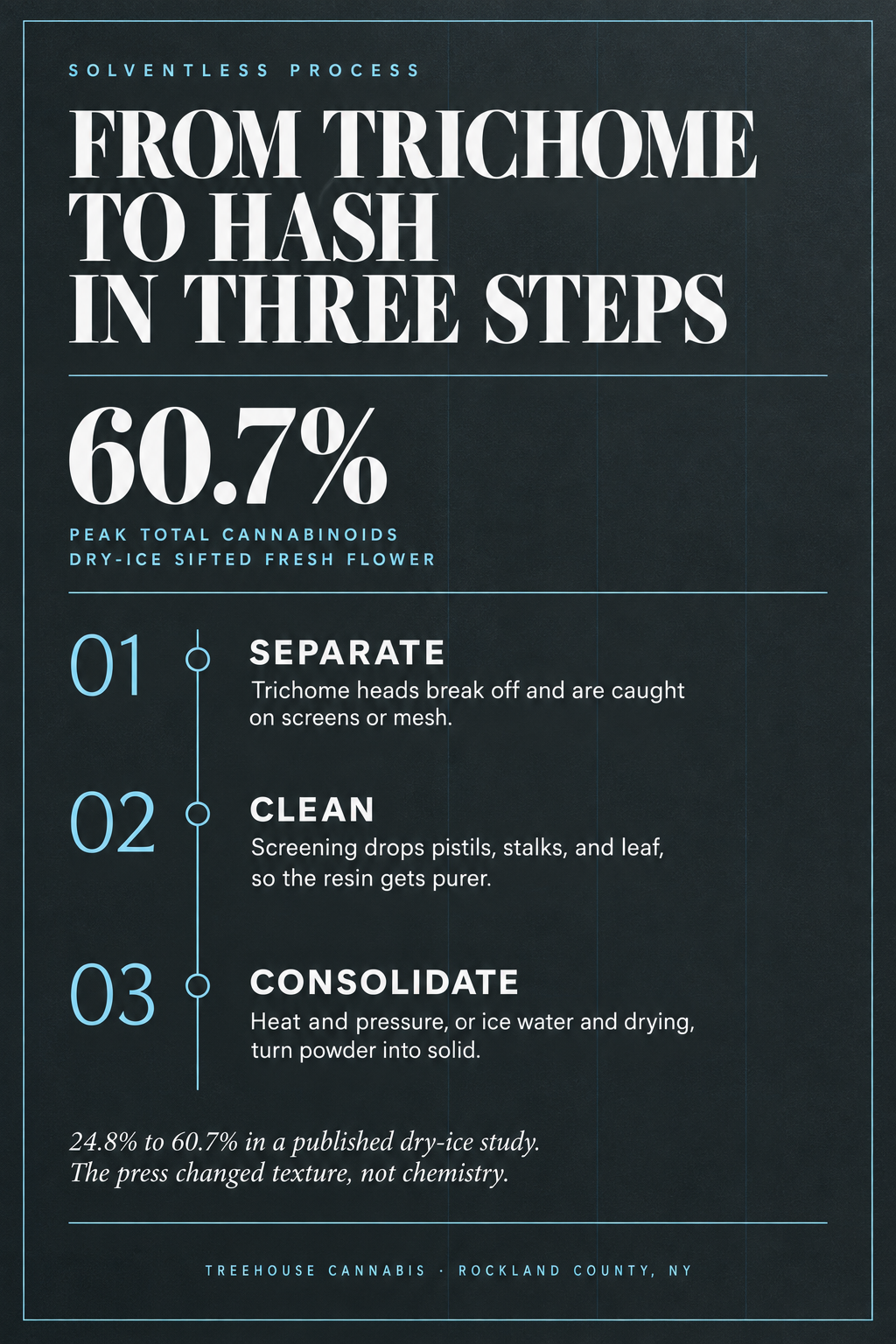
The upside of doing the separation well is measurable. In a published study, solventless dry-ice sifting of fresh flower pushed total cannabinoids as high as 60.7 percent from a 24.8 percent starting material — roughly a 2.5x concentration [3]. That figure is a measured peak from one extraction study, not a typical number for a jar on a shelf.
Trichome content is also why formats behave so differently. Flower, Vapes, Edibles, or Concentrates: Which Format Fits You? compares how much of that resin actually reaches you depending on whether you are smoking, vaping, or eating it, and Vapes vs Flower: What's the Difference? narrows the same question to two formats people weigh most often.
How Is Hash Made From Kief?
Hash is made by consolidating resin: either press sifted kief with heat and pressure until the trichomes bind, or wash cannabis in ice water so the heads break off and collect in mesh bags, then dry what comes out.
Hash covers several processes, and the label rarely tells you which one you are getting. Federal reference material groups them as dry processing, dry ice processing, water-based processing, and pressure with heat [1]. A consumer reference adds the useful distinction that full-melt grades can be dabbed while lower grades are smoked or pressed into rosin [5].
The dry route is the older one. Resin is sifted, optionally cleaned through finer screens to drop more plant matter, then pressed — by hand, with a warm press, or with friction — until the trichomes bind into a solid. The result is a patty or block whose texture depends on how much heat and pressure went into it.
The wet route works differently. Ice water and agitation knock heads off the plant material without heat, mesh bags sort the collected resin by size, and the result is dried before it becomes bubble hash [1]. Bubble hash is generally the cleaner of the two routes and the more dab-friendly one, because water and filtration remove more plant matter than screens alone.
The four routes side by side:
- Pressed kief: sift the resin, clean it through finer screens, then bind it with heat and pressure.
- Bubble hash: agitate cannabis in ice water, catch the heads in mesh bags, then dry the collected resin.
- Dry ice sifting: frozen carbon dioxide makes trichomes brittle so they snap off cleanly for collection.
- Finger hash: the crude version — resin rubbed off hands during trimming and rolled into a ball.
- Grade decides the finish: full melt can be dabbed, lower grades get smoked or pressed into rosin.
- Same starting resin, different equipment — which is why one block crumbles and another melts.
None of this is an at-home production guide, and New York's adult-use rules govern personal cultivation and processing rather than promising that any method is fine to run in a kitchen. Solvent-based extraction is a separate category with its own equipment and its own regulations, and nothing above describes it.
Kief also ends up inside other products rather than on a shelf as loose powder. Infused Pre-Rolls Explained: Flower, Kief, Oil, and Potency covers how flower, kief, and oil get combined in infused pre-rolls and what that does to potency.
Is Hash Stronger Than Kief?
Not automatically. Pressing consolidates resin and changes texture, density, burn, and flavor, but it does not create cannabinoids — the potency was set by how clean the sift was before anyone pressed it.
The market data backs that up. An analysis of roughly 45 million individually priced items in Washington State's legal market found hash and kief products averaging 41 percent total THC, with a first quartile of 30 percent and a third quartile of 50 percent, at an average price of $23.57 [6]. Those are 2018 market averages across a whole category, not a promise for a specific jar.
For scale, the same analysis put vaporizer cartridges at 68 percent average THC — the highest-potency category it measured [6]. That is a different product class, not a stronger version of the same thing. If you want to see that format side by side, Cartridges Vaporizers is where it lives.
What does move the number is separation, not pressure. Sifting concentrates whatever was already in the starting material, and dry-ice sifting of fresh flower reached 60.7 percent total cannabinoids from 24.8 percent [3]. That gain came from removing plant matter, not from anything the press did.
Labels are also more trustworthy here than people assume. In a study of 277 products bought from 52 Colorado dispensaries, 96.0 percent of concentrates tested within plus or minus 15 percent of their labeled THC, against 56.7 percent of flower products, with both categories testing slightly below label on average [7].
So what actually decides the comparison:
- Pressing changes texture, density, burn, and flavor — not cannabinoid content.
- Market data put hash and kief at 41 percent average total THC, first quartile 30 percent, third quartile 50 percent.
- For scale, vaporizer cartridges in the same market averaged 68 percent total THC.
- Sifting is what raises the number, reaching 60.7 percent from 24.8 percent starting material in a published dry-ice study.
- Concentrate labels hold up reasonably well — 96.0 percent tested within plus or minus 15 percent of label, versus 56.7 percent for flower.
- The real variable is how clean the sift was and what went into it, not whether it was pressed.
| What changes the number | Effect on potency | Evidence |
|---|---|---|
| Pressing kief into hash | Changes texture, density, burn, and flavor; cannabinoid content carries over from the starting resin | Process description, not a potency gain |
| Sifting out plant matter | Concentrates what was already in the starting material, reaching 60.7% total cannabinoids from 24.8% | Published dry-ice sifting study, 2021 |
| Choosing a solvent extract instead | Cartridges averaged 68% total THC, the highest-potency category measured | Washington State market analysis, 2018 |
A THC percentage is a measurement, not a quality score. A 45 percent hash made from clean heads and a 45 percent hash padded with leaf dust will read the same on a label and behave nothing alike.
Why Does Hash Smell Different From the Flower It Came From?
Traditional hash is cured and stored as a pressed block, and that aging changes the chemistry. Some THC oxidizes into CBN while myrcene converts into a terpene researchers nicknamed hashishene, which is why classic hash reads spiced and earthy rather than bright and floral [3].
The physical reason aroma concentrates at all is the same reason potency does. Cannabinoids and terpenes share a secretory cavity between the secretory disc cells and the cuticle [2], so separating trichome heads separates the aroma compounds from leaf and stem at the same time.
From there, hash and kief diverge even when they started on the same plant. A pressed block has far less exposed surface than loose powder, so it holds its volatiles longer and ages in a slower, more even way. Loose kief has almost nothing but surface, dries out faster, and loses its brighter top notes first.
What to watch for:
- Curing and storage oxidize some THC into CBN, so the cannabinoid profile shifts with age.
- Myrcene converts into hashishene, the source of the spiced, earthy smell in classic pressed hash.
- Aroma compounds live in the same secretory cavity as cannabinoids, so separating heads concentrates both.
- A pressed block has less exposed surface than loose powder, so it holds volatiles longer.
- Loose kief dries and loses its brighter top notes faster because so much of it is surface.
- Read aroma as a handling signal: bright and floral suggests recent material, spiced and earthy suggests a cure, hay or cardboard suggests it sat too long or got too warm.
Aging is a trade, not an upgrade. Oxidation into CBN means the profile shifts over time — that is a change in the chemistry, and whether you like it is a preference rather than a quality verdict. Fresh pressed hash and well-aged hash are simply different products.
At a counter, smell is one of the few things you can assess before you buy. Hash Concentrates is where pressed blocks and ice water hash sit if you want to compare them in person.
How Do You Use and Store Hash and Kief?
Kief is easiest sprinkled over ground flower in a bowl or rolled into a joint, hash needs a little warmth or friction to crumble so it burns evenly, and both keep longest airtight, cool, dark, and dry.
Loose kief is awkward on its own because it burns fast and pulls through screens. Most people top a bowl of Thai Sunrise Flower - 70g with it, layer it into a joint, or press it into a puck first so it burns more slowly and evenly.
Hash needs a step before it will cooperate. Break off a piece, warm it briefly between your fingers or with gentle heat so it crumbles instead of sitting as one dense lump, then smoke it in a bowl or a joint. Full-melt grades can be dabbed; lower grades are smoked or pressed into rosin [5].
Storage is where the two formats really separate. Kief exposes far more surface area to air, so it degrades faster, dries out, and clumps. A pressed block protects itself better and holds texture and aroma longer [3]. Store it the way you would store Fruity Pebbles | Live Resin Badder | 1g: airtight, cool, dark, and dry.
The handling habit that matters most is portioning. Every time a jar of loose kief is opened and poked, moisture and plant dust get in, so work from a small amount rather than the whole jar.
Practical version:
- Kief on its own burns fast and pulls through screens, so sprinkle it over flower or layer it into a joint.
- Pressing loose kief into a puck first makes it burn slower and more evenly.
- Hash needs brief warmth or friction to crumble rather than sitting as a dense lump.
- Full-melt hash can be dabbed; lower grades are smoked or pressed into rosin.
- Store both airtight, cool, dark, and dry — kief degrades faster because it has far more exposed surface.
- Work from a small amount at a time so the main stash is not opened and re-opened.
One thing worth noticing while you handle it: if you have been grinding through the same jar of Thai Sunrise Flower - 70g for a while, the kief in the bottom of the grinder is the same resin as the flower above it, just separated by motion. That is the entire concept in miniature. If you are buying flower specifically as a base for kief or hash, Flower is the shelf to start from.
Kief is what falls off the plant; hash is what happens when someone decides to press it. Treehouse Cannabis in Rockland County, NY stocks both — pressed hash and ice water hash on the concentrate shelf, plus Gumball Diamond Infused | Pre-Rolls | 5 pack if you would rather skip the loose powder entirely. Our staff will walk you through what the label says and which grade you are actually buying. Browse the shelf or order online for pickup and delivery across Rockland, Orange, and Westchester Counties.
Frequently Asked Questions
What is the difference between hash and kief?
Kief is loose, sifted cannabis resin made of trichomes and some plant particles. Hash is that same resin processed further, usually pressed with heat and pressure or washed with ice water, until it holds together as a block, patty, or ball. Kief is the raw material; hash is the finished, compacted form.
Is hash stronger than kief?
Not automatically. Pressing changes texture, density, burn, and flavor, not the cannabinoid content of the starting resin. Hash often tests higher because makers start with cleaner, better-separated trichomes. A clean, well-sifted kief can match or beat an average pressed hash.
Is kief the same thing as dry sift?
They are closely related but not identical. Kief usually means the loose powder that falls off flower, including leftover plant material. Dry sift refers to resin cleaned through a series of fine screens, which removes more plant matter and produces a purer, lighter-colored powder.
How is bubble hash different from pressed kief?
Pressed kief is a dry process: trichomes are sifted and then compacted with heat and pressure. Bubble hash is a wet process: flower is agitated in ice water and the resin is collected in mesh filter bags, then dried. Bubble hash is generally cleaner and more dab-friendly.
Can you smoke kief on its own?
You can, but it is awkward. Loose kief burns fast and pulls through screens easily. Most people sprinkle it over flower in a bowl or roll it into a joint, or press it into a puck first so it burns more slowly and evenly.
Does pressing kief into hash make it more potent?
No. Pressing consolidates the resin and can deepen aroma and flavor, but the THC carries over unchanged from the starting material. Any potency difference comes from how clean the sift was before pressing, not from the pressure itself.
Why does hash smell different from the flower it came from?
Traditional hash is cured and stored as a pressed block, and that aging lets some THC oxidize into CBN while myrcene converts into a terpene researchers nicknamed hashishene. That is why classic hash often smells spiced and earthy rather than bright and floral.
How should you store kief and hash?
Keep both airtight, cool, dark, and dry. Kief has far more surface area exposed to air, so it degrades faster and dries out or clumps. A pressed block protects itself better and typically holds its texture and aroma longer than loose powder.
Sources
- National Institute on Drug Abuse (NIDA) — Defines cannabis concentrates as products made by removing trichomes and other p
- Frontiers in Plant Science (National Library of Medicine) — Peer-reviewed review explaining that cannabis carries bulbous, capitate-sessile,
- Molecules (National Library of Medicine) — Peer-reviewed study showing solventless dry-ice sifting of fresh flower concentr
- Journal of Cannabis Research (National Library of Medicine) — Peer-reviewed paper describing the powder produced by trichome sifting as contai
- Leafly — Consumer reference describing hash as a solventless extract made by removing tri
- International Journal of Drug Policy (National Library of Medicine) — Peer-reviewed analysis of roughly 45 million individually priced items in Washin
- Scientific Reports (National Library of Medicine) — Peer-reviewed study of 277 products bought from 52 Colorado dispensaries finding
About Treehouse Cannabis
Treehouse Cannabis is a licensed adult-use dispensary in Rockland County, New York, serving customers across Rockland, Orange, and Westchester Counties. The concentrate shelf carries pressed hash and ice water hash alongside flower, pre-rolls, and infused pre-rolls, and the team will walk you through what the label says and which grade you are buying before you decide.
Cannabis is for adults 21 and older. Keep all cannabis products out of reach of children and pets. This article is educational and is not medical advice; it does not diagnose, treat, or cure any condition. Cannabis affects people differently, and anyone with a health condition, anyone taking medication, and anyone who is pregnant or breastfeeding should speak with a licensed healthcare provider before using cannabis. Do not drive or operate machinery while impaired. Buy only from licensed New York dispensaries and follow local possession and consumption laws.

Shop our products

Shop All

Deals

Flower
Pre-rolls
Vaporizers

Edibles
Drinks

Concentrates
Tinctures

Topicals

CBD

Pet CBD

Accessories