Delta-8 vs Delta-9 THC: What New York Consumers Should Know
Delta-8 vs Delta-9 THC: What New York Consumers Should Know
Delta 8 vs delta 9 comes down to where a single double bond sits: carbon 8 for delta-8, carbon 9 for delta-9. That one position makes delta-8 bind CB1 receptors less tightly, so it takes roughly twice the oral dose to match delta-9, and New York allows delta-9 through licensed dispensaries while barring delta-8 from its hemp program.
In New York the two are not interchangeable at the counter. Delta-9 THC is the cannabinoid sold in licensed adult-use dispensaries. Delta-8 is barred from the state's cannabinoid hemp program as an isomerized cannabinoid, yet it remains widely available in gas stations, corner stores, and smoke shops, which is where most of the confusion starts.
This guide works through the chemistry, the potency data from a 2025 clinical trial, the specific New York rules and their limits, why the unlicensed market persists, how the effects actually compare, and what a legal purchase looks like. The numbers come from regulators, peer-reviewed research, and independent lab testing rather than from packaging.
Delta-8 vs Delta-9 THC: What Is the Actual Difference?
They are isomers: same molecular formula, same atoms, one double bond in a different place. Delta-8 carries it on the eighth carbon of the ring, delta-9 on the ninth.
That is the entire structural distinction, and it is not a small one in effect. A pharmacology review describes delta-8 as a partial agonist at the CB1 receptor with weaker receptor affinity than delta-9, which is the mechanism credited for its lower potency [5]. The same review finds the two have very similar pharmacokinetics and pharmacodynamics, meaning they move through the body and act on it in comparable ways. The difference is how hard they push, not where they push.
Where the molecules come from is a separate question with a less flattering answer. Delta-8 occurs naturally in cannabis only in negligible amounts, so the delta-8 sold in stores is manufactured by cyclizing hemp-derived CBD [8]. That conversion uses acids and solvents, and its output varies.
| What differs | Delta-8 THC | Delta-9 THC |
|---|---|---|
| Molecular formula | C21H30O2, identical | C21H30O2, identical |
| Double bond position | Carbon 8 | Carbon 9 |
| CB1 receptor binding | Weaker, partial agonist | Stronger affinity |
| Natural presence in cannabis | Trace amounts only | Primary psychoactive cannabinoid |
| How retail supply is made | Cyclized from hemp-derived CBD | Extracted from cannabis flower |
| New York cannabinoid hemp products | Not permitted | Permitted within limits |
- Same molecular formula, different double-bond position: carbon 8 for delta-8, carbon 9 for delta-9
- Delta-8 binds the CB1 receptor less strongly and acts as a partial agonist, which is the accepted explanation for its lower potency
- Delta-8 appears naturally in cannabis only in trace amounts, so concentrated retail delta-8 is converted from CBD
- The conversion relies on acids and solvents, which is a large part of why potency and purity vary between products
None of that makes delta-8 a different drug class. It is not a synthetic cannabinoid in the sense of the compounds behind the Spice and K2 outbreaks, and describing it that way gets the chemistry wrong in the opposite direction. It is a THC isomer produced by chemical conversion, which is a regulatory and labeling problem more than a category problem. The consumer-facing version of this comparison gets a fuller treatment in Delta-8 THC: What It Is and How It Differs From Delta-9.
Delta-8 vs Delta-9 Potency: Which Is Stronger?
Delta-8 is weaker milligram for milligram. The clearest measurement comes from a 2025 double-blind crossover trial run by the Johns Hopkins Behavioral Pharmacology Research Unit in 19 adults [6].
At 20 mg by mouth, delta-8 produced significantly lower drug-effect ratings than 20 mg of delta-9, along with fewer negative effects, less cognitive impairment, and less psychomotor impairment. Doubling the delta-8 dose closed the gap: 40 mg of delta-8 matched 20 mg of delta-9 on subjective effects. Drug liking came out comparable at both dose levels, which is what keeps this from being a story about delta-8 being mild.
| Measure at matched milligrams | 20 mg delta-8 | 20 mg delta-9 |
|---|---|---|
| Overall drug-effect rating | Lower | Higher |
| Negative effects | Fewer | More |
| Cognitive impairment | Less | More |
| Psychomotor impairment | Less | More |
| Drug liking | Comparable | Comparable |
| Dose needed to match subjective effects | 40 mg | 20 mg |
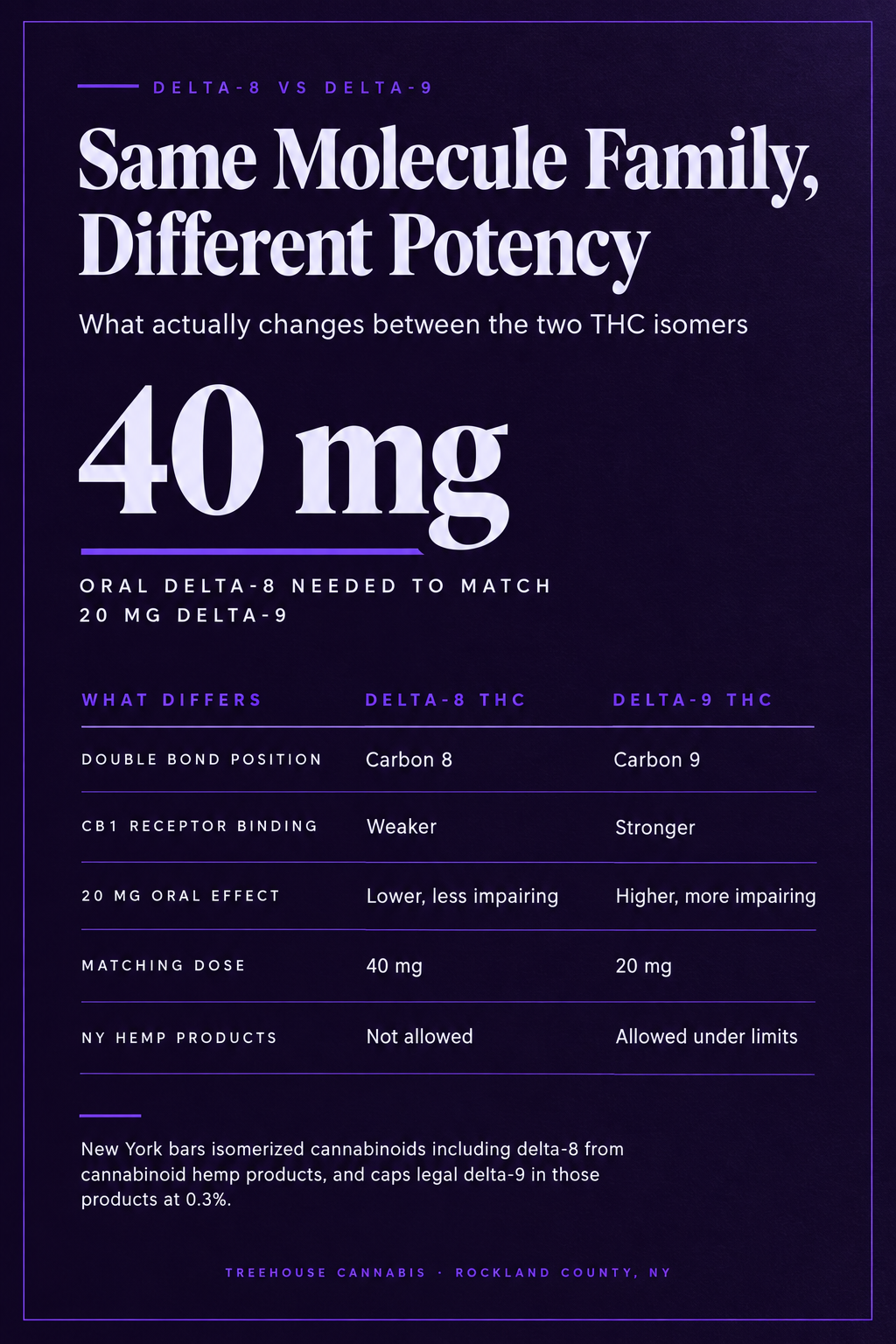
The mechanism is the receptor difference described above: weaker CB1 affinity means less receptor activation at a given milligram [5]. That still says nothing about how much THC is in the package you are holding. Independent lab analysis of 20 retail delta-8 products found delta-8 in 95% of them, but only a weak correlation between labeled and actual content, and delta-9 THC in 35% [7]. Potency per milligram and certainty about the milligram are two separate questions, and the unregulated market answers the second one badly.
- 20 mg of oral delta-8 produced lower drug-effect ratings than 20 mg of delta-9
- 40 mg of delta-8 matched 20 mg of delta-9 on subjective effects
- Drug liking was comparable at both dose levels, so weaker is not the same as negligible
- Less impairment at matched milligrams follows from weaker CB1 binding
The trial measured acute effects in 19 adults over short sessions. It is good evidence about relative strength and no evidence at all about long-term safety or about what happens when a label understates the dose. Terpene content does not change any of these milligram figures, though it shapes how a given batch presents, and The Cannabis Terpene Wheel: A Visual Guide to Every Common Terpene maps out what each one contributes. For anyone who would rather work with smaller amounts than compare isomer strength, Microdosing THC in New York covers that approach on its own terms.
Is Delta-8 THC Legal in New York?
No, not as a hemp product. New York's cannabinoid hemp rules bar isomerized cannabinoids outright, and delta-8 is named in the regulation.
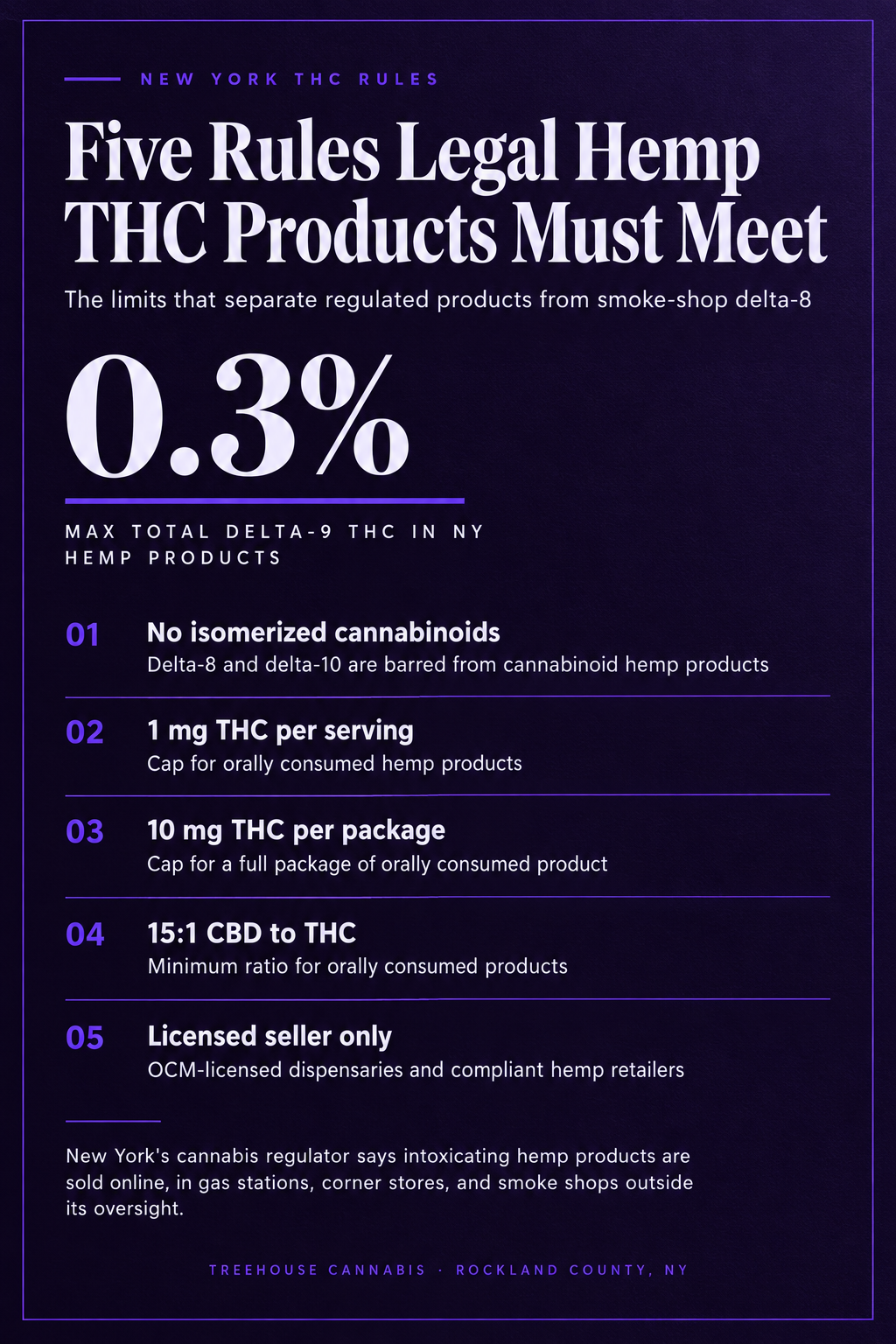
Section 114.8 of 9 NYCRR caps cannabinoid hemp products at 0.3% total delta-9 THC by dry weight and forbids products containing synthetic, artificially derived, or isomerized cannabinoids, naming delta-8 and delta-10 THC specifically [4]. Orally consumed products carry tighter limits still: 1 mg total THC per serving, 10 mg per package, and a CBD-to-THC ratio of at least 15:1.
The Office of Cannabis Management states the same position from the consumer side. Intoxicating hemp products, including those made with delta-8 THC, are not legal in the state's cannabinoid hemp program, and they are sold outside OCM oversight through online listings, gas stations, corner stores, and smoke shops [3].
| Requirement for cannabinoid hemp products | Limit |
|---|---|
| Total delta-9 THC by dry weight | No more than 0.3% |
| Total THC per serving, oral products | 1 mg |
| Total THC per package, oral products | 10 mg |
| CBD-to-THC ratio, oral products | At least 15:1 |
| Isomerized cannabinoids, including delta-8 and delta-10 | Not permitted |
- 9 NYCRR 114.8 forbids synthetic, artificially derived, or isomerized cannabinoids, including delta-8 and delta-10
- Legal hemp products may not exceed 0.3% total delta-9 THC by dry weight
- Orally consumed hemp products are capped at 1 mg total THC per serving and 10 mg per package
- Those products also need at least a 15:1 CBD-to-THC ratio
- Legal THC sales run through OCM-licensed dispensaries or compliant cannabinoid hemp retailers
That leaves two lawful channels and one conspicuous gap. An adult 21 and older can buy regulated cannabis at an OCM-licensed adult-use dispensary, or buy a compliant low-THC hemp product from a licensed hemp retailer. Converted delta-8 is not sold through either. The rules about where consumption is permitted are a separate body of law, and Where Can You Legally Use Cannabis in New York? covers those in detail, because buying legally and using legally are two different questions in New York.
Hemp-Derived Delta-8 in New York: Why Is It Still Sold at Smoke Shops?
Because those sales sit outside the system the state licenses, not because the rules allow them.
OCM's description of the retail landscape is explicit. Intoxicating hemp products reach buyers through online sellers, gas stations, corner stores, and smoke shops, channels that do not carry the testing, labeling, and licensing obligations of a licensed business, and the agency treats their presence as a public health risk [3].
The testing gap is the part that matters most at the counter. In the independent analysis of 20 retail delta-8 products, 95% actually contained delta-8, only a weak correlation existed between labeled and actual content, and 35% also contained delta-9 THC [7]. A label that correlates weakly with contents is not a dosing tool, and it is not a safety document either.
The reported safety record is not reassuring. The FDA logged 104 adverse event reports involving delta-8 THC between December 2020 and February 2022, 55% of which required intervention or hospital admission, and 66% of which followed an edible [1]. Poison control centers handled 2,362 delta-8 exposure cases over roughly the same period, 41% of them involving children under 18.
The CDC's health advisory adds the clinical picture and, importantly, the labeling point. Delta-8 products were widely available with insufficient labeling, and reported effects resembled delta-9 intoxication: lethargy, slurred speech, low blood pressure, difficulty breathing, and sedation [2]. The advisory treats the labeling gap as part of the hazard rather than an administrative detail.
- Unlicensed channels sell intoxicating hemp products without OCM testing or labeling oversight
- Of 20 retail delta-8 products tested, 95% contained delta-8, but labels correlated only weakly with actual content
- 35% of those products also contained delta-9 THC
- The FDA logged 104 adverse event reports in about 14 months, with 55% needing intervention or hospital admission
- Two-thirds of those adverse events followed an edible
The contrast with a regulated shelf is concrete. A licensed flower product such as New York City Diesel | Diamond Infused Flower | 3.5G arrives with a batch result and a printed total THC figure, so the package answers the question the smoke-shop label leaves open. That is the practical difference between a product the state tested and a product nobody did.
Delta-9 THC vs Delta-8: How Do the Effects Compare?
They produce the same family of effects through the same receptor, with delta-8 landing at lower intensity for a matched milligram. This is a difference in degree, not in kind.
Both are intoxicating and both act on CB1 receptors, and the pharmacology review finds their pharmacokinetics and pharmacodynamics very similar [5]. The crossover trial confirms the direction of that similarity: at 20 mg, delta-8 delivered the same kinds of subjective effects as delta-9 at lower intensity, with fewer negative effects and less cognitive and psychomotor impairment [6].
The CDC's reported symptom profile describes what the stronger of the two can do at higher exposure: lethargy, slurred speech, low blood pressure, difficulty breathing, and sedation [2]. Those reports describe adverse events, not typical experiences, and they are worth reading as the upper end of the range rather than the expected one.
| What changes | Delta-8 THC | Delta-9 THC |
|---|---|---|
| Receptor | CB1, partial agonist | CB1, stronger affinity |
| Effect at 20 mg oral | Lower intensity | Higher intensity |
| Cognitive and psychomotor impairment | Less | More |
| Negative effects in the trial | Fewer | More |
| Onset, oral route | Delayed | Delayed |
Edibles deserve their own paragraph because the timing is what catches people. Oral products take a while to come on, and two-thirds of the reported delta-8 adverse events followed an edible [1]. Waiting on a dose that has not arrived yet is how a second one gets taken.
- Same receptor, same family of effects, different intensity at matched milligrams
- CDC-reported effects include lethargy, slurred speech, low blood pressure, and sedation at higher exposure
- Edibles delay onset, and two-thirds of reported delta-8 adverse events followed an edible
- A hemp label does not guarantee a clean drug test
- Product labels frequently do not match actual content
Drug testing is the question this comparison usually gets wrong in both directions. New York's required hemp product warnings state that a product derived from hemp may still contain THC that could result in a failed drug test, and the CDC notes that the ability of standard hospital tests to detect delta-8 is not fully characterized [2]. So the honest answer is that it can show up, the label does not settle it, and no packaging claim changes that.
Lemon Lime Squeeze Beverage Infusion | 100mg
Where Can New York Consumers Legally Buy THC?
Through two licensed channels, and the difference between them is what the label is allowed to say.
OCM-licensed adult-use dispensaries sell regulated cannabis to adults 21 and older, with testing and labeling requirements attached to the license. Licensed cannabinoid hemp retailers sell products that meet the 0.3% delta-9 cap, the 1 mg per serving and 10 mg per package limits, and the 15:1 CBD-to-THC ratio [4]. Converted delta-8 is not part of either channel [3].
A short checklist covers most of what separates a compliant package from a smoke-shop one:
- Total THC per serving and total THC per package, both printed rather than implied
- The delta-9 percentage, checked against the 0.3% hemp cap if the product is a hemp product
- The CBD-to-THC ratio on oral hemp products, which must be at least 15:1
- A batch number or a lab result a customer can actually look at
- A seller holding a state license, whether a dispensary or a hemp retailer
A checklist only helps if the answers are on the package, and that is the first thing to look for. A compliant product states its numbers where a customer can read them before paying, not on a website or in a conversation with a clerk. If the total THC per serving is missing, or the percentage on the label is the only potency figure available, the package cannot answer the question the buyer is actually asking.
The regulated shelves are not limited to one format either. Flower like Lemon Cherry BX | Flower | 3.5g carries a printed potency figure, and the Edibles category prints total THC per serving, which makes a comparison possible before purchase instead of after.
Cranberry Jam • T-pro Disposable Vape • 2g
What Should Hudson Valley Customers Ask at the Counter?
Four questions settle it: total THC per serving, a batch result, a state license on the seller, and a printed delta-9 percentage. Customers in Rockland, Orange, and Westchester County can get all four answered at a licensed counter before paying.
- What is the total THC per serving, and what is it per package?
- Does this product come with a batch result I can look at?
- Does this shop hold an OCM license for adult-use sales?
- Does the package print the delta-9 percentage, or only a potency claim?
- If it is a hemp product, does it meet the 0.3% cap and the 15:1 ratio?
A licensed counter answers those questions as a matter of course, because the license depends on it. A smoke shop selling converted delta-8 generally cannot, and the gap between those two conversations is the most useful thing a customer can listen for.
The point is not that one cannabinoid is virtuous and the other is not. It is that a regulated product comes with answers, and an unregulated one comes with a label that independent testing has repeatedly found unreliable.
The team at Treehouse Cannabis will walk through those numbers on any product in the store before you decide, which is the practical version of this whole article.
Frequently Asked Questions
Is delta-8 THC legal in New York?
No, not as a hemp product. New York regulation 9 NYCRR 114.8 bars cannabinoid hemp products from containing synthetic, artificially derived, or isomerized cannabinoids, and names delta-8 and delta-10 THC specifically. The Office of Cannabis Management says intoxicating hemp products are not legal in its cannabinoid hemp program, and licensed dispensaries sell regulated delta-9 cannabis instead.
Is delta-8 stronger or weaker than delta-9 THC?
Weaker milligram for milligram, according to a 2025 Johns Hopkins crossover trial. At 20 mg, oral delta-8 produced lower drug-effect ratings, fewer negative effects, and less impairment than 20 mg delta-9. At 40 mg, delta-8 matched 20 mg of delta-9, and drug liking was comparable at both doses.
Does delta-8 THC show up on a drug test?
It can. New York's required hemp product warnings state that a product derived from hemp may contain THC that could result in a failed drug test. The CDC adds that the ability of standard hospital tests to detect delta-8 is not fully characterized, so a hemp label is no guarantee of a clean screen.
What is the chemical difference between delta-8 and delta-9 THC?
Both are THC isomers with the same formula, differing in where a double bond sits on the carbon ring: the eighth carbon for delta-8, the ninth for delta-9. That difference makes delta-8 bind the CB1 receptor less strongly, which pharmacology reviews credit for its lower potency rather than a different kind of high.
Why is delta-8 sold at smoke shops if New York bans it?
Because those sales sit outside the regulated system. The Office of Cannabis Management says intoxicating hemp products are sold online, in gas stations, corner stores, and smoke shops without the testing, labeling, and licensing oversight required of OCM-licensed businesses, and the agency treats them as a public health risk.
How much THC is allowed in a legal New York hemp edible?
New York caps orally consumed cannabinoid hemp products at 1 mg total THC per serving and 10 mg total THC per package, with a CBD-to-THC ratio of at least 15:1 and no more than 0.3% total delta-9 THC by dry weight, under 9 NYCRR 114.8.
Where can New York consumers legally buy THC products?
Through OCM-licensed adult-use dispensaries, which sell regulated cannabis to adults 21 and older, or through licensed cannabinoid hemp retailers selling compliant low-THC hemp products. Converted delta-8 is not part of either licensed channel.
Is delta-8 THC natural?
Only in trace amounts. The chemistry literature notes that delta-8 appears naturally in cannabis in very small quantities, so concentrated retail delta-8 is manufactured by converting hemp-derived CBD with acids and solvents, a process regulators flag for inconsistent potency and possible byproducts.
Sources
- U.S. Food and Drug Administration — FDA states delta-8 THC products have not been evaluated or approved for safe use
- Centers for Disease Control and Prevention — CDC health advisory warns that delta-8 THC products are widely available with in
- New York State Office of Cannabis Management — New York's cannabis regulator states that intoxicating hemp products, including
- New York State Cannabis Control Board (9 NYCRR Part 114) — State regulation requires cannabinoid hemp products to contain no more than 0.3%
- British Journal of Pharmacology (Tagen & Klumpers) — Peer-reviewed review finds delta-8 and delta-9 THC have very similar pharmacokin
- Drug and Alcohol Dependence (Johns Hopkins Behavioral Pharmacology Research Unit) — Double-blind crossover trial in 19 adults found 20 mg oral delta-8 produced sign
- Journal of Medical Toxicology (Kaczor et al.) — Independent laboratory analysis of 20 retail delta-8 products detected delta-8 i
- Molecules / PubMed Central (Abdel-Kader et al.) — Chemistry review explains that delta-8 THC occurs naturally in cannabis only in
About Treehouse Cannabis
Treehouse Cannabis is a licensed adult-use dispensary in Rockland County, New York, serving customers across Rockland, Orange, and Westchester Counties. The menu carries flower, pre-rolls, vapes, and edibles with total THC printed per serving and batch testing behind the products, and the team will read the panel with you before you buy.
Cannabis is for adults 21 and older. This article is educational and informational only and is not medical advice. Cannabis affects people differently, and oral products can take up to two hours to take effect. Do not drive or operate machinery while impaired, keep all cannabis products out of reach of children and pets, and consult a licensed healthcare provider if you have questions about how cannabis interacts with your health or medications.
Shop our products

Shop All

Deals

Flower

Pre-rolls
Vaporizers

Edibles
Drinks

Concentrates
Tinctures

Topicals
CBD

Pet CBD

Accessories