Cannabis and Hiking: Planning a Safe Outdoor Experience
Cannabis and Hiking: Planning a Safe Outdoor Experience
Cannabis and hiking can work together in New York, but the planning decides the outcome. Adults 21 and older may possess cannabis, yet smoking it is barred in most public parks, and measurable balance and endurance deficits last up to 12 hours after use.
That is the short version. The longer version is where most people get caught out. New York's rules on where you can smoke changed in 2022, the physical effects linger longer than most people assume, and a mile of rock scramble does not forgive a wobble the way a flat sidewalk does.
This guide covers the legal boundaries first, then the measurable effects on heart rate, balance, and endurance, then the timing, packing, and etiquette that make a cannabis-friendly hike a reasonable one. Everything here is planning guidance for adults, not medical advice.
Is cannabis and hiking a legal combination in New York?
Partly. Possession and consumption are legal for adults 21 and older, but public land is where the two rules split apart.
Adults 21 and older in New York may possess up to 3 ounces of cannabis flower and 24 grams of concentrated cannabis, and may consume in a private home or in most places where tobacco smoking is permitted [1]. That possession right does not travel with you into a park. New York's smoke-free parks law, signed July 15, 2022 and effective 90 days later, prohibits smoking in any public park, beach, pool, boardwalk, marina, playground, recreation center, or group camp under state or local control [2]. The Public Health Law definition of smoking expressly includes cannabis, so a joint at a scenic overlook on state land is a violation, not a gray area.
The rules, in the order they matter on a hike:
- Possession limits for adults 21 and older are 3 ounces of flower and 24 grams of concentrate [1]
- Smoking is barred in state and locally controlled parks, beaches, pools, boardwalks, marinas, playgrounds, recreation centers, and group camps [2]
- Each violation carries a $50 civil penalty under the smoke-free parks law [2]
- Adirondack Park and Catskill Park are excluded from that law, which is a carve-out for those two parks and not a general permission slip [2]
- Federal land stays off limits entirely, because cannabis remains illegal under federal law even where state law allows adult use [1]
That last point catches people who assume a state-legal product travels anywhere. National parks and national forests are federal property, and possession there can carry federal penalties regardless of what New York allows [1].
So what is the workable path? Private property with the landowner's permission, and your own home before or after the hike. If your trailhead sits on town or county land in Rockland, Orange, or Westchester County, check the posted rules at the lot before you assume anything. Individual parks can set stricter rules than the state minimum, and a municipal ordinance is easier to run into than a state statute. For the broader map of where consumption is allowed, see Where Can You Legally Use Cannabis in New York?, and if the plan involves crossing a state line with product in the car, Can You Travel With Cannabis Inside New York State? covers what changes at the border.
How does cannabis change the way your body handles a trail?
It changes three things that matter on a climb and a descent: heart rate, muscle control, and how long you can keep going.
Start with the cardiovascular load. In a controlled exercise study, inhaling THC-predominant cannabis raised heart rate by 14 to 18 beats per minute at a fixed submaximal cycling workload, and it did so whether the product was smoked or vaporized [7]. The same study found average power over a 20-minute maximal time trial dropped after THC. The method of inhalation did not matter. A vape pen is not a lighter metabolic load than a joint.
The contrast in that study is the useful part for anyone who wants the ritual without the cost. CBD-predominant cannabis containing no THC did not change physiological responses or performance measures [7].
Then there is the muscular and balance side. A separate trial that assessed 28 adult cannabis users at baseline and again at 1, 6, and 12 hours after a standardized cannabis cigarette found elevated muscle force variability, a slower rate of force development, and impaired balance and endurance [6]. Translated to trail terms:
- Heart rate runs 14 to 18 beats per minute higher at the same submaximal effort, so a climb feels harder than the map says it should [7]
- Power output falls over a sustained maximal effort, which shows up as a slower pace on the steep section [7]
- Muscle force control gets less precise and balance degrades, which matters far more on a rocky descent than on the uphill [6]
- Endurance declines measurably, so the same route takes more out of you [6]
- Altered time perception is a documented short-term effect, and it can make a short exposed section feel longer than it is [8]
The National Institute on Drug Abuse also lists impaired thinking, memory, and body movement among the short-term effects [8]. None of that is a reason to stay home. It is a reason to plan the dosing around the part of the hike where a lapse is survivable. Related reading on how cannabis interacts with rest and recovery is in Cannabis and Sleep Quality: What Actually Works (and What Doesn't).
How long should you wait after using cannabis before you hike?
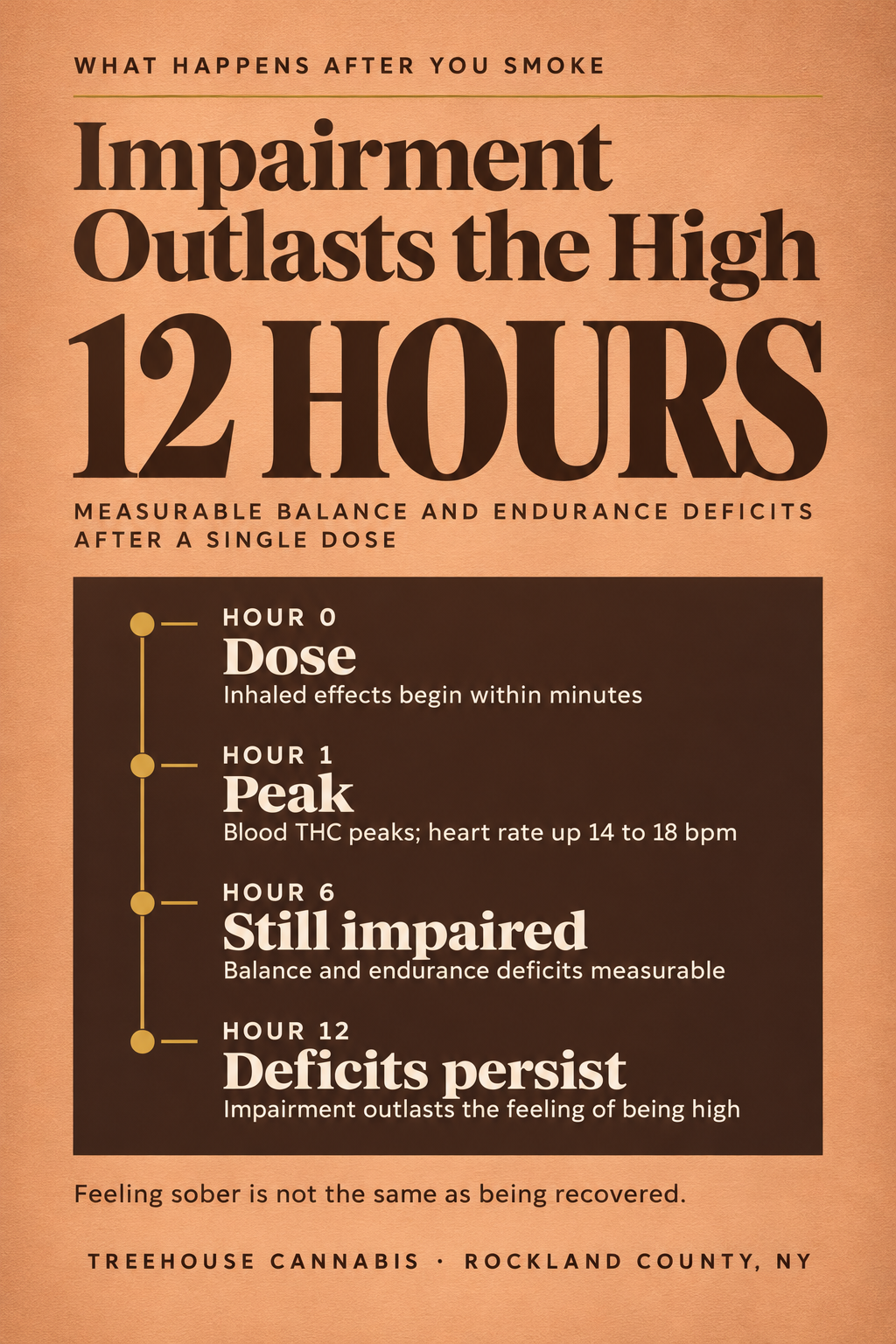
Longer than the feeling of being high suggests. Measurable deficits in balance, muscle force control, and endurance persisted for up to 12 hours after a single standardized cannabis cigarette, and they outlasted the point at which participants reported feeling sober [6].
That gap is the whole problem. Blood THC peaked around the one-hour mark, but the performance measures had not returned to baseline at 12 hours [6]. Subjective sobriety is not a reliable signal, which means "I feel fine" is the wrong test to run before a descent with a loose scree field at the bottom.
A workable planning frame, in the order most people get it backwards:
- Blood THC peaks around one hour after smoking, well before the effects on movement clear [6]
- Balance, force control, and endurance deficits persisted to the 12-hour assessment [6]
- Participants felt sober before the deficits resolved, so self-assessment is not a gate [6]
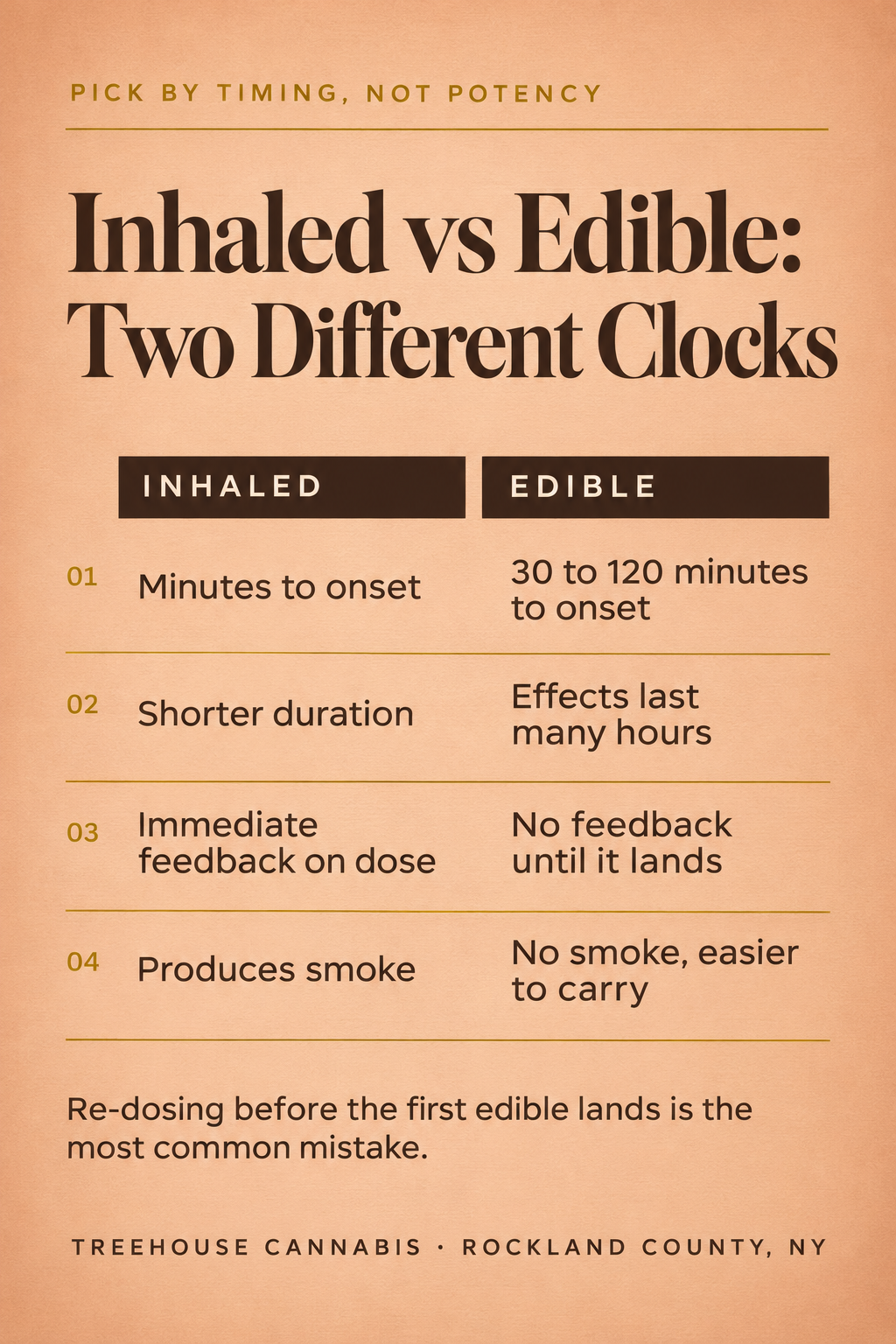
- Inhaled effects arrive within minutes, while edible onset runs 30 to 120 minutes [8]
- Plan the dose for the end of the hike rather than the start of the climb
The 30 to 120 minute edible onset deserves its own line, because it is the most common way people overshoot. Someone eats something at the trailhead, feels nothing at 45 minutes, eats more, and then both doses land at once on a section that needs steady feet [8]. If the route is long, the honest answer is that the product waits in the car.
This is not a dosage recommendation, and there is no universal hour count that makes a hike safe for everyone. The study measured a specific population after a standardized dose. What it does establish is the direction and the scale: the impairment window is measured in hours, not minutes, and it is longer than the high.
Home-grown flower complicates the timing further, since potency varies from plant to plant and there is no label to read before you decide how much of the afternoon to give up. Growing Cannabis at Home in New York: What You Need to Know covers what New York allows for a home grow if that is where your supply comes from.
Are edibles or a vape a better fit than a joint on a hike?
Neither is better in the abstract. They run on different clocks, and the right pick depends on the length of the route and how much margin you want on the way down.
| Factor | Inhaled (joint, vape) | Edible |
|---|---|---|
| Onset | Minutes | 30 to 120 minutes |
| Duration | Shorter, clears faster | Effects last many hours |
| Dose feedback | Immediate, you can stop | None until it lands |
| Peak control | Easier to gauge | Hard to predict on a climb |
| Smoke | Produces smoke, barred in parks | No smoke |
| Carrying it | Needs a case, can crush | Compact and discreet |
| Trail fit | End of hike, short window | Long day at home, not a descent |
The tradeoffs, side by side:
- Inhaled runs on minutes, with a shorter duration and immediate feedback on dose, so you know where you stand before you commit to the next mile [8]
- Edible onset runs 30 to 120 minutes with effects lasting many hours, which is a poor match for a route that asks for balance on the way down [8]
- Smoke is the inhaled cost, since a joint or vape produces smoke that the park law disfavors on public land [2]
- Anxiety, panic, and distrust are more likely with large doses, high-THC products, and low experience [8]
- The most common edible error is re-dosing before the first dose lands [8]
Inhaled products give you feedback. Effects arrive in minutes, so you know where you stand before you commit to the next mile, and the duration is shorter [8]. The tradeoff is smoke, which the park law disfavors on public land and which reads badly to everyone else on a narrow trail [2].
Edibles avoid the smoke problem entirely and travel better in a pack. The cost is the clock. A 30 to 120 minute onset plus a long tail is a poor match for a route that asks for balance on the way down, and the classic failure is re-dosing at 45 minutes because nothing has happened yet [8]. If edibles are the plan, they work better as an after-hike choice than a mid-climb one. Browse Edibles if you want to compare formats and potency before you decide.
The anxiety angle belongs here too. NIDA notes that anxiety, fear, distrust, panic, or hallucinations are more common when a person takes a large amount, uses a product high in THC, or has little experience with cannabis [8]. An unfamiliar trail at dusk, with a headlamp and a route you have not walked, is a bad setting for a first strong dose. Lower-potency products and smaller servings reduce the odds of that turn, which is a format question rather than a willpower question.
Worth knowing before you build a habit around it: a University of Colorado Boulder summary of survey data found that 80 percent of cannabis users reported using it before or shortly after exercise, and that combining cannabis with workouts was associated with more weekly activity, not less [12]. The same research is clear that cannabis makes exercise feel more enjoyable without improving performance, and lists dizziness and loss of balance among the risks [12]. Enjoyment is a real benefit. It is not a substitute for footing.
What should you pack when cannabis is part of the plan?
The ten essentials come first, and cannabis is an addition to that list rather than a replacement for any part of it.
New York's DEC publishes ten hiking essentials: navigation, insulation and rain gear, light, first aid, emergency kit, fire, nutrition, water, sun and insect protection, and emergency shelter [3]. DEC advises at least 2 liters of water per person, and more than you expect to need [3]. On a summer climb in Harriman or the Catskills, that second clause is the one that matters.
The full list, plus the cannabis-specific additions:
- Navigation, insulation and rain gear, light, first aid, and an emergency kit [3]
- Fire, nutrition, at least 2 liters of water per person, sun and insect protection, and emergency shelter [3]
- A written trip plan and the Forest Ranger and county dispatch numbers left with a responsible contact [4]
- Weather, regulations, and trail conditions checked before you leave, per Leave No Trace's Plan Ahead and Prepare principle [9]
- Cannabis sealed, labeled, in a container that will not crush, and out of reach of anyone under 21 in the group
That trip plan item is not paperwork. DEC's lost-hiker guidance asks hikers to leave a plan and the dispatch numbers with someone who will notice if you do not come back [4]. A phone with a dead battery and no one expecting you is how a wrong turn becomes a search.
On the cannabis side, format matters for packing. A crushable pre-roll in a hip belt pocket is a mess by mile three, so a hard case earns its space. Packs of pre-rolls travel well for a group where one format covers everyone, and you can see the current Packs Pre_rolls selection for that. If you prefer loose flower for a pipe or a dry herb vaporizer, a sealed jar keeps the smell contained in a shared car and keeps the product labeled, and Bottomless Mints Flower - 70g is one option that comes in a resealable format.
Two more packing rules that come from the legal section rather than the gear list. Keep the product in its original labeled packaging, because an unmarked bag is both a legal headache and an easy way to lose track of potency. And check the rules for the specific land you are walking on before you pack, since the ten essentials keep you alive and the land rules keep you out of a $50 citation [2].
What are the real risks of mixing cannabis with a hike?
The risks are measurable, and the biggest one on a trail is also the most ordinary: falling.
In a cross-sectional analysis of an estimated 24,922 emergency department visits for unintentional injury tied to cannabis exposure among people aged 15 to 24, falls were the single largest category at 37.0 percent, ahead of poisonings at 21.9 percent [11]. A fall on a flat path is a scraped knee. A fall on an exposed rock scramble is a rescue, and the injury data does not distinguish between the two.
The older-hiker comparison is where the gap shows up clearly:
| Measure, adults 50 and older | Cannabis users | Non-users |
|---|---|---|
| Past-year injury rate | 28.8% | 18.9% |
| Past-year emergency department visit rate | 30.9% | 23.5% |
| Adjusted odds ratio for injury | 1.48 | reference group |
The numbers, with their limits stated:
- Falls accounted for 37.0 percent of cannabis-linked unintentional injury emergency visits among people 15 to 24 [11]
- Poisonings were 21.9 percent of the same visits, often from overconsumption rather than trail conditions [11]
- Among adults 50 and older, past-year injury rates were 28.8 percent for cannabis users versus 18.9 percent for non-users [10]
- Emergency department visit rates in that same survey were 30.9 percent versus 23.5 percent, with an adjusted odds ratio of 1.48 for injury [10]
- Hypothermia can occur even when temperatures are above freezing, per DEC's guidance [4]
Those figures are associational. A national survey cannot prove cannabis caused an injury, and it does not capture whether the person was impaired at the time. What it does show is a consistent pattern across two very different datasets: cannabis use tracks with more falls and more emergency visits, and the size of the effect is large enough to plan around rather than dismiss.
Then there are the risks that are not injuries. Dehydration on a climb, since THC raises heart rate at the same workload [7]. Disorientation at an unmarked junction, which altered time perception and impaired memory make worse [8]. Cold, which DEC warns about because hypothermia does not require a freezing thermometer [4].
For the moment something does go wrong, DEC publishes a simple sequence: STOP, which is sit down, think, observe, and plan [4]. It sounds obvious until you are the person who has just realized the trail marker is gone and the light is going. Sitting down first is what breaks the panic spiral, and panic is the thing that turns a ten-minute correction into a call to the rangers.
How do you hike with cannabis without ruining the trail for everyone else?
Etiquette is secondary to legality, not a workaround for it. On land where smoking is barred, the polite version of a violation is still a violation [2]. On land where it is allowed, etiquette decides whether the group after you has a good day.
Start with right of way, because it is the rule most groups get wrong when they spread out. DEC's trail etiquette guidance is that hikers coming uphill have the right of way, and a descending hiker should step aside to give space [5]. A group of five stopped across a narrow trail to pass something around is the exact situation that rule exists for.
What it looks like in practice:
- Hikers coming uphill have the right of way, so descending hikers step aside [5]
- Keep noise down and leave room for everyone to enjoy the outdoors, per Leave No Trace's Be Considerate of Others principle [9]
- Step well off the trail and away from viewpoints before lighting anything, rather than at a crowded overlook
- Keep smoke and lit products away from children and from anyone who did not sign up for it
- Pack out packaging, filters, and any leftover material, because neither a roach nor a wrapper belongs in a fire ring
Leave No Trace's seven principles open with Plan Ahead and Prepare and close with Be Considerate of Others, which is a fair summary of the whole approach: know the rules before you go, and behave as though the next person on the trail matters [9]. If you carry loose flower, pre-ground options are easier to manage without scattering trim on the ground, and the current Pre Ground Flower selection is a reasonable place to start.
One local note. Many trailheads in Rockland, Orange, and Westchester County sit on town or county land, and those parcels post their own rules at the lot. A county park's sign governs the county park, whatever the state law says about possession. Read it before you decide what the plan is.
How should you plan the hiking day around cannabis?
The order of operations matters more than any single rule here. Pick the route, check who owns the land, check the weather, and pack the ten essentials. Then decide whether cannabis is part of the day, and if it is, decide when.
The sequence that actually holds up:
- Pick the route and confirm who owns the land, since a county park sign governs the county park
- Check the weather and trail conditions, and pack the ten essentials before adding anything else
- Leave a written trip plan and the dispatch numbers with someone who will notice
- Decide whether cannabis is part of the day, and if so, decide when in the day it belongs
- Choose the format last, once the route length and the descent are known
Treehouse Cannabis serves customers 21 and older in Rockland, Orange, and Westchester County with pre-rolls, edibles, vaporizers, and flower, so the format decision can follow the hike decision. If the route is short and the plan is a summit lunch, Boss Prophet | 28pk Pre-rolls | 14g travel better than a loose eighth. If the day ends at home with boots off, BOOST+ Drops 3-Pack fit that timeline. If you want the shortest possible window of effect, Rose' Runtz | Disposable Vape | 2g give you feedback in minutes. And if flower is how you prefer to finish an afternoon outside, Bottomless Mints Flower - 70g covers that.
None of it makes a climb easier. A clear head, a full water bottle, and a trip plan left with someone who will notice are what make a climb safer. Cannabis fits into that plan or it does not.
Frequently Asked Questions
Can you smoke cannabis while hiking in New York?
Not on most public land. New York's smoke-free parks law bars smoking, cannabis included, in state and local parks, beaches, pools, boardwalks, marinas, playgrounds, recreation centers, and group camps, with limited exceptions such as Adirondack Park and Catskill Park. On private property, follow the landowner's rules and any local ordinance [2].
Is it legal to consume cannabis in a New York state park?
Smoking is prohibited. A 2022 state law extended smoke-free rules to state and municipal parks, and cannabis falls inside its definition of smoking. Vaping is not covered by that statute, though individual parks may restrict it. Adirondack Park and Catskill Park sit outside the law's reach [2].
How long after using cannabis should you wait before hiking?
Longer than most people expect. A 2026 trial found measurable deficits in balance, muscle control, and endurance for up to 12 hours after smoking, even once participants stopped feeling high. Plan the dose around the end of the hike rather than the climb [6].
Does cannabis affect hiking performance?
Yes, in measurable ways. Inhaled THC raised heart rate by 14 to 18 beats per minute at a fixed submaximal workload and cut 20-minute cycling power output whether it was smoked or vaporized. CBD-dominant products with no THC did not produce those changes [7].
Are edibles a better choice than smoking on a hike?
They avoid smoke and last far longer, which cuts both ways. Onset runs 30 to 120 minutes, so people who re-dose too soon overshoot the dose, and effects can stretch for many hours. A long, slow peak is a poor match for a descent that asks for balance [8].
What should you carry if cannabis is part of the plan?
The ten essentials come first: map and compass or GPS, headlamp, insulation and rain gear, first aid, fire starter, extra food, at least two liters of water per person, sun protection, and emergency shelter. Add a charged phone, sealed and labeled cannabis, and a written trip plan left with someone reliable [3].
Why does cannabis make some people anxious on the trail?
Anxiety, fear, distrust, and panic are documented effects, and they are more common with large doses, high-THC products, and little prior experience. An unfamiliar trail at dusk is a bad setting for a first strong dose. Lower potency and smaller amounts reduce the odds [8].
Can you consume cannabis on federal land?
No. Cannabis remains illegal under federal law, so consumption is prohibited in national parks, national forests, and other federal property even in states where adult use is legal. Possession can carry federal penalties. Plan around state, municipal, or private land instead [1].
Sources
- New York State Office of Cannabis Management — States that New York adults 21 and older may possess 3 ounces of cannabis and 24
- Public Health Law Center — Explains that New York's smoke-free parks law, signed July 15, 2022 and effectiv
- New York State Department of Environmental Conservation — Publishes New York's official hiking preparedness guidance, including ten hiking
- New York State Department of Environmental Conservation — Advises hikers to leave a trip plan and the Forest Ranger and county dispatch nu
- New York State Department of Environmental Conservation — States the right-of-way convention that hikers coming up the hill have the right
- Substance Use and Misuse (National Library of Medicine) — Study of 28 adult cannabis users assessed at baseline and 1, 6, and 12 hours aft
- Journal of Applied Physiology (American Physiological Society) — Controlled exercise study reporting that inhaling THC-predominant cannabis raise
- National Institute on Drug Abuse — Federal research overview describing short-term cannabis effects as altered time
- Leave No Trace Center for Outdoor Ethics — Outlines the seven Leave No Trace principles, opening with Plan Ahead and Prepar
- American Journal of Drug and Alcohol Abuse (National Library of Medicine) — National survey analysis of adults aged 50 and older finding past-year injury ra
- Journal of Emergency and Critical Care Medicine — Cross-sectional analysis of an estimated 24,922 emergency department visits for
- University of Colorado Boulder — University of Colorado Boulder research summary reporting that in a prior survey
About Treehouse Cannabis
Treehouse Cannabis is a licensed adult-use dispensary in Rockland County, New York, serving customers across Rockland, Orange, and Westchester Counties. The shop carries pre-rolls, edibles, vaporizers, and flower, and the team will walk you through formats, potency labels, and packaging before you head for a trailhead.
Cannabis is for adults 21 and older. Keep all cannabis products in their original labeled packaging, out of reach of children and pets, and never consume on federal land or on any public land where smoking is prohibited. This article is educational and is not medical advice. Cannabis affects people differently, and the research cited here describes measured effects in study populations rather than predictions about any individual.
Shop our products

Shop All

Deals

Flower

Pre-rolls
Vaporizers

Edibles
Drinks

Concentrates
Tinctures

Topicals

CBD

Pet CBD

Accessories