
Does Cannabis Really Boost Creativity? What the Science Says
Does Cannabis Really Boost Creativity? What the Science Says
Cannabis and creativity have a complicated relationship in the research literature. Most users feel more creative while high, but controlled studies show objective gains are small, dose-dependent, and inconsistent across creative tasks. The honest answer is that THC can shift how you experience creativity without reliably improving measurable creative output.
Does Cannabis Really Boost Creativity?
The short answer is that cannabis and creativity interact through subjective experience more than measurable output. Across four controlled experiments, cannabis use increased positive mood and inflated participants' subjective ratings of creative work without producing objectively more creative ideas [4]. In a sample of 412 sober cannabis users compared with 309 non-users, regular users self-reported higher creativity, but the difference was fully accounted for by higher openness-to-experience scores rather than cannabis use itself [3].
If you have ever felt that cannabis unlocked a new angle on a problem, you are not imagining the shift in perception. How Seniors Are Using Cannabis in New York shows the same pattern across age groups, where subjective effects on mood and creative experience often outpace objective gains. For some adults, this shift shows up as becoming more talkative or expressive, and Why Some Strains Make You Chatty explores how certain strains can lower conversational inhibitions. Others describe an enhanced sense of immersion in music or art, which Why Music Feels Better High covers in detail.
The chemistry behind those moments is worth understanding. The Science of Cannabis Terpenes: Beyond THC walks through the terpene profiles and minor cannabinoid combinations that influence how a given flower feels, well beyond raw THC percentage. The strain you reach for, the dose you consume, and your baseline mindset all change what cannabis actually does to creative thinking on any given day.
Key takeaways from the controlled literature:
- Subjective creative confidence rises reliably; objective creative output rises little or not at all
- The gap is consistent across studies, dose bands, and creative task types
- Openness-to-experience, not cannabis use, predicts self-reported creativity in sober comparisons
What Does Cannabis Do to the Brain That Affects Creativity?
Cannabis acts on the brain through THC binding to CB1 receptors, which raises cerebral blood flow to the frontal lobe -- the region most associated with divergent thinking and idea generation [5]. THC also triggers dopamine release in the striatum, which affects how the brain selects between competing responses. Those two changes together explain why some users report feeling more open and less internally censored while high.
The cognitive trade-offs are real and well documented. The CDC confirms that cannabis directly affects parts of the brain responsible for memory, learning, attention, decision-making, and reaction time [6]. Harvard Medical School reports that long-term heavy cannabis use is linked to impaired memory and attention, and that any sense of clearer thinking reported by medical-cannabis patients often reflects symptom management rather than cognitive enhancement [7].
For adults using cannabis specifically to support creative work, the practical takeaway is that the brain regions involved in idea generation are genuinely modulated, but the same modulation that opens up free-flowing thought can also reduce your ability to evaluate, edit, and converge on a final answer. If you are trying to write, paint, or brainstorm, Cannabis for Focus & Productivity covers how to balance focus and creativity with cannabis more deliberately.
How cannabis reshapes the creative brain, step by step:
- THC binds CB1 receptors in the frontal lobe and raises local cerebral blood flow
- Dopamine release in the striatum loosens response selection between competing ideas
- Prefrontal activity shifts toward associative, less filtered thinking
- Memory, attention, and editing systems are simultaneously down-weighted, which cuts both ways
How Does THC Dose Change the Effect on Creative Thinking?
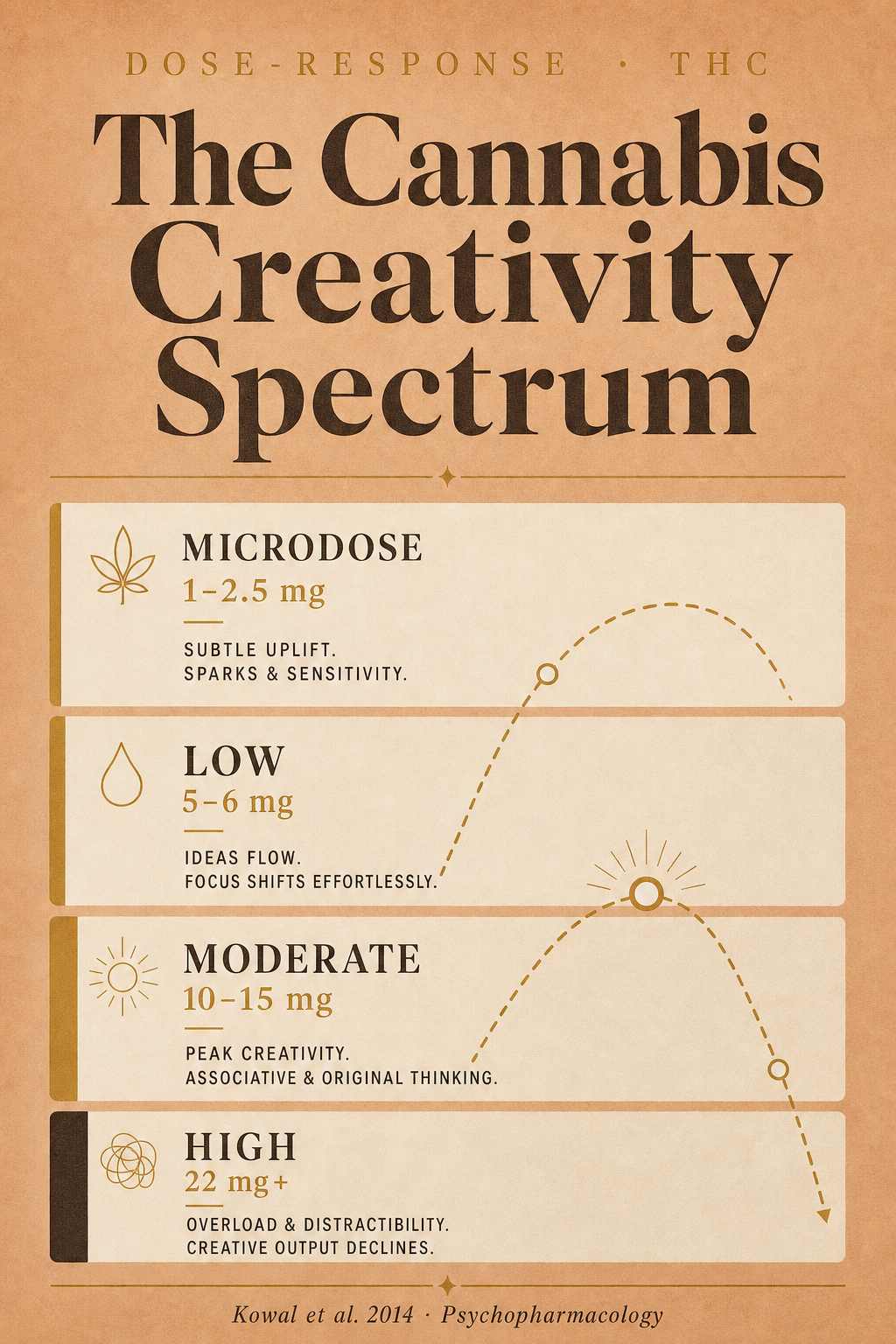
Dose is the single most important variable in the cannabis-and-creativity question. A randomized, double-blind Leiden University study found that 22 mg of vaporized THC significantly impaired divergent-thinking flexibility and originality in regular cannabis users compared with both a 5.5 mg dose and a placebo [1]. The same study found that low-dose cannabis produced no clear impairment, and in some measures showed small fluency gains.
A separate study from University College London found that smoked cannabis at roughly 10 percent THC modestly improved verbal fluency only in users with low baseline trait creativity, while impairing convergent performance on the Remote Associates Test in users with high baseline creativity [2]. In other words, the dose you need depends on who you are when you start.
If you are exploring low-dose options, balanced CBD-rich products tend to produce less of the high-dose impairment. The Treehouse Cannabis catalog includes a range of low-THC and CBD-forward options for adults who want to experiment with smaller doses. For adults curious about the broader wellness framing, An Exploration of Potential Health Benefits covers how cannabis fits into general adult-use routines in New York.
Practical dosing rules for creative work:
- Microdose (1 to 2.5 mg THC): mild openness, minimal measurable impairment
- Low dose (5 to 6 mg THC): occasional small fluency gains, especially for low-baseline users
- Moderate dose (10 to 15 mg THC): peak subjective creativity, but originality and flexibility begin to drop
- High dose (22 mg+ THC): consistent impairment of divergent thinking and slower convergent problem-solving
Does Cannabis Improve Divergent Thinking, Convergent Thinking, or Both?
Key points:
- Cannabis and creativity depend heavily on which kind of creative task you are attempting.
- Divergent thinking generating many ideas from one prompt shows small or inconsistent gains under cannabis, with subjective experience usually outpacing objec…
- Convergent thinking finding the single best answer to a defined problem is more reliably impaired at moderate and high doses in regular users .
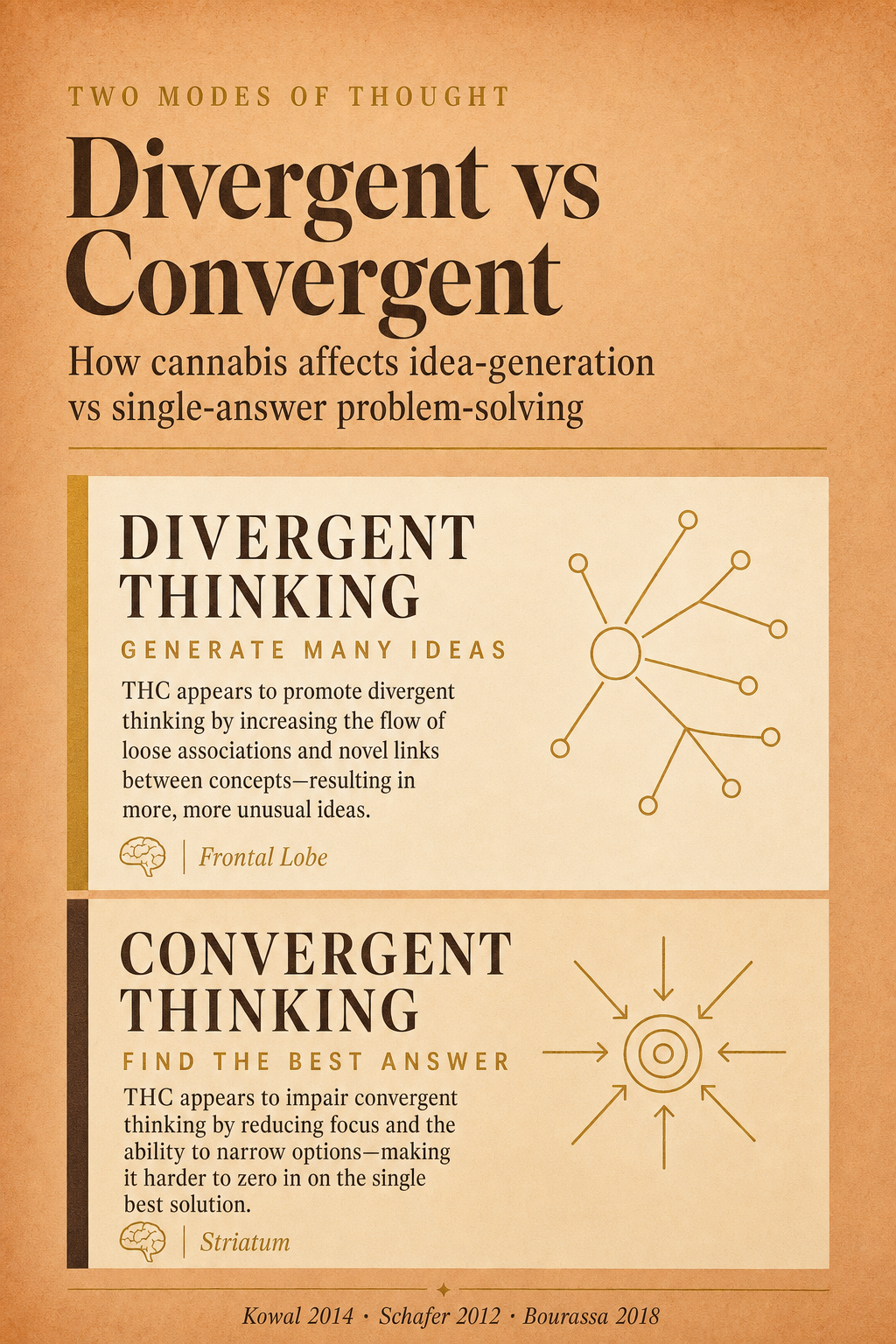
Cannabis and creativity depend heavily on which kind of creative task you are attempting. Divergent thinking -- generating many ideas from one prompt -- shows small or inconsistent gains under cannabis, with subjective experience usually outpacing objective scores [1]. Convergent thinking -- finding the single best answer to a defined problem -- is more reliably impaired at moderate and high doses in regular users [2].
The mechanism tracks with which brain regions each task depends on. Idea generation leans on the frontal lobe, where THC raises blood flow and loosens associative filtering. Response selection and problem-solving lean more on the striatum and prefrontal cortex, where cannabis can slow evaluation and reduce the sharpness needed to land on one correct answer [5].
For practical purposes, this means the same session that helps you brainstorm ten different angles on a brief may make it harder to pick the best one and commit to an answer. If you are most interested in the exploration phase of a project, low-to-moderate dosing can support that. If you need sharp, decisive problem-solving under time pressure, cannabis is more likely to interfere than help. Single Infused Pre Roll Pre_rolls covers single infused pre-roll formats that allow controlled, low-dose consumption sessions.
Divergent versus convergent thinking under cannabis:
| Creative mode | What it asks of you | Effect of cannabis | Best matched dose |
|---|---|---|---|
| Divergent thinking | Generate many ideas from one prompt | Small or no objective gain; strong subjective boost | Low to moderate (5 to 10 mg THC) |
| Convergent thinking | Find the single best answer to a defined problem | Consistently impaired in regular users at moderate and high doses | Avoid, or use microdose only |
| Idea generation (frontal lobe) | Free-flowing association | Loosened filtering, more associations | Low (5 to 6 mg THC) |
| Response selection (striatum) | Choose between competing answers | Slowed evaluation, less decisive output | High doses are most disruptive here |
Why Do People Feel More Creative When They're High?
The gap between how creative cannabis makes you feel and how creative it actually makes you is one of the most consistent findings in this literature. Intoxication increases positive mood, lowers inhibitions, and slows internal editing -- three changes that make thoughts feel more novel even when measured output stays the same [4]. The brain is busy reporting that the experience is rich; that does not mean the work produced is objectively better.
There is also a personality component. People who already score high in openness-to-experience are more likely to seek out cannabis and more likely to report creative benefits from it [3]. The sober-user advantage documented in that research sample may reflect the personality traits that drew them to cannabis in the first place, not the drug itself.
The practical implication is that cannabis can be a useful ritual for entering a creative headspace -- lowering the activation energy to start a session, reducing self-censorship, and increasing tolerance for rough drafts. It is less useful as a tool for producing objectively better output under time pressure. If you are curious about a reliable, controllable starting point for those sessions, Whole Flower Flower covers Treehouse Cannabis's whole-flower options across sativa, hybrid, and indica chemotypes.
Why intoxication feels more creative than it measures:
- Positive mood inflates the perceived novelty of any idea you generate
- Lowered inhibitions reduce self-censorship at the start of a session
- Slowed internal editing removes the editor that normally filters "bad" ideas
- None of these three changes require the work itself to be measurably better
Can CBD or Low-THC Products Support Creativity Without the High?
CBD does not produce the dopamine-driven boost users associate with cannabis and creativity, because CBD does not meaningfully activate the CB1 receptor the way THC does [7]. What CBD may offer is anxiolytic support -- lowering the mental blocks and perfectionism that get in the way of starting a creative session in the first place. For some users, that translates into an easier entry into flow without the cognitive trade-offs that come with THC.
The research on CBD and creativity specifically is preliminary and most findings remain anecdotal. Anecdotal reports of CBD helping with focus and creative flow tend to come from users treating underlying anxiety, which is a different cognitive intervention than a creativity booster.
For customers in Rockland County and the surrounding area who want to experiment with the non-intoxicating angle, balanced CBD-rich flower and low-THC options are worth exploring at our dispensary. from the Treehouse catalog includes sativa-leaning chemotypes that some adults find useful for daytime creative sessions, with dosing that stays well below the impairment thresholds documented in the research above.
How to think about CBD versus THC for creative work:
- THC drives the subjective boost; CBD does not, because CBD does not activate CB1 the same way
- CBD's main creative-relevant effect is anxiolytic -- fewer mental blocks, easier session start
- Balanced CBD-rich flower may suit adults who want focus without the high-dose trade-offs
- For brainstorming, a low-THC flower is the closest match to the research findings
Frequently Asked Questions
Does cannabis really boost creativity? The evidence is mixed. Some studies show low doses of THC (about 5.5 mg) can produce small gains in divergent thinking, but higher doses (22 mg) significantly impair originality and flexibility. Most users feel more creative while intoxicated, even when measurable creative output does not improve.
What is divergent thinking and why does cannabis affect it? Divergent thinking is the cognitive process of generating many possible solutions to an open-ended problem, often measured by the Alternate Uses Task. THC raises cerebral blood flow to the frontal lobe and releases dopamine in the striatum, two brain changes linked to this kind of free-flowing ideation and brainstorming.
Why do people feel more creative when they are high? Intoxication increases positive mood, reduces inhibitions, and slows internal editing, which makes thoughts feel more novel. A 2022 Journal of Applied Psychology study found cannabis use biases subjective ratings of creative work without producing objectively more creative output.
Does the dose of THC matter for creativity? Yes, dose is the single most important variable. Low doses have occasionally produced small fluency gains in low-baseline-creativity users, while moderate-to-high doses consistently impair both divergent thinking in regular users and convergent thinking across the board.
Do sativa strains really make you more creative than indica? Strain labels are not reliable predictors of effect. Chemotype, terpene profile, and your individual tolerance and mindset matter far more than the sativa-versus-indica marketing label. Even within sativas, a high-THC flower will likely impair creativity more than a balanced CBD-rich option.
Can CBD help with creativity without the high? CBD does not produce the psychoactive boost users associate with cannabis creativity, but its anxiolytic effects may lower mental blocks and help some people enter a focused flow state. The research on CBD and creativity specifically is preliminary and most findings remain anecdotal.
Sources
- Leiden University / Psychopharmacology (Springer) — A randomized, double-blind study of regular cannabis users found that 22 mg of v
- University College London / Consciousness and Cognition (Elsevier) — Smoked cannabis (about 10% THC) modestly improved verbal fluency only in users w
- Elsevier / ScienceDirect (NeuroImage) — In a sample of 412 sober cannabis users and 309 non-users, cannabis users self-r
- American Psychological Association / Journal of Applied Psychology — Across four experiments, cannabis use increased positive mood and inflated parti
- Leafly — Cannabis raises cerebral blood flow to the frontal lobe, the brain region associ
- Centers for Disease Control and Prevention — The CDC confirms that cannabis directly affects the parts of the brain responsib
- Harvard Medical School — Harvard Medical School reports that long-term heavy cannabis use is linked to co
About Treehouse Cannabis
Treehouse Cannabis is an adult-use dispensary serving Rockland County, Orange County, and Westchester County in New York. Our team curates flower, pre-rolls, vapes, edibles, and CBD options from licensed producers for customers 21 and older.
Cannabis is for adults 21 and older. Keep all cannabis products out of reach of children and pets. This article is intended for educational and informational purposes only and is not medical advice. Consult a qualified healthcare professional before making any decisions about cannabis use, and always consume responsibly and in accordance with New York State regulations.
Shop our products

Shop All

Flower

Pre-rolls
Vaporizers

Edibles
Drinks

Concentrates
Tinctures

Topicals

CBD

Pet CBD

Accessories