
Cannabis Dosing: How to Find Your Right Amount by Consumption Method
Cannabis Dosing: How to Find Your Right Amount by Consumption Method
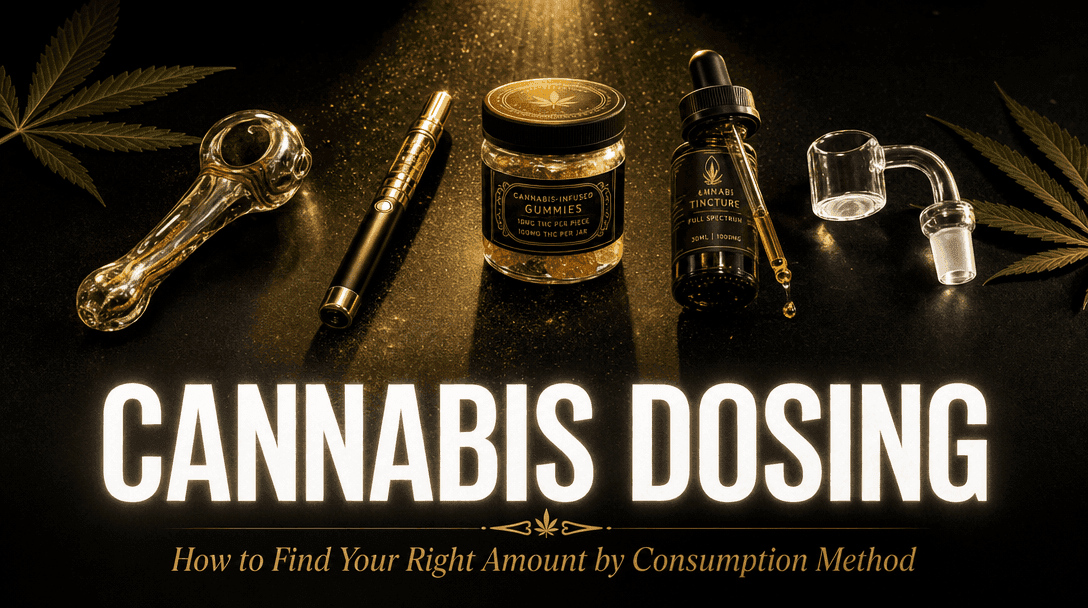
Cannabis dosing depends on the route you take, not the milligrams on the label. Inhaled THC peaks in the bloodstream within minutes, while oral THC can take two hours to peak and produces a more potent metabolite. The guide below maps each method to a starting point, wait time, and redose rule for adult-use consumers.
How Does Cannabis Dosing Differ by Consumption Method?
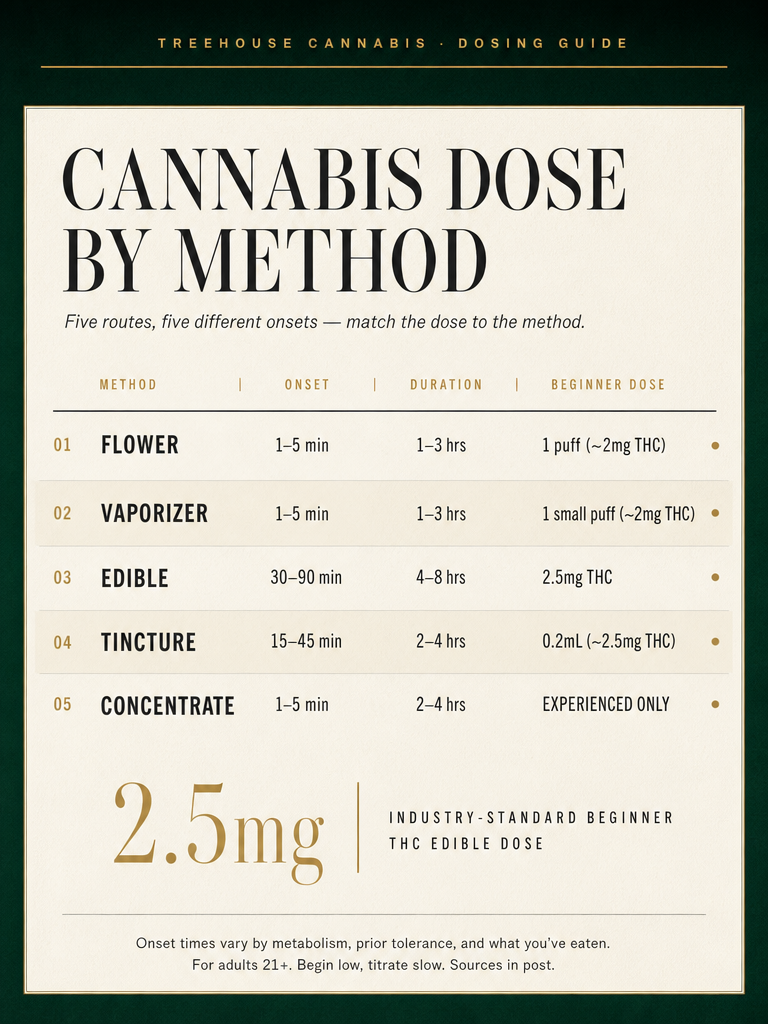
Cannabis dosing is a pharmacokinetics problem. Inhaled THC crosses the lungs and reaches peak plasma concentration within roughly 3-10 minutes, while ingested THC has to survive stomach acid and a first pass through the liver before it ever reaches the brain, peaking around 1-2 hours after the dose [1]. That timing difference alone explains why a "10 mg" experience feels so different across methods, and why the same edible can peak at an inconvenient hour long after you've stopped thinking about it: a useful explainer lives in the Treehouse Cannabis blog post You’re Not Lazy—Your Edible Just Peaked at the Wrong Time.
Bioavailability is the second divider. Oral THC ends up at only 6-20% systemic availability because of stomach acid degradation and liver metabolism, while vaporization at around 200 degrees C delivers 36-61% of the available THC without combustion byproducts [3]. In plain numbers: most of what you swallow is lost before it gets to your receptors, while most of what you inhale is not.
The pharmacokinetic gap between routes boils down to a few measurable differences:
- Onset — Inhaled THC peaks in plasma within 3-10 minutes; oral THC peaks in 1-2 hours.
- Bioavailability — Vaporized THC reaches 36-61% of available THC; oral THC delivers only 6-20%.
- Active metabolite — Inhaled delta-9 THC vs. oral 11-hydroxy-THC, the latter being 1.5-3x more potent per milligram.
- Duration — Inhaled effects last 1-3 hours; oral effects last 4-8 hours.
Because Flower tends to deliver a more predictable per-puff dose than homemade infusions, most adults begin their dosing journey with inhalation. You can browse the current Flower menu at Flower if you want to see what strengths are on the shelf today.
What Is a Safe Starting Dose of THC for Beginners?
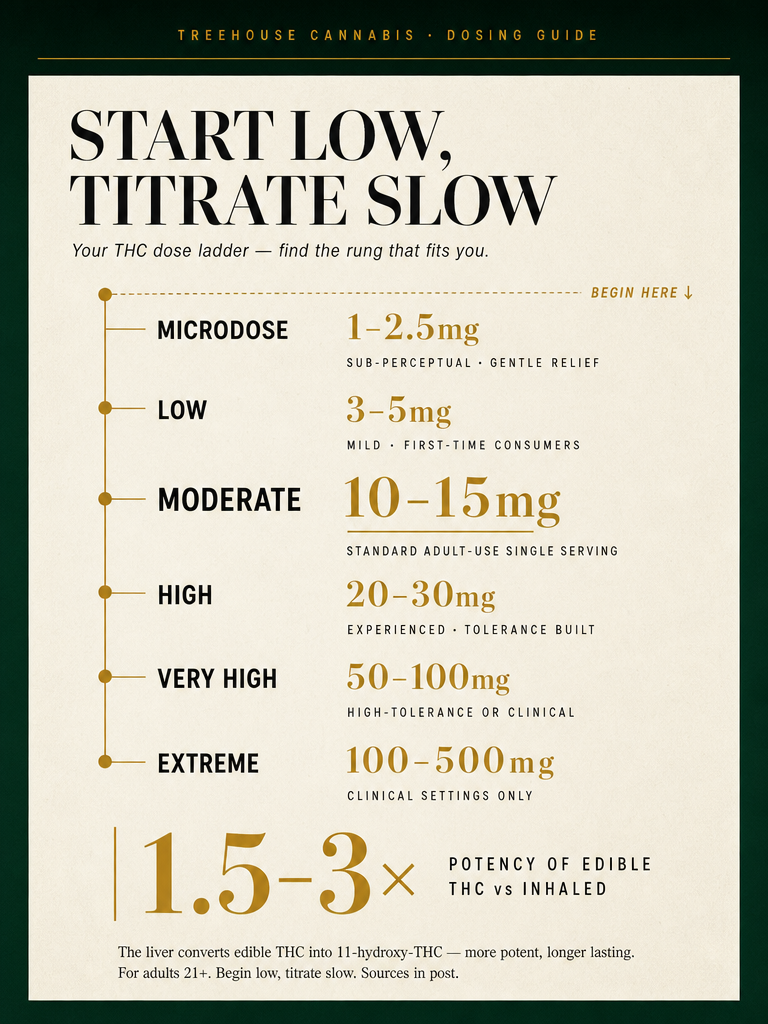
The short answer: as low as you can. The canonical dose ladder used across the cannabis industry pegs a true microdose at 1-2.5 mg THC, a low dose at 3-5 mg, a moderate single-serving at 10-15 mg, high at 20-30 mg, very high at 50-100 mg, and extremely high at 100-500 mg [2]. Most regulators have settled on 2.5 mg as the official beginner dose for oral products, well below the 10 mg single-serving cap used in New York adult-use products.
In practice, "start low and titrate slow" is the only rule that holds across every method. MacCallum and Russo frame sub-perceptual microdosing at 1-2.5 mg THC and a stepwise titration approach as the practical clinical baseline for both inhaled and oral routes [6]. The rhythm is the same no matter which product you pick: take a small dose, wait, assess, and only redose after the effect of the first dose has fully developed.
The beginner dose ladder in practice:
- Microdose (1-2.5 mg THC) — Sub-perceptual; the safe starting point for first-timers.
- Low (3-5 mg THC) — Mild effects for new consumers; the standard starting tier.
- Moderate (10-15 mg THC) — The standard adult-use single edible serving in regulated markets.
- High (20-30 mg THC) — Experienced consumers with tolerance; not a beginner range.
- Very high (50-100 mg THC) — High-tolerance adults only.
- Extremely high (100-500 mg THC) — Clinical settings, not consumer territory.
For inhalation, the beginner dose is one small puff of mid-potency flower. For edibles, it is 2.5 mg of THC, which is why Treehouse Cannabis stocks a range of low-dose Edibles Edibles for first-time consumers.
How Do You Dose Inhaled Cannabis (Flower and Vape)?
Inhalation is the easiest method for dose exploration because the onset is fast enough to titrate in real time. A single puff from flower under 20% THC delivers roughly 1-3 mg of THC to the bloodstream, depending on inhalation depth and bowl size [1]. Vaporizers are even more efficient: the Volcano-style devices that ran at 226 degrees C in the validation studies converted 36-61% of available THC into vapor, a meaningfully higher yield than a typical joint [3].
Translated into a daily budget, the math is anchored to a federal reference. The FDA-referenced dronabinol range of 30-90 mg THC per day works out to roughly 0.93-5.55 g of 10% THC flower per day depending on the potency tier [5]. That sounds like a lot of math, but the practical reading is simple: most adult consumers need far less than they think, and the fastest way to find your floor is one puff followed by a fifteen-minute wait.
For beginners who want to skip the grinding and packing step, the Whole Flower subcategory on the menu at Whole Flower Flower is a clean starting point. A single eighth typically tests between 15% and 25% THC, which is plenty of potency to learn dose-response with one or two pulls at a time.
- Wait at least 15 minutes between puffs before deciding to take more.
- A session cap of 2-3 mg THC for first-time users is a reasonable adult-use rule of thumb.
- If you feel nothing after two puffs, the issue is more often the device or technique than the strain.
How Do You Dose Cannabis Edibles Safely?
Edibles ask for the most patience because the dose and the timing both behave differently than inhalation. After you swallow THC, your liver converts delta-9 THC into 11-hydroxy-THC, a metabolite that crosses the blood-brain barrier more efficiently and is roughly 1.5-3 times as potent per milligram as inhaled delta-9 THC [2]. The ride also lasts longer. Most edible experiences run 4-8 hours, compared with 1-3 hours for inhalation.
Why the same mg feels different across methods:
| Factor | Inhaled THC (flower/vape) | Oral THC (edible) |
|---|---|---|
| Onset | 1-10 minutes | 30-90 minutes (up to 2 hrs on full stomach) |
| Active compound | delta-9 THC | 11-hydroxy-THC (1.5-3x more potent) |
| Duration | 1-3 hours | 4-8 hours |
| Bioavailability | 36-61% (vaporized) | 6-20% (oral) |
Onset is the other surprise. Edibles typically take 30-90 minutes to take effect, and a full meal can stretch that window out toward two hours as digestion slows absorption [1]. The most common dosing mistake is redosing a 2.5 mg edible after thirty minutes because "nothing is happening," only to have the original dose and the redose both peak at the same moment two hours later. For beverages especially, the variability is high enough that you should plan your evening around the dose, not the other way around. If you want to branch beyond gummies, the Treehouse Cannabis piece THC Mocktails: 5 Cannabis Drink Recipes for Your Next Gathering walks through recipes with very different per-serving potencies.
Overconsumption symptoms are real and worth knowing in advance. A 2024 systematic review on cannabis and health flagged anxiety, paranoia, and tachycardia as the most common adverse events in adults who take more THC than their bodies can handle [7]. The fix is not another dose; it is water, a calm room, and time. Symptoms typically resolve within a few hours as the THC is metabolized.
- Always wait at least 90 minutes, ideally two hours, before any edible redose.
- Do not stack doses to "catch up" with someone who is already feeling it.
- Keep the package visible so you remember exactly how many milligrams you took.
How Do You Dose Cannabis Tinctures and Sublinguals?
Tinctures are the most precisely dosable adult-use product on the shelf, because a dropper measures milligrams directly. A typical 300 mg THC, 30 mL tincture delivers 10 mg per full 1 mL dropper, so a beginner starting dose of 0.10-0.25 mL puts 1-2.5 mg of THC under the tongue, well inside the microdose range [2]. Hold the liquid under your tongue for 30-60 seconds before swallowing; that sublingual hold matters, because it lets THC absorb through the mucosal lining and bypass some of the liver's first-pass metabolism.
Onset lands between inhalation and edibles: most adults feel tinctures within 15-45 minutes and reach the peak around the one-hour mark [1]. The wait-time rule is shorter than for edibles but longer than for puffs, so 45 minutes is a sensible minimum between redoses. Because the dropper is milliliter-accurate, tinctures are a good middle path for adults who want tighter dose control than an edible can offer but a slower onset than a joint. You can compare strengths and carrier oils across the current Tinctures selection at Tinctures.
- Shake the bottle before drawing, since THC and carrier oil can separate in storage.
- Avoid eating or drinking for five minutes before and after the sublingual hold, so nothing washes the dose down early.
- Start at 0.10 mL and step up by 0.05 mL per session until you find your sweet spot.
What Should You Know About Dosing Concentrates and High-Potency Products?
Concentrates are not beginner territory, and most industry guidance says so plainly. A single dab can deliver 25-80 mg or more of THC in one breath, depending on the extract's potency and the dab size [8]. That single inhalation can outstrip an entire beginner's first edible session in raw milligrams, even before the tolerance question comes up.
The risk profile for concentrates is steeper than for flower because potency swings are wider and dose-response is harder to feel in real time. The 2024 systematic review tied higher-potency products and dabbing specifically to more frequent overconsumption symptoms, including anxiety, paranoia, and tachycardia [7]. A harm-reduction mindset here is not optional: it is the difference between a tolerable experience and an ER visit.
- Use a quartz or titanium banger with a thermometer so you stay below 400 degrees F and avoid burning the extract.
- Start with a rice-grain-sized dab (or smaller); you can always take a second pull, you cannot untake the first.
- Build tolerance with flower or low-dose edibles before graduating to dab rigs and high-strength vape cartridges. If you already see concentrates on your shortlist, the live Concentrates menu at Concentrates lists current potency tiers so you can plan around percentages rather than guesses.
How Does Tolerance, Body Chemistry, and a Tolerance Break Affect Dosing?
Even with a perfect method choice, the same milligrams will not hit the same adult the same way twice. Prior use history, body weight, metabolism, sleep, food intake, and the speed of your individual endocannabinoid system all nudge dose-response up or down. There is no single equation that fits every consumer, which is why dosing guides like this one work in ranges rather than precise numbers.
The cleanest reset available to a regular consumer is a tolerance break. A break of two to four weeks allows CB1 receptor density in the brain to recover toward baseline, and most adults return to a baseline where 5-15 mg of edible THC produces a clear, controlled effect [6]. The Treehouse Cannabis walkthrough Cannabis Tolerance Break: The Complete Guide to Resetting Your System covers the planning and pacing for a break that lands well.
Variables that shift individual dose-response:
- Prior use history — Daily consumers need more THC than occasional consumers for the same effect.
- Body weight and metabolism — Heavier or faster-metabolizing adults may need slightly higher doses.
- Food intake — A full stomach stretches edible onset but can intensify the eventual peak.
- Sleep and stress — Both modulate endocannabinoid tone and can amplify or blunt dose effects.
- Method — Inhaled vs. oral bioavailability gaps (36-61% vs. 6-20%) explain most of the variability.
For adults who cannot or do not want a full break, smaller swaps still help: lowering potency by a tier, switching from concentrates back to flower, or spacing sessions further apart. The point of every adjustment is to widen the gap between the dose you take and the dose you feel, so you have room to learn.
What Are the Best Practices for Responsible Cannabis Dosing?
Responsible adult-use dosing is mostly about the boring half: set, setting, and patience. NORML's framework for adult-only, set-and-setting-aware consumption, with no impaired driving, anchors the most important guardrails in cannabis dosing [4]. Translation: pick a calm environment, know what you took and how much, wait the right interval, and never drive or operate machinery while impaired.
A few rules of thumb:
- Start at 2.5 mg THC for edibles, one small puff for inhalation, and 0.10 mL for tincture, then wait the full interval before any redose.
- Do not mix cannabis with alcohol or other intoxicating substances; the combination amplifies impairment in ways that are hard to predict.
- Store all products in child-resistant packaging, locked away from kids and pets; edibles look like candy and dosing errors in children can require an ER visit.
- Keep a simple dose log for the first month: method, milligrams, time, effect. Patterns show up faster than memory allows.
For product-by-product questions, potency lookups, and in-person guidance, the Treehouse Cannabis team is happy to talk you through labels and limits at the dispensary. Shop online to compare strengths across current menus in Flower, Edibles, Tinctures, and Concentrates, and reach out before your first session if you want a recommendation tailored to your experience level.
Cannabis is for adults 21 and older. Keep all products out of reach of children and pets. This article is educational and does not constitute medical advice; consult a qualified clinician for personalized health guidance. Do not drive or operate machinery while impaired.
Sources
- StatPearls / National Center for Biotechnology Information — Provides clinical pharmacology showing inhaled THC peaks in plasma within 3-10 m
- Leafly — Provides the canonical THC edible dose ladder used industry-wide: 1-2.5mg microd
- Journal of Cannabis Research (PMC) — Documents that oral THC has only 6-20% systemic bioavailability due to stomach a
- NORML — Establishes the framework of set-and-setting, no-impaired-driving, and adult-onl
- NORML New Zealand — Calculates daily inhaled cannabis requirements from the FDA dronabinol guideline
- European Journal of Internal Medicine (MacCallum & Russo) — Defines the practical framework for sub-perceptual microdosing (1-2.5mg THC) and
- PMC (systematic review on cannabis and health) — Reviews how higher-potency products and diverse formulations (edibles, beverages
- Leafly — Side-by-side breakdown of inhalation, edible, tincture, topical, and concentrate
About Treehouse Cannabis
Treehouse Cannabis is a New York State-licensed adult-use dispensary serving Rockland, Orange, and Westchester Counties. The team helps adult customers compare products across Flower, Edibles, Tinctures, Vape Cartridges, Pre-Rolls, and Concentrates, and is available in person or online for potency, label, and consumption-method questions. Shop the full menu at treehousecannabis.com for current strengths, strains, and availability.

Shop our products

Shop All

Deals

Flower
Pre-rolls
Vaporizers

Edibles
Drinks

Concentrates
Tinctures

Topicals

CBD

Pet CBD
Accessories