Why Cannabis Can Make You Paranoid (and What Helps)
Why Cannabis Can Make You Paranoid (and What Helps)
Cannabis paranoia can happen when THC changes perception and amplifies worry, making ordinary situations feel threatening. Stop consuming, avoid driving, and seek calm support from a trusted sober person. Severe symptoms or immediate danger need urgent help; there is no proven home antidote or universal recovery countdown.
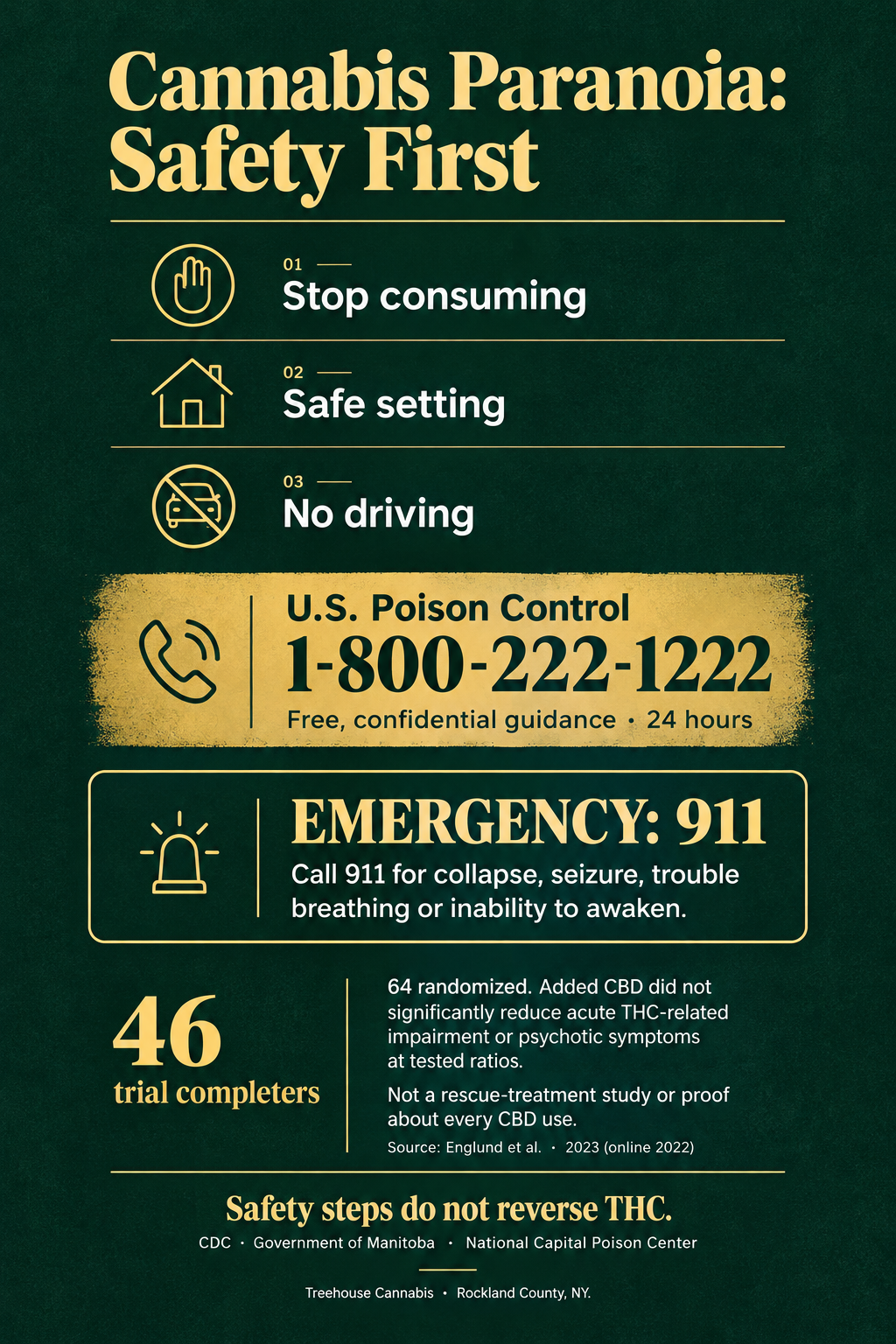
If this is happening now, put safety before figuring out the science. U.S. Poison Control provides free, confidential guidance around the clock at 1-800-222-1222. Call 911 immediately if someone collapses, has a seizure, has trouble breathing, cannot be awakened, or is in immediate danger. Do not assume those signs are simply part of being high. [6]
An uncomfortable reaction is not a personal failing, and feeling suspicious during intoxication does not automatically establish a lasting psychiatric disorder. Still, distress deserves attention rather than embarrassment or pressure to keep consuming. The useful distinction is between offering calm support and promising that a particular product, household remedy, or amount of waiting will fix the experience.
What is cannabis paranoia, and how is it different from anxiety?
Cannabis paranoia involves suspicious thoughts that other people intend harm. Anxiety is broader fear or worry; the two can overlap when cannabis makes someone feel frightened, disoriented, or unusually alert to possible threats. The CDC identifies anxiety and paranoia among cannabis's possible effects. [2]
A person might interpret an ordinary conversation as being about them, or read a neutral expression as hostile. Those examples describe a way of interpreting events, not evidence that the suspected threat is real.
- Anxiety can feel like dread without a specific person being involved.
- Paranoid thoughts involve suspicion about someone else's intentions.
- Both can occur together during an uncomfortable cannabis experience.
- The intensity of a feeling does not establish the accuracy of an interpretation.
| Experience | What it can feel like | Important distinction |
|---|---|---|
| Anxiety | Feeling frightened, tense, or on edge | Suspicion of other people is not necessary |
| Paranoid thoughts | Interpreting neutral behavior as hostile | A frightening thought is not proof of a threat |
| Severe or persistent symptoms | Marked confusion, hallucinations, or ongoing suspicion | Professional assessment matters more than self-diagnosis |
For related background on anxiety, see Cannabis and Anxiety: Finding Relief Without the Panic. That broader discussion should not be read as a recommendation to use cannabis to manage an anxious or paranoid reaction.
A brief episode cannot settle a diagnosis. Equally, hallucinations, difficulty knowing what is real, or symptoms continuing after intoxication should not be dismissed as ordinary worry. [2]
Why does weed make some people paranoid instead of relaxed?
THC can increase negative feelings and make familiar experiences feel unusual. When worry and altered perception occur together, an ordinary situation may seem threatening instead of relaxing. Research supports this pathway, but it is not a complete explanation for every person's reaction. [1]
In a randomized experiment published in Schizophrenia Bulletin in 2015, Freeman and colleagues studied 121 adults selected because they had experienced recent paranoid thoughts. THC increased paranoia, and negative feelings and unusual experiences statistically helped explain that increase. [1]
A possible pathway involves overlapping contributors:
- THC can make sensations or surroundings feel unfamiliar.
- Unusual experiences can occur alongside anxious or negative feelings.
- Worry may influence how an ambiguous event is interpreted.
- Neutral events may seem threatening; responses differ between people and occasions.
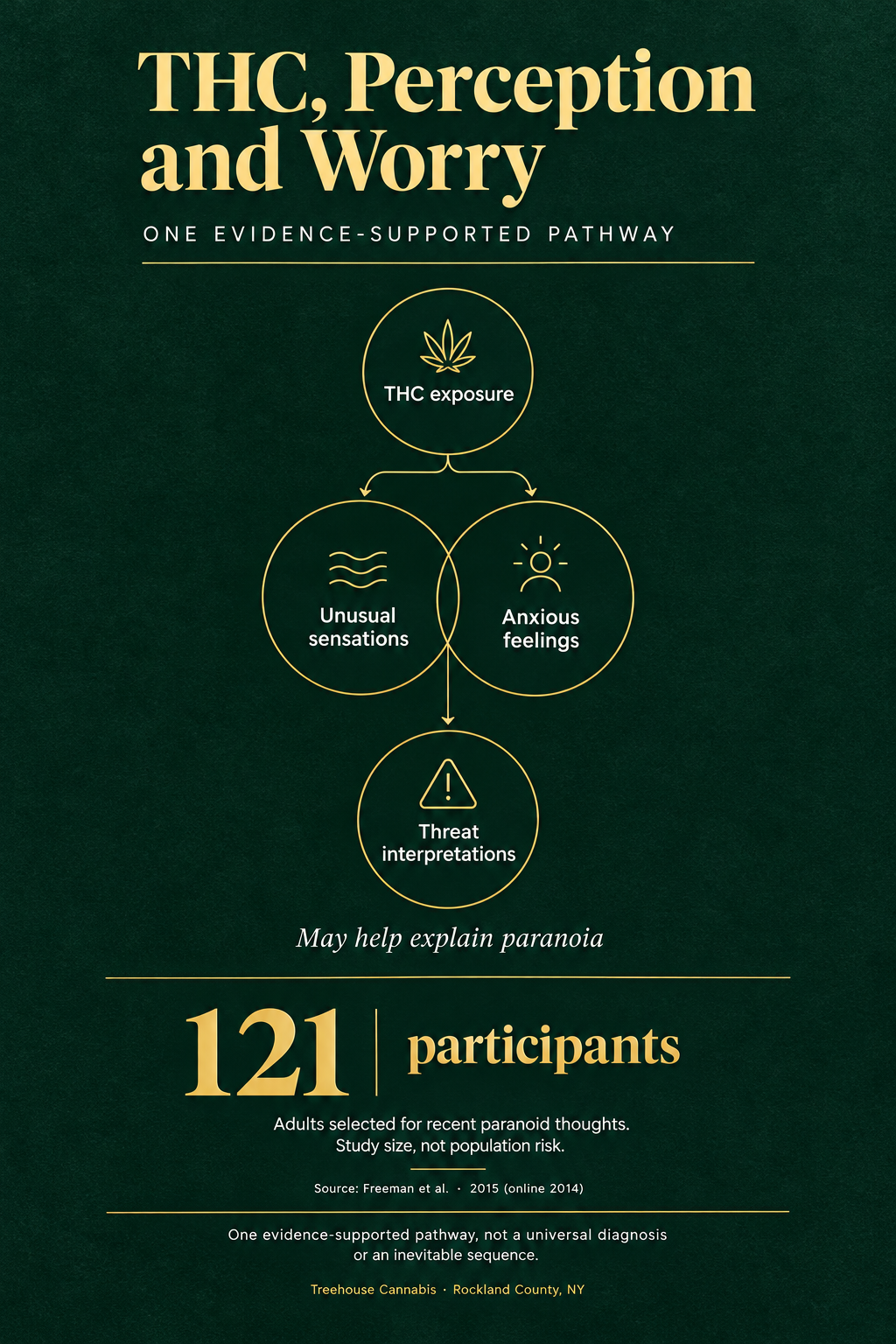
This is a possible pathway, not an inevitable sequence or a diagnosis. The experiment used intravenous THC in a selected group, not ordinary retail products in a representative sample of customers. Its findings cannot supply a percentage chance that a particular gummy or flower product will cause paranoia.
Understanding the explanation is also not an antidote. An awareness intervention in the same experiment did not significantly reduce paranoia, so knowing that THC can affect perception should not be promised as a way to prevent the reaction. [1]
The related article Why Does Weed Make Some People Paranoid? The Science Behind the Anxious High provides another entry point to the topic. For an individual experience, amount, route, mood, mindset, and surroundings also matter; the same product need not produce the same response on every occasion. [4]
How do THC strength and edible timing affect cannabis paranoia?
Amount, THC strength, and how cannabis is consumed can influence an uncomfortable experience. Edibles add delayed effects: someone may consume more because little seems to be happening, then feel overwhelmed as the effects develop. Initial onset is not a signal that the experience has finished building. [3]
The CDC says edibles can take 30 minutes to 2 hours to produce intoxicating effects and can last longer than expected. That guidance describes intoxication timing, not how long paranoid thoughts will last or when someone is safe to drive. [3]
- Read the THC information rather than relying on a reassuring name.
- Recognize that a delayed beginning does not mean an edible had no effect.
- Do not add more cannabis during an uncomfortable reaction.
- Keep onset, developing effects, and recovery separate when discussing timing.
- Do not use a clock to dismiss severe or worsening symptoms.
| Format | Timing consideration | Why it matters |
|---|---|---|
| Inhaled cannabis | Effects generally begin sooner than with edibles | Faster onset does not guarantee a comfortable experience |
| Edibles | Intoxicating effects are delayed | Taking more before effects develop can lead to unintended overconsumption |
| Either format | Amount and individual response influence the experience | There is no universal recovery deadline |
Government of Manitoba guidance also emphasizes that route, amount, mood, mindset, and setting can change the experience. A quiet evening and an unfamiliar, crowded gathering are different contexts, even before differences between products enter the picture. [4]
For background outside an active reaction, How to Avoid Taking Too Much Cannabis discusses overconsumption, while How Long Should You Wait Before Taking More Cannabis? addresses the timing question. Neither replaces individualized advice when someone feels unwell.
Cannabis can affect more than one aspect of an experience, including appetite, explored separately in Why Does Cannabis Give You the Munchies?. An appetite change is not a useful measure of whether someone is recovering from paranoid thoughts, and food should not be presented as an antidote.
What helps someone stay safe during cannabis paranoia?
The priority is to stop consuming, avoid hazards, and seek calm support. A quieter setting and a trusted sober person may make the situation less overwhelming, but support is not a proven way to reverse THC or instantly end paranoia. [4]
A practical safety checklist is:
- Stop consuming cannabis rather than trying another product.
- Do not drive, cycle, operate machinery, or take on hazardous tasks while impaired.
- Move to a quieter, safer place if that can be done safely.
- Ask a trusted sober person to stay nearby.
- Offer calm reassurance without arguing about suspicious thoughts or endorsing them as facts.
- Call U.S. Poison Control at 1-800-222-1222 for guidance about a concerning reaction.
- Call 911 for trouble breathing, inability to wake, collapse, seizures, or immediate danger. [4] [6]
A companion can acknowledge distress without agreeing that the feared event is happening: "That sounds frightening. Let's stay somewhere safe and get help if we need it." The point is to reduce confrontation, not to talk someone out of symptoms through a debate.
When calling Poison Control, explain what was consumed, approximately when, and whether alcohol, medication, or another substance was also involved. Do not delay an emergency call to gather packaging or reconstruct every detail.
There is no established rescue remedy in this source set involving peppercorns, lemons, supplements, or another cannabis product. Trying to force a quick fix can distract from monitoring safety and contacting someone qualified to help. Poison Control can guide the next step without requiring a self-diagnosis. [6]
Does CBD stop THC paranoia, or can a different strain prevent it?
CBD is not an established antidote to THC paranoia, and a strain name cannot guarantee a comfortable experience. Evidence from simultaneous CBD and THC use does not establish that taking CBD after symptoms begin will rescue someone from an uncomfortable reaction. [5]
In a randomized crossover trial published in Neuropsychopharmacology in 2023, 46 participants completed testing with different CBD-to-THC ratios. Adding CBD at the tested ratios did not significantly reduce the acute cognitive impairment or psychotic symptoms studied. [5]
That result has boundaries. The researchers studied CBD and THC inhaled together, not rescue CBD taken after paranoia began; the findings do not settle every formulation, route, or ratio.
- CBD is not a verified rescue treatment for this situation.
- A cannabinoid ratio is product information, not a promise of protection.
- Strain names do not predict every individual's reaction.
- Repeated frightening reactions are a reason to stop and seek professional advice, not keep experimenting.
The same caution applies to reassuring descriptions of flower. Mood, setting, amount, and individual response still matter; a familiar name cannot remove those uncertainties. [4]
What can cannabis labels and formats tell you about paranoia?
Product categories and labels describe products, not protection against paranoia. A format name, cannabinoid ratio or preparation accessory does not establish that an uncomfortable reaction can be prevented or reversed.
Treehouse's Pre Ground Flower category describes a flower format rather than a predictable mental effect. A preparation accessory such as Treehouse "THC" Metal Grinder | Small 1.5'h x 2'w likewise provides no evidence that a frightening reaction can be avoided.
The catalog entry ayrloom | Rescue 1:1 Topical | 1000MG THC : 1000MG CBD identifies a topical product, not an established rescue treatment for cannabis paranoia. Its listed cannabinoid amounts are product information, not consumption instructions; the inhalation trial above did not test this topical or establish that it reverses THC's effects. [5]
Keep these distinctions in mind:
- A product name is not clinical evidence.
- A format or accessory cannot guarantee a particular experience.
- Evidence about inhalation does not establish the effects of a topical formulation.
- Product browsing should remain separate from urgent-help decisions.
How long does weed paranoia last, and when is professional help needed?
There is no reliable countdown for everyone. Product, route, amount, and individual response affect the experience, while edible effects may develop slowly and last longer than expected. Symptoms that worsen or continue after intoxication fades deserve professional attention, not another waiting estimate. [3] [4]
Three different questions often get mixed together: when effects begin, how long intoxication lasts, and how long suspicious thoughts continue. An answer about one does not establish the others.
- Do not drive while impaired, even if the most frightening feeling has eased.
- Call Poison Control about a concerning reaction or uncertainty about what to do.
- Seek prompt assessment for severe confusion, hallucinations, or difficulty knowing what is real.
- Arrange professional assessment if suspicious thoughts persist after intoxication has faded or frightening reactions recur.
- Call 911 for collapse, seizures, breathing difficulty, inability to awaken, or immediate danger. [2] [6]
The CDC discusses associations between cannabis use and more serious mental-health problems. Those associations do not mean a temporary episode proves schizophrenia or that a lasting disorder is inevitable. They do mean persistent symptoms should not be diagnosed or waved away by a blog. [2]
Someone does not need to wait until an imagined deadline has passed before asking for help. Poison Control is available at 1-800-222-1222 around the clock, and emergency warning signs require immediate action. [6]
What else should adults know about cannabis paranoia?
The central distinctions are between anxiety and suspicion, support and treatment, and intoxication timing and persistent symptoms. These short answers recap those boundaries:
- Delayed effects can lead to unintended overconsumption.
- Calm support is not an antidote.
- Persistent or severe symptoms warrant professional attention.
Why does weed make me paranoid?
THC can change perception and increase negative feelings, making ordinary situations seem threatening. In a controlled experiment, unusual experiences and negative feelings helped explain increased paranoia. That supports a possible pathway, not a universal explanation or a diagnosis of anyone who has an uncomfortable experience. [1]
Is cannabis paranoia the same as anxiety?
No. Anxiety is broader fear or worry, while paranoia involves suspicion that other people intend harm. They can overlap during intoxication. A brief episode does not establish a lasting psychiatric disorder, but hallucinations, severe confusion, or difficulty knowing what is real require professional attention. [2]
What helps when someone feels paranoid after cannabis?
Stop consuming, avoid driving and hazards, and stay with a trusted sober person in a safer, quieter setting when possible. Call Poison Control at 1-800-222-1222 if concerned. Trouble breathing, inability to awaken, collapse, seizures, or immediate danger require 911 rather than reassurance alone. [4] [6]
How long does weed paranoia last?
There is no dependable duration for everyone. Amount, route, and individual response affect the experience, and edible effects may last longer than expected. Onset estimates are not recovery deadlines. Worsening symptoms or suspicious thoughts continuing after intoxication fades warrant professional assessment rather than more waiting. [3] [4]
Can edibles cause paranoia even when nothing happens at first?
Yes. Delayed intoxicating effects mean an initially uneventful experience does not establish that the edible had no effect. The CDC describes onset of 30 minutes to 2 hours and warns about unintended overconsumption. That window does not establish when paranoid thoughts will stop. [3]
Does CBD stop THC paranoia?
CBD is not an established rescue treatment. A controlled trial found no significant reduction in the acute adverse effects studied when CBD was added at the tested ratios to vaporized THC. It did not test CBD taken after paranoia began, and it does not justify product-specific protection claims. [5]
Can choosing a different strain prevent paranoia?
No strain name guarantees a paranoia-free response. Amount, route, mood, mindset, and setting can all influence an experience. Repeated frightening reactions are a reason to stop using and consult a qualified healthcare professional rather than treating another product as the answer. [4]
Sources
- Freeman et al., Schizophrenia Bulletin; NIH PubMed Central — In a randomized experiment involving 121 adults with recent paranoid thoughts, T
- Centers for Disease Control and Prevention — Cannabis can cause disorientation, anxiety and paranoia; associations with schiz
- Centers for Disease Control and Prevention — Edibles can take 30 minutes to 2 hours to produce intoxicating effects, encourag
- Government of Manitoba — Cannabis experiences vary with amount, route, mood, mindset and setting; someone
- Englund et al., Neuropsychopharmacology; NIH PubMed Central — Among 46 trial completers, adding CBD at the tested ratios did not significantly
- National Capital Poison Center — U.S. Poison Control offers free confidential expert help at 1-800-222-1222 aroun
About Treehouse Cannabis
Treehouse Cannabis shares adult-use education to help customers understand cannabis labels and product formats.
- Staff cannot diagnose paranoia or provide medical treatment.
- Repeated or persistent symptoms belong in a conversation with a qualified healthcare professional, not a search for another cannabis product.
Cannabis is for adults 21 and older. Keep all cannabis products away from children and pets. This article is educational and is not medical advice. Do not drive or operate machinery while impaired.

Shop our products

Shop All

Deals

Flower

Pre-rolls
Vaporizers

Edibles

Drinks

Concentrates
Tinctures

Topicals

CBD

Pet CBD

Accessories