
Cannabis Oil vs Cannabutter: Which Infusion Should You Make?
Cannabis Oil vs Cannabutter: Which Infusion Should You Make?
A side-by-side guide to choosing between oil and butter for homemade cannabis edibles.
Cannabis oil vs cannabutter comes down to your recipe and storage needs. Both rely on the same principle — decarboxylated cannabis slowly heated with a butter or oil carrier — so potency and onset are essentially identical. Pick cannabutter for baked goods that need structure; pick cannabis oil for savory dishes, dressings, gummies, and longer refrigerator storage.
What Is the Difference Between Cannabis Oil and Cannabutter?
Cannabis oil and cannabutter are the same idea in two different fats. Both are a carrier — butter or cooking oil — that has been slowly heated with decarboxylated cannabis so the plant's fat-soluble cannabinoids (mainly THC and CBD) bind to the fat and stay dissolved in it. Strain the plant material out, and you are left with an infused fat you can cook with, bake with, or dose by the spoonful. The chemistry is identical; only the carrier changes.
That shared principle is also why most of the practical questions a home cook asks — which recipe works better, how each stores, how dose compares, which is easier to make — end up being about the fat itself, not the cannabis. If you have ever eaten a homemade edible that came on too late, too strong, or not at all, the carrier was rarely the problem; the dose, the decarb, or the wait time was. For a deeper look at why timing matters so much with homemade edibles, see You're Not Lazy—Your Edible Just Peaked at the Wrong Time.
Cannabis oil is also worth distinguishing from the concentrated oils you might find on a dispensary shelf. Those products — sold under categories like Oil Concentrates — are extracted and refined cannabis products meant for vaping or dabbing, not infusions you cook with. The infusion method in this guide uses whole decarbed flower, kief, or hash combined with a neutral cooking fat, and the result is a homemade edible ingredient rather than a smokable extract.
The four practical differences to weigh before you start:
- Recipe fit: butter for brownies, cookies, and cake; oil for dressings, sautés, marinades, and gummies
- Chemistry: both rely on the same fat-soluble cannabinoid binding, so the infusion process is interchangeable
- Storage: oil keeps for several months refrigerated; butter keeps 1–4 weeks refrigerated or up to 6 months frozen
- Potency and onset: nearly identical between the two — both deliver THC through the same oral pathway
How Does Decarboxylation Affect Oil and Butter Infusions?
Decarboxylation is the same step whether you are making oil or butter, and it is the step that turns raw cannabis into something that will actually get you high. Fresh, cured flower contains mostly THCA, the acidic precursor to THC that is not directly psychoactive on its own. Heating the flower at roughly 240°F for 30–40 minutes converts THCA into active THC, which then dissolves into whatever fat you combine it with [1] [2] [3].
The two common home methods land at the same temperature window:
- Oven decarb on a baking sheet — spread ground flower in a thin, even layer and bake at 240°F for 30–40 minutes.
- Decarb in the infusion fat itself — hold the flower and fat together at 220–245°F for 30–45 minutes as part of the infusion.
Both work. The separate oven method is more forgiving and easier to verify, which is why most recipes default to it. Project CBD confirms the oven-window approach as the reliable home standard [3].
If you start with material that is already decarbed — kief, dry sift hash, or a quality hash from a licensed dispensary like the Hash Concentrates shelf — you can skip this step entirely and move straight to infusion. The same shortcut applies to distillate, which is decarbed during manufacturing.
One detail worth flagging: do not skip decarb and assume the infusion temperature alone will activate the THC. A 160–200°F infusion window is too low to drive the reaction efficiently, and you will end up with a butter or oil that looks and smells right but barely works. Decarb first, then infuse.
How Do You Make Cannabutter Step by Step?
Cannabutter is the right pick when your end goal is baking — brownies, cookies, cake, or any recipe that needs solid fat. The method is low and slow, and the main pitfalls are heat control and straining.
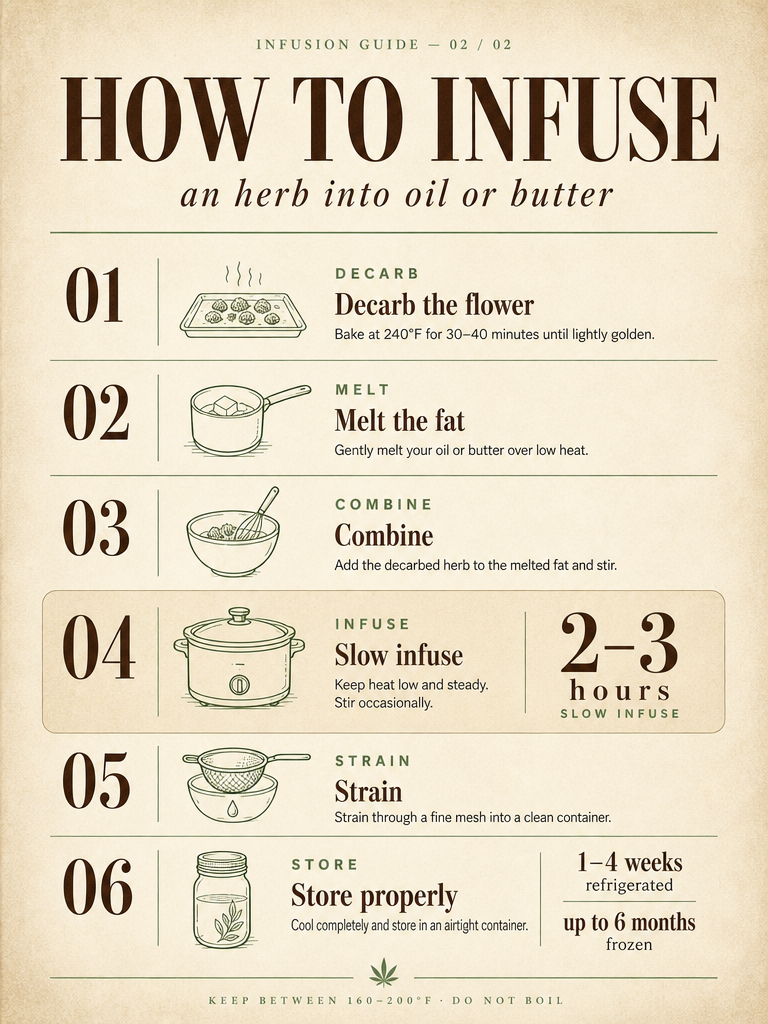
Here is the standard home process, based on Leafly's stovetop and slow-cooker method [1]:
- Decarb the flower. Grind 7–10 grams of flower, spread on a parchment-lined baking sheet, and bake at 240°F for 30–40 minutes.
- Melt one cup (227 g) of unsalted butter in a heavy-bottomed pot or slow cooker on low. Unsalted butter is the default because it gives a neutral flavor and lets the cannabis flavor come through cleanly.
- Combine and infuse. Add the decarbed flower to the melted butter and hold the temperature between 160°F and 200°F for 2–3 hours. Stir occasionally. Do not let it boil — once butter scorches above roughly 245°F, you lose cannabinoids and the infusion turns bitter [1].
- Strain. Pour the mixture through a few layers of cheesecloth into a glass jar or silicone mold. Squeeze the cheesecloth gently to recover as much butter as possible, then discard the plant material.
- Cool and store. Once it firms up, refrigerate. Properly stored cannabutter keeps for weeks in the refrigerator or several months frozen [7].
A slow cooker makes this easier because it holds the low temperature steady without much babysitting. A heavy pot on the stove works fine — just stay close enough to keep the heat under 200°F and never let it come to a rolling simmer.
If you are picking starting material specifically for the eventual high, the strain matters more than the carrier. Our guide to Why Some Strains Make You Chatty walks through how terpene and cannabinoid profiles shape the effects you actually feel, which is a useful companion read before you choose what to bake with.
How Do You Make Cannabis Cooking Oil Step by Step?
Cannabis cooking oil follows the same low-and-slow infusion principle, just with a liquid fat instead of butter. The end result is a versatile infusion that stays liquid at room temperature (or solid in the fridge if you use coconut oil), which makes it the natural pick for savory dishes, salad dressings, drizzles, and gummy-style doses.
Step by step, mirroring the cannabutter method above [2]:
- Decarb the flower. Same as cannabutter — 240°F for 30–40 minutes on a baking sheet.
- Warm one cup of carrier oil in a heavy pot or slow cooker. Stay between 160°F and 200°F.
- Combine and infuse. Add the decarbed flower to the oil and hold at 160–200°F for 2–3 hours, stirring occasionally. Do not let it boil.
- Strain through cheesecloth into a glass jar with a tight lid.
- Store refrigerated. Properly stored cannabis oil keeps for several months in a sealed jar in the fridge.
The carrier you pick changes the flavor, smoke point, and texture of the final dish. The four most common home options:
- Olive oil — versatile, moderate smoke point, works for sautés and dressings; the cannabis flavor comes through.
- Coconut oil — solid at room temperature (under about 76°F), MCT-friendly, and a natural pick if you want a butter-like solid infusion.
- Avocado oil — high smoke point and very neutral flavor, the most flexible carrier for high-heat cooking.
- Grapeseed oil — light, neutral, and affordable, with a high smoke point.
Avoid nut oils (walnut, hazelnut, sesame) and anything strongly flavored unless the recipe specifically calls for it — cannabis flavor concentrates in those carriers and can dominate the dish. If you are sourcing starting material for a serious infusion project, our Flower menu is a good place to browse current batches by strain and terpene profile.
Which Is Better for Different Recipes: Oil or Butter?
The carrier is really a recipe-matching decision. Use this side-by-side as a quick reference:
| Recipe type | Better carrier | Why |
|---|---|---|
| Brownies, cookies, cake | Cannabutter | Solid fat gives structure and crumb |
| Frostings, ganache | Cannabutter | Solidifies on cooling |
| Recipes where butter flavor is welcome | Cannabutter | Flavor match |
| Salad dressings, marinades, drizzles | Cannabis oil | Stays liquid at room temperature |
| Savory sautés, pasta finishing oil | Cannabis oil | High smoke point, easy to dose by spoonful |
| Gummies, tincture-style doses | Cannabis oil | Liquid fat mixes cleanly into a base |
| Long-pantry storage | Cannabis oil | Months refrigerated vs. weeks for butter |
Quick rule of thumb on the choice:
- Baking — go butter. Brownies, cookies, cakes, and anything needing structure or that solidifies on cooling benefit from a solid fat.
- Savory and liquid uses — go oil. Dressings, marinades, drizzles, and finishing oils stay liquid at room temperature and dose cleanly by the spoonful.
- Uncertain — match the recipe's fat. If a recipe already calls for butter or a neutral oil, use the infusion that mirrors it to keep texture and flavor predictable.
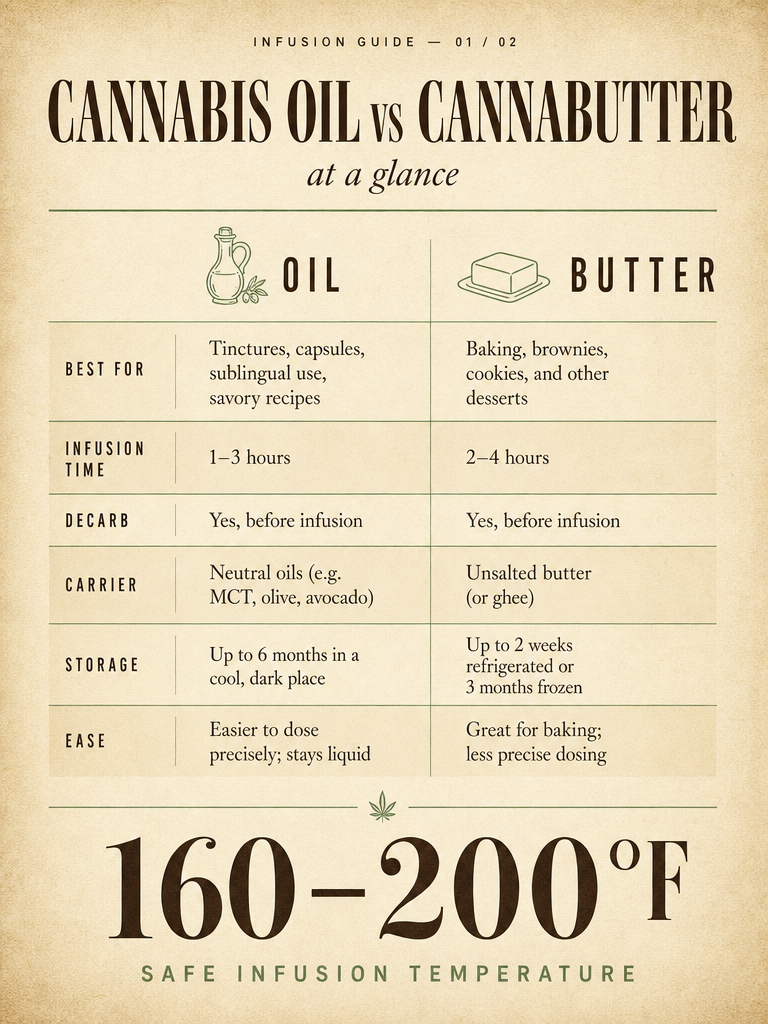
If the recipe already calls for butter or a solid fat, use cannabutter. If it calls for a neutral oil or any savory application, use cannabis oil. The two methods are interchangeable at the chemistry level — cannabinoids bind to either — but the dish you are making will usually make the choice for you.
For ready-made options in either category, our Gummies Edibles shelf is a good place to compare dose formats, and our broader edible and pre-roll menus cover the grab-and-go side of the spectrum if you would rather skip the infusion step entirely.
How Does Storage and Potency Compare Between Oil and Butter?
Storage is where oil and butter diverge the most, and potency is where they are basically the same. Cannabis oil keeps for several months in the refrigerator in a sealed, dark glass jar. Cannabutter keeps for 1–4 weeks refrigerated or up to 6 months frozen [7].
- Cannabis oil keeps for several months in the refrigerator in a sealed, dark glass jar. The fat stays stable, and the dose per teaspoon stays predictable.
- Cannabutter keeps for 1–4 weeks refrigerated or up to 6 months frozen [7]. Because it is a dairy-based fat with plant material traces even after straining, it spoils faster than oil does and benefits from freezing in single-use portions.
If you make infusions in batches and want to store them for weeks or months at a time, oil is the lower-maintenance option. If you bake through your batch quickly, butter is fine in the fridge.
Potency is a different question, and the answer is reassuring: potency is set by the cannabis dose and the infusion time, not by whether you used oil or butter. Both carriers bind the same fat-soluble cannabinoids, so a well-made infusion of either delivers comparable milligrams per gram of starting flower. Edible intensity tracks the dose you actually eat, not the carrier [5] [6].
Onset is also identical between the two carriers, because both deliver THC through the same oral pathway. After you eat an infused fat, the THC passes through your digestive system and through the liver, where it is metabolized into 11-hydroxy-THC before reaching your bloodstream [4]. That first-pass metabolism is why oral THC has lower bioavailability than inhaled THC — roughly 6% (±3%) from food in published measurements [5] — and why onset is slower and longer-lasting than smoking.
Typical timeline for either carrier:
- 60–120 minutes to first noticeable effects
- 2–4 hours to peak intensity
- Several hours of gradual fade
Onset is slower on a full stomach, which is why experienced edible users always start low and wait the full window before taking more.
For storing either infusion at home, an opaque container in the back of the fridge is the practical default. If you are transporting infusions or any cannabis between home and a friend's place, a Treehouse Locking Cross Body Smell-Proof Bag keeps things sealed and discreet.
Frequently Asked Questions
Is cannabis oil stronger than cannabutter?
Potency depends on the cannabis dose and infusion time, not the carrier fat. Oils and butter both bind fat-soluble cannabinoids, so a well-made infusion of either delivers comparable potency per milligram of starting flower. Edible onset and intensity track the dose eaten, not whether you used oil or butter.
Which lasts longer in storage, cannabis oil or cannabutter?
Cannabis oil lasts longer. Properly stored infused oil keeps in a sealed container for several months in the refrigerator, while cannabutter typically stays fresh for about 1–4 weeks refrigerated and up to six months frozen. Choose oil when you want a longer pantry life and fewer freezer rounds.
Do you have to decarboxylate before infusing oil or butter?
Yes, for raw flower. Heating ground cannabis at about 240°F for 30–40 minutes converts non-active THCA into psychoactive THC, otherwise the infusion will be very mild. If you start with already-decarbed kief, hash, or distillate, you can skip decarboxylation and move straight to infusion.
What is the best temperature to infuse cannabis into oil or butter?
Keep the fat between 160°F and 200°F during infusion. Above about 245°F you risk burning off cannabinoids and terpenes and giving the infusion a harsh taste. A low, slow simmer of 2–3 hours is the standard home method for both oil and butter.
Can I use any cooking oil to make cannabis oil?
Stick to fats with a high smoke point and neutral flavor when you want a versatile infusion. Olive oil, avocado oil, coconut oil, and grapeseed oil all work well. Avoid nut oils and anything strongly flavored unless the recipe calls for it, since the cannabis flavor will be more pronounced in those carriers.
How long does it take for cannabutter or cannabis oil edibles to kick in?
Most homemade edibles take 60–120 minutes to begin producing noticeable effects, with peak intensity around 2–4 hours after eating. Onset is slower on a full stomach, which is why experienced edible users always start low and wait the full window before taking more.
Which is easier for a beginner: oil or butter?
Cannabis oil is generally easier for a first-time infusion because there is no water phase to separate and no risk of scorching the solids the way butter can scorch. Cannabutter rewards a little more care — a heavy-bottomed pot and patient low heat — but is the right pick if your goal is baked goods.
Sources
- Leafly — Leafly's stovetop and slow-cooker cannabutter method, decarboxylation at 240°F f
- Leafly — Leafly's cannabis cooking oil method calls for decarboxylation at 245°F for 30-4
- Project CBD — Project CBD confirms oven decarboxylation on a baking sheet for 40 minutes activ
- PubMed Central / NCBI — NIH-indexed review explains that orally ingested THC undergoes first-pass liver
- PubMed Central / NCBI — Systematic review showing oral THC bioavailability ranges 6%±3% in food and 10-2
- NCBI Bookshelf (StatPearls) — StatPearls/NCBI clinical reference documenting the pharmacology of THC absorptio
- tCheck — tCheck documents that properly stored cannabutter keeps for weeks in the refrige
About Treehouse Cannabis
Treehouse Cannabis is an adult-use dispensary serving customers across Rockland, Orange, and Westchester Counties. We carry a curated menu of flower, pre-rolls, edibles, vapes, concentrates, and accessories, with pickup and delivery available throughout the region.
Browse the Treehouse Cannabis edible menu and pre-rolls for ready-to-enjoy options while you plan your next infusion — pickup and delivery available across Rockland, Orange, and Westchester Counties.
This content is intended for adults 21 and older who are of legal consumption age in their state of residence. Effects of cannabis, particularly when infused and ingested, can vary significantly based on dose, individual tolerance, recent meals, and other factors. Always start with a low dose, wait the full onset window before taking more, and store all infused products securely and out of reach of children and pets. Do not drive or operate machinery while under the influence of cannabis. If you are pregnant, nursing, or have a medical condition, consult a qualified healthcare provider before consuming cannabis.


Shop our products

Shop All

Flower

Pre-rolls
Vaporizers

Edibles

Drinks

Concentrates
Tinctures

Topicals

CBD

Pet CBD

Accessories