Cannabis and Gaming: Focus, Immersion, and Overdoing It
Cannabis and Gaming: Focus, Immersion, and Overdoing It
Cannabis and gaming do not mix the way players hope: controlled studies consistently find THC impairs attention, working memory, reaction time, and motor coordination, which is most of what a match asks for. What cannabis does change is how the session feels, and that gap between feeling locked in and actually performing is where most of the confusion lives.
That gap explains the whole conversation. Players report deeper immersion, sharper concentration, and a better sense of flow. Labs report slower reaction times and worse recall at the same doses. Both can be true at once, because one is a report and the other is a measurement.
This guide follows the research on cannabis and gaming through four questions: whether it helps focus, why it feels immersive, what it does to the specific skills competitive play needs, and when a nightly session starts costing more than it gives. It covers the timing window after inhaling, why edibles behave differently, and what the evidence on habit actually supports.
Cannabis and Gaming: Does It Actually Help You Focus?
No controlled study shows THC improving sustained or divided attention. The direction in the literature runs the other way, and it runs consistently across decades of testing.
A 2025 narrative review of the cognitive literature reports impairment in attention, executive function, memory, and learning, with acute motor-coordination deficits described as well established [2]. The same review identifies early onset of use and high-frequency use as the strongest risk factors for more severe and longer-lasting effects, which matters here because the gaming audience skews young and the habit often runs nightly.
Then there is the tolerance result that gets misread constantly. Light users showed measurable attention and concentration impairment about 30 minutes after a moderate-THC cigarette, while daily users showed no significant accuracy differences on attentional tasks [3]. That looks like a benefit until you read it correctly: tolerance means the drug is doing less, not that the person's focus improved. The baseline did not rise. The response flattened.
Dose decides how large the effect gets. In a randomized, double-blind study of regular cannabis users, a 22 mg vaporized THC dose significantly worsened divergent-thinking performance compared with both 5.5 mg and placebo, while the 5.5 mg dose produced nothing above placebo [4]. Regular users, high dose, measurable decline. Low dose, no measurable change in either direction.
- The direct answer: no controlled study shows THC improving sustained or divided attention
- What the 2025 cognitive review finds impaired: attention, executive function, memory, learning, plus acute motor-coordination deficits
- Why heavy users report no drop-off: daily users showed no significant accuracy differences on attentional tasks while light users were measurably impaired 30 minutes after a moderate cigarette, which is tolerance rather than enhancement
- Why dose decides the size of it: 22 mg of vaporized THC worsened divergent thinking in regular users while 5.5 mg was indistinguishable from placebo
- The gap between feeling locked in and performing: narrowed attention plus less self-monitoring reads as focus from the inside
The honest mechanism is unglamorous. THC narrows attention and reduces self-monitoring, so fewer distractions register and the mind stops auditing itself. From the inside that feels like concentration. On a timed task, nothing improves. The broader performance question follows the same logic, which is why Cannabis in Sports: Performance, Recovery, and Controversy reaches a similar conclusion about physical performance and recovery.
Why Does Weed Gaming Feel So Immersive?
Because immersion is a reported state, not a scored one, and THC changes the inputs that feed the report.
Researchers define flow as a state of full immersion that emerges when a person's skills match the challenge in front of them. They can reliably induce high and low flow in players by tuning game difficulty to individual skill, which confirms the state is real and reproducible [7]. Difficulty that fits your ability produces flow. Difficulty that is too easy produces boredom. Too hard produces anxiety.
A conceptual review goes further and argues that flow and immersion do not substantially differ in the video-game literature. Both involve concentration, a lost sense of time, a skill-challenge balance, and a loss of self-awareness [8]. The same review notes that most immersive experiences are still measured with self-report questionnaires rather than objective performance, and that is the hinge of this entire question.
If immersion is measured by asking people how absorbed they felt, then anything that deepens absorption will raise the score. THC changes mood, thoughts, and perceptions of reality, and the products on the market have grown in variety, THC content, and routes of consumption [9]. Altered time perception alone makes a session feel longer and more enveloping, because the clock in your head stops agreeing with the clock on the wall.
- The working definition of flow: full immersion that shows up when skill meets challenge
- Why the definition matters for gaming: difficulty tuned to skill reliably produces high versus low flow in players
- How immersion compares on paper: the literature says the two barely differ, sharing concentration, lost time, and loss of self-awareness
- The measurement problem: immersion is mostly self-reported, so a deeper feeling is not a performance result
- What THC plausibly adds: altered mood, perception, and time sense, which make the reported state feel stronger
None of that is a knock on the experience. A game that feels more absorbing is a real thing to enjoy, and it is the reason a lot of people play the way they do. It is simply a different measurement from skill, rank, or accuracy. Sleep quality sits upstream of both, which is why Cannabis and Sleep Quality: What Actually Works (and What Doesn't) is worth reading alongside this if the nightly session has pushed bedtime later. The daytime version of the same question, whether cannabis helps or hurts tasks that need sustained attention, gets a closer look in Cannabis for Focus & Productivity.
Does Playing Video Games High Make You Better?
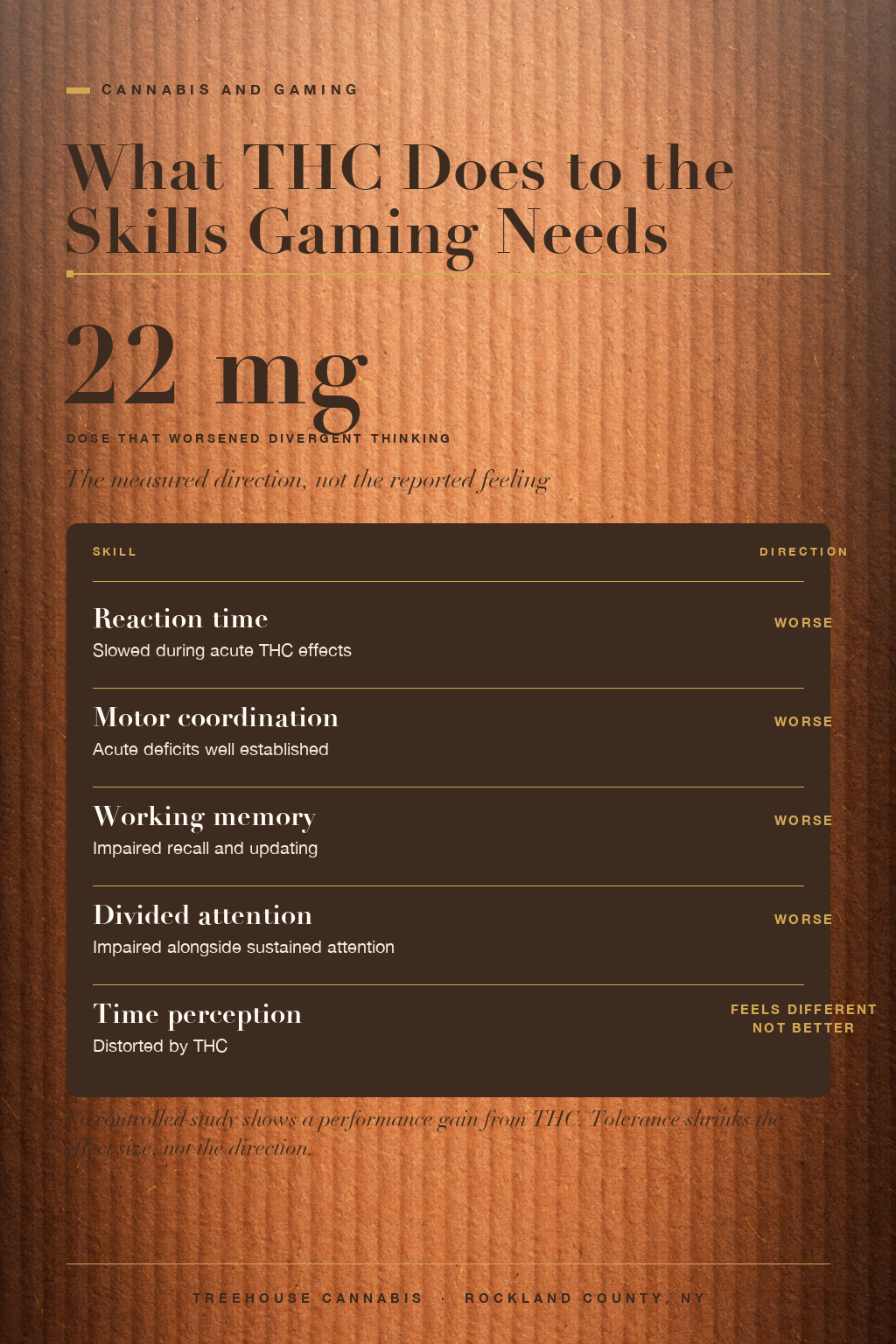
No, and the answer is over-determined. Competitive play runs on reaction time, fine motor control, working memory, and divided attention. Research finds THC degrading every one of them [2].
| Skill competitive play needs | What THC does to it | What that means in a match |
|---|---|---|
| Reaction time | Slowed during acute effects | Later inputs, later rotations, lost first-contact advantage |
| Fine motor control | Acute coordination deficits well established | Missed shots, sloppy movement, worse tracking |
| Working memory | Impaired recall and updating | Lost map awareness, forgotten cooldowns and callouts |
| Divided attention | Impaired alongside sustained attention | Missed minimap pings and audio cues |
| Time perception | Distorted | Mistimed pushes and late rotations that feel on time |
- Every row moves the same direction: this is not a trade-off between strengths and weaknesses
- Modest is the accurate word, and it still counts: a modest deficit matters in a ranked match where the margin is a few frames
- Tolerance changes the size, not the sign: regular users show less impairment, not an advantage
- None of it is a reason to feel bad about playing high, only a reason to stop expecting a performance gain
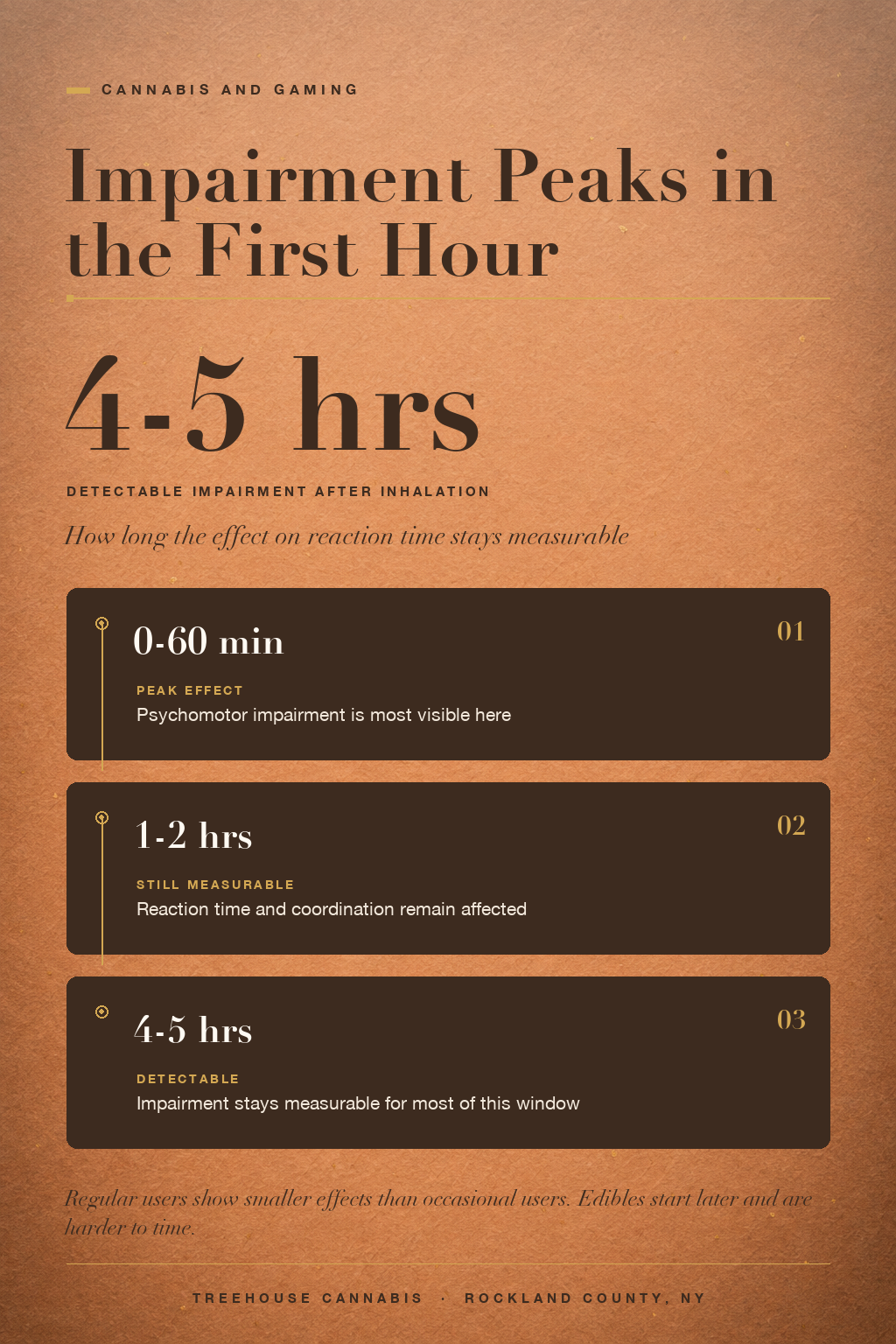
The closest analogue with real measurements is psychomotor research on driving rather than gaming, and it points the same direction. Reviews of the past five years of controlled work report that THC acutely impairs driving and psychomotor performance, most visibly in the first hour after use and detectable for roughly four to five hours after inhalation, with regular users showing less impairment than occasional users [5].
It is not a gaming study and should not be presented as one. What it offers is a measured version of the same underlying task: tracking, steering, braking, and responding to something unexpected while the drug is active.
The size of the effect varies rather than disappearing. Experimental and simulator work concludes that certain abilities are significantly though modestly impaired during acute THC effects, moderated by dose, delivery method, recency of use, and tolerance, with recent-use crash-risk odds ratios across meta-analyses ranging from 1.28 to 2.49 [6]. Modest is the operative word, and it cuts both ways: a modest deficit is still a deficit in a ranked match where the margin is a few frames.
The one true concession is that a tolerant daily user taking a low dose may feel nothing at all. That is a real outcome, and it is not an edge. Neutral is the absence of a penalty, not the presence of a bonus, and no study has found the bonus. For the broader picture of what cannabis does and does not do well, An Exploration of Potential Health Benefits covers the claims that hold up.
THC Reaction Time: How Long Does It Stay Slowed?
The effect is strongest in the first hour and measurable for roughly four to five hours after inhalation [5]. It is shorter than most people assume and longer than they hope.
Several things stretch or shrink it. Dose, delivery method, how recently you last used, and tolerance all move the curve [6]. An occasional user at a higher dose sits at the long end. A daily user at a low dose sits at the short end, with a smaller peak in between.
- The headline timing: strongest in the first hour, detectable roughly four to five hours after inhalation
- What stretches or shrinks it: dose, delivery method, recency of use, and tolerance
- Why edibles break the pattern: delayed onset means the window starts later than the clock you were tracking
- What the edibles data shows: verbal recall down 150 minutes after a mean 7.3 mg dose, visual attention unchanged, blood THC uncorrelated with outcomes
- How to plan a session around the window instead of discovering it mid-match
Inhaled cannabis is the route those figures describe. The four to five hour estimate is tied to inhalation specifically, and it comes from flower and vaporizer formats rather than from anything you swallow. If a bowl of Thai Sunrise Flower - 70g or a vape session is what you are timing, that is the window in question. If you are working from an edible instead, the whole timeline shifts, which is why the Edibles category is worth understanding before you plan around a number.
The edibles data is where the surprise lives. In a naturalistic observational study of 22 people using their own legally purchased edibles at a mean of 7.3 mg THC, verbal free-recall performance declined 150 minutes after dosing, while visual attention and trail-making scores showed no effect, and blood THC did not correlate with any cognitive outcome [10].
Two things follow from that. First, the impairment that showed up was recall, which in a game is your memory for what happened thirty seconds ago. Second, the clock starts at onset rather than at consumption, so an edible session has a different shape than a smoking session. Plan around the window you actually get, not the one the label implies.
How Do Edibles and Smoking Differ for a Gaming Session?
They differ on four dimensions that change how a session plays out: how fast the effect arrives, how long it holds, how precisely you can control the amount, and how easy it is to overshoot before anything registers.
| Dimension | Inhaled (flower, vape, pre-roll) | Edible |
|---|---|---|
| Onset | Minutes, felt quickly | Delayed, well after the decision |
| Duration | Roughly four to five hours of detectable effect | Longer and less predictable |
| Dose control | Adjustable mid-session, one draw at a time | Fixed at the moment you eat it |
| Overshoot risk | Lower, because feedback arrives fast | Higher, because the effect trails the decision |
- Onset decides the shape of the session: inhalation delivers feedback in minutes, an edible delivers it after the decision is already made
- Duration decides the tail: four to five hours detectable for inhalation, longer and less predictable for edibles
- Dose control decides how correctable a mistake is: one draw at a time, or fixed at the moment you eat it
- Overshoot risk follows from the other three, since fast feedback is what lets you stop
- Recall is the first thing the edible data shows going, which is the sense a long session punishes hardest
The edible side is where folklore and data part company. At a mean of 7.3 mg THC from legally purchased products, verbal free recall had declined 150 minutes after dosing while visual attention and trail-making scores showed no effect, and blood THC did not track any cognitive outcome [10]. People felt fine and recalled less. That is the exact failure mode a gaming session punishes, because the thing you lose first is the memory of what just happened.
Product variety makes the label matter more than it used to. THC content and routes of consumption have both expanded substantially, and the same category can now hold very different milligram counts [9]. A beverage, a gummy, and a chocolate are not interchangeable units, which is why reading the panel on something from the Drinks Edibles shelf is a different exercise from reading a flower label.
Lemon Lime Squeeze Beverage Infusion | 100mg
The structural difference is simpler than any number. Inhaling is short and adjustable, so you can stop when you have had enough. Eating is long and committed, so the decision gets made before you have any information about how it landed. Neither is safer or stronger in the abstract. They fail differently, and the failure mode that hurts a session is the one where you cannot correct course for a few hours.
Is Your Cannabis Gaming Habit Becoming a Problem?
Maybe, and the research cannot tell you which way the relationship runs. That limitation is the most useful thing in the literature, so it is worth stating plainly.
The best available summary is a 2025 scoping review of 25 studies published between 2000 and February 2025. It found that a relationship between video gaming and cannabis use does appear to exist, with most studies reporting a positive association, but the evidence is too heterogeneous to define what kind of relationship it is, and no included study drew on a fully legalized-market sample [1].
Read that carefully. A positive association in most studies means the two show up together. It does not mean gaming causes cannabis use, or that cannabis use causes gaming. It also means the claim that either one drives the other is ahead of the data, in both directions, and the legalized-market gap means the studies describe a market that mostly no longer exists in New York.
- What the 25-study review actually supports: a positive association in most studies, and no clarity on direction
- The limitation worth repeating: heterogeneity across studies and no fully legalized-market sample
- Better signals than hours or grams: how often, and what it costs you, including sleep, spending, sessions you did not plan, and things you skipped
- Why tolerance makes self-assessment unreliable: daily users stop showing the acute accuracy drop that light users show, so feeling fine says less than it used to
- When to take it to a professional rather than a forum
The tolerance point deserves its own line because it quietly breaks the most common self-check. Daily users showed no significant accuracy differences on attentional tasks while light users were measurably impaired [3]. If you are a daily user and you feel sharp, that feeling is consistent with tolerance and says nothing about whether your baseline has moved. A widening gap between how high you feel and how you actually perform is worth noticing, whether that shows up in a rank, a sleep schedule, or a budget.
Frequency and consequences are the signals to watch, not hours played or grams used. A nightly bowl of Whole Flower Flower and a nightly vape both count the same way, and the format is not the variable that matters. If you recognize your own pattern and want help with it, a healthcare professional is the right conversation, not a forum thread.
What Should You Ask Before Choosing for a Long Session?
If you are picking something for a long session in Rockland, Orange, or Westchester County, the team at Treehouse Cannabis will walk you through what is actually in a product before you choose. Walk in with four questions:
- What the milligram count is per serving, and how many servings sit in the package
- Whether a vape and a pre-roll run on meaningfully different timelines at similar potency
- How long the product tends to run, so the session can be planned around the window instead of discovered mid-match
- Whether the batch certificate is available before you buy rather than after
Then decide with the numbers in front of you instead of the label's mood.
Frequently Asked Questions
Does cannabis actually help you focus while gaming?
The research does not support it as a focus aid. Controlled studies find THC impairs sustained and divided attention, working memory, and reaction time, especially at higher doses. Regular users show smaller effects because of tolerance, but tolerance means the drug is doing less, not that focus improved.
Why does being high make a game feel more immersive?
Immersion and flow are self-reported states built on concentration, a lost sense of time, and a match between skill and challenge. THC changes mood, perception, and time sense, which can make the experience feel deeper. Feeling absorbed is not the same as performing better, and studies measure them separately.
Can weed make you better at video games?
No controlled study shows a performance gain. The evidence points the other way: THC slows reaction time, reduces motor coordination, and worsens working memory, all of which matter in competitive play. A low dose may feel neutral in a tolerant user, but neutral is not an edge.
How long after smoking does THC affect reaction time?
Reviews of controlled research find impairment is most visible in the first hour and detectable for roughly four to five hours after inhalation. Regular users show less impairment than occasional users. Edibles run on a different clock, because the effect arrives well after the decision to use.
Does tolerance change how cannabis affects gaming?
Yes, and it is the clearest finding in the literature. Daily users show smaller acute effects on attentional tasks than light users given the same dose. Tolerance develops to the impairing effects too, so the gap between how high you feel and how you actually perform can widen.
Is gaming high every night a problem?
It is worth watching rather than panicking. A 2025 scoping review of 25 studies found gaming and cannabis use are linked in most studies, but the evidence cannot show which way the relationship runs and no study used a fully legalized-market sample. Frequency and consequences are better signals than hours played.
Do edibles affect gaming differently than smoking?
They arrive later and hold longer. In a naturalistic study, verbal recall dropped about 150 minutes after a mean 7.3 mg THC edible while visual attention was unaffected, and blood THC did not predict performance. The delayed onset makes it easy to take more than intended before anything registers.
Sources
- Journal of Behavioral Addictions — A scoping review of 25 studies published between 2000 and February 2025 found th
- Neurology International — This narrative review of the cognitive literature reports consistent impairment
- Journal of Addiction Medicine — Reviewing acute, residual, and long-term effects, this paper found that light us
- Psychopharmacology — In a randomized, double-blind study of regular cannabis users (n=18 per group),
- Current Addiction Reports — This review of the past five years of controlled research reports that THC acute
- Current Opinion in Psychology — Reviewing experimental and simulator research, this paper concludes that certain
- Behavior Research Methods — Researchers induced high and low flow states in players by matching game difficu
- Frontiers in Psychology — This conceptual review argues that flow and immersion do not substantially diffe
- National Institute on Drug Abuse (NIDA) — NIDA's reference page states that cannabis products containing THC can cause cha
- Psychopharmacology — In a naturalistic observational study of 22 people using their own legally purch
About Treehouse Cannabis
Treehouse Cannabis is a licensed adult-use dispensary in Rockland County, New York, serving customers across Rockland, Orange, and Westchester Counties. The menu carries flower, pre-rolls, vapes, and edibles with total THC printed per serving and a batch certificate behind a scannable code, and the team will read the panel with you before you buy.
Cannabis is for adults 21 and older. This article is educational and informational only and is not medical advice. Cannabis affects people differently, and oral products can take up to two hours to take effect. Do not drive or operate machinery while impaired, keep all cannabis products out of reach of children and pets, and consult a licensed healthcare provider if you have questions about how cannabis interacts with your health or medications.
Shop our products

Shop All

Deals

Flower

Pre-rolls
Vaporizers

Edibles
Drinks

Concentrates
Tinctures

Topicals

CBD

Pet CBD

Accessories