Cannabis Capsules vs Edibles: What Is the Difference?
Cannabis Capsules vs Edibles: What Is the Difference?
Cannabis capsules vs edibles come down to format, not chemistry: both are swallowed, both are processed by the liver, and both take 30 minutes to 2 hours to start. Capsules carry a fixed milligram dose with no food ingredients. Edibles deliver the same cannabinoids inside something you eat.
What Is the Difference Between Cannabis Capsules and Edibles?
Both formats are swallowed, broken down in the digestive tract, and processed by the liver before THC reaches the bloodstream. That shared route is why the two behave so similarly in timing, and why New York sells them under one set of rules.
What changes is the delivery vehicle. A cannabis capsule is cannabis oil, distillate, resin, or powdered extract sealed inside a gelatin or plant-based shell. It carries a fixed milligram dose and nothing else. A capsule has no sugar, no flavoring, and no calories worth counting. [5]
An edible delivers the same cannabinoids inside something you eat or drink. That means a gummy, a chocolate bar, a baked good, a mint, or a beverage infusion. It also means added sugar, calories, flavoring, and usually a piece you can score or cut. [6]
New York regulators treat the two formats as the same category for a simple reason. The Office of Cannabis Management groups food products and capsules and tablets together because all of them are swallowed and absorbed through the digestive system. [4]
- Both formats are swallowed and processed by the liver, so onset and duration track closely
- Capsules deliver a sealed, fixed milligram dose with no sugar, calories, or flavoring
- Edibles deliver cannabinoids inside food, which adds ingredients and typically a portion you can divide
- New York classifies capsules and tablets alongside food products because the absorption path is the same
If you are still working out which category of product suits you at all, Flower, Vapes, Edibles, or Concentrates: Which Format Fits You? is a useful starting point before narrowing down to a capsule or a gummy.
How Long Do Cannabis Capsules Take to Kick In?
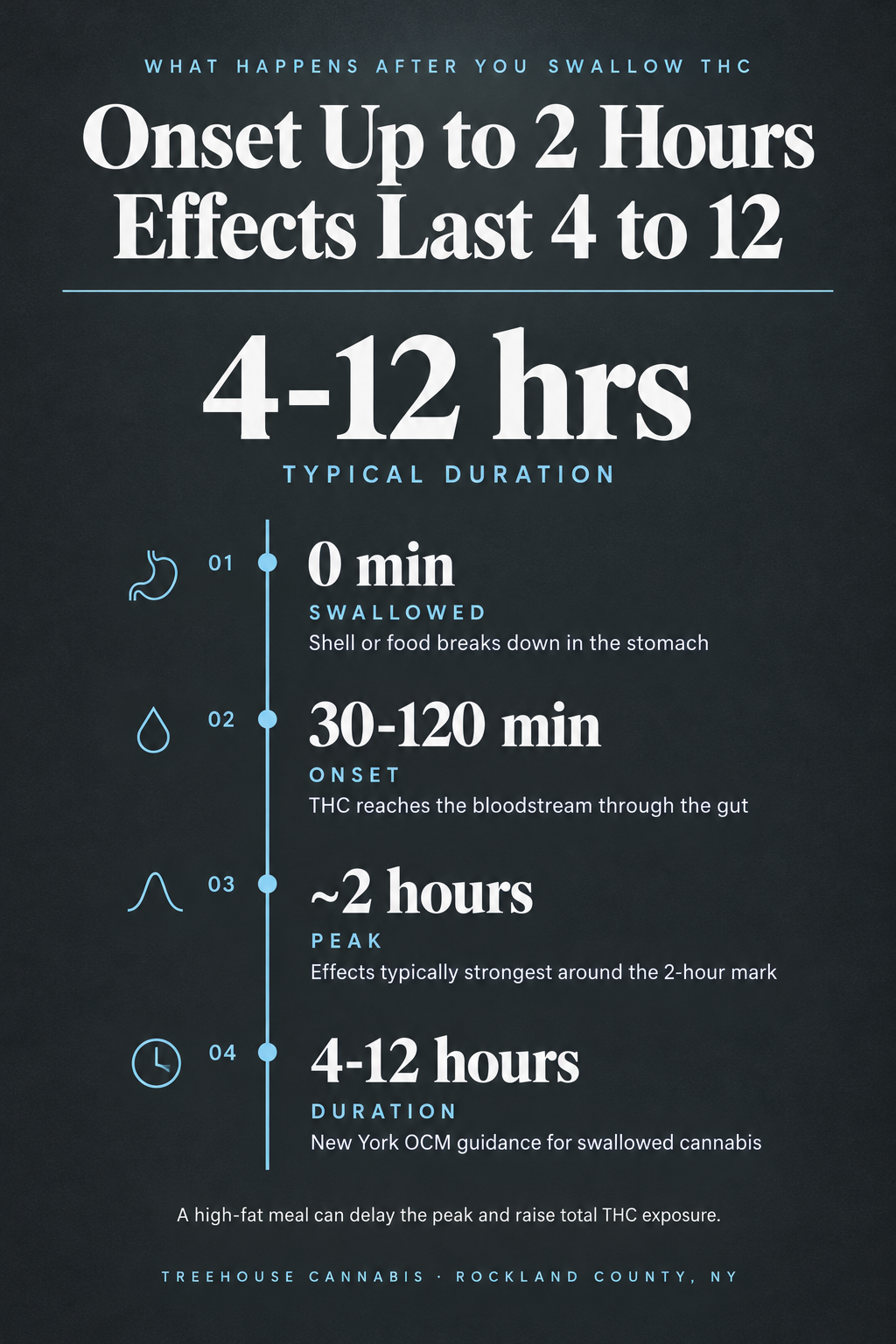
Plan on 30 minutes to 2 hours before a cannabis capsule starts working, with peak effects often landing around the 2-hour mark. The full window typically runs 4 to 12 hours. That range comes directly from New York's Office of Cannabis Management consumer guidance, which groups capsules with food products and lists onset of up to 2 or more hours and duration of 4 to 12 hours. [4]
Why such a wide window? Oral THC is simply less efficient than inhaled THC. Roughly 4% to 12% of an ingested dose reaches the bloodstream, compared with 10% to 35% when inhaled. When absorption is that variable, the timeline stretches. [2]
Food makes it stretch further. In a human trial of 5 mg and 10 mg oral THC capsules, a high-fat meal eaten before dosing delayed the time to peak and raised total THC exposure roughly 2- to 3-fold. Peak concentration itself did not change. The exposure went up, but the ceiling did not. [1]
- Onset typically lands between 30 minutes and 2 hours, with the peak often near 2 hours
- Duration is listed by New York OCM at 4 to 12 hours
- Oral bioavailability runs 4% to 12%, versus 10% to 35% inhaled, which widens the variability
- A high-fat meal delayed time to peak and increased total exposure about 2- to 3-fold in a human capsule trial
- Wait a full two hours before taking more
The two-hour rule is the one that matters most in practice. If a capsule has not done anything after 45 minutes, the correct move is to wait, not to swallow a second one. We wrote a longer explanation of that timing in How Long Should You Wait Before Taking More Cannabis?.
One more thing worth separating: capsules are not a different drug from other oral formats, and they are not a different drug from the cannabinoids you may have read about elsewhere. If you are comparing specific cannabinoids rather than delivery formats, CBG vs CBD: How the Cannabinoids Compare covers how CBG and CBD differ from THC.
Are Cannabis Capsules Stronger Than Edibles?
No, not inherently. Milligram for milligram, a capsule carrying 10 mg of THC and a gummy carrying 10 mg of THC are handled the same way once they are swallowed. Same gut, same liver, same conversion. There is no mechanism by which the shell makes the dose larger.
What actually changes the experience is more ordinary:
- Total dose, meaning how many milligrams you actually took
- Whether you ate beforehand, and how much fat was in that meal
- Your tolerance and your history with oral cannabis
- How precisely you measured the amount, which is where format starts to matter
The liver piece is what makes swallowed cannabis feel qualitatively different from smoked or vaped cannabis at all. Oral THC undergoes substantial first-pass metabolism in the liver, producing far more 11-hydroxy-THC than inhalation does. In the capsule trial, the ratio of 11-OH-THC to THC ran about 0.5:1 to 1:1 after oral dosing, versus roughly 1:20 after inhalation. That is not a small difference in metabolite exposure. [1] [7]
So capsules are not stronger. They are harder to accidentally double. A capsule shell cannot be halved cleanly, which means the dose you take is the dose on the label. A gummy can be cut, which is either an advantage or a hazard depending on whether you cut it before you eat it.
How Do Cannabis Capsules and Edibles Compare Side by Side?
Here is the comparison that answers most of the practical questions.
| Factor | Capsules | Edibles |
|---|---|---|
| How it is taken | Swallowed whole | Eaten or drunk |
| Dose control | Fixed milligram count per capsule, printed on the label | Often scored or cuttable, but cutting is imprecise |
| Added ingredients | None to minimal; no meaningful sugar, calories, or gluten | Sugar, calories, flavoring, and possible allergens |
| Typical onset | 30 minutes to 2 hours | 30 minutes to 2 hours |
| Typical duration | 4 to 12 hours | 4 to 12 hours |
| Taste and smell | Essentially none | The whole point of the product |
| Discretion | Quiet and portable | Requires eating in front of people |
| New York serving cap | 10 mg total THC | 10 mg total THC |
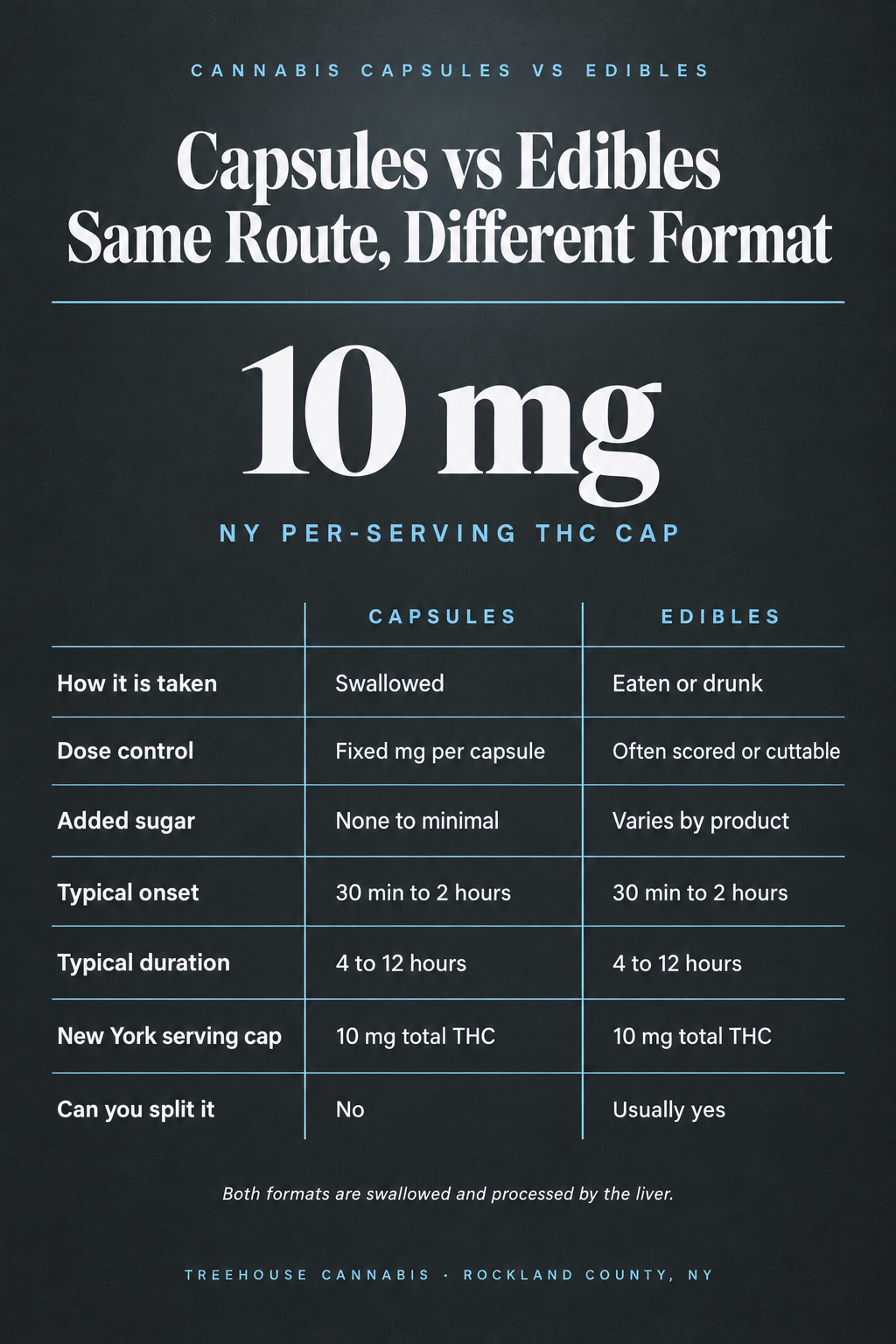
The rows that actually change your decision:
- Dose control: a fixed capsule versus a piece you can often cut
- Ingredients: none versus sugar, calories, and possible allergens
- Onset and duration: effectively the same, because both are swallowed
- Taste and discretion: tasteless versus a flavored product
- Labeling: New York requires per-serving and per-package THC disclosure on both
Walk the rows and the tradeoffs become clear. On dose control, a capsule gives you a number and nothing to argue with. An edible gives you flexibility, but only as good as your knife work. A 10 mg gummy cut into quarters is 2.5 mg only if the piece was evenly dosed to begin with, and scored products are more reliable than freehand cuts.
On ingredients, capsules win by default if you are watching sugar or avoiding gluten. A gummy or a chocolate bar is a confection with cannabis in it, and it carries the sugar and calories that implies. [5]
On taste and discretion, the formats are opposites. A capsule is tasteless and takes three seconds. An edible is a snack, which is exactly why some people prefer it and exactly why others would rather not.
On labeling, New York does not leave you guessing with either format. A single serving of an edible or orally ingested product is capped at 10 mg total THC. The label must state milligrams of total THC per serving and per package, the number of servings, and the recommended serving size. [3]
If you want to browse what the two formats actually look like on a licensed menu, the Edibles collection covers gummies, chocolates, drinks, and capsules together because New York sells them as one category.
Why Do Edibles Sometimes Feel Stronger Than Capsules at the Same Dose?
Two mechanisms explain it, and neither one involves edibles containing a stronger drug.
The first is the food matrix. An edible is eaten as a whole piece, and the fat and calories travelling with it change absorption. That is the same effect measured in the capsule trial, where a high-fat meal before dosing raised total THC exposure roughly 2- to 3-fold and delayed the peak. [1] A chocolate bar brings its own fat to the party. A capsule does not.
The second is portion reality. A 10 mg gummy is one bite and it tastes like candy. A 10 mg capsule is a capsule. People eat the whole edible without a second thought, and the dose arrives all at once because it always was all at once.
Then there is the liver, which nobody thinks about until the difference shows up. Swallowed THC is converted to 11-hydroxy-THC at levels far above what inhalation produces, and that metabolite crosses into the brain more readily. That is why eaten cannabis can feel like a different experience, not merely a slower one. [7]
- Fat and calories in a food matrix change absorption speed and total exposure
- A whole gummy is easy to eat entire; a capsule is a defined unit
- The liver converts swallowed THC into high levels of 11-hydroxy-THC
- Perceived strength is absorption plus behavior, not a different drug
If you want the capsule and tablet side of the menu specifically, they sit in their own Capsules Tablets Edibles view, which makes it easier to compare milligram counts across brands without scrolling past the candy.
The practical takeaway: if a 10 mg edible hit harder than a 10 mg capsule did, the difference was probably the meal, the timing, or the fact that you ate the whole thing. Not the format.
Which Format Should You Choose, Capsules or Edibles?
Capsules suit a specific kind of consumer, and so do edibles. Here is where each one earns its place.
Choose capsules if you want:
- A fixed milligram dose you do not have to measure
- No sugar, no calories, and no cannabis taste
- Something quiet you can carry in a pocket
- A unit that is hard to accidentally double
Choose edibles if you want:
- A serving you can physically divide, like a quarter of a 10 mg piece
- A familiar food format instead of a pill
- A slower, longer experience you can pace through an evening
- Flavor, because the flavor is the product
For a first purchase, either format works as long as the rule holds: start low and wait two hours. Capsules remove the measurement guesswork. Edibles remove the "I cannot take a smaller amount" problem. Pick the failure mode you would rather avoid.
Lemon Lime Squeeze Beverage Infusion | 100mg
One safety note that applies to both formats and gets skipped too often. Edible-format cannabis products and capsules look like candy or medicine, and children and pets do not distinguish between the two. Cannabis-related poisoning visits among young children rose after legalization, with edibles identified as a specific and growing concern. [8] Store everything locked, up high, and out of sight.
If concentrates are also on your list, the Sugar Concentrates category is a different route entirely and worth reading before you assume the same timing applies.
And if a beverage sounds like the right entry point, the Lemon Lime Squeeze Beverage Infusion | 100mg runs 100 mg per package, which is ten servings at the New York cap. That math is exactly why the label matters more than the package size.
What Do New York Rules Require for Capsules and Edibles?
New York regulates orally ingested cannabis products with a short list of hard requirements, and they apply to capsules the same way they apply to gummies. [4]
- No single serving may exceed 10 mg of total THC
- The principal display panel must state milligrams of total THC per serving
- The panel must state milligrams of total THC per package
- The label must state the number of servings and the recommended serving size
- Products are sold in child-resistant packaging through licensed dispensaries only
- Purchase is limited to adults 21 and older
That first rule is the one that shapes everything else. A 100 mg package is not a 100 mg serving. It is a package with ten 10 mg servings inside it, and the label is required to say so. [3]
For shoppers in Rockland, Orange, and Westchester Counties, the label is also the fastest way to confirm what a package actually contains before you buy it. Milligrams per serving, milligrams per package, number of servings. Three numbers, and they answer more than any budtender conversation will.
The rest of New York's possession limits sit outside the package itself. How Much Cannabis Can You Legally Possess in New York? covers how much cannabis an adult can legally carry, which is a separate question from how much THC is in a single serving.
What Is the Bottom Line on Cannabis Capsules vs Edibles?
Cannabis capsules and edibles are the same route with different packaging. Both are swallowed, both are processed by the liver, both take 30 minutes to 2 hours to start, and both last 4 to 12 hours.
- Same route, same onset window, same 4 to 12 hour duration
- Capsules: a fixed milligram count, no sugar, no cannabis taste, pocket-sized
- Edibles: a portion you can often divide, plus flavor and a familiar food format
- Either way: start low, wait two hours, read the label, keep it locked up
If a 10 mg edible hit harder than a 10 mg capsule, the meal, the timing, or the whole-piece portion explains it. Not the format.
Pick capsules for precision and no sugar. Pick edibles for flexibility and flavor.
Frequently Asked Questions
- What is the main difference between cannabis capsules and edibles?
- How long do cannabis capsules take to kick in?
- Are cannabis capsules stronger than edibles?
- Can you split a cannabis capsule in half?
- Why do edibles sometimes feel stronger than capsules at the same milligram?
- Do cannabis capsules count as edibles under New York rules?
- Do cannabis capsules contain sugar or calories?
- Which is better for a first-time consumer, capsules or edibles?
What is the main difference between cannabis capsules and edibles?
Both are swallowed and processed by the liver, so onset and duration are similar. The difference is format. Capsules deliver a fixed milligram dose in a shell with no sugar, flavoring, or food ingredients. Edibles deliver the same cannabinoids inside a gummy, chocolate, baked good, or drink, which means added sugar, calories, and a portion you may need to cut.
How long do cannabis capsules take to kick in?
Plan on 30 minutes to 2 hours, with peak effects often around 2 hours. New York's Office of Cannabis Management groups capsules with food products and lists onset of up to 2 or more hours and duration of 4 to 12 hours. Eating a high-fat meal beforehand can delay the peak further and increase total absorption.
Are cannabis capsules stronger than edibles?
Not inherently. Milligram for milligram, a capsule and a gummy delivering 10 mg of THC are handled the same way by your body. What changes the experience is total dose, whether you ate beforehand, your tolerance, and how precisely you can measure the amount you took. Capsules are simply harder to accidentally double.
Can you split a cannabis capsule in half?
No. A capsule is a sealed shell holding oil or powder, so cutting it spills the contents and gives you an unreliable dose. If you want a smaller serving, buy a lower-milligram capsule. Edibles are the format you can usually score or cut, which is why many people start with a gummy they can divide.
Why do edibles sometimes feel stronger than capsules at the same milligram?
Two reasons. Edibles often come as a whole piece that is easy to eat entirely, and the food matrix affects absorption speed. Swallowed THC is also converted by the liver into 11-hydroxy-THC, a compound that reaches far higher levels after oral dosing than after inhalation, which is why eaten cannabis can feel different from what you expect.
Do cannabis capsules count as edibles under New York rules?
New York treats capsules as an orally ingested cannabis product. That means they are sold through licensed dispensaries with child-resistant packaging and labels stating total THC per serving and per package, and no single serving may exceed 10 mg of total THC. Only adults 21 and older may buy them.
Do cannabis capsules contain sugar or calories?
Generally no. A capsule is a shell around cannabis oil or extract, so it carries no meaningful sugar, calories, or gluten the way a gummy, chocolate, or baked edible does. Consumers who are managing sugar intake, or who dislike the taste of cannabis, often prefer capsules for exactly that reason.
Which is better for a first-time consumer, capsules or edibles?
Either works if you start low and wait. Capsules remove guesswork because the milligram dose is fixed and printed on the label. Edibles let you physically divide a serving, which helps if you want 2.5 mg from a 10 mg piece. In both cases, wait at least two hours before taking more.
Sources
- Cannabis and Cannabinoid Research (National Library of Medicine / PMC) — In a human trial of 5 mg and 10 mg oral THC capsules, a high-fat meal before dos
- The Permanente Journal (Chayasirisobhon, via PMC) — Absorption and metabolism depend on route: inhaled THC reaches the bloodstream w
- New York State Office of Cannabis Management — New York caps any single serving of an edible or orally ingested cannabis produc
- New York State Office of Cannabis Management — OCM consumer guidance groups food products and capsules/tablets together as prod
- Leafly — A cannabis capsule is an ingestible form, usually oil, sealed in a swallowable s
- Leafly — Cannabis capsules are pills you swallow, filled with cannabis oil or powdered ex
- Journal of Analytical Toxicology (Schwilke et al., via PMC) — Oral THC undergoes substantial first-pass metabolism in the liver, producing gre
- BMC Public Health (via PMC) — Cannabis-related poisoning visits among young children rose after legalization,
About Treehouse Cannabis
Treehouse Cannabis is an adult-use dispensary serving Rockland, Orange, and Westchester Counties in New York. The menu carries capsules, tablets, gummies, chocolates, and beverage infusions side by side, with total THC printed per serving on every label, and staff will talk through format, portion, and timing without a lecture attached.
This article is for adults 21 and older in New York State. This content is educational and informational only and is not medical advice. Cannabis affects people differently, and oral products can take up to two hours to take effect. Do not drive or operate machinery while impaired, keep all cannabis products locked away from children and pets, and consult a licensed clinician if you have questions about how cannabis interacts with your health or medications.

Shop our products

Shop All

Deals

Flower
Pre-rolls
Vaporizers

Edibles
Drinks

Concentrates
Tinctures

Topicals

CBD

Pet CBD
Accessories