What “Full-Spectrum” Means on a Cannabis Label
What “Full-Spectrum” Means on a Cannabis Label
The full spectrum cannabis meaning is narrow: the producer is claiming the extract kept the plant's wider chemistry, including minor cannabinoids, terpenes, and usually some THC, rather than isolating one purified compound. That is a statement about extraction intent, not a measured grade, and no regulator scores how full a spectrum actually is.
Two packages can carry identical wording and hold very different chemistry inside. One may list six cannabinoids and a full terpene breakdown on its certificate of analysis. The other may list two cannabinoids and nothing else. The front of both packages says full spectrum, because nothing stops it.
This guide separates what the phrase promises from what the label can prove. It covers how the term is used, what New York and federal rules do and do not require, how full spectrum differs from broad spectrum and distillate, and how to check a specific batch rather than trusting an adjective.
What Does “Full-Spectrum” Mean on a Cannabis Label?
In practical terms, full spectrum means the extract retains a wide slice of the plant rather than a single compound, so the chemistry on the panel should be broader than an isolate's.
That is the whole claim. It describes how the material was handled, not how strong it is, how clean it is, or what it will feel like.
A producer using the term is generally implying three things:
- Minor cannabinoids such as CBG, CBN, CBC, and THCV are still present rather than stripped out
- Terpenes are retained, since they are volatile and easy to lose during refinement
- Some THC remains, which is what separates full spectrum from broad spectrum in most usage
None of those three is a regulated threshold. No state agency, testing lab, or trade body scores a product on how complete its chemistry is, and there is no pass or fail. A jar can carry trace terpenes and still print the words.
The practical consequence is that the same two words appear on a $20 tincture and a $70 rosin jar with nothing on the front distinguishing them. Price is not a reliable proxy either, since it tracks input material and process yield as much as anything else on the package.
The industry's own vocabulary is not settled. The American Herbal Products Association publishes separate definitions for full spectrum extract and full spectrum hemp extract, and its lexicon notes that the hemp-industry usage conflicts with the established botanical definition of the term [4]. When the trade association's glossary splits a phrase in two and flags the split, shoppers should expect the shelf to be inconsistent.
That ambiguity is not a loophole anyone is exploiting quietly. Processors and Canadian regulators have both acknowledged there is no regulatory definition and no scientific test that verifies the claim [5]. New York's labeling rules, meanwhile, require potency figures without ever defining spectrum wording [1]. If you want the arithmetic behind those potency figures first, What Does “Total THC” Mean on a Cannabis Label? walks through how total THC is calculated and why it differs from the THC number people expect.
Brownie Points | Tier 1 Live Rosin Concentrate | 4g
Is “Full-Spectrum” a Regulated Term on a Cannabis Label?
No. Neither New York's adult-use rules nor federal law defines full spectrum, so the phrase carries no legal standard a producer has to meet. What is regulated is the numbers, not the adjective.
New York's Part 128 packaging and labeling rules require total THC and total CBD on the principal display panel, a scannable bar code or QR code linked to a downloadable certificate of analysis, and a terpene profile only when terpenes are marketed [1]. The regulation defines how those totals are calculated but never defines full spectrum [2].
Federal law sets a different kind of boundary. Hemp is defined as cannabis, including its extracts and cannabinoids, with a total delta-9 THC concentration of not more than 0.3 percent on a dry weight basis [3]. That ceiling governs hemp-derived CBD products and has nothing to say about spectrum claims.
So the same phrase lands differently depending on where you bought it:
- In a licensed New York dispensary, full spectrum sits beside mandatory potency figures and a batch-level lab report
- In a hemp-derived CBD shop, the same words sit under a 0.3 percent delta-9 THC ceiling and a different testing regime
- In neither setting does any rule define what "full" is supposed to mean
There is also no test that could settle it. Health Canada and processors alike have said the claim cannot be verified scientifically, which is why it means whatever the producer intends [5].
That is worth knowing before you treat the term as a specification, and it is why comparison shopping across product types helps. A guide like Cannabis Holiday Gifts 2026: The Complete Buyer's Guide is a more useful starting point than a front-of-pack word.
The same confusion shows up in cannabinoid basics, where CBD vs THC: The Science Behind the Two Most-Discussed Cannabinoids covers how THC and CBD actually differ rather than how they are marketed.
The rule to take away: read the panel for the numbers, read the certificate for the chemistry, and treat the spectrum wording as a description of intent that you then check.
Full-Spectrum vs. Broad-Spectrum vs. Distillate: What Is the Difference?
All three describe how far a producer pushed separation during extraction. Full spectrum keeps the widest chemistry, including THC. Broad spectrum also keeps wide chemistry but removes or reduces THC. Distillate isolates a single cannabinoid at high purity.
| Full spectrum | Broad spectrum | Distillate | |
|---|---|---|---|
| Cannabinoid range | Several cannabinoids, minor ones included | Several cannabinoids, THC removed | One cannabinoid, typically 85-95 percent |
| Terpenes retained | Usually yes | Partially, often reduced | Usually stripped, sometimes re-added |
| THC status | Some THC present | Non-detectable or trace | Isolated target compound only |
| Typical use | Extracts and tinctures aiming at whole-plant chemistry | Products for people avoiding THC | Vape carts and precision dosing |
The short version, if you are reading a menu rather than a lab report:
- Full spectrum: THC appears on the potency panel, alongside minor cannabinoids and terpenes
- Broad spectrum: the wide profile is there, but THC reads as non-detectable or trace
- Distillate: one dominant cannabinoid and very little else on the panel
- The useful follow-up: ask which compounds are listed, at what quantity, on which batch
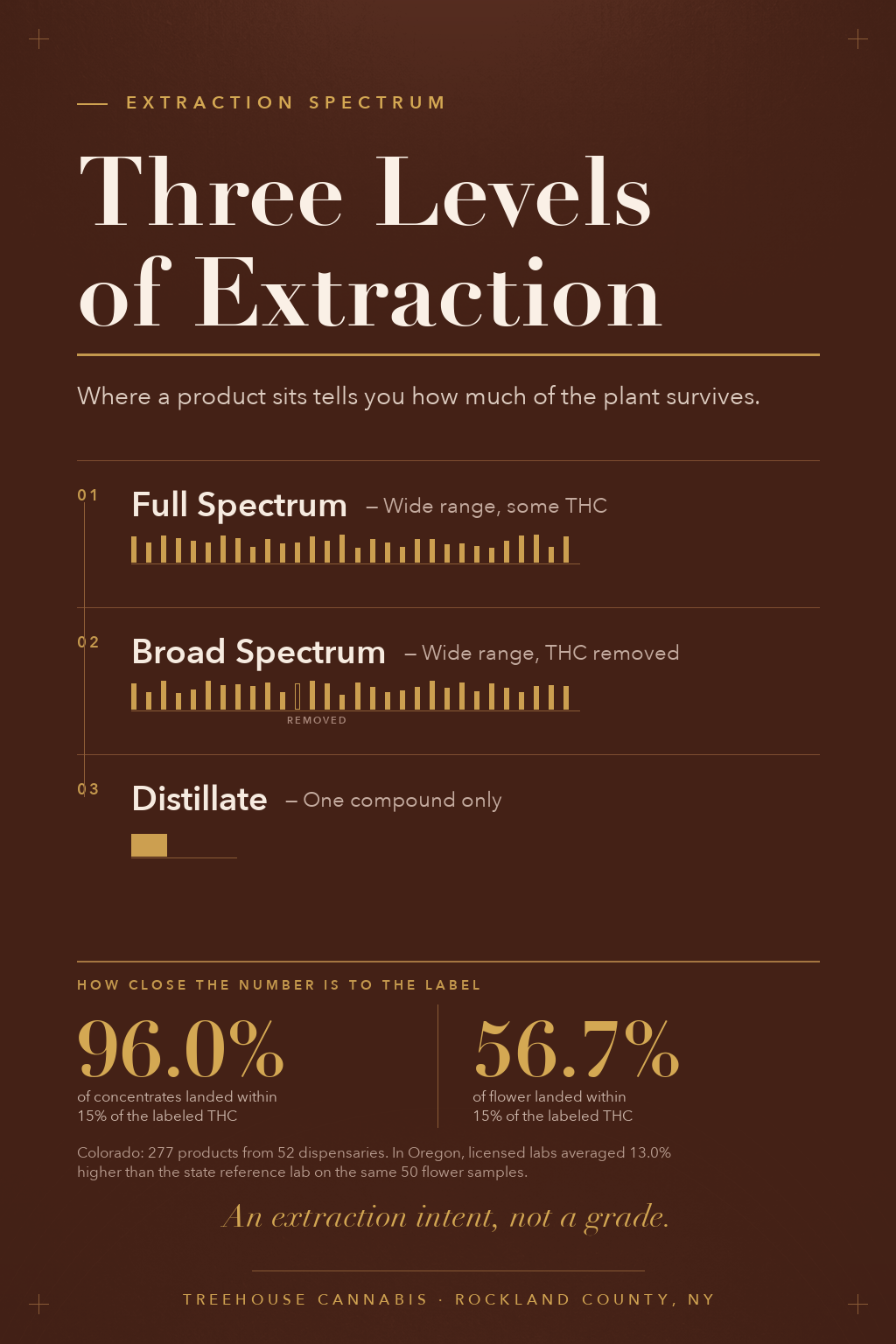
The mechanical detail that matters most: removing THC is itself a separation step. Producers typically use chromatography or distillation, and those processes do not politely take only THC. They carry other volatile compounds with them. That is why broad spectrum is usually a little less chemically complex than a true full spectrum extract, even though both are marketed as wide-range products.
Distillate is the easiest of the three to verify. A single dominant cannabinoid is simple to confirm on a lab panel, and the number either matches the label or it does not. Full spectrum is the hardest to verify, because "wide" has no threshold.
These are three descriptions of process, not three quality tiers. A producer can reasonably draw the lines wherever they like, since no one defines them [4]. Whether a broad spectrum product is a downgrade depends entirely on whether you wanted THC in the first place.
It is also worth resisting the instinct to sort extracts into good and bad. Strain classification invites the same mistake — The Real Deal About Cannabis: Breaking Down Indicas, Sativas, and Everything in Between covers why indica, sativa, and hybrid labels are looser categories than they appear. The entourage hypothesis behind much full spectrum marketing remains a hypothesis rather than an established finding [6], and the science on terpenes is genuinely mixed.
Rose' Runtz | Disposable Vape | 2g
What Do Cannabis Extract Labels Have to Show You?
The regulated fields are the practical answer to a vague adjective. Those fields are testable, comparable across products, and tied to a specific batch, which makes them far more useful than the word at the top of the package.
Start with total THC. New York defines it as THC plus THCA multiplied by 0.877, and total CBD the same way using CBDA [2]. The conversion exists because raw cannabis carries THCA, which becomes THC when heated. A label reporting only THC understates what the material delivers, which is why the 0.877 factor appears in the formula rather than a raw sum.
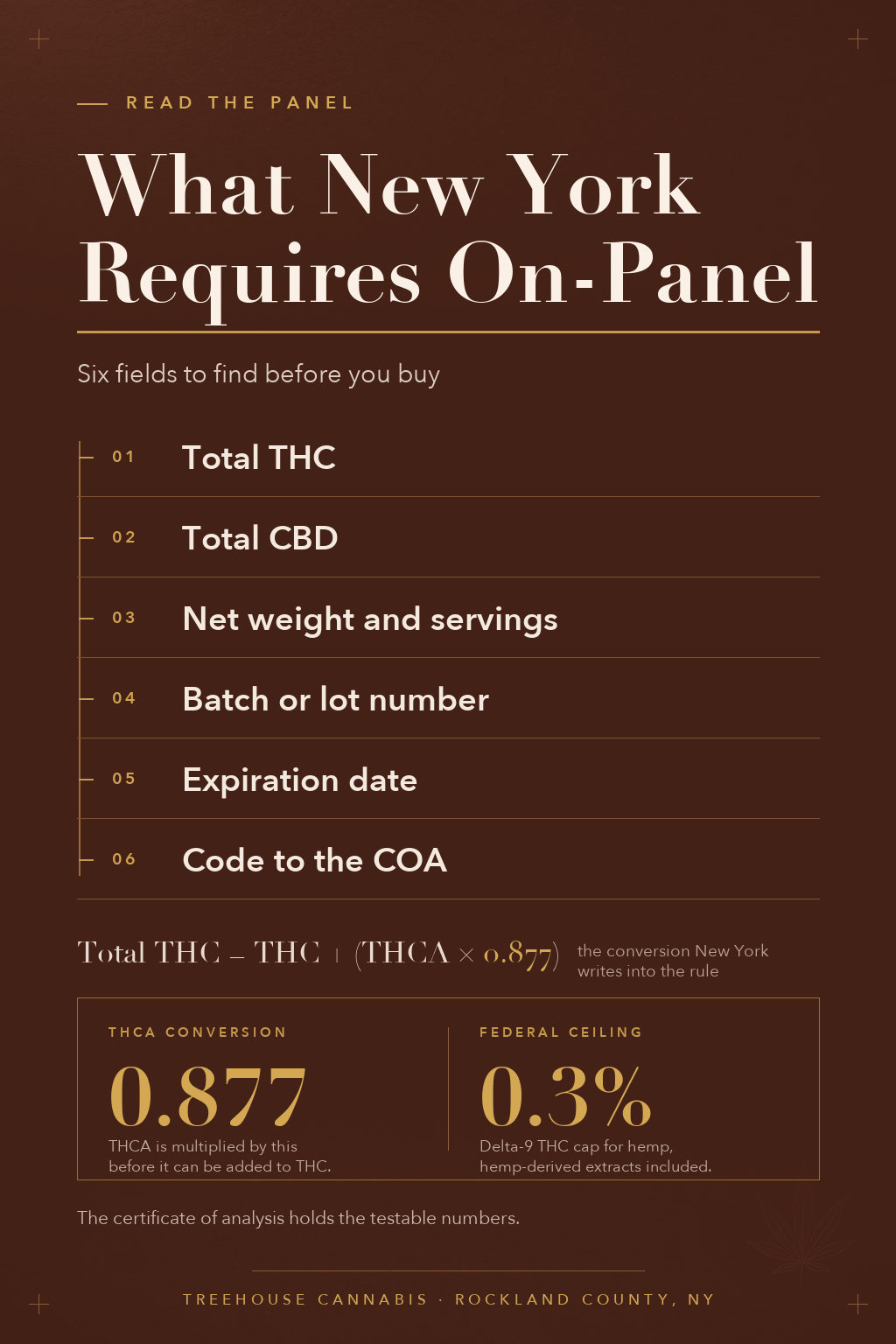
The fields worth finding, in order:
- Total THC in milligrams per serving and per package, calculated with the THCA conversion
- Total CBD on the same panel, calculated the same way from CBDA
- Serving count, without which a per-package total tells you very little
- Batch or lot number, which ties the package to one specific test result
- Expiration date, since cannabinoid and terpene content drift over time
- The scannable code that resolves to the certificate of analysis
New York requires that scannable code and a downloadable certificate, and requires a terpene profile only when terpenes are marketed [1]. California's licensed labs test every commercial batch for cannabinoids and terpenes and report the results on a certificate of analysis, which is what makes the COA the verifiable record of what is actually in the product [12].
The per-serving versus per-package distinction deserves attention. A package total of 100 milligrams tells you nothing until you know whether it holds two servings or twenty. A tincture and an edible can carry identical package totals and behave very differently per use.
These fields apply across product types. A jar of Whole Flower Flower carries the same potency and batch obligations as a refined extract, and the same reading habits transfer. When terpenes are named on the package, look for the profile — if a producer markets terpenes and the certificate has no terpene section, that is a gap worth noticing.
Nothing on that list describes full spectrum. That is the point: the regulated fields tell you what is in the product, and the spectrum word tells you what the producer says about how it was made.
How Do You Verify a Full-Spectrum Claim?
Pull the certificate of analysis for that exact batch, then read it. That is the whole procedure, and it takes about two minutes once you know what to look for.
Step one is finding the batch. Scan the code on the package, or search the lot number on the producer's site, and open the certificate for that specific lot rather than a generic product page. Batches vary, and a certificate from a different run proves nothing about the package in your hand. New York requires the label to link to that document, and licensed labs produce it for cannabinoids and terpenes [2] [12].
Step two is counting cannabinoids on the panel. A genuine wide-spectrum extract lists several: THC and THCA, CBD and CBDA, and often CBG, CBN, CBC, or THCV at lower levels. A panel with one dominant number and everything else non-detectable is not describing a broad extraction, whatever the front of the package says.
Step three is looking for a terpene breakdown. If the package names terpenes or markets a flavor, the certificate should quantify them. Their absence is informative.
Then calibrate your trust using the accuracy data, because testing is not perfect and the numbers deserve context rather than cynicism:
- Across 277 products bought from 52 Colorado dispensaries, 96.0 percent of concentrates fell within plus or minus 15 percent of labeled THC, against only 56.7 percent of flower [10]
- Observed THC ran lower than labeled in both categories, meaning the label was optimistic more often than conservative
- On the same 50 flower samples, Oregon-licensed third-party lab results averaged 13.0 percent higher than the state reference lab, about 2.4 percentage points of total THC, with 72 percent of results running high [11]
The takeaway is that concentrates track their labels reasonably well and flower does not, which is a measurement-spread problem rather than a fraud story. Neither study examined spectrum claims; they looked at potency accuracy generally. A certificate also cannot prove an entourage effect, only what compounds are present and in what quantity.
Concentrates are where the certificate does the most work, since a refined product's whole value proposition is its chemistry. Concentrates is where those panels matter most, and it is the category where reading the COA pays off fastest.
High Dose "UP" | Tincture | 1000MG
Full-Spectrum THC: Stronger, or Just Different?
In THC terms, full spectrum is usually the weaker option, because distillate concentrates a single cannabinoid while a full spectrum extract spreads its mass across many compounds.
Distillate typically runs 85-95 percent of one cannabinoid. If the goal were maximum THC per gram, full spectrum would not be the pick.
What people describe as a fuller or different experience is the entourage hypothesis — the idea that cannabinoids and terpenes interact to produce effects greater than any single compound alone. It remains a hypothesis. Advocates point to anecdotal and real-world reports; critics call the term unfounded and largely a marketing device [6].
The evidence runs in both directions, and it is worth seeing the split:
- A receptor-level study found five common cannabis terpenes showed no interaction with THC, CBD, or the endocannabinoid 2-AG at CB1 or CB2, apart from a weak beta-caryophyllene signal at CB2 [7]
- In mouse and cell experiments, alpha-humulene, geraniol, linalool, and beta-pinene produced cannabinoid-like effects and were selectively additive with a cannabinoid agonist [8]
- A PRISMA systematic review concluded that terpenes may influence cannabis effects but that synergistic enhancement remains unproven and needs clinical trials [9]
Read together, those results say the mechanism is not settled. Terpenes may act through pathways other than direct receptor binding, which is why the receptor study does not close the question. It also does not open it very far: mouse and cell models are not human outcomes, and a 2024 review calling for clinical trials is a statement about the state of the evidence, not a finding in either direction.
The practical read is to choose by chemistry and by the numbers on the panel rather than by the promise in the adjective. A full spectrum extract is a reasonable choice if you want a wide cannabinoid and terpene profile and are comfortable with THC. Distillate is a reasonable choice if you want a precise, high-potency single cannabinoid. Something like RSO F.E.C.O Syringe | 1g sits at the wide end of that range, and its certificate is where the actual composition lives.
Full spectrum is not safer, not more medicinal, and not a way to use less. It is a description of how much of the plant survived the process, and the label's real information is in the milligrams.
What Should You Check Before You Buy a Cannabis Extract?
Five label checks settle almost everything the package can actually tell you, and the spectrum adjective carries no weight once you have run them.
- Read total THC in milligrams per serving, then per package, and confirm the serving count beside it
- Read total CBD the same way, remembering it is calculated from CBDA
- Find the batch or lot number, so the certificate matches the package in your hand
- Scan the code and open the certificate for that lot, then count the cannabinoids it lists
- Look for a terpene breakdown whenever terpenes are named on the package
That habit works whether you are shopping for a concentrate, a tincture, or flower, and it works in a dispensary and in a hemp shop. The adjective is the least reliable thing on the package and the easiest to check around.
Bring the package to Treehouse Cannabis in Rockland County and the team will walk you through the total THC panel, the serving count, and the batch certificate of analysis before you pick a concentrate or tincture. Label reading gets much easier once someone shows you the six fields in person.
Frequently Asked Questions
- What does full spectrum mean on a cannabis label?
- Is full spectrum a regulated term?
- Does full spectrum mean the product contains THC?
- What is the difference between full spectrum and broad spectrum?
- Is full spectrum stronger than distillate?
- How can I check whether a full spectrum claim is accurate?
- What else should I read on the label besides the spectrum wording?
What does full spectrum mean on a cannabis label?
It means the producer claims the extract kept the plant's wider chemistry, including minor cannabinoids, terpenes, and usually some THC, rather than a single purified compound. Full spectrum describes an extraction intent, not a measurable grade. Two products with the same words on the front can have very different chemical profiles inside.
Is full spectrum a regulated term?
No. Neither federal law nor New York's adult-use labeling rules define full spectrum, and Health Canada has said there is no scientific test that verifies the claim. The American Herbal Products Association publishes definitions, but they are voluntary guidance, so the term means whatever the producer intends it to mean.
Does full spectrum mean the product contains THC?
Usually yes, but the amount varies enormously. Dispensary extracts can carry meaningful THC, while hemp-derived full spectrum CBD products are capped at 0.3% total delta-9 THC on a dry weight basis. Read the milligram or percentage panel instead of assuming the spectrum label settles it.
What is the difference between full spectrum and broad spectrum?
Broad spectrum generally means the same wide profile with THC removed or reduced to non-detectable levels. In practice the THC-removal step, often chromatography or distillation, strips some other compounds too, so broad spectrum is usually a little less chemically complex than a true full spectrum extract.
Is full spectrum stronger than distillate?
Not in THC terms. Distillate typically runs 85% to 95% of a single cannabinoid, while full spectrum extracts usually carry less of the target cannabinoid and more of everything else. What people describe as a fuller or different effect is the entourage hypothesis, which researchers have not confirmed in humans.
How can I check whether a full spectrum claim is accurate?
Pull the certificate of analysis for that batch. In New York the label must carry a scannable code linked to the COA, which lists cannabinoid potency and, where marketed, terpene content. A real full spectrum panel shows several cannabinoids and a terpene breakdown, not one number and a flavor note.
What else should I read on the label besides the spectrum wording?
Total THC in milligrams per serving and per package, total CBD, the serving count, the terpene profile if terpenes are marketed, the batch or lot number, and the expiration date. Those fields are regulated and testable, which makes them far more useful than the marketing adjective at the top of the package.
Sources
- New York State Office of Cannabis Management — New York's adult-use labeling rules require total THC and total CBD on the princ
- New York State Office of Cannabis Management — The regulation defines total THC as THC plus THCA multiplied by 0.877 and total
- U.S. Government Publishing Office (Electronic Code of Federal Regulations) — Federal law defines hemp as cannabis, including its extracts and cannabinoids, w
- American Herbal Products Association — The industry's own lexicon gives "full spectrum extract" and "full spectrum hemp
- StratCann — Cannabis processors and Health Canada both acknowledge there is no regulatory de
- Biomedicines (Christensen et al., National Library of Medicine) — The entourage effect remains a hypothesis: advocates point to anecdotal and real
- Frontiers in Pharmacology (Finlay et al., National Library of Medicine) — Five common cannabis terpenes showed no receptor-level interaction with THC, CBD
- Scientific Reports (LaVigne et al., National Library of Medicine) — In mouse and cell experiments, alpha-humulene, geraniol, linalool, and beta-pine
- Pharmaceuticals (André et al., National Library of Medicine) — A PRISMA systematic review found exploratory evidence that terpenes may influenc
- Scientific Reports (Giordano et al.) — Of 277 products bought from 52 Colorado dispensaries, 96.0% of concentrates but
- Oregon Liquor and Cannabis Commission — On the same 50 flower samples, OLCC-licensed third-party lab results averaged 13
- California Department of Cannabis Control — Licensed labs test every commercial cannabis batch for cannabinoids and terpenes
About Treehouse Cannabis
Treehouse Cannabis is an adult-use dispensary serving Rockland, Orange, and Westchester Counties in New York. The menu carries concentrates, tinctures, and vapes with total THC printed per serving and a batch certificate behind a scannable code, and the team will read the panel with you before you buy.
This article is for adults 21 and older in New York State. This content is educational and informational only and is not medical advice. Cannabis affects people differently. Do not drive or operate machinery while impaired, keep all cannabis products locked away from children and pets, and consult a licensed clinician if you have questions about how cannabis interacts with your health or medications.

Shop our products

Shop All

Deals

Flower

Pre-rolls
Vaporizers

Edibles
Drinks

Concentrates
Tinctures

Topicals
CBD

Pet CBD

Accessories