
CBN vs CBD: What Is the Difference?
CBN vs CBD: What Is the Difference?
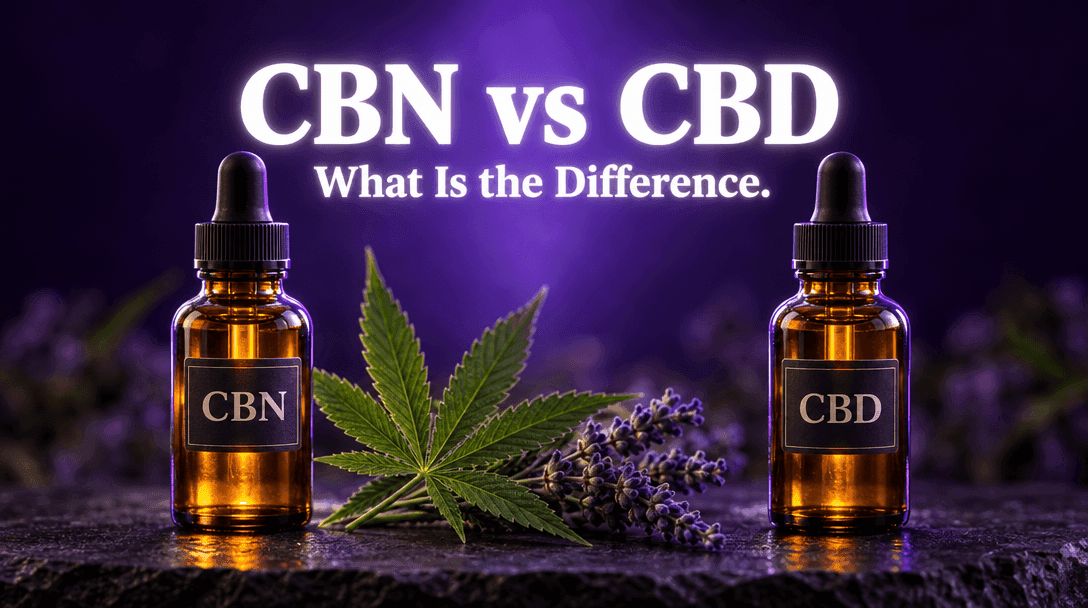
CBN vs CBD comes down to three clean differences: origin, psychoactivity, and evidence depth. CBD is produced directly by the plant from CBDA, is non-intoxicating at any dose, and has decades of clinical research behind it including an FDA-approved drug. CBN forms only when THC degrades over time, is mildly psychoactive at higher doses, and has a much smaller evidence base centered on sleep.
What Are CBN and CBD, and How Are They Different?
CBN and CBD are both cannabinoids — naturally occurring compounds found in cannabis — but they originate through different chemical paths and act on the body through different receptor pathways. The practical takeaway is that the two are not interchangeable, even when a product lists them on the same panel.
CBN and CBD at a glance:
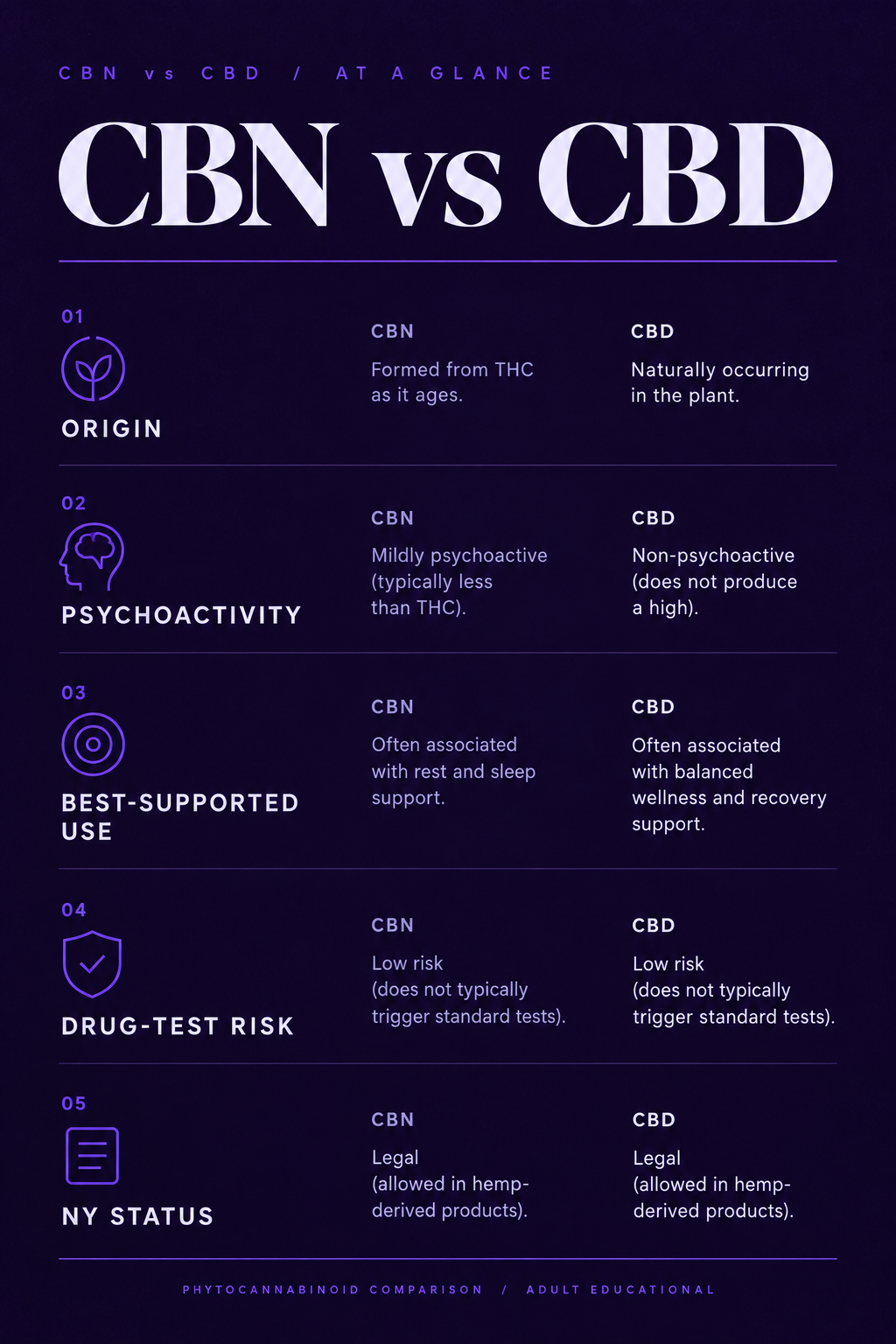
- Origin: CBD is produced directly from CBDA in hemp and cannabis plants. CBN is not produced by the living plant in meaningful amounts; it forms when THC degrades after harvest.
- Psychoactivity: CBD is non-intoxicating at any dose. CBN is mildly psychoactive only at higher doses.
- Best-supported use: CBD has human evidence for anxiety, inflammation, and seizures. CBN has emerging evidence focused on sleep.
- Evidence depth: CBD has thousands of peer-reviewed papers and one FDA-approved drug. CBN has a small but growing trial base.
- Legal status: Hemp-derived CBD is federally legal under the 2018 Farm Bill. CBN legality depends on whether it is sourced from hemp or marijuana THC [7].
CBD is the second most abundant cannabinoid in mature cannabis and hemp and is produced directly from CBDA during growth [3]. CBN is much rarer in fresh flower because it is not produced by the living plant in any meaningful amount. Instead, CBN forms when THC breaks down after the plant is harvested, which is why old, exposed flower tests higher for CBN than fresh flower [2].
The two compounds also work through different receptor pathways in the body. CBD is a negative allosteric modulator of the CB1 receptor, a weak CB2 agonist, a GPR55 antagonist, a serotonin 5-HT1A agonist, and a PPARγ agonist [4]. CBN binds more directly to CB1 but with much lower potency than THC and appears to act partly through an active metabolite, 11-OH-CBN [6].
For a refresher on how individual cannabinoids and terpenes interact inside the plant, A Guide to Terpenes and Their Effects covers the basics of the terpene side, and How THC and CBD Work walks through how THC and CBD actually work at the receptor level.
How Does CBN Form from THC, and Why Does That Matter?
CBN does not show up in significant amounts in living cannabis; it forms when THC oxidizes after the plant is harvested. The chemistry matters because it determines what is actually in a CBN product and whether that product can pass a drug test.
Why CBN's THC origin matters at the dispensary:
- Trace THC risk: Most CBN is sourced from THC-rich material, and even isolate-grade CBN can fail a drug test depending on purity and dose [2].
- Source-dependent legality: Hemp-derived CBN (made from hemp THC) is federally legal under the 2018 Farm Bill. CBN derived from marijuana-grade THC falls under state cannabis law.
- Label variance: Products labeled "CBN isolate" can still contain residual THC if the isolation was not rigorous enough.
- Higher cost, smaller market: Because CBN starts as THC, production cost is higher and supply is smaller than for CBD.
- Shelf-life signal: Aged flower naturally tests higher for CBN than fresh flower, which is also why dispensaries sometimes flag "old" lots as CBN-positive.
CBN does not show up in significant amounts in living cannabis. It is a degradation product of THC: when THC is exposed to heat, light, and oxygen over time, it slowly oxidizes into CBN [7]. This is also why CBN concentrates tend to come from aged flower or from deliberate chemical conversion of THC in a lab.
For customers specifically curious about CBN and bedtime use, CBN for Sleep: What to Know goes deeper into the sleep angle, including how dose and product format tend to matter more than the cannabinoid alone.
Is CBN Psychoactive Like THC, and Does CBD Get You High?
Neither CBN nor CBD produces the high associated with THC, but the two sit on different points of the psychoactivity scale and carry different drug-testing risks.
How CBN and CBD compare on psychoactivity:
- At any dose: CBD is non-psychoactive — no intoxication, euphoria, or impairment, even at very high oral doses studied in seizure trials [3].
- At typical supplement doses: CBN is not psychoactive; users do not report a high.
- At higher doses: CBN is described as mildly psychoactive, with a softer and shorter profile than THC [2].
- Drug-testing risk — CBD: Pure CBD isolate is generally considered safe for most workplace drug screens. Broad- and full-spectrum products can carry trace THC that builds up with heavy daily use.
- Drug-testing risk — CBN: CBN products can trigger a positive test if the CBN was not isolated cleanly from THC, which is common with poorly documented hemp extracts.
Older reviews of CBN literature concluded that the perceived sedative effect of CBN in aged cannabis was likely due to residual THC in the same sample rather than CBN on its own [1].
Anyone balancing THC and CBD for daily use can also read How to Choose the Right THC:CBD Ratio for Your Needs for a practical walkthrough of THC:CBD ratios and how to think about the tradeoffs.
CBN vs CBD for Sleep: Which One Actually Works?
Sleep is the single most common reason adult-use customers compare CBN and CBD, and the honest answer is that the evidence points in two different directions.
CBN vs CBD for sleep, side by side:
| Factor | CBN | CBD |
|---|---|---|
| Direct human sleep trial | 2023 placebo-controlled trial: 20 mg CBN reduced nighttime awakenings vs placebo [8] | No large dedicated sleep trial; signals are indirect |
| Best mechanism | May act through CB1 and the active metabolite 11-OH-CBN [6] | Anxiety and pain reduction may improve sleep indirectly [3] |
| Earliest reviews | Older reviews concluded CBN alone has little sedative effect [1] | Limited direct sleep data, but decades of anxiety/pain research |
| Typical dose studied | 20 mg in the 2023 trial | Varies widely; 25–50 mg common in anxiety studies |
| Drug-testing risk | Higher if isolate is not clean | Lower with isolate; varies with full-spectrum |
On the CBN side, a 2023 double-blind, placebo-controlled trial published in Sleep found that 20 mg of CBN reduced nighttime awakenings and overall sleep disturbance compared with placebo, with no next-day impairment [8]. A separate 2024 pharmacology paper identified an active CBN metabolite, 11-OH-CBN, that may drive part of the sleep signal [6]. Both findings argue against dismissing CBN as a placebo.
On the other side, an earlier peer-reviewed review concluded that CBN alone has little to no sedative effect in controlled studies and that CBN's sleepy reputation probably came from aged flower containing both CBN and residual THC [1]. CBD, meanwhile, has a larger evidence base for anxiety and pain reduction, both of which can improve sleep indirectly [3].
How to read the conflicting evidence:
- CBN's case is concrete but narrow: a single 2023 trial showed fewer awakenings; older reviews are skeptical [1] [8].
- CBD's case is broad but indirect: decades of anxiety and pain research, no dedicated sleep trial [3].
- The honest frame is "different tools for different problems": CBN for sleep architecture, CBD for whatever is keeping you up.
- Many customers combine them: a small THC dose with CBD and CBN in one evening edible is common.
The most useful frame is that CBN is the more specific option for sleep architecture (fewer awakenings) while CBD is the more general option for whatever is keeping you up, whether that is anxiety, discomfort, or general overarousal. Many customers use both, especially in a single evening edible that combines a small THC dose with CBD and CBN.
If you want a ready-made option, the Nighttime Strawberry Chews w/ Organic Adaptogens 1:1:1 | THC/CBN/CBD | 20 Pack | 100mg pairs all three cannabinoids in one chewable Nighttime Strawberry Chews w/ Organic Adaptogens 1:1:1 | THC/CBN/CBD | 20 Pack | 100mg, and more broadly includes CBN-forward gummies, mints, and capsules for customers who prefer not to measure tinctures by hand.
What Does the Research Actually Say About CBN vs CBD?
The depth of evidence is one of the cleanest differences between the two cannabinoids. CBD has thousands of peer-reviewed studies and one FDA-approved drug; CBN has a handful of modern trials, mostly focused on sleep.
What the research shows, at a glance:
- Regulatory anchor for CBD: Epidiolex was approved by the FDA on June 25, 2018, the first plant-derived purified pharmaceutical CBD, approved for Dravet syndrome and Lennox-Gastaut syndrome in patients two years and older [9].
- CBD clinical scope: Published clinical data on seizure control, plus broader research on anxiety, inflammation, and pain signaling, with a recent pharmacology overview documenting activity at CB1, CB2, GPR55, 5-HT1A, and PPARγ [4].
- CBN clinical scope: A 2023 placebo-controlled trial on 20 mg CBN [8] and the 2024 work on 11-OH-CBN [6] are the strongest modern human signals.
- CBN literature profile: Outside those recent studies, most CBN literature is preclinical or based on older observational data; review papers keep coming back to the same cautious conclusion: promising, not proven.
- Safety data asymmetry: An FDA-conducted randomized trial found dose-dependent liver enzyme elevations in 5.6% of healthy adults taking consumer-equivalent daily CBD doses [5] — a measurable safety profile, not a free pass.
Safety also falls on the CBD side of the data ledger. An FDA-conducted randomized trial found dose-dependent liver enzyme elevations in 5.6% of healthy adults taking consumer-equivalent daily CBD doses [5]. That is not a reason to avoid CBD, but it is a reason to take it seriously, especially if you are on prescription medications that share the same liver metabolism pathways.
How Should You Choose Between CBN and CBD, and Are They Safe?
The safest starting point is to pick the cannabinoid that matches your actual goal, then keep the dose low until you know how you respond. CBD is the better first choice for anxiety, inflammation, and general relaxation, because that is where the human evidence is deepest. CBN is a reasonable second step specifically for sleep, especially if you have a bedtime ritual already in place and CBD alone has not moved the needle. The two are often combined in a single product, and there is no known dangerous interaction between them, though both can be sedating, so a combination can feel stronger than either alone.
Two practical guardrails apply to both. First, look for products with a published third-party certificate of analysis (COA) that confirms cannabinoid content and screens for pesticides, heavy metals, and residual solvents. Second, avoid any product marketed with medical claims, including language like "treats," "cures," or "prevents." Those claims are not allowed for adult-use products and are usually a sign the rest of the labeling is unreliable.
For customers who want to compare formats, are the most flexible for dosing, since you can titrate drop by drop and stack CBN and CBD separately, while are easier for consistent nighttime dosing. 2:1:1 THC:CBD:CBN Lullaberry Blackberry Jellies | 100 mg links to the 2:1:1 THC:CBD:CBN Lullaberry Blackberry Jellies | 100 mg as one option if you want a single product that combines all three at a balanced ratio. For broader exploration, Tinctures shows the full adult-use tincture menu available at Treehouse Cannabis.
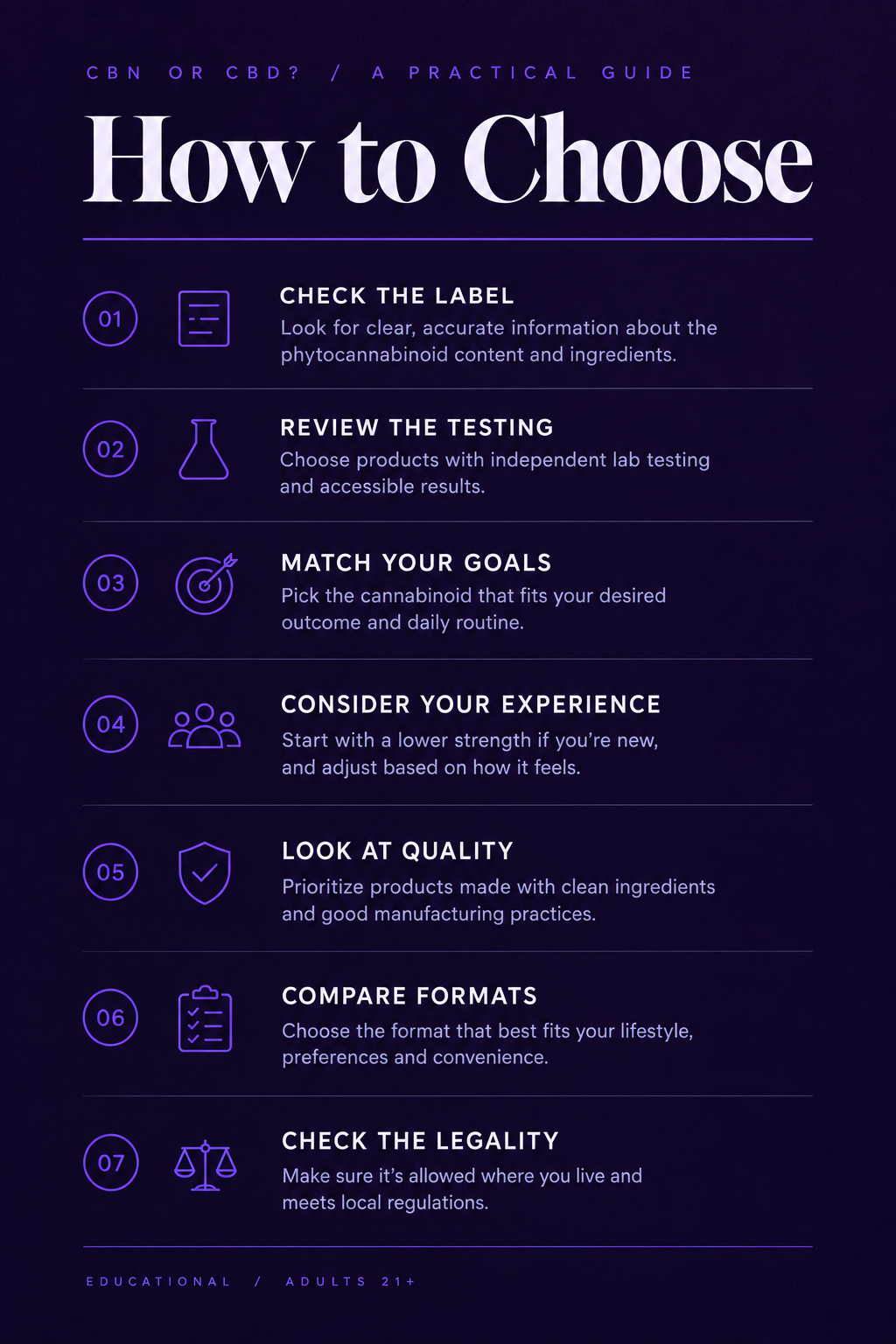
A short checklist for picking a starting product:
- Goal is anxiety, inflammation, or general relaxation — start with CBD
- Goal is sleep and CBD alone has not worked — try a low-dose CBN product around 20 mg
- You take prescription medications — talk to a clinician before daily CBD
- You are drug-tested — favor CBD isolate over broad- or full-spectrum, and treat CBN products with caution
- You want a single bedtime product — consider a balanced THC:CBD:CBN edible
Frequently Asked Questions
What is the main difference between CBN and CBD? CBN and CBD are both cannabinoids, but CBD comes from CBDA in hemp and cannabis and is non-intoxicating, while CBN forms as THC breaks down over time and is only mildly psychoactive at higher doses. CBD has decades of clinical evidence including an FDA-approved drug; CBN's research is far more limited [2].
Is CBN psychoactive like THC? CBN is not psychoactive in the way THC is. At typical supplement doses, CBN does not produce a high; at higher doses it is described as mildly psychoactive. CBD is non-psychoactive at any dose. Anyone subject to drug testing should treat any CBN product with caution because commercial CBN isolates can carry trace THC [2].
Which is better for sleep, CBN or CBD? There is no clear winner. A 2023 placebo-controlled trial found a modest sleep benefit from 20 mg CBN [8], while earlier reviews concluded CBN alone has little sedative effect [1]. CBD has more human evidence overall and may support sleep indirectly through anxiety and pain reduction [3].
Does CBN come from THC? Yes. CBN is a degradation product of THC. When THC is exposed to heat, light, and oxygen over time, it converts into CBN. CBD is produced directly by the plant from CBDA and does not derive from THC [7].
Is CBD legal in New York? Hemp-derived CBD is legal under federal law (2018 Farm Bill) and in New York State, with state-level rules on sales channels and labeling. THC-containing cannabis products are sold through licensed dispensaries to adults 21 and older [3].
Are there side effects to taking CBN or CBD? CBD is generally well-tolerated, but an FDA trial showed dose-dependent liver enzyme increases at consumer-level daily doses, so people on prescription medications should talk to a clinician [5]. CBN is less studied but appears to share a mild side-effect profile including drowsiness and dry mouth at higher doses.
Can you take CBN and CBD together? Many products combine CBN and CBD, and there is no known dangerous interaction between the two. Both can be sedating, so the combination may feel stronger than either alone [4].
How should a beginner choose between CBN and CBD? If the goal is anxiety, inflammation, or general relaxation, CBD is the better starting point because the evidence is deeper. If the goal is specifically sleep and CBD has not worked, a low-dose CBN product around 20 mg is a reasonable second step [3].
Sources
- Cannabis and Cannabinoid Research (PubMed) — Reviews the limited evidence for CBN's sedative effects, concluding that CBN alo
- Sleep Foundation — Explains that CBN is the first cannabinoid ever isolated, is minimally psychoact
- Harvard Health Publishing — CBD is the second most abundant cannabinoid in marijuana, has strong evidence fo
- Molecules (PMC/NIH) — Reviews CBD's pharmacological profile: negative allosteric modulator of CB1, wea
- U.S. Food and Drug Administration — FDA-conducted randomized trial found dose-dependent liver enzyme elevations in 5
- PMC / NIH — Recent pharmacology work shows CBN does affect sleep via objective measures and
- WebMD — Plain-language summary of key differences: CBD derives from CBDA in hemp/cannabi
- Sleep (Oxford Academic / PubMed) — In a placebo-controlled human sleep study, 20 mg CBN reduced nighttime awakening
- Journal of Pediatric Pharmacology and Therapeutics (PMC/NIH) — On June 25, 2018, the FDA approved Epidiolex, the first plant-derived purified p
About Treehouse Cannabis
Treehouse Cannabis is an adult-use dispensary serving adult customers in Rockland, Orange, and Westchester Counties in New York. We carry a curated selection of CBD-forward tinctures, CBD and CBN gummies, balanced THC:CBD:CBN edibles, and other cannabinoid-forward formats for adults 21 and older browsing for relaxation, sleep support, or everyday relief. Our menu is updated regularly and includes third-party lab results on every product page.
Cannabis is for adults 21 and older. Keep all cannabis products out of reach of children and pets. Do not drive or operate machinery after consuming cannabis. This article is for educational purposes only and is not medical advice; talk to a clinician before using CBD or CBN daily if you take other medications or have a medical condition.

Shop our products

Shop All

Deals

Flower

Pre-rolls
Vaporizers

Edibles
Drinks

Concentrates
Tinctures

Topicals

CBD

Pet CBD

Accessories