
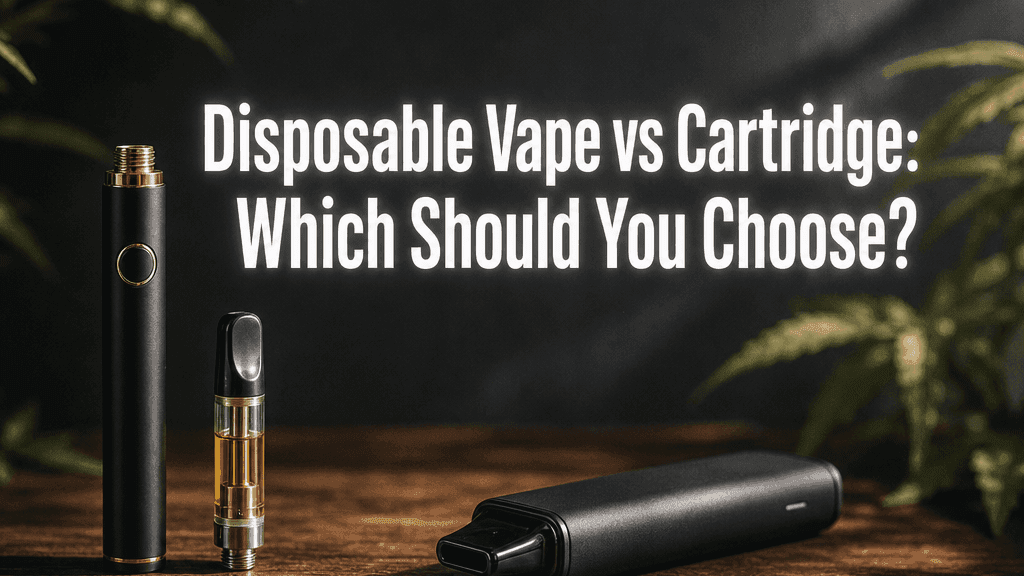
Disposable Vape vs Cartridge: Which Should You Choose?
Disposable Vape vs Cartridge: Which Should You Choose?
A disposable vape is a sealed unit combining battery, coil, and pre-filled oil tank that you discard whole. A 510 cartridge is just the oil tank; it must screw onto a separate reusable 510-thread battery to work. Pick a disposable vape vs cartridge for grab-and-go, or a 510 setup for lower long-term cost and voltage control.
What Is the Actual Difference Between a Disposable Vape and a Cartridge?
The two formats look similar from the outside and feel similar in the hand, but the hardware inside is fundamentally different.
- Disposable (sealed unit). Battery, coil, and pre-filled oil tank are built into one chassis. You draw on it until the oil runs out, then throw the whole device away — battery and all.
- 510 cartridge (open component). Only the oil tank, atomizer coil, and mouthpiece. There is no battery inside; the cart must screw onto a separate, reusable 510-thread battery to function. When the cart is empty you discard the tank and screw a fresh one onto the same battery.
- One tank, one battery. A disposable throws away a working lithium-ion cell with every tank. A 510 setup keeps the same battery for hundreds of refills and swaps only the empty tank.
The 510 thread itself became the cannabis industry standard for a reason. Joyetech introduced the format in the late 2000s on its eGo battery line, and the spec — 10 threads at a 0.5mm pitch on an M7x0.5 metric base — was simple enough that other manufacturers copied it for interoperability [7]. Today the 510 thread is universal across almost every refillable cannabis cart and battery, which is why one cart fits any 510 battery you buy [8].
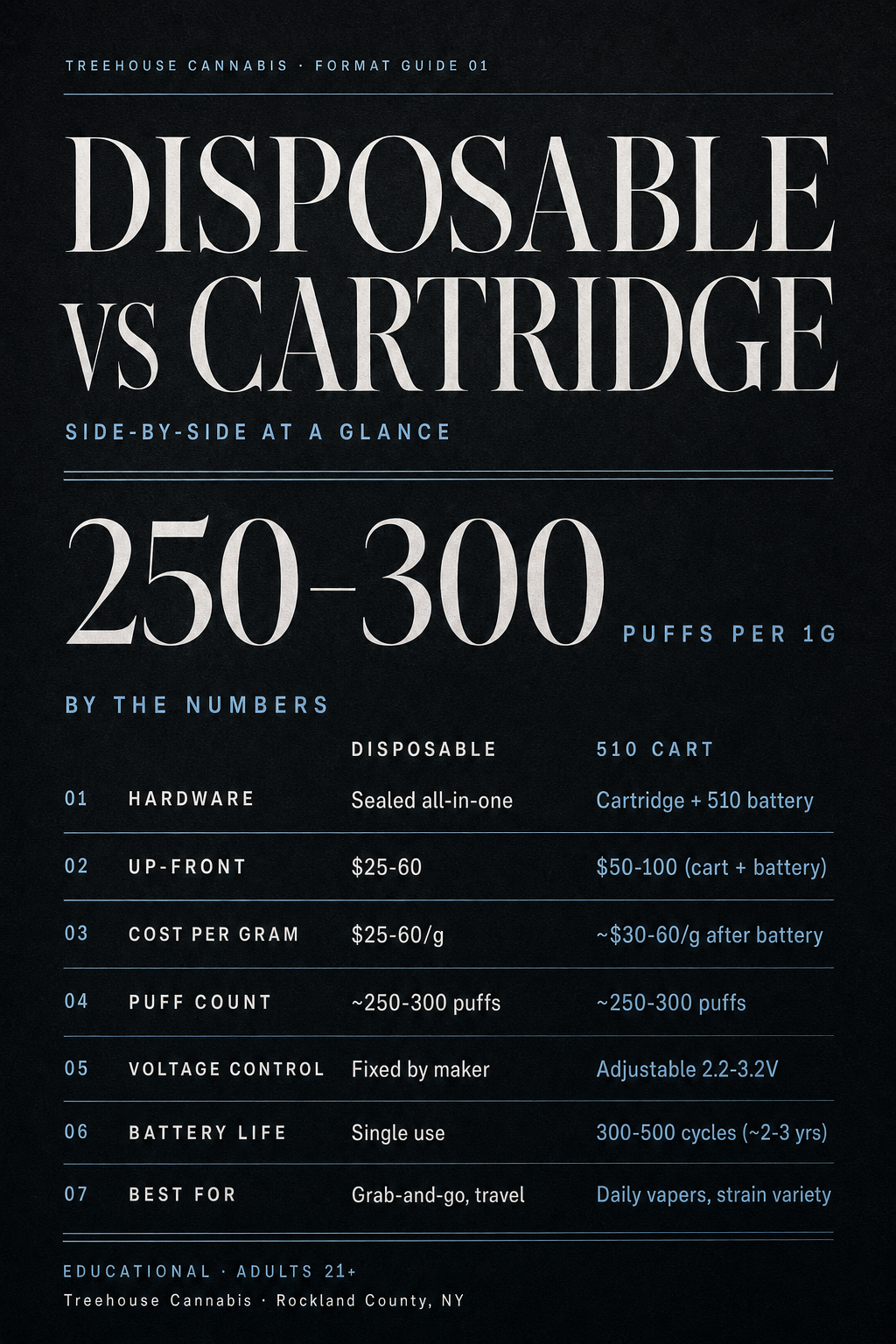
For a side-by-side look at how the two formats stack up on hardware, cost, voltage, and lifespan, see the comparison table below.
| Spec | Disposable Vape | 510 Cartridge |
|---|---|---|
| Hardware | Sealed all-in-one (battery + tank + coil) | Oil tank + coil only; needs separate 510 battery |
| Up-front cost (typical 1–3g) | $25–60 per device | $30–60 per cart + $20–40 battery (one-time) |
| Cost per gram | $25–60/g | ~$30–60/g after the battery is paid off |
| Puff count (1g) | ~250–300 three-second puffs | ~250–300 three-second puffs (oil-based, hardware is comparable) |
| Voltage control | Fixed by manufacturer | Adjustable 2.2–3.2V on most 510 batteries |
| Battery lifespan | Single use | 300–500 charge cycles (~2–3 years) |
| Best for | Grab-and-go, beginners, travel | Daily vapers, strain variety, lower waste |
If you want a deeper look at how timing affects a high, You’re Not Lazy—Your Edible Just Peaked at the Wrong Time walks through the edible side of that question. For a focused comparison of the two extract types most often sold in carts and disposables, Live Resin vs Distillate Carts is a useful companion read.
How Do the Costs Compare Over Time?
The cost story flips depending on how often you vape, and the math is simple enough to do on a napkin.
- Disposable, occasional use (under once a week). Pay $25–60, use it, discard it. No battery, no charger, no second purchase to amortize.
- Disposable, daily use. Replacing $25–60 devices every few days runs into the hundreds of dollars a month. The "convenience tax" compounds fast.
- 510 setup, first month. Battery $20–40 plus the first cart $30–60. First-month outlay typically $50–100.
- 510 setup, after break-even. The battery pays for itself within 3–4 cart replacements for daily or near-daily vapers. Every refill after that is pure product cost.
Up front, a disposable is the cheaper option for a one-off purchase. A typical 1–3g all-in-one runs $25–60. You pay, you vape, you discard. There is nothing else to buy.
A 510 setup costs more at the start. The battery runs $20–40 and lasts through 300–500 charge cycles — roughly 2–3 years of regular use [7]. Carts run $30–60 each depending on size and extract type. So your first month with a 510 setup might look like $50–100 total, versus $25–60 for a single disposable.
The math flips after the third or fourth cart. Once the battery is paid for, every refill costs the same as a cart-only purchase and there is no second battery fee. Heavy users — daily or near-daily vapers — usually break even on the battery within 3–4 cart replacements. Light users, or anyone who vapes less than once a week, rarely catch up and are usually better off staying with disposables.
| Usage pattern | Best fit | Realistic first-month cost | Per-gram cost over 6 months |
|---|---|---|---|
| Occasional (under once a week) | Disposable | $25–60 | $25–60/g |
| First-time, testing the waters | Disposable | $25–60 | $25–60/g |
| Daily or near-daily | 510 setup (battery + carts) | $50–100 | ~$30–60/g after break-even |
For a closer look at what happens when a cart starts to taste off or stops hitting, Is Your Vape Cart Burnt or Just Clogged? How to Tell What to Do Next covers the clog-versus-burnt question in detail.
Do Disposable Vapes or Cartridges Hit Harder?
Potency comes from the oil, not the hardware, so neither format is reliably stronger on its own.
- Same THC, same feel. A 96% THC distillate cart and a 96% THC distillate disposable feel near-identical because the oil is doing the work.
- Format is not potency. The chassis (sealed unit vs. open tank) does not raise or lower the high.
- Extract type matters more than format. Distillate typically runs 85–95% THC with botanical terpenes reintroduced after distillation. Live resin holds 70–85% THC with the plant's original terpene profile preserved. Live rosin sits around 65–85% THC with solventless extraction and a full native terpene spectrum [5].
- The entourage effect. Two carts at the same THC percentage can feel very different because preserved terpenes in live resin and live rosin produce a different subjective effect than re-introduced botanical terpenes in many distillates.
What the hardware does affect is control. A 510 battery with adjustable voltage lets you dial in 2.2–3.2V depending on the extract: lower for live resin and live rosin, higher for thick distillate [8]. Most disposables run at a fixed voltage set by the manufacturer. If you care about dialing in flavor and vapor temperature, that gap matters. If you just want a consistent pull every time, it does not.
For a primer on how these formats fit into a broader cannabis routine, Cannabis Use For Beginners covers the basics. To compare the underlying extracts themselves across the full menu, browse the Concentrates lineup.
Are Disposable Vapes Safe, and How Do They Compare to 510 Carts?
The short answer: regulated, lab-tested disposables and 510 carts sold at licensed dispensaries are both considered safer options, and the format itself is not the safety issue. The 2019–2020 EVALI outbreak is the case study that proved it.
- Format ≠ risk. Hardware is not the variable. The variable is whether the oil inside is regulated and lab-tested.
- EVALI was an unregulated-oil crisis. 2,807 hospitalizations and 68 deaths across 29 states and DC by Feb 18, 2020 [2], with vitamin E acetate — a cutting agent used to thicken illicit THC oil — detected in 100% of 29 BALF samples and 94% of an expanded 51-sample set [4].
- Illicit-market carts were the source. 82% of EVALI patients reported vaping THC-containing products, mostly from informal sources [3]. Earlier CDC tallies tracked the same trajectory in real time [1].
- COA is the single most important safety step. A Certificate of Analysis confirms cannabinoid potency, terpene profile, and the absence of pesticides, heavy metals, residual solvents, and vitamin E acetate. If the dispensary cannot produce a COA, the product is not worth the price.
By February 18, 2020, the CDC had logged 2,807 hospitalizations and 68 deaths across 29 states and the District of Columbia [2]. The agency had identified vitamin E acetate — a cutting agent used to thicken unregulated THC oil — in 100% of 29 bronchoalveolar lavage fluid samples and in 94% of an expanded 51-sample set [4]. About 82% of patients reported vaping THC-containing products, mostly from informal sources [3]. Earlier CDC tallies tracked the same trajectory in real time [1].
The outbreak was concentrated in unregulated cartridges from the illicit market, not in regulated dispensary products. The single most important safety step is buying from a licensed dispensary that publishes a Certificate of Analysis for every batch. A COA confirms cannabinoid potency, terpene profile, and the absence of pesticides, heavy metals, residual solvents, and vitamin E acetate. If the dispensary cannot produce a COA, the product is not worth the price.
Independent emissions testing has also shown that regulated vape hardware — in either format — produces cleaner emissions than burned flower. A 2026 California NORML pilot study found that store-bought, state-licensed disposable and reusable vape pens emitted significantly fewer toxins than pre-roll joints across nearly every metric tested, and stayed within EPA safe daily exposure limits [6].
For a regulated disposable option that publishes full COA results, Super Lemon Haze "limited Edition" | Ultra Extract High Potency oil | Disposable Vape | 1g is a citrus-forward example from our current menu.
Which Is Better for Beginners and Which Is Better for Daily Use?
The choice maps almost perfectly to usage pattern. Disposables are the easier starting point for beginners: no battery to buy, nothing to charge, no threading, no voltage settings. Most modern disposables are draw-activated, so you inhale and it fires. That low friction is exactly what a first-time customer needs.
A 510 setup starts to pay off for daily or weekly users. The reasons:
- Voltage control. A variable-voltage 510 battery lets you run live resin and live rosin at 2.4–2.8V for flavor, then bump to 2.8–3.2V for thick distillate [8]. Disposables lock you into whatever the manufacturer chose.
- Strain selection. Disposables ship in whatever strains a brand decides to pre-fill. Carts come in the full live resin, live rosin, and distillate catalog, and you can swap strains on the same battery in seconds.
- Lower cost per gram. After the battery pays off, every refill is pure product cost.
- Replaceable parts. If the battery dies, you swap it. If the cart clogs, you swap it. Nothing has to be thrown out prematurely.
Most first-time vapers start with a disposable, get a feel for how often they actually vape, and graduate to a 510 setup once the pattern is clear.
For a beginner-friendly all-in-one that takes the charging question off the table, Sour Diesel | All In One Disposable Vape | 1g is a popular pick from our current disposable menu.
Which Is Better for the Environment, and How Should You Decide?
The 510 cartridge with a reusable battery is the lower-impact choice. A disposable throws away a working lithium-ion battery every time the oil runs out; that is a real downstream cost in terms of mining, landfill load, and the small but nonzero fire risk at waste facilities. A 510 battery lasts 300–500 charge cycles — roughly 2–3 years of regular use [7] — and the carts themselves are a small fraction of the total hardware mass.
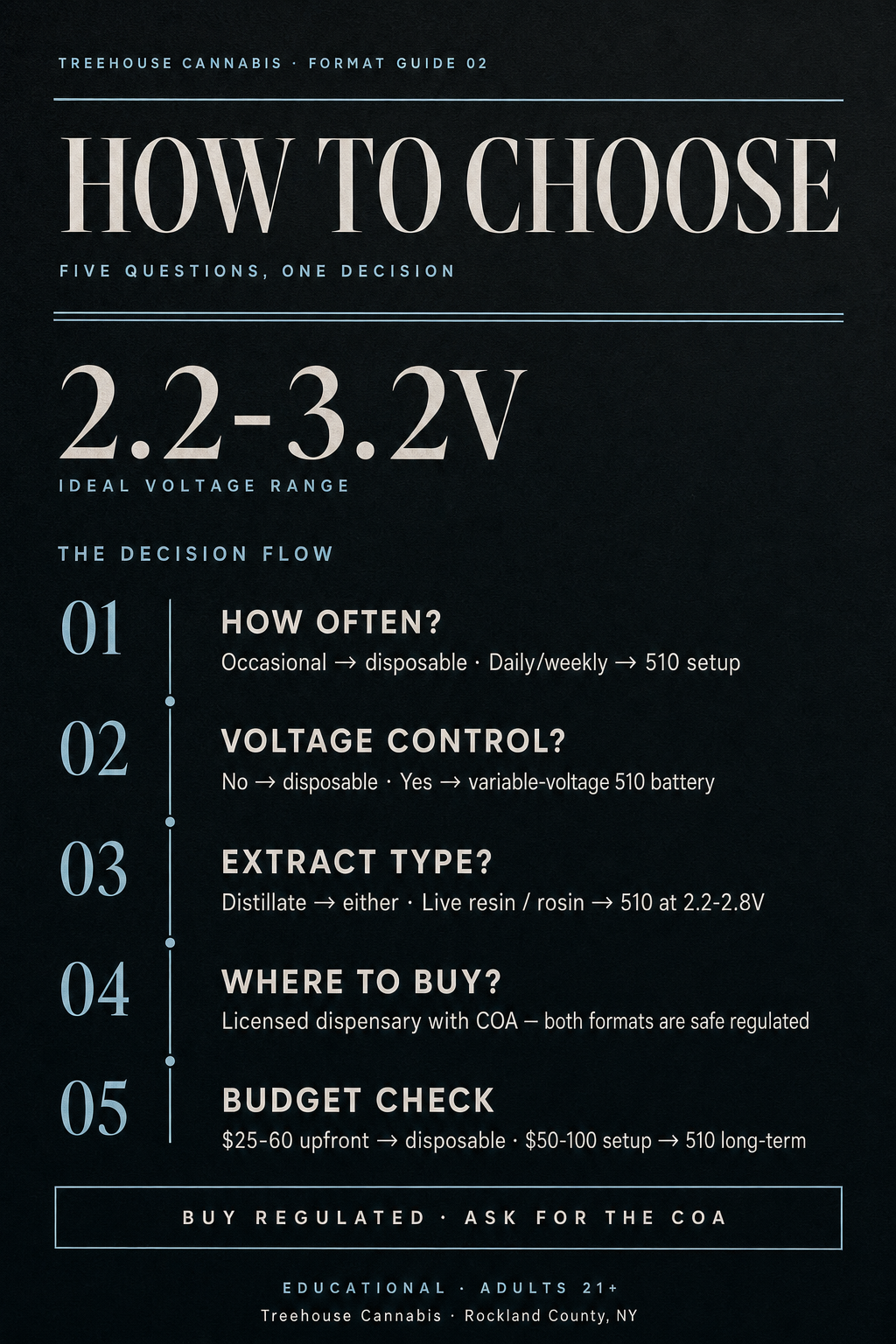
The decision rule is straightforward:
- Choose a disposable when convenience and grab-and-go trump everything else — travel, weekends, trying a new strain without committing to a full cart, or handing off to a friend who has nothing to charge.
- Choose a 510 cartridge plus battery when cost, extract selection, voltage control, and lower environmental impact matter more.
- Always buy from a licensed dispensary with verifiable COAs. The format does not matter if the oil inside is unregulated.
If you decide on the 510 route, a simple pen-style battery like Black | Slim Pen 510 Vape Battery is a sensible starting point — no app, no buttons beyond voltage, and broad compatibility with any 510 cart.
Frequently Asked Questions
What is the actual difference between a disposable vape and a cartridge?
A disposable vape is one sealed unit that contains the battery, heating coil, and pre-filled oil tank together — you use it and discard the whole device. A cartridge is just the oil tank; it has no battery and must be screwed onto a separate reusable 510-thread battery to work.
Which is cheaper, disposable vapes or cartridges?
Up front, disposables cost $25-60 per device. A 510 setup costs $20-40 for a battery plus $30-60 per cart. For occasional or first-time use, the disposable is cheaper. For daily or weekly use, the battery pays for itself within a few cart replacements, and every cart after that is pure savings.
Do disposable vapes or cartridges hit harder?
Neither format is reliably stronger. Potency depends on the oil inside, not the hardware. A 96% THC distillate disposable and a 96% THC distillate cart will feel very similar; a 75% live rosin cart and a 75% live rosin disposable will feel similar to each other but different from the distillate because of the preserved-terpene effect.
Are disposable vapes safe?
Regulated, lab-tested disposables sold at licensed New York dispensaries are considered safer than unregulated street-cart products. They publish a Certificate of Analysis confirming cannabinoid potency, terpene profile, and the absence of pesticides, heavy metals, residual solvents, and vitamin E acetate — the additive that drove the 2019-2020 EVALI outbreak.
How long does a 1g disposable or cartridge last?
A 1-gram cart or disposable yields roughly 250-300 three-second puffs. A casual user taking around 10 puffs a day gets about a month; daily heavy users can finish one in a week. Larger 2-3g disposables triple that range.
Which is better for beginners — disposable or cartridge?
Disposables are the easier starting point: no battery to buy, nothing to charge, no threading, draw-activated in most cases. A cartridge plus battery setup asks for a small upfront learning curve but pays you back with voltage control and lower cost per gram. Most first-time vapers start with a disposable and graduate to a 510 setup once they know how often they will actually vape.
Sources
- Centers for Disease Control and Prevention (CDC) — MMWR — Reports 2,668 hospitalized EVALI cases by January 14, 2020, with a median patien
- Wikipedia (consensus public-health summary) — Confirms the final CDC tally of 2,807 hospitalized cases and 68 deaths across al
- PubMed / NCBI — Lessons from the public health responses to the US outbreak of vaping-related lung injury — Documents that 82% of EVALI patients reported vaping cannabis products (usually
- PMC / NCBI — The implications of Vitamin E acetate in E-cigarette, or vaping, product use-associated lung injury — Confirms CDC's 2,807 EVALI cases, that vitamin E acetate was detected in 100% of
- PMC / NCBI — Cannabis concentrate vaping chemistry — Reviews aerosol chemistry of cannabis concentrates and confirms vaping liquids a
- California NORML — Independent NN Analytics emissions testing of store-bought, state-licensed dispo
- Joyetech / Smoke Cartel — 510 Cartridge Evolution — Documents that the 510 thread (10 threads at 0.5mm pitch) was introduced by Joye
- DiscountVapePen — 510 Thread Explained — Provides the technical M7x0.5 metric spec for the 510 thread and confirms its or
About Treehouse Cannabis
Treehouse Cannabis is a licensed adult-use dispensary serving customers across Rockland County, Orange County, and Westchester County, with locations in Nyack and surrounding areas. Browse our COA-tested disposables, 510-thread batteries, and vape cartridges in-store or online at treehousecannabis.com. This article is intended for adults 21 and older. Cannabis is for adults 21 and older. Keep all cannabis products out of reach of children and pets, store in a cool dry place, and never drive or operate machinery under the influence of cannabis.


Shop our products

Shop All

Deals

Flower

Pre-rolls
Vaporizers

Edibles
Drinks

Concentrates
Tinctures

Topicals

CBD

Pet CBD

Accessories