
How Long Does THC Stay in Your System?
How Long Does THC Stay in Your System?
How long does weed stay in your system? For a urine test — the most common screen — light users typically clear in 1 to 3 days, while chronic heavy users can stay positive for 30 days or longer. The actual window depends on the test type, the cutoff, and how often someone uses.
How Long Does THC Stay in Your System for a Urine Test?
Urine is the most common workplace and pre-employment specimen for cannabis, and it is the test most people will encounter first. Standard screens do not measure active THC; they detect THC-COOH, the inactive metabolite your liver produces after processing THC [3]. Because THC-COOH is fat-soluble, it leaches back into the bloodstream and urine long after the high has worn off [5].
The landmark monitored-abstinence study by Huestis and colleagues followed 60 cannabis users for 30 days and reported the average time until the last positive urine specimen at the standard federal cutoff [2]:
| Use frequency | Average days to last positive at 50 ng/mL |
|---|---|
| Light (1 to 2 times per week) | About 4.3 days |
| Intermediate (3 to 4 times per week) | About 9.7 days |
| Heavy (daily or near-daily) | About 15.4 days, with 60 to 100 percent still positive 28 days after first negative |
How the federal urine cutoff process works:
- 50 ng/mL THC-COOH is the initial immunoassay screen threshold [4]
- 15 ng/mL is the GC-MS confirmation cutoff for any sample that screens positive [4]
- Anything below 50 ng/mL on the screen is reported negative without confirmation
- A diluted sample (low creatinine or specific gravity) is treated the same as a positive
For a one-time exposure, most people clear within 1 to 3 days at the standard cutoff, and occasional users rarely test positive beyond 7 days [5].
For a closer look at how THC and CBD behave once they enter the body, How THC and CBD Work covers the receptor and metabolism basics. On a related tangent, How Long Does Weed Stay Fresh? looks at how long cannabis flower itself stays fresh in storage, where the underlying chemistry of THC degradation overlaps with what happens inside the body.
The most important thing to know about a positive urine screen is that it indicates past exposure, not current impairment. THC-COOH has no psychoactive effect, and a heavy user who stopped two weeks ago can test positive long after the high is gone [5].
How Long Does THC Stay in Blood, Saliva, and Hair?
Blood, saliva, and hair tests each measure something different, and that difference reshapes the window. Blood and saliva look for parent THC rather than the long-lived metabolite, so the window is much shorter than urine. Hair tests look for the metabolite trapped inside the hair shaft, so the window is much longer.
Side-by-side, the four test types break down like this:
| Test type | What it measures | Typical detection window | Best for |
|---|---|---|---|
| Urine | THC-COOH (inactive metabolite) | 1–3 days (single); up to 30+ days (heavy) | Workplace, pre-employment |
| Blood | Parent THC | 12–24 hours (occasional); 1–7 days (heavy) | Clinical, some impairment cases |
| Saliva | Parent THC | ~24 hours typical; ~30 hours frequent smokers | Roadside, very recent use |
| Hair | THC-COOH trapped in hair shaft | ~90 days (1.5-inch sample) | Pattern of repeated use |
For a side-by-side view of all four test types, see the infographic below.
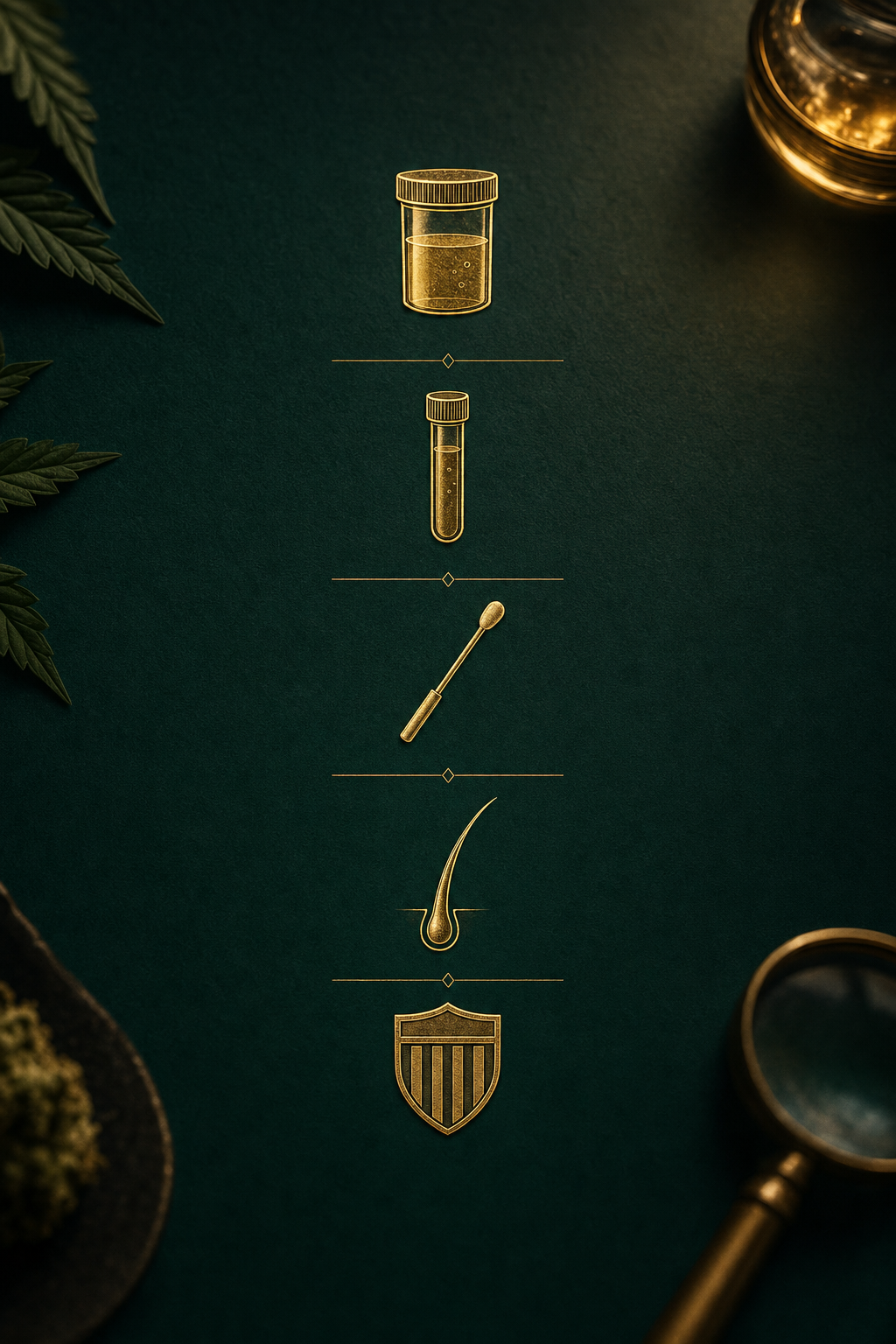
The per-test highlights, in plain English:
- Blood tests are used in clinical settings and in some roadside-impairment cases. THC concentrations peak within minutes of inhalation and drop sharply within hours. Occasional users typically clear within 12 to 24 hours, while chronic heavy users may still show low THC levels for 1 to 7 days as stored THC seeps out of fat tissue [5].
- Saliva tests are used for very recent use, like roadside checks. After a controlled smoked dose, THC clears in oral fluid within a median of about 27 hours in occasional smokers and beyond 30 hours in frequent smokers [8]. Federal oral-fluid thresholds sit at 4 ng/mL for the screen and 2 ng/mL for confirmation [4].
- Hair follicle testing covers the longest window. A standard 1.5-inch scalp sample represents roughly 90 days of history, because head hair grows about half an inch per month [5]. Hair testing is reliable for repeated heavy use but is poor at detecting a single isolated exposure, since it takes about a week for new hair containing metabolites to grow above the scalp.
What Factors Affect How Long THC Stays in Your System?
Frequency of use is the single biggest driver, because each session adds to a fat-stored metabolite reservoir that takes weeks to drain. Daily or near-daily users carry a much heavier stored load than weekend users, and that load is what eventually leaks back into urine [1].
Other variables that lengthen the window include:
- Higher body fat percentage, since THC-COOH is stored in adipose tissue and released slowly [6]
- Slower metabolism, which extends the elimination curve
- Higher-potency products, including concentrates and dabs, which raise stored metabolite load
- Edibles, which produce 11-hydroxy-THC alongside THC and can extend the effective window in some users
THC is highly lipid soluble and has an apparent volume of distribution of about 10 L/kg, which means it accumulates in fat, spleen, and liver at concentrations far higher than plasma [6]. Elimination happens primarily through feces (about 65 percent) and urine (about 20 percent), with the remainder stored in tissues and gradually released [7].
Hydration and exercise do not meaningfully speed this process. Drinking water dilutes urine slightly, but labs run specimen validity checks that catch diluted samples. Fat burn from exercise can transiently raise urine THC levels rather than clear them.
For a different angle on adult-use consumption patterns, How Seniors Are Using Cannabis in New York looks at how age-related metabolism shifts change the picture for older customers.

Does CBD Show Up on a Drug Test?
Pure CBD isolate should not trigger a positive THC result at standard immunoassay cutoffs. The real-world wrinkle is that many commercial CBD products contain trace delta-9 THC, and full-spectrum CBD in particular has caused confirmed positives with daily use [5].
The three common CBD formats to know:
- Isolate: pure CBD, no other cannabinoids. Safest option if a drug test matters.
- Broad-spectrum: multiple cannabinoids and terpenes but THC removed. Labeled THC-free in most cases, the safer middle ground.
- Full-spectrum: includes trace THC alongside CBD and other cannabinoids. Most likely to trigger a positive.
For example, a 2:1 THC:CBD drink like Ayrloom | Root Beer | 2:1 | 10MG THC : 5MG CBD| Singles is explicitly a low-dose THC beverage rather than a CBD product, so anyone facing a test should treat it as a THC exposure. Even hemp-derived CBD products are not uniformly tested for trace THC content, so the label alone is not a guarantee.
Can Detox Drinks or Water Flush THC Out Faster?
No scientifically validated method accelerates THC elimination from fat stores. Drinking large amounts of water can dilute urine enough to drop below the screening cutoff, but SAMHSA-certified labs run specimen validity checks for creatinine, specific gravity, and oxidants, and a diluted sample is typically treated the same as a positive [4]. The same is true for "detox" drinks and high-dose niacin regimens, which have no controlled data behind them.
What the shortcut industry actually does, and why it doesn't work:
- "Detox" drinks — no controlled data; the marketing claim that they accelerate fat-stored metabolite clearance is not supported
- High-dose niacin — same story; risks liver toxicity without changing detection times
- Excessive water intake — dilutes urine, but certified labs flag low creatinine and specific gravity as invalid
- Strenuous exercise immediately before a test — fat burn can transiently raise urine THC rather than clear it
The only reliable path is time and abstinence. For a single, occasional exposure, that is roughly a week. For daily heavy use, it can run several weeks, with a small percentage of long-term heavy users still showing positive 60 to 90 days after stopping [5].
For customers who are considering low-dose edible formats while monitoring their intake, Drinks Edibles lists the current drink options at Treehouse Cannabis. Doses per serving matter more than the format itself when thinking about detection windows.
How Should Customers in Rockland County Think About This Practically?
Three different testing contexts are worth distinguishing:
- Workplace testing — federal SAMHSA cutoffs (50 ng/mL urine screen, 15 ng/mL confirmation); looks only at past exposure
- Clinical testing — at the discretion of the treating clinician; not bound by SAMHSA cutoffs
- Roadside impairment in New York — oral fluid and blood tests that measure very recent use, on the order of hours, not weeks
Adult-use cannabis is legal in New York for those 21 and older, and a positive workplace test does not indicate impairment at the time of purchase or possession. The only variables a customer can actually control are consumption frequency, product potency, and how far out from any test they stop. Beyond that, the elimination curve runs on its own timeline.
Treehouse Cannabis serves adult-use customers 21 and older across Rockland, Orange, and Westchester Counties. If you have questions about a specific product format or how different consumption methods tend to feel and clear, our budtenders can walk you through it without making medical claims. Stop by the store or pick up New York Wants Weed T-Shirt to show your stripes.
Frequently Asked Questions
How long does weed stay in your system for a urine test?
For a single, occasional use, THC-COOH typically clears a urine test in 1 to 3 days at the standard 50 ng/mL cutoff. With moderate use a few times per week, expect about 5 to 7 days. Daily or chronic heavy use routinely extends the window to 10 to 30 days, and a small percentage of long-term heavy users can still test positive 60 to 90 days after stopping.
What does a urine drug test actually measure for cannabis?
Standard urine screens do not detect THC itself. They detect THC-COOH, an inactive metabolite your liver produces after processing THC. Because THC-COOH is fat-soluble and stored in adipose tissue, it trickles back into the bloodstream for days or weeks after the psychoactive high has worn off, which is why a positive result indicates past exposure rather than current impairment.
How long does THC stay in your blood?
Blood tests detect active THC rather than the long-lived metabolite, so the window is much shorter than urine. THC concentrations peak within minutes of inhalation and drop sharply within hours. Occasional users typically clear within 12 to 24 hours, while chronic heavy users may still show low THC levels for 1 to 7 days as stored THC seeps out of fat tissue.
How long does cannabis stay detectable in saliva?
Saliva tests also look for parent THC, so the window is short. Most users test negative within 24 hours, and frequent smokers usually clear within about 30 hours after smoking. Saliva testing is therefore used for very recent use, such as roadside impairment checks, rather than to detect use that happened days earlier.
How far back does a hair follicle test detect THC?
A standard 1.5-inch scalp hair sample covers roughly 90 days of history because head hair grows about half an inch per month. Hair testing is reliable for repeated heavy use but is poor at detecting a single isolated exposure, since it takes about a week for new hair containing metabolites to grow above the scalp.
Does CBD show up on a drug test?
Pure CBD should not trigger a positive THC result, but many CBD products contain trace delta-9 THC that can accumulate with daily use. Full-spectrum CBD in particular has caused confirmed positives at standard cutoffs. If a drug test matters, broad-spectrum CBD labeled THC-free or isolates are safer choices.
What factors make THC stay in your system longer?
Frequency of use is the single biggest driver, because each session adds to a fat-stored metabolite reservoir that takes weeks to drain. Beyond that, higher body fat percentage, slower metabolism, higher-potency products, concentrates, and edibles that produce 11-hydroxy-THC can all extend detection. Hydration and exercise shift urine concentration slightly but do not meaningfully speed up actual clearance.
Can you flush THC out of your system faster with water or detox drinks?
No method has been scientifically validated to accelerate THC elimination from fat stores. Drinking water can dilute urine enough to drop below the screening cutoff, but certified labs run specimen validity checks for creatinine, specific gravity, and oxidants, and a diluted sample is typically treated the same as a positive. Time and abstinence are the only reliable paths.
Sources
- National Center for Biotechnology Information / StatPearls — Establishes the core pharmacokinetic facts the article rests on: THC plasma half
- National Institute on Drug Abuse (Huestis et al., Journal of Analytical Toxicology) — The landmark 30-day monitored-abstinence study of 60 cannabis users: at the stan
- NCBI Bookshelf / StatPearls — Clinical reference confirming that urine is the most common specimen, that chron
- Substance Abuse and Mental Health Services Administration (SAMHSA), HHS — Authoritative source for the federal cutoff numbers used in every US workplace d
- California NORML — Cited harm-reduction reference summarizing urine, blood, hair, and saliva detect
- National Institute on Drug Abuse (Huestis review, Clinical Pharmacokinetics) — Detailed review documenting that THC has a large volume of distribution of about
- PubMed / Grotenhermen review — Confirms that elimination of inhaled THC and metabolites occurs primarily via fe
- National Institute on Drug Abuse (oral fluid study, Analytical and Bioanalytical Chemistry) — Controlled smoked-cannabis study showing THC in oral fluid typically clears with
About Treehouse Cannabis
Treehouse Cannabis is an adult-use dispensary serving customers 21 and older across Rockland, Orange, and Westchester Counties. This article is intended for educational purposes only and is not medical or legal advice. Cannabis is for adults 21 and older. Keep all cannabis products out of reach of children and pets, and never drive under the influence of cannabis.

Shop our products

Shop All

Flower

Pre-rolls
Vaporizers

Edibles
Drinks

Concentrates
Tinctures

Topicals

CBD

Pet CBD

Accessories