
How Long Should You Wait Before Taking More Cannabis?
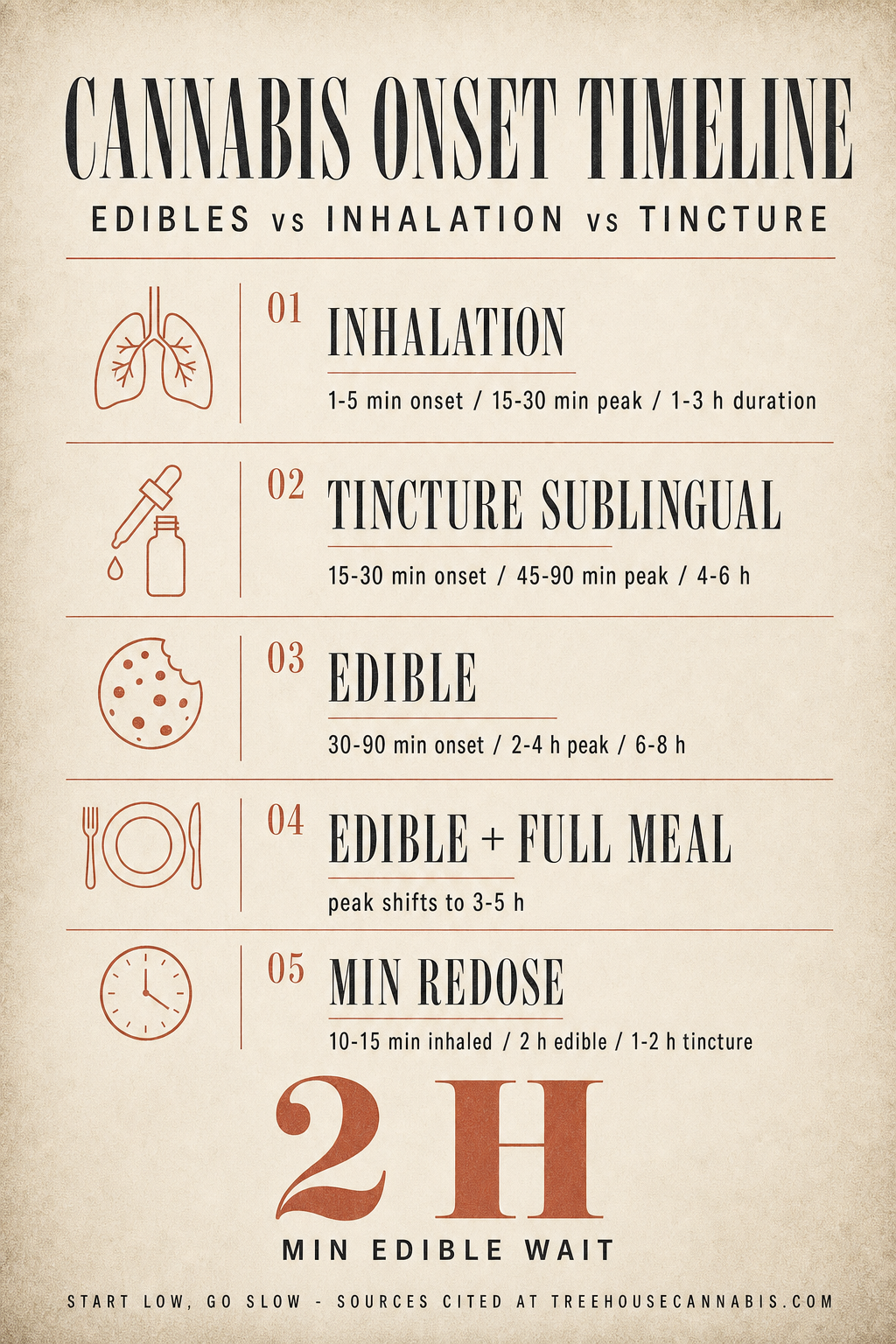
How long should you wait before taking more edibles? The standard harm-reduction answer is to wait at least 2 hours after an edible, 10 to 15 minutes between inhalations, and 1 to 2 hours between tincture doses. Different routes peak at different speeds, so a second dose before the first has finished climbing is the most common cause of uncomfortable experiences.
The short version, route by route:
- Edibles, including most Blueberry Raz x Zativa Live Resin Gummies | 10 pk on the dispensary shelf: wait at least 2 hours between doses; peak effects arrive 2 to 4 hours after ingestion.
- Inhalation through Mango Gelato x Strawberry Kush | Disposable Live Resin Vape | 1g or smoked flower: wait 10 to 15 minutes between puffs; effects begin in 1 to 5 minutes and clear within 1 to 3 hours.
- Sublingual options such as Chemdog "Live Rosin" | Tincture: wait 1 to 2 hours between doses; onset is around 15 to 30 minutes, with peak around 45 to 90 minutes.
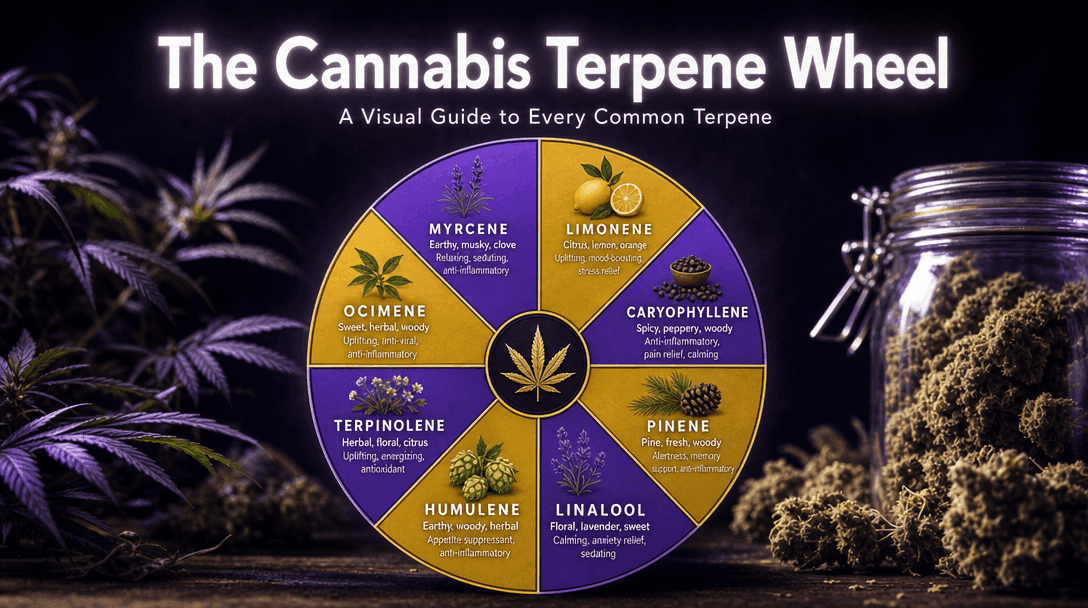
For a broader look at how the compounds driving those different timing curves shape how a strain feels, see A Guide to Terpenes and Their Effects. Storage also matters: a gummy that has lost potency will feel weaker and tempt a faster redose, so How Long Does Weed Stay Fresh? covers how to keep flower, edibles, and tinctures fresh so the dose on the label still matches what you actually take.
The rest of this guide breaks down why those windows exist, how food and tolerance change them, and what to do if you think you have already taken too much.
Why Do Edibles Take Longer to Kick In Than Smoking or Vaping?
Edibles feel slower than inhaled cannabis because they take a longer, more complicated route through your body. When you smoke or vaporize cannabis, THC crosses from the lungs into the bloodstream and reaches the brain within 1 to 5 minutes, which is why a single puff can change how you feel almost immediately [4]. Edibles have to pass through the stomach, survive the acidic environment of the digestive tract, and clear the liver before THC reaches general circulation, a process called first-pass metabolism.
How the routes compare, side by side:
| Route | Onset | Peak | Typical duration |
|---|---|---|---|
| Inhalation (smoked or vaped) | 1–5 min | 15–30 min | 1–3 h |
| Sublingual tincture | 15–30 min | 45–90 min | 4–6 h |
| Edible, empty stomach | 30–90 min | 2–4 h | 6–8 h |
| Edible, full or high-fat stomach | 30–90 min | 3–5 h | 6–8 h |
Along the way, the liver converts a portion of the THC into 11-hydroxy-THC, a metabolite that crosses the blood-brain barrier more readily than inhaled THC and tends to produce a stronger, longer-lasting effect at the same nominal dose [1].
That extra step is also why the wait window for an edible is measured in hours instead of minutes. Most clinical and consumer guidance places edible onset at 30 to 90 minutes, with full effects sometimes arriving 2 to 4 hours after ingestion [2].
The four-step edible absorption chain, in plain terms:
- Inhalation: THC enters the bloodstream through the lungs and reaches the brain within 1–5 minutes.
- Stomach: an edible's THC dissolves and enters the digestive tract over 30–90 minutes.
- Liver (first pass): the liver converts part of the THC into 11-hydroxy-THC, a stronger metabolite.
- Brain: THC and 11-hydroxy-THC cross the blood-brain barrier together, 2–4 hours after ingestion.
For a beginner, those numbers can feel counterintuitive: you take the dose, you feel nothing for an hour, and you assume the edible was weak. The reality is usually that the dose is still climbing. If you want to read more about how edibles behave over time — including shelf life and how potency drifts, which can change how a stored gummy compares to a fresh one — see Do Edibles Expire? Potency & Safety Guide.
What Is the Safest Wait Time Between Edible Doses?
The widely cited harm-reduction answer is at least 2 hours between edible doses, and longer if you have eaten a full meal or are using a higher-potency product. The British Columbia government's cannabis harm-reduction fact sheet advises that edibles can take 30 minutes to 2 hours to begin producing effects and up to 4 hours to reach peak effects, and recommends a minimum 2-hour wait before considering any additional dose [6].
Medical News Today echoes the same line, encouraging anyone who feels nothing to wait at least 2 to 3 hours before redosing to avoid stacking doses that have not yet peaked [5]. Leafly's standard dosing guide frames the same advice as "start low, go slow," with first-time users advised to begin at 2.5 to 5 mg and wait before taking more, and 10 mg considered a standard single serving for adults with some tolerance [3]. Most dispensary-labeled Blueberry Raz x Zativa Live Resin Gummies | 10 pk on the shelf are clearly marked with mg per serving for exactly this reason.
How to apply that in practice:
- First-time or low-tolerance users: start with 2.5 to 5 mg and wait at least 2 hours before deciding whether to take more.
- Experienced adult users: a 10 mg serving is a common single dose, but the 2-hour wait rule still applies.
- After a full edible dose: Healthline recommends waiting 24 hours before taking another full dose, on top of the 2-hour minimum checkpoint, to avoid compounding [2].
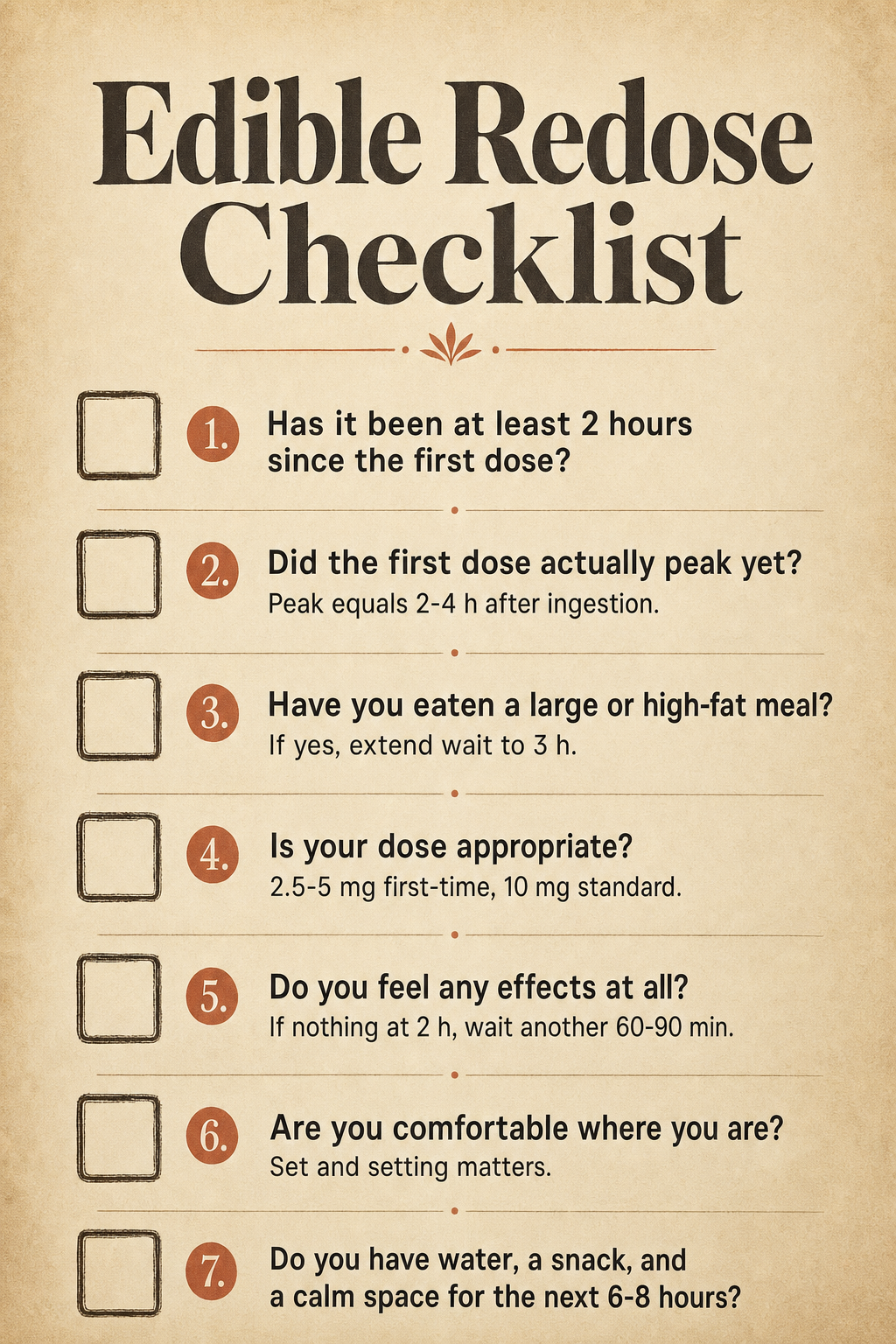
That 2-hour checkpoint is the practical anchor: at 2 hours, if you feel clearly high, do not take more. If you feel nothing, wait another 60 to 90 minutes, because the original dose may still be climbing. If you are new to edible THC and want a broader walk-through of how to pick a starting product, see How to Choose Your First Cannabis Product: A Complete Guide for Beginners.
Does Eating Food Change How Long You Should Wait?
Yes, and the change goes in both directions. Pharmacokinetic studies on oral THC show that absorption is highly variable and significantly affected by food, especially high-fat meals. In fed states, slowed gastric transit pushes time-to-peak later and can raise total THC exposure, so the same edible dose can feel both later and stronger when you have eaten a full meal [4]. On an empty stomach, the same dose tends to hit faster but at a lower peak.
Practically, that means:
- On a full or high-fat stomach: extend the wait window toward 3 hours before considering a second dose, and consider lowering the next dose.
- On an empty stomach: the 2-hour checkpoint still applies, but expect onset to be a little sooner.
- If you are unsure whether you have eaten recently: treat the situation as if you had a full stomach and wait the longer window.
The takeaway is that the 2-hour wait is a floor, not a fixed timer, and the right wait depends on what is in your stomach as much as on what is in the edible.
How Does Tolerance Affect Redose Timing?
Tolerance changes how a dose feels but does not change how long the body takes to absorb it. Regular cannabis users develop tolerance to THC's effects within days to weeks of frequent use, which is why an experienced user can take 10 mg and feel moderate while a beginner feels overwhelmed by 5 mg. That difference can push experienced users toward faster redosing, especially when the dose feels weaker than expected.
The catch is that the absorption curve does not speed up with experience. A regular user still has to wait through the same 30 to 90 minutes of onset and the same 2 to 4 hours to peak. What changes with tolerance is the perceived intensity, not the pharmacokinetics, so the 2-hour wait rule still applies regardless of how experienced you are.
A common mistake is to take a second edible at the 1-hour mark because the first one "isn't doing anything," only to have both doses peak together a few hours later.
Why the 2-hour wait applies regardless of experience:
- The 30–90 minute onset window is set by digestion and liver metabolism, not by how experienced you are.
- The 2–4 hour peak window is set by how long THC and 11-hydroxy-THC take to cross the blood-brain barrier.
- Tolerance changes how intense the peak feels, not when it arrives.
- Redosing earlier because the first dose feels weak is the most common stacking mistake.
What Should You Do If You Think You Took Too Much?
First, try to stay calm. Most uncomfortable cannabis reactions are temporary and resolve within a few hours as the THC metabolizes. The standard steps that harm-reduction sources and clinicians recommend:
- Move to a safe, calm space with a trusted person nearby if possible.
- Hydrate with water and have a light snack, which can help with the "edible hangover" feeling as it wears off.
- Breathe slowly and avoid trying to "push through" with more caffeine or more cannabis.
- Wait it out. The peak will pass.
If symptoms feel genuinely dangerous rather than just unpleasant — chest pain, persistent vomiting, severe confusion, or signs of dehydration — seek medical attention. This is not a moment to tough it out alone.
The reason this section exists in the article is that cannabis-related emergency department visits have been rising sharply. CDC syndromic surveillance data show cannabis-involved ED visit rates roughly tripled among people aged 15 to 24 during the early pandemic and have stayed elevated [8]. A separate CDC analysis estimated that between January 2023 and May 2026, around 199,565 U.S. emergency department visits involved cannabis hyperemesis syndrome, the cyclic vomiting condition linked to frequent, high-THC use [7]. Most of those visits are driven by stacking doses, not by the first dose itself.
For readers who do want a clearly labeled starting point, the Gummies Edibles collection and a single, low-dose product like Blueberry Raz x Zativa Live Resin Gummies | 10 pk make it easier to control the per-serving THC number on the label rather than guessing.
Frequently Asked Questions
Quick answers at a glance:
- Wait at least 2 hours between edible doses, 10 to 15 minutes between inhalations, and 1 to 2 hours between tincture doses.
- Edible peak effects arrive 2 to 4 hours after ingestion, so a "no-effect" feeling at 1 hour does not mean the dose has failed.
- A full or high-fat meal extends the wait window toward 3 hours and can intensify the eventual peak.
- Tolerance changes perceived intensity but not pharmacokinetics — the 2-hour minimum still applies regardless of experience.
How long should you wait before taking more cannabis edibles?
Most harm-reduction guidance — including public-health agencies, Leafly, and clinical pharmacokinetic reviews — recommends waiting at least 2 hours after an edible dose before considering any redose, and waiting closer to 3 hours if the edible contains a higher THC dose or you have eaten a large meal, because oral THC is absorbed slowly and full effects may not peak for 2 to 4 hours.
Why do edibles take so much longer to kick in than smoking or vaping?
Inhaled cannabis is absorbed through the lungs and reaches the brain within 1 to 5 minutes, while edibles have to pass through the stomach, the liver, and first-pass metabolism — where THC is converted into 11-hydroxy-THC — before reaching the bloodstream, which is why the same dose can feel later, longer, and stronger when eaten.
How do you know if an edible has hit its peak?
Peak effects from a typical edible arrive 2 to 4 hours after ingestion, so the safest rule is to treat the 2-hour mark as your checkpoint: if you feel clearly high, do not take more; if you feel nothing at all at 2 hours, wait another hour to 90 minutes before considering a small additional dose, because the original dose may still be climbing.
Does eating food before or with an edible change how long you should wait?
Yes. Pharmacokinetic studies show that taking an edible on a full or high-fat stomach slows absorption, can delay peak effects, and can increase total THC exposure, so the wait window should be extended toward the 3-hour side when you have eaten a full meal; conversely, an edible on an empty stomach tends to hit faster but at a lower peak.
Can you overdose on cannabis by redosing too soon?
Cannabis is not associated with fatal overdose in adults, but taking a second edible before the first has peaked is the most common cause of uncomfortable or distressing experiences — including severe anxiety, nausea, vomiting, dizziness, and rapid heartbeat — and CDC emergency-department data show cannabis hyperemesis syndrome ED visits rising sharply with frequent, high-THC use.
How does redosing work differently for smoking or vaping vs. edibles?
Smoking and vaping act within 1 to 5 minutes and clear within 1 to 3 hours, so users can usually self-titrate a second puff within 10 to 15 minutes and feel the result almost immediately; edibles, by contrast, are a set-and-wait experience, and the standard advice is to treat each dose as a single commitment for at least 2 hours.
What should you do if you think you took too much cannabis?
Most uncomfortable reactions are temporary and resolve within a few hours as the THC metabolizes; the standard steps are to find a safe, calm space, hydrate, snack lightly, breathe slowly, and wait it out, and to seek medical attention if you experience chest pain, persistent vomiting, or symptoms that feel genuinely dangerous rather than just unpleasant.
Does tolerance affect how long you should wait between doses?
Yes. Regular cannabis users develop tolerance to THC's effects within days to weeks and often feel an edible less strongly at the same dose, which can tempt faster redosing — but the underlying pharmacokinetics do not speed up, so the 2-hour minimum wait applies regardless of how experienced you are, and what changes is the perceived intensity, not the actual absorption curve.
Sources
- National Library of Medicine (PMC) — Tasty THC review — Edible THC is processed through the liver into 11-hydroxy-THC, a metabolite that
- Healthline — Edibles typically take 30 to 60 minutes to begin producing effects, with a high
- Leafly — The standard harm-reduction rule is "start low, go slow" — dispensary edibles ar
- National Library of Medicine (PMC) — Oral THC absorption is highly variable and significantly affected by food: in fe
- Medical News Today — Anyone who has eaten an edible and does not feel the effects should wait at leas
- BC Cannabis Secretariat (Government of British Columbia) — Government harm-reduction fact sheet states it takes anywhere from 30 minutes to
- CDC / MMWR — Between January 2023 and May 2026, an estimated 199,565 U.S. emergency departmen
- CDC / MMWR — CDC National Syndromic Surveillance Program data show cannabis-involved ED visit
About Treehouse Cannabis
Treehouse Cannabis is an adult-use dispensary serving Rockland County, NY, with locations in the lower Hudson Valley. We carry clearly labeled, mg-tested edible products for first-time and experienced adult consumers, and our budtenders help customers pick a starting dose based on tolerance, route of administration, and experience level. Browse our edibles collection to compare per-serving THC numbers across gummies, tinctures, and inhalables, or stop into our Rockland County store for a one-on-one dosing conversation.
Cannabis is for adults 21 and older. Keep all cannabis products out of reach of children and pets. This article is for educational purposes only and is not medical advice. Consult a qualified healthcare professional before using cannabis, especially if you are pregnant, nursing, taking medications, or have a medical condition. Effects vary by person; start low and go slow.

Shop our products

Shop All

Flower

Pre-rolls
Vaporizers

Edibles
Drinks

Concentrates
Tinctures

Topicals

CBD

Pet CBD

Accessories