Cannabis Lounges and Dab Bars: What They Are
Cannabis Lounges and Dab Bars: What They Are
A cannabis lounge is a licensed indoor venue where adults 21 and older consume cannabis on-site, and a dab bar is that same format organized around concentrates instead of flower. New York law authorizes on-site consumption but has not opened a general lounge application window, so the practical answer for most customers is narrower than the headlines suggest.
Two details drive most of the confusion. The first is whether a venue sells cannabis for on-site use or expects you to bring your own, and the second is whether a state license for that kind of venue exists yet. New York answers the second question narrowly, and the rules it does publish are specific enough to check against a town or village's own local law.
What Is a Cannabis Lounge?
A cannabis lounge, also called a cannabis consumption lounge, is a licensed indoor venue where adults 21 and older consume cannabis on-site. The seating, the pacing, and the staff who explain the menu read closer to a bar than to a dispensary counter, except that cannabis replaces alcohol.
The defining feature is the license, not the decor. A dispensary cannot let customers light up in the back room without holding the specific authorization that permits on-site consumption, and a storefront cannot decide on its own to become a lounge. Connecticut's review of states already operating these venues found the same floor everywhere it looked: no one under 21 on the premises, mandated ventilation, no alcohol or tobacco sales, no games that encourage consumption, cannabis not visible from the street, and local government approval before a license issues [8].
Two operating models dominate. In a sell-on-site venue, you buy cannabis from the lounge and consume it there, which means the menu, the inventory, and the transaction all belong to the licensed operator.
In a bring-your-own venue, you arrive with legally purchased product and the business supplies the space, the seating, and often the equipment. Which model applies is set by the state license, not by the venue's preference, and the two are not interchangeable [10].
The two models, side by side:
| Sell-on-site venue | Bring-your-own venue | |
|---|---|---|
| Where the cannabis comes from | You buy it from the lounge and consume it there | You arrive with product you already purchased legally |
| Who handles the transaction | The licensed operator owns the menu, the inventory, and the sale | The business supplies the space, the seating, and often the equipment |
| Who decides which model applies | The state license | The state license |
| What the shared floor looks like | 21-plus only, mandated ventilation, no alcohol or tobacco sales, cannabis not visible from the street, local approval | 21-plus only, mandated ventilation, no alcohol or tobacco sales, cannabis not visible from the street, local approval |
Nationally, some form of regulated on-site consumption is authorized in 15 states plus Washington, D.C. [9]. That number describes authorization, not availability.
New York has licensed retail stores far faster than it has developed a consumption market, so a customer who reads that lounges are legal in their state may still find nothing within driving distance.
The short version of what a cannabis lounge is:
- A licensed indoor space for on-site consumption by adults 21 and older
- Two models: venues that sell cannabis for on-site use, and bring-your-own venues
- Common rules across states: 21-plus only, no alcohol or tobacco sales, product not visible from the street, local approval required
- 15 states plus Washington, D.C. authorize some form of regulated on-site consumption
- Availability varies widely, and authorization is not the same as an open venue near you
Inside, the experience is deliberately unhurried. Guests sit rather than queue, staff talk through what is available, and the room is built for conversation instead of a quick transaction. That social framing is the entire product.
What Is a Dab Bar and How Does It Work?
A dab bar is a cannabis lounge built around concentrates rather than flower. The venue supplies the hardware, which usually means dab rigs, e-nails, or vaporizers, plus a menu of wax, shatter, live resin, or rosin, and staff walk guests through temperature and technique before anything is heated.
The equipment is the reason the format exists. Dabbing has a real learning curve, and the tools involved are unfamiliar to most people who have only ever rolled a joint.
A bar removes that friction by handing over the rig, setting the temperature, and explaining what the guest is looking at. The social rhythm follows the same pattern as any shared cannabis ritual, which Cannabis and Social Life: How Sharing Weed Shapes Friendships describes in detail.
What gets served is not a separate product category. The concentrates a bar pours from are the familiar dispensary formats, including rosin, live resin, badder, sugar, and diamonds, so a dab bar is a format rather than a distinct class of product. If you want to see what one of those formats looks like on a label before you go, Sugarcane | Live Rosin Concentrate | 1g is a fair reference point.
State rules bound how much a venue can sell for on-site use, and Nevada is the clearest published example. When Nevada approved its first consumption lounge in 2024, it had 19 conditional licenses, 14 attached to dispensaries and five independent, and it capped single-use flower at 3.5 grams, extracted inhalable products such as dabbing and vaping concentrates at 300 milligrams THC, and individual edible servings at 10 milligrams [14]. Nothing purchased inside may leave with the customer.
Ventilation requirements shape the room as much as the menu does. Nevada requires indoor smoking and vaping to happen in a separate room with an approved ventilation and odor mitigation plan, and it mandates overconsumption training for employees [13]. That is why a dab bar often looks like a series of connected rooms rather than one open floor.
The dab bar format in five points:
- A lounge built around concentrates instead of flower
- The venue provides the rig, e-nail, or vaporizer and a curated concentrate menu
- Staff explain temperature and technique, which is the main draw for newcomers
- Nevada caps on-site sales at 300 milligrams THC for dabbing and vaping products
- Concentrate formats are the familiar dispensary ones: rosin, live resin, badder, sugar, diamonds
Bring-your-own rules complicate the picture for travelers. A state that permits guests to arrive with their own product will not necessarily permit a venue to sell concentrates on the premises, and rules differ on whether shared equipment such as Black | Slim Pen 510 Vape Battery may be provided at all. The menu explains which model applies before anyone sits down.
Two boundaries sit outside the venue's control. What you may legally carry through the door is a possession question rather than a lounge rule, and How Much Cannabis Can You Legally Possess in New York? breaks down the New York limits. Where you may consume once you leave is a separate question again, and Where Can You Legally Use Cannabis in New York? sets out the places the state permits.
Are Cannabis Lounges Legal in New York Right Now?
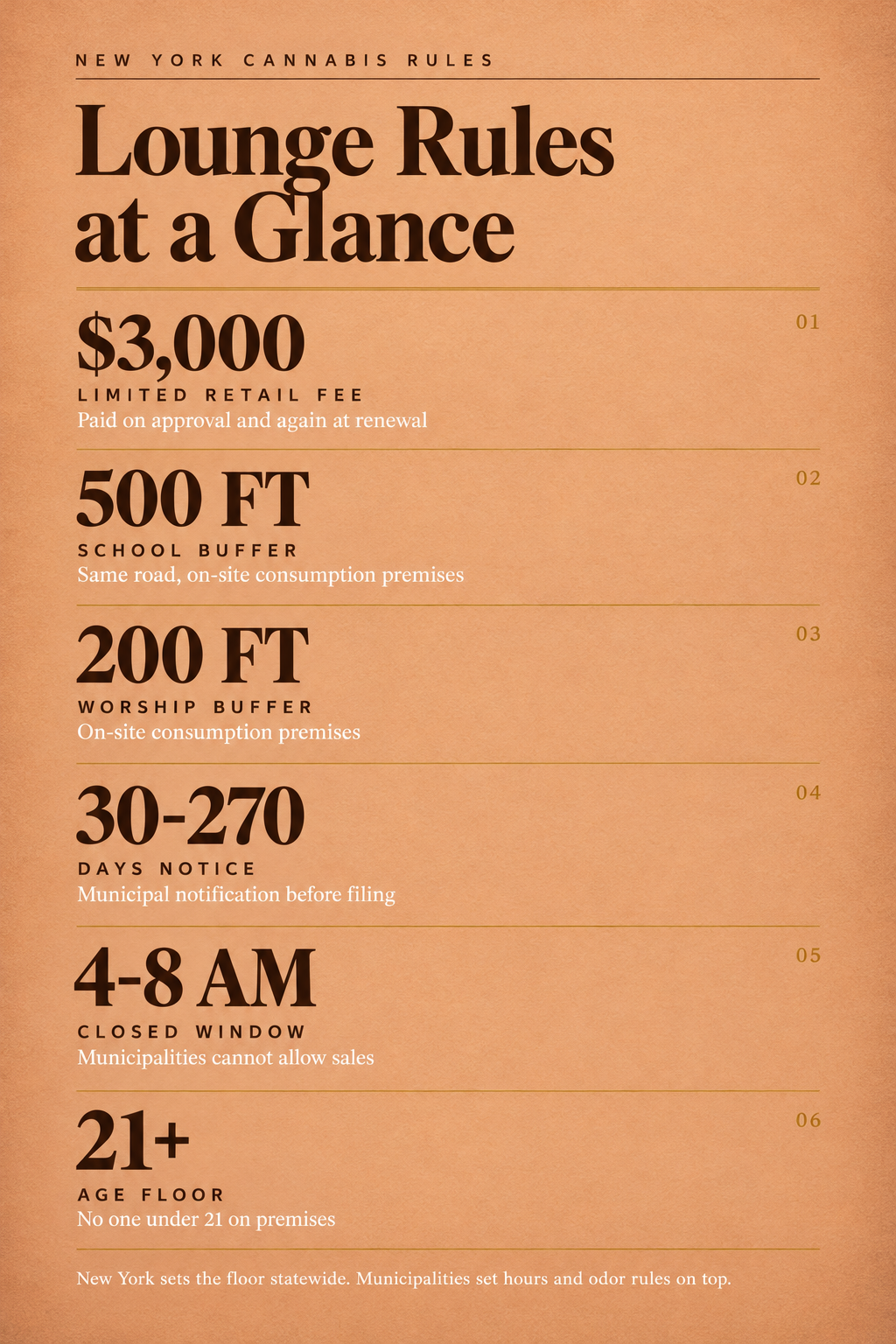
New York authorizes on-site consumption, but the route that actually exists today runs through a dispensary rather than through a standalone lounge license. A licensed retail dispensary may operate a limited retail consumption facility, paying a $3,000 fee on approval and again at renewal, and that facility counts as an adult-use on-site consumption premises under the Clean Indoor Air Act [1].
A standalone consumption lounge license is a separate category, and the state has not opened a general application window for it. That distinction matters because it is the difference between "legal in New York" and "available in New York." The authorization exists in the regulations; the opportunity to apply does not, for most would-be operators.
The local layer is where most plans stall. An applicant must notify the municipality 30 to 270 days before filing [7], which gives a city, town, or village time to weigh in publicly. The Office of Cannabis Management also publishes the list of municipalities that opted out of allowing on-site consumption licenses, and a customer or operator checking whether a lounge can exist in a given town should read that list rather than assume [7].
Buffer distances are fixed statewide and municipalities cannot waive them. No on-site consumption premises may operate on the same road within 200 feet of a house of worship or 500 feet of a school [5]. Municipalities may regulate hours and odor on top of that floor, but they cannot permit operation between 4:00 a.m. and 8:00 a.m. [6].
New York's on-site consumption rules, in short:
- A licensed dispensary may add a limited retail consumption facility for a $3,000 fee, due again at renewal
- A standalone consumption lounge license is a separate category with no open general application window
- Applicants must notify the municipality 30 to 270 days before filing
- OCM publishes the list of municipalities that opted out of on-site consumption
- Fixed buffers: 200 feet from a house of worship and 500 feet from a school, measured on the same road
- Municipalities cannot allow sales between 4:00 a.m. and 8:00 a.m.
For customers, the useful takeaway is that the statewide rules governing possession and use still apply outside any venue door, and NY Cannabis Possession & Use Rules covers that baseline. A facility being licensed does not change what is legal on the sidewalk in front of it.
How Do States Regulate Cannabis Consumption Lounges?
Fifteen states plus Washington, D.C. authorize some form of regulated on-site cannabis consumption [9]. The national picture is uneven in both directions: some states license venues and see few open, while others have written rules that no operator has yet used.
The licensing split is the first thing to understand. Bring-your-own states such as Illinois and Michigan let a licensed venue host consumption without selling cannabis, while other states allow cannabis to be sold for on-site use.
Alaska sits further out still, prohibiting concentrates and tobacco on the premises entirely [10]. Those differences are not cosmetic. They decide whether a lounge looks like a cafe with a consumption room or like a dispensary with seating.
How the two licensing models divide across the states:
| Bring-your-own states | Sell-on-site states | |
|---|---|---|
| Examples named in the sources | Illinois and Michigan | States where cannabis is sold for on-site use |
| Who supplies the cannabis | The guest, who bought it legally elsewhere | The licensed venue |
| Rules common to both models | 21-plus only, mandated ventilation, no alcohol or tobacco sales, no consumption-encouraging games, product not visible from the street, local approval | The same shared floor, plus whatever the state license adds |
| Published on-site caps | Set by the state license | Nevada caps single-use flower at 3.5 grams and extracted inhalable products at 300 milligrams THC [14] |
| Notable exception | Not applicable | Alaska prohibits concentrates and tobacco on the premises entirely [10] |
Across the states already operating, the shared floor is consistent. Connecticut's review found no one under 21, mandated ventilation, no alcohol or tobacco sales, no games that encourage consumption, cannabis not visible from the street, and local approval required [8]. A reader who has visited one lounge should not assume the next state's rules match.
What to check before traveling to a lounge in another state:
- 15 states plus Washington, D.C. authorize some form of regulated on-site consumption
- Bring-your-own states such as Illinois and Michigan versus states that sell for on-site use
- Alaska prohibits concentrates and tobacco on the premises
- Shared rules: 21-plus only, mandated ventilation, no alcohol or tobacco sales, no consumption-encouraging games, product not visible from the street, local approval
- Rules do not travel, and a license in one state means nothing in another
Equipment rules are part of that variation, which is why a traveler who owns their own Dab Tools Accessories should not assume a venue will allow them to bring it in. Some states treat shared paraphernalia as a sanitation question, others as a licensing one, and the venue's posted policy is the only reliable answer.
Why Do Cannabis Lounges Need Special Ventilation and Air Quality Rules?
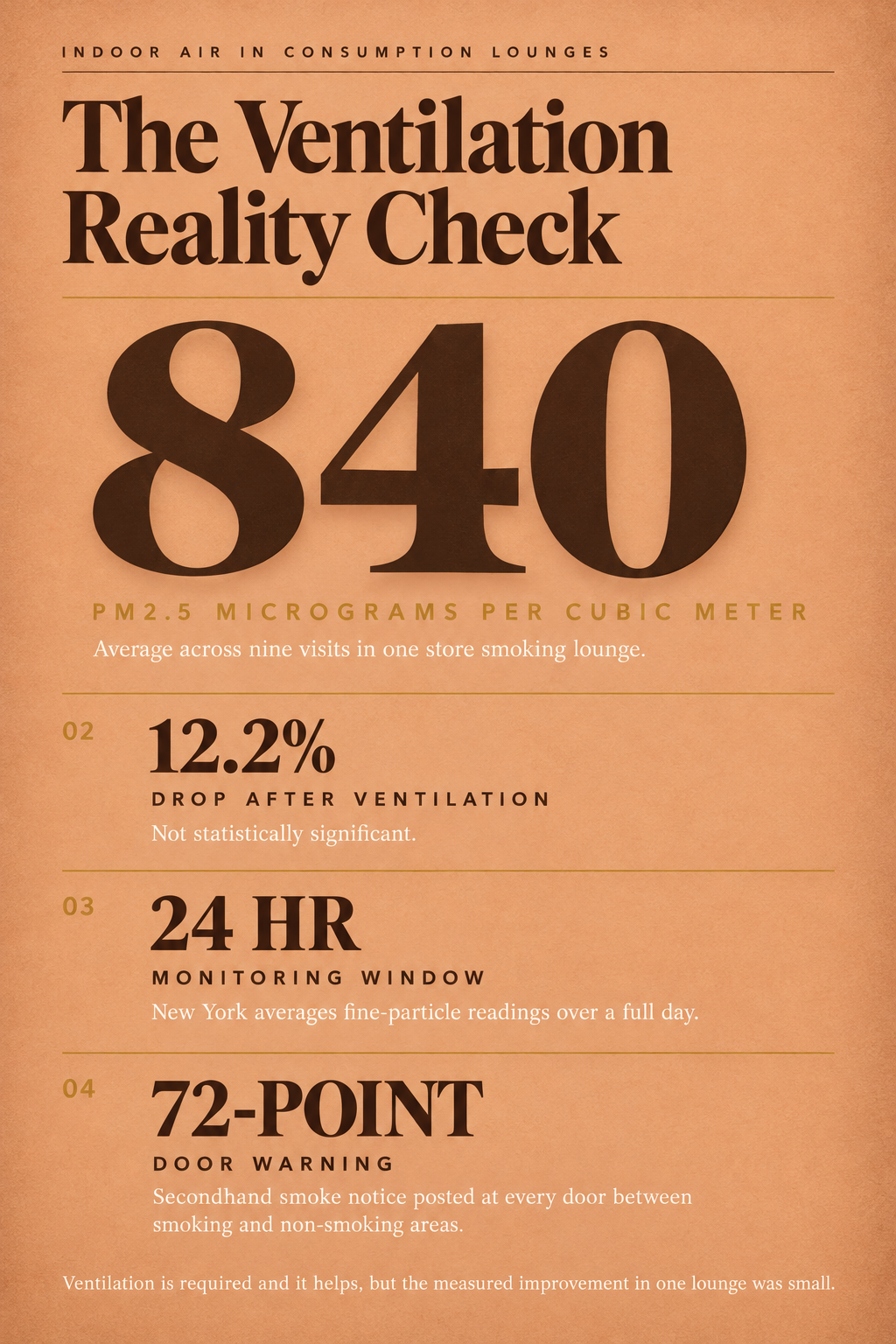
Because the air inside a smoking lounge measurably changes. One study of a cannabis store smoking lounge recorded average PM2.5 of 840 micrograms per cubic meter across nine visits, and a ventilation system installed midway through the study cut concentrations by only 12.2 percent, a change the researchers found was not statistically significant [11].
That result is the reason the rules are as detailed as they are. Ventilation is required and it does help, but the measured improvement in that one venue was small, so regulators layer filtration, monitoring, and signage on top of it rather than treating an air handler as a solution.
New York's requirements follow that logic. Indoor consumption areas must use acceptable odor mitigation technology, such as activated carbon filtration or vapor-phase systems, alongside ongoing fine-particle monitoring averaged over 24 hours [4].
Facility plans must document every ventilation system and air quality monitor, the number of air changes per hour, the filtration used, and the procedures for sanitizing shared cannabis paraphernalia [3]. Operators also submit indoor air quality reports, keep doors and windows between smoking and non-smoking areas closed while anyone is smoking or vaping, and post a specific 72-point secondhand smoke warning at every such door [2].
There is an occupational dimension too. Secondhand cannabis smoke contains carcinogenic polycyclic aromatic hydrocarbons, and the dose accumulated across an eight-hour work shift exceeded California's No Significant Risk Level at every venue studied where cannabis was consumed mainly by smoking [12]. That is a finding about staff exposure over a career, not a warning about a two-hour visit, but it explains why employee protections appear in the same regulations as customer-facing ones.
The measured picture:
- A cannabis store smoking lounge averaged 840 micrograms per cubic meter of PM2.5 across nine visits
- A ventilation system installed mid-study cut concentrations 12.2 percent, which was not statistically significant
- New York requires odor mitigation such as activated carbon or vapor-phase filtration plus 24-hour fine-particle monitoring
- Facility plans must document air changes per hour, filtration, monitors, and paraphernalia sanitization
- Secondhand cannabis smoke contains carcinogenic PAHs, and shift-length exposure exceeded California's No Significant Risk Level at smoking venues
The practical consequence for customers is architectural. Expect separate rooms, closed doors, visible monitors, and posted warnings rather than one open room with an exhaust fan. The format of the smoke matters less than the volume, which is why even a small bowl of Small Buds Flower contributes to the same particulate load over an evening.
How Do Cannabis Lounges Differ From Dispensaries and Bars?
The three are easy to conflate and behave nothing alike. A dispensary is a retail transaction: you buy packaged product and leave.
A bar is a licensed social venue serving alcohol. A cannabis lounge is social like a bar but permits or sells cannabis instead of alcohol, and, in states that license them, alcohol sales and consumption on the premises are prohibited [8].
| Feature | Dispensary | Bar | Cannabis lounge |
|---|---|---|---|
| Primary transaction | Retail purchase, product leaves with you | Drinks served and consumed on site | Cannabis sold or permitted for on-site consumption |
| Alcohol | Not sold | The core product | Prohibited on the premises |
| Cannabis sales | Yes, packaged | None | Yes in sell-on-site states, no in bring-your-own states |
| Age floor | 21 in adult-use states | 21 | 21 |
| Local approval | Required for the store license | Required for the liquor license | Required, plus state on-site consumption authorization |
| Product visible from the street | Restricted by advertising rules | Signage and windows typical | Cannabis generally cannot be visible from the street |
| Ventilation controls | Standard commercial | Standard commercial | Mandated filtration, monitoring, and signage |
The visibility rule is why a lounge rarely looks like a bar from the sidewalk. Windows are treated, entrances are discreet, and the cannabis stays inside, which is also why a first-time visitor may walk past one without noticing it [8]. Many venues serve coffee, non-alcoholic drinks, and prepackaged food where local rules allow, but a lounge is not a place to combine cannabis and alcohol, and no licensed venue is set up for that.
Differences that matter in practice:
- Dispensary: retail purchase of packaged product, and you leave to consume it
- Bar: licensed social venue serving alcohol, with no cannabis sales
- Cannabis lounge: social venue for cannabis, with alcohol prohibited on the premises
- All three are 21-plus in adult-use states, but only the lounge needs state on-site authorization plus local approval and ventilation controls
- Cannabis generally cannot be visible from the street at a lounge
Consumer expectations carry over between the first two and mostly do not for the third. A dispensary visit ends at the register whether you bought Pre Ground Flower or a live resin cartridge, while a lounge visit is priced and paced like time spent somewhere rather than a purchase made quickly. Bringing dispensary habits into a lounge is the most common source of confusion on a first visit.
What Should You Expect on a First Visit to a Weed Lounge?
Expect an ID check at the door, a 21-and-over room, staff who explain the menu and the equipment, and seating meant for staying rather than transacting. The check happens before anything else, and a lounge that skips it is not operating legally in any state that licenses on-site consumption [8].
The four questions worth asking before you sit down: what the consumption limits are, whether outside product is allowed, how long a session lasts, and what the venue charges beyond the product itself. The answers vary by license and by state, and no general guide can substitute for asking.
Nevada shows why the limits question matters. Its lounges cap single-use flower at 3.5 grams, extracted inhalable products at 300 milligrams THC, and individual edible servings at 10 milligrams, and nothing purchased inside may leave with you [14]. A customer who assumes lounge rules mirror dispensary purchase limits will be surprised at the counter.
Costs vary too. Some venues charge a door or session fee plus whatever is consumed, while others fold access into product sales or equipment rental.
Lounge pricing usually runs above dispensary retail because you are paying for the space, the gear, and staff guidance. If you would rather own the hardware than rent it by the hour, a personal Alpine Strawberry • T-pro Disposable Vape • 2G covers the same ground at home.
What to expect, in order:
- An ID check at the door and a 21-and-over crowd
- Staff who explain the menu and the equipment before you commit
- Clear answers on consumption limits, outside-product policy, session length, and fees
- Nevada example: 3.5 grams of single-use flower and 300 milligrams THC for dabbing and vaping, with nothing leaving the premises
- Pricing above dispensary retail, because you are paying for space, gear, and guidance
Frequently Asked Questions
The questions that come up most often, answered directly.
- What is a cannabis lounge, and what is a dab bar?
- Are cannabis lounges legal in New York right now?
- Do you bring your own cannabis to a lounge?
- Can you drink alcohol at a cannabis lounge?
- Why do cannabis lounges need special ventilation?
- How much does it cost to visit a cannabis lounge?
- What should you expect on a first visit?
What is a cannabis lounge?
A cannabis lounge is a regulated venue where adults 21 and older consume cannabis on-site, roughly the cannabis version of a bar. Depending on state and local rules, you either buy products there or bring your own from a licensed dispensary, and the venue supplies seating, equipment, and trained staff [8] [9].
What is a dab bar?
A dab bar is a cannabis lounge organized around concentrates instead of flower. The venue provides dab rigs, e-nails, or vaporizers and a curated menu of wax, shatter, live resin, or rosin. Staff typically walk guests through temperature and technique, which makes dabbing more accessible to newcomers [13] [14].
Are cannabis lounges legal in New York?
New York law authorizes on-site consumption. Licensed dispensaries can add a limited retail consumption facility for a $3,000 fee, subject to ventilation, signage, and air quality rules. A standalone consumption lounge license is a separate category, and the state has not opened a general application window for it [1] [7].
Do you bring your own cannabis to a lounge?
It depends on the license. Some venues sell cannabis for on-site use, so you purchase there and consume on the premises. Others operate bring-your-own, where you arrive with legally purchased product. Nevada, for example, requires single-use products bought inside, and nothing may leave with you [10] [14].
Can you drink alcohol at a cannabis lounge?
Generally no. States that license on-site cannabis consumption prohibit alcohol sales and consumption on the premises, and a venue cannot hold a liquor license alongside a cannabis consumption permit. Many lounges serve coffee, non-alcoholic drinks, and prepackaged food where local rules allow it [8].
Why do cannabis lounges need special ventilation?
Because indoor smoking concentrates fine particulate matter. One study measured average PM2.5 of 840 micrograms per cubic meter in a dispensary smoking lounge, a level regulators classify as unhealthy. New York responds by requiring odor control technology and continuous indoor air quality monitoring in consumption areas [11] [4].
How much does it cost to visit a cannabis lounge?
Costs vary by venue and state. Some charge a door or session fee plus whatever you consume, while others build access into product sales or equipment rental. Lounge prices usually run above dispensary retail because you are paying for the space, the gear, and staff guidance [14].
What should I expect on a first visit?
Expect an ID check at the door, a 21-and-over crowd, and staff who explain the menu and equipment. Seating is social rather than transactional. Before you sit down, ask about consumption limits, whether outside product is allowed, and how long you can stay [8] [14].
Sources
- New York State Register / Cornell Legal Information Institute — A New York retail dispensary may operate a limited retail consumption facility,
- New York State Register / Cornell Legal Information Institute — New York consumption facilities must submit indoor air quality reports, post a s
- New York State Register / Cornell Legal Information Institute — Consumption facility plans must document every ventilation system and air qualit
- New York State Register / Cornell Legal Information Institute — New York requires acceptable odor mitigation technology such as activated carbon
- New York State Register / Cornell Legal Information Institute — New York bars any on-site consumption premises from operating on the same road w
- New York State Register / Cornell Legal Information Institute — Municipalities may regulate on-site consumption hours and odor, but cannot permi
- New York State Office of Cannabis Management — On-site consumption applicants must notify the municipality 30 to 270 days befor
- Connecticut Department of Consumer Protection — Reviewing states that permit on-site consumption found shared rules: no one unde
- The Marijuana Herald — Some form of regulated on-site cannabis consumption is authorized in 15 states p
- Marijuana and the Law — Lounge licensing models split into bring-your-own states such as Illinois and Mi
- University of California eScholarship — A cannabis store smoking lounge averaged 840 micrograms per cubic meter of PM2.5
- Lawrence Berkeley National Laboratory — Secondhand cannabis smoke contains carcinogenic polycyclic aromatic hydrocarbons
- Nevada Cannabis Compliance Board — Nevada requires indoor smoking and vaping to occur in a separate room with an ap
- Marijuana Moment — Nevada approved its first consumption lounge in 2024 with 19 conditional license
About Treehouse Cannabis
Treehouse Cannabis serves adult-use customers in Rockland County, with regular shoppers coming in from Orange and Westchester Counties. Every menu listing states potency and product type, so you can compare what you are buying instead of guessing from a name.
- Concentrates, vaporizers, and dab tools stocked for the formats covered in this guide
- Staff available to walk you through concentrate formats before a purchase
- Licensed adult-use retail serving Rockland County, New York
If you are in Rockland, Orange, or Westchester County and want to understand concentrate formats before you ever walk into a dab bar, Treehouse Cannabis carries rosin, live resin, badder, sugar, and diamonds alongside the vaporizers and dab tools that go with them. Ask the team to walk you through the menu the same way a lounge host would.
Cannabis is for adults 21 and older. Keep all cannabis products locked away from children and pets, and never drive after consuming. This article is educational and is not medical advice. Licensing rules change, so confirm current requirements with the New York State Office of Cannabis Management before relying on anything described here.
Shop our products

Shop All

Deals
Flower

Pre-rolls
Vaporizers

Edibles
Drinks

Concentrates
Tinctures

Topicals
CBD

Pet CBD
Accessories