How to Talk to a Budtender: Six Questions Worth Asking
How to Talk to a Budtender: Six Questions Worth Asking
A practical counter guide to the six questions that turn a vague request into a product you actually want, plus what a budtender can and cannot tell you under New York rules.
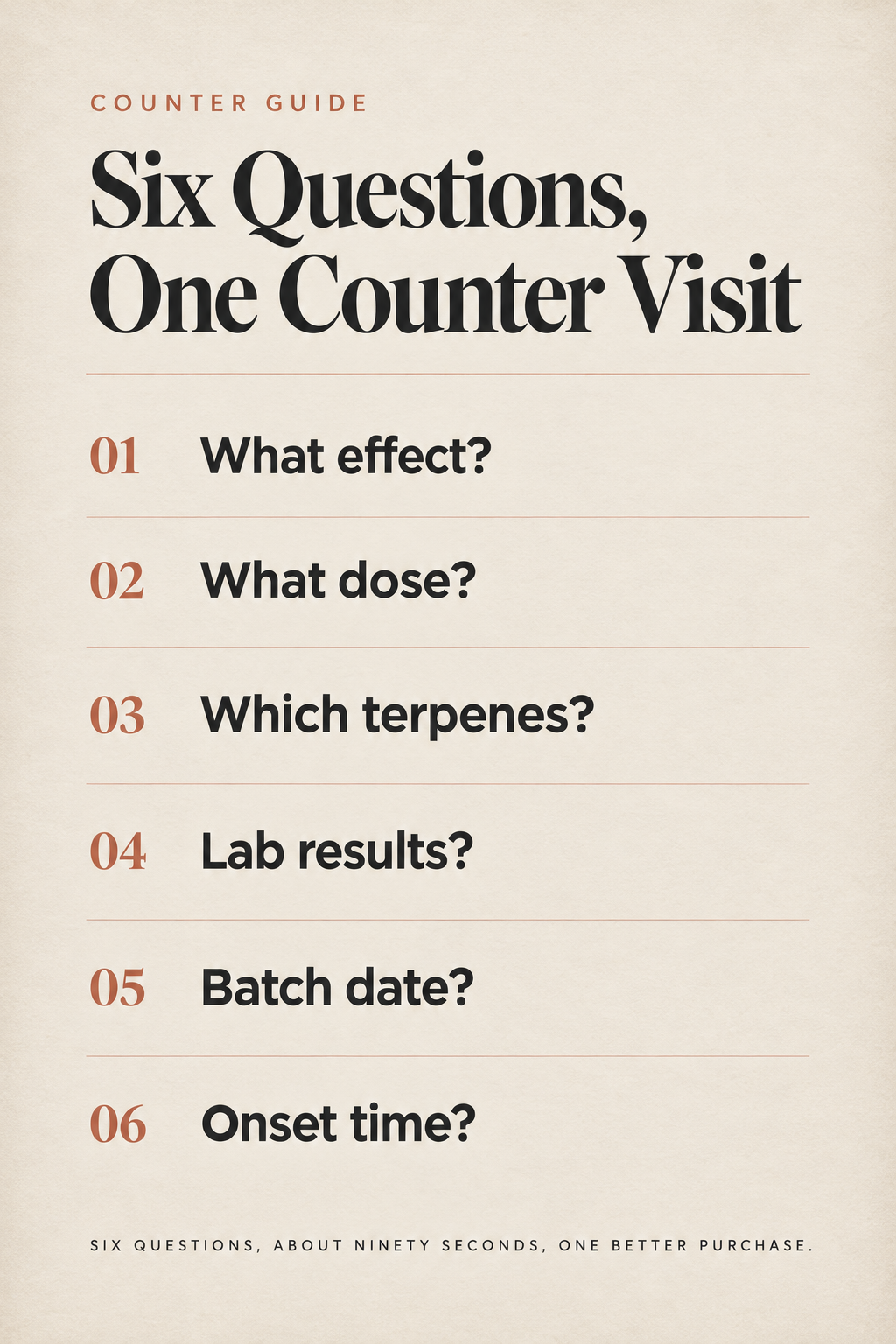
The six questions to ask a budtender follow a fixed order: what you want the next few hours to feel like, what a real dose is for your tolerance, which terpenes lead the batch, what the lab results say, how fresh it is, and how long until it hits. Ask them in sequence and the counter stops being a guess.
Most people walk into a dispensary and name a strain. The better move is to run the six questions in order, because the whole exchange takes about ninety seconds.
Why Does the Way You Ask Matter More Than What You Ask?
Counter conversations stall for one predictable reason: the customer asks for a name, and the budtender is left guessing what that name means for this person, on this day, in this amount. A productive counter conversation starts with three things instead of a product name: how you want to consume, what you want the experience to do, and what you intend to spend [4].
Preparation also varies from shop to shop, because budtenders come with no universal business training [4]. The good news is that New York does require real preparation on the retail side.
Dispensary workers must complete Responsible Workforce Training within 30 days of starting, on paid time and at no cost, built from four elements: a Cannabis Product Safety and Responsibility course, a Cannabis Workforce Responsibility course, at least one hour of implicit bias or cultural competency training, and at least two hours of employer role-specific safety training [2]. What that framework does not include is any separate qualification for product or cultivar expertise [2].
The training is genuine and required. It just does not certify that a person knows every cultivar on the shelf, which is why the specificity has to come from you.
Five things to say before you name a product:
- How you plan to consume: smoking, vaping, edibles, a tincture, or a topical
- What you want the next few hours to do: unwind, sleep, focus, socialize, move without pain
- What you intend to spend, out loud, so the recommendation lands inside your budget
- Your experience level: new, returning after a break, or daily
- That the six questions below cover effect, dose, terpenes, lab results, freshness, and onset
Freshness is one of those six, and How Long Does Weed Stay Fresh? covers what actually determines how long a product holds on to its character.
Question 1: What Should the Next Few Hours Feel Like?
Effect and occasion narrow a wall of products faster than any strain name. A two-hour evening wind-down, a long hike, a dinner party, and a night of sleep are four entirely different assignments, and describing the setting, the time window, and the intensity you want resolves most of the menu before a single product is mentioned.
This matters more now than it used to because the range of cannabis product types and THC concentrations has expanded sharply in recent years, alongside the number of ways people consume them [9]. THC itself is the compound responsible for intoxicating effects and for changes in mood, thoughts, and perception of reality [9]. When every format from flower to vaporizer to infused edible carries a different delivery profile, "what do you have" stops being a useful question. The budtender needs your target, not your curiosity.
Three phrasings that work at the counter:
- "I want to unwind for about two hours without being completely useless for the next morning."
- "Something for a hike that will not make me anxious or foggy on the trail."
- "I want to sleep and I do not want to wake up groggy."
Name three things before you name a product:
- The setting: couch, trail, dinner table, or bed
- The window: roughly ninety minutes, or a full evening
- The intensity: functional, social, or completely offline
Once you have said it out loud, the recommendation becomes specific. If you want the practical numbers behind how much to take and how long to wait, Cannabis Dosing: How to Find Your Right Amount by Consumption Method breaks dosing down by consumption method, and How Long Should You Wait Before Taking More Cannabis? covers how long to wait before adding more.
Question 2: What Is a Real Dose for My Tolerance?
Dose and potency percentage are two different numbers, and the distinction is where most first purchases go wrong. Potency tells you how concentrated the material is; dose tells you how much of it you are actually taking.
On an edible label, that means milligrams of total THC per serving and per package, both of which New York requires to be stated in bold [3]. On flower, it means the THC percentage plus the portion size you will actually load.
The two numbers answer different questions:
| Factor | Potency percentage | Actual dose |
|---|---|---|
| What it measures | How concentrated the material is | How much THC you take in one sitting |
| Where you read it | THC percentage on the shelf tag or package | Milligrams per serving on edibles, grams per portion on flower |
| What New York requires | Milligrams of total THC per serving and per package, stated in bold [3] | The same label figure, counted as servings rather than as a package total |
| Why it matters | A high number is not the same as a strong experience | Portion size decides what you actually feel |
Say your experience level plainly first. Brand new, returning after years away, and daily all need different answers, and staff would rather hear it than have to guess.
The potency numbers on a modern shelf also have no relationship to the plant your memory remembers. NIDA's monitoring of DEA-seized cannabis shows average THC content rising from 3.96 percent in 1995 to 16.14 percent in 2022 [8]. If the flower you remember came from 2010, the menu in front of you is calibrated to a different world entirely.
And higher does not map cleanly onto feeling higher. In a study of 121 regular consumers randomly assigned to higher or lower potency products, concentrate users reached far higher plasma THC levels than flower users, 0.32 versus 0.14 micrograms per milliliter, yet reported similar subjective intoxication and showed similar short-term impairment [6]. That finding is a reason to describe your tolerance honestly, not a reason to chase concentrates.
Four things to ask about dose:
- Your experience level, stated plainly: new, returning, or daily
- On edibles, milligrams of THC per serving and per package, not just total milligrams in the package
- On flower, what a single portion looks like in grams, not only the percentage
- What a first-timer portion of this particular product physically looks like
For edibles, the per-serving count on Love Is All You Need | 10 Pack | Gummies | 100mg Thc | 400mg CBD is printed right on the package, and if you want to understand how the milligram math works at home, How to Make Cannabis Gummies at Home walks through making your own gummies.
Question 3: Which Terpenes Lead in This Batch?
Terpenes are the aromatic compounds behind smell and flavor, and they are also the easiest way to get a straight answer about what a batch is like before you buy it. Ask which terpene leads, and ask whether the profile is printed on the label. Under New York labeling rules, a terpene profile is required when the product markets terpenes [3], so the answer should be printed rather than improvised.
The research behind the question is worth knowing. A review in the British Journal of Pharmacology identified cannabis terpenoids including myrcene, limonene, linalool, and beta-caryophyllene as pharmacologically active at low concentrations, and proposed that they contribute to the plant's overall effect profile [7]. The same review notes that CBD modulates the psychoactivity of THC and is associated with fewer THC-related adverse events [7].
Treat that synergy model as a proposal rather than settled clinical guidance. It is a reasonable way to predict the character of an experience, not a guarantee of what will happen to you, and it is not a basis for treating anything.
Two things worth asking:
- Which terpene leads this batch: myrcene, limonene, linalool, or beta-caryophyllene
- Whether the terpene profile is printed on the label or only available in the certificate of analysis
The question also works as a quick check on the conversation itself. A budtender who knows which terpene leads the batch they are handing you is telling you they have read the product, not just the menu.
Question 4: Can I See the Lab Results Before I Buy?
Yes, and in New York the answer has to be yes. Every cannabis product label carries a scannable QR code linked to a downloadable certificate of analysis, along with the lot number that ties the package to a specific batch [3]. A certificate of analysis covers cannabinoid content and safety screening for that batch. It is not a general brand statement, and results do not carry over to the next harvest.
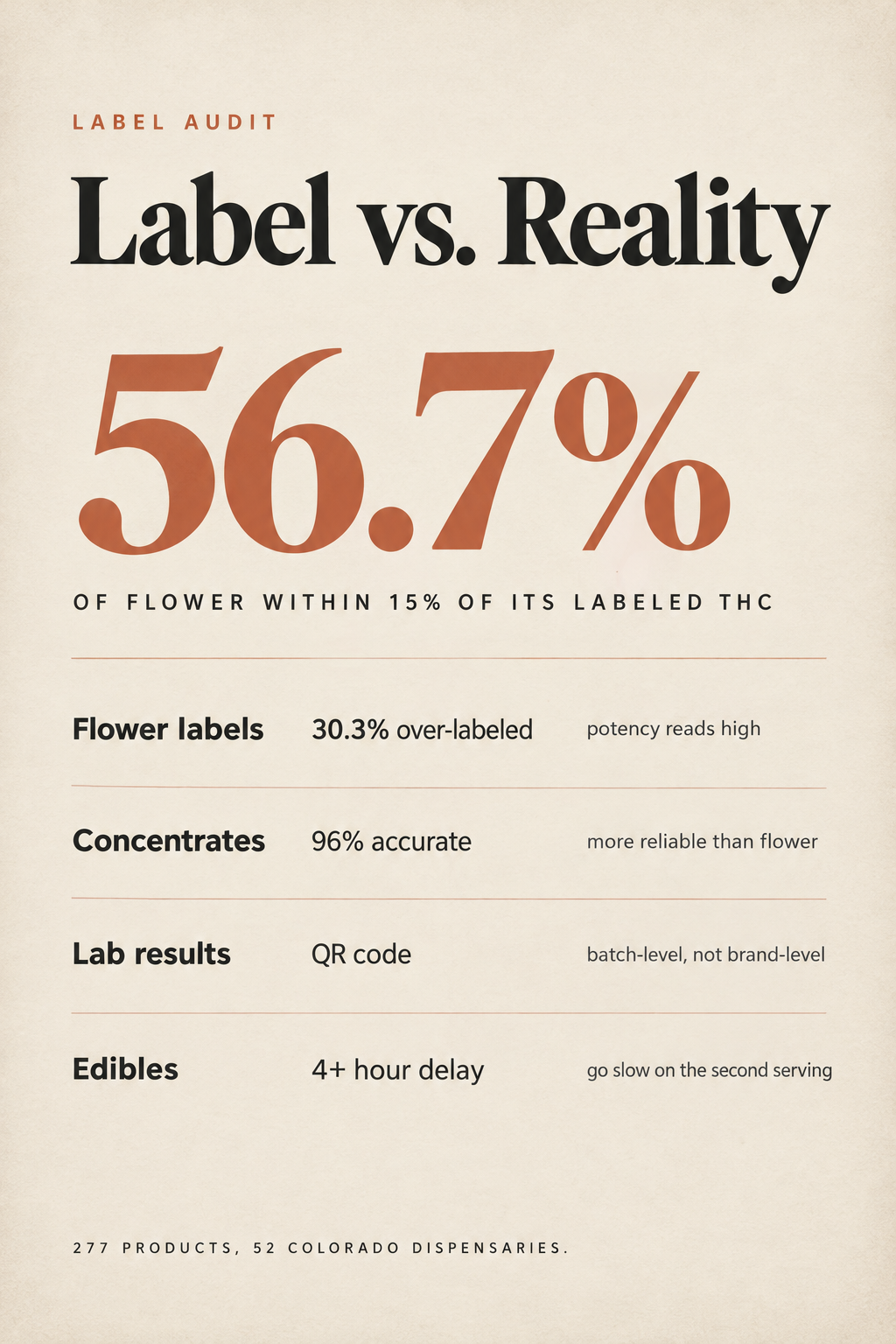
Independent testing is the strongest argument for asking out loud. An audit that tested 277 products bought from 52 Colorado dispensaries found only 56.7 percent of flower products landed within 15 percent of their labeled THC, with 30.3 percent of flower over-labeled, while 96 percent of concentrates were accurate [5]. Observed potency ran lower than labeled potency in both categories [5]. Those are Colorado figures, not New York figures, but they describe the category well enough to make a general point: a percentage on a label is a claim, and a batch result is a measurement.
Three things to ask and one phrase to use:
- "Can you pull the certificate of analysis for this lot?"
- The lot number on the package, which is what ties it to a specific batch
- Whether the batch-level results cover the product in your hand
- What the batch-level result says about the percentage printed on the shelf tag
When you are comparing flower options, Flower is where the current shelves are listed, and the batch details behind B.A.M • Flower • 70g are what turn a shelf tag into a real decision.
Question 5: How Fresh Is This Batch, and How Should I Store It?
New York labels must list expiration and use-by dates along with proper storage conditions, and the lot number connects the package to its batch [3]. That means freshness is a question you can verify rather than take someone's word for, which is a rare luxury in a product category.
Ask three things:
- When this batch was packaged, as opposed to when it arrived at the store
- The expiration or use-by date printed on the package
- How the shop recommends storing it once you take it home
The reason to care is character, not danger. Material that has sat too long, or been stored warm and open, loses the aroma and texture that make it worth buying, and aroma and texture are the same terpene profile you asked about in Question 3. Stale product does not become dangerous. It becomes a worse version of what you came for.
Two things worth checking:
- The packaging or harvest date on the label, rather than the delivery date to the store
- The printed storage conditions, which are on the package and not a guess
Airtight containers keep the result stable longer, and Storage Containers Accessories covers the storage options on the shelf.
Question 6: How Long Until It Hits, and What If I Take Too Much?
This is the question that prevents the bad night, and it has a completely different answer depending on how you consume. Orally ingested cannabis is metabolized by the liver into 11-hydroxy-THC, which is more potent and lasts longer than inhaled cannabis, so onset is considerably slower [10]. Inhaling gives you a short feedback loop: you know within minutes whether you took too much. An edible does not.
The two methods behave nothing alike:
| Factor | Inhaled (smoke or vape) | Orally ingested (edible) |
|---|---|---|
| How it is processed | THC reaches the bloodstream through the lungs | The liver converts THC into 11-hydroxy-THC, which is more potent and longer lasting [10] |
| How fast you know | Minutes, so the feedback loop is short | Considerably slower, so the feedback loop is long |
| What New York requires on the label | No delay warning required | A warning that effects may be delayed by four or more hours [3] |
| The common mistake | Taking another hit too soon | Taking a second serving before the first one lands |
New York requires orally ingested products to carry a warning that effects may be delayed by four or more hours [3]. That warning is the reason a second serving taken too early is the most common way people overshoot. The product has not failed you. The timing has.
What to ask and what to do:
- How long onset takes for this specific product type, not for cannabis in general
- Whether the package carries the four-hour delay warning, and where to find it
- What a starting portion looks like for someone with no recent experience
- Whether the counter can answer dosage questions on a product you have already bought
If it was too much, stay put, drink some water, and remember that the peak passes. Do not add more product on top of it, and do not try to fix the experience with something else.
"Start low and go slow" is the counter version of this question, asked before the purchase instead of after it. Hardware like Alpine Strawberry • T-pro Disposable Vape • 2G changes the timing question rather than the dosing one, since inhaled products land in minutes, and Edibles lists the edible formats where timing matters most.
What Can't a Budtender Tell You?
The line is set by New York retail regulation, and it is worth knowing where it sits so you do not ask for something the person behind the counter cannot legally give you. Under 9 NYCRR 123.10, retail dispensary staff must inspect identification and confirm the buyer is 21 or older on every sale, may not sell to a visibly intoxicated person, may only sell product that passed state laboratory testing and meets Part 128 labeling, and may not let anyone under 21 interact directly with customers [1]. The same rule requires staff to disclose that they are not a pharmacist when a medical customer's dosing recommendation reads "Per Pharmacist Consultation" [1]. That disclosure requirement is the clearest illustration of the boundary in the whole rulebook: counter staff explain products, not conditions.
Their required training reinforces the same shape. Cannabis Product Safety and Responsibility and Cannabis Workforce Responsibility are part of what every New York dispensary worker completes, with implicit bias and employer safety training on top [2]. That is a foundation built around safety and responsible sales. It is not a diagnostic license.
So ask for what they can actually give you:
- What the product is, how it is made, and how people typically use it
- How strong it is, in milligrams per serving or percentage, and what the batch result says
- Which terpenes lead the batch and what the label is required to show
- How fresh the batch is and how the shop recommends storing it
A product like 21 Flavors | 10pk Kief Infused Pre-Rolls | 7.5g is exactly the kind of item that sits on the right side of that line. Staff can walk you through what is in it, how it was made, how strong it is, and how it is typically used, and none of that requires any medical judgment at all.
And leave these alone:
- Whether a product treats a condition or is right for a diagnosis
- Which product a clinician would recommend, or anything that reads as a prescription
- A promise about how something will affect you, since no one at the counter can guarantee that
Keep your questions on the right side of that line and you still get a real recommendation. Asking about potency, terpenes, freshness, onset, and lab results is not asking for medical advice. It is asking the questions the job is built to answer.
How Do You Put These Six Questions to Work in Rockland, Orange, and Westchester?
Bring the six questions in order, and bring them ready. If it helps, write them on your phone before you go so you are not reconstructing them at the counter. Treat the first visit as calibration rather than a test: the point of the first trip is to learn how this shop's products are labeled and how the staff describes them, so the second trip is faster.
Keep it practical about timing. A busy Saturday counter is not the moment for a twenty-minute consultation, but the six questions themselves take about ninety seconds in total. That is the entire point of having them ready.
The good news for anyone shopping in Rockland, Orange, or Westchester Counties is that the rules do not change at the county line. The same New York labeling requirements apply wherever you shop in the region, so the QR code to the certificate of analysis, the milligram count per serving and per package, the terpene profile, the expiration date, and the four-hour delay warning on orally ingested products are on the package in Nyack and in every other licensed store you walk into [3]. Staff still check identification and confirm you are 21 or older on every sale, wherever the store is [1].
Bring the six questions in this order:
- What should the next few hours feel like, and how long do you have
- What is a real dose for your tolerance, in milligrams or in grams
- Which terpenes lead this batch
- What the lab results for this lot actually say
- When was this batch packaged, and how should it be stored
- How long until it hits, and what to do if you take too much
Browse the Treehouse Cannabis menu before you walk in and pick two or three products that look interesting, so the counter time goes to questions rather than to browsing. Bring the six questions to the counter in Rockland, Orange, or Westchester County, and let the conversation do the rest.
Frequently Asked Questions
What should I ask a budtender on my first visit?
Start with what you want the next few hours to feel like, how much you plan to spend, and how you want to consume. Then ask how strong the product actually is, what the main terpenes are, and how long it takes to hit. Those six answers give a budtender enough to make a real recommendation instead of a guess [4] [3].
How do I ask a budtender for something that will not get me too high?
Say plainly that you are new or returning after a long break and that you want a low dose. Ask for the milligrams of THC per serving on edibles and the THC percentage on flower, then ask what a first-timer portion actually looks like. Staff field this question constantly, so it never reads as naive [4] [3].
Can a budtender tell me what is medically right for me?
No. Budtenders can explain products, potency, and general safe-use information, but they cannot give medical advice or say a product treats a condition. New York rules also require staff to disclose they are not a pharmacist when a medical customer's dosing recommendation calls for pharmacist consultation [1].
Should I buy cannabis based on the THC percentage?
It is one data point, not the whole story. A JAMA Psychiatry study found concentrate users reached much higher blood THC levels than flower users but reported similar intoxication, and an audit of 277 products found only 56.7 percent of flower landed within 15 percent of its labeled potency [6] [5]. Ask about dose, terpenes, and how a product is meant to be used.
What are terpenes and why should I ask about them?
Terpenes are the aromatic compounds that give cannabis its smell and flavor, and research shows several of them are pharmacologically active at low concentrations [7]. They may shape the character of a product's effect, so asking which terpenes dominate is a fast way to learn how a batch actually behaves. New York requires a terpene profile on the label when terpenes are marketed [3].
Can I see lab results before I buy?
Yes. New York requires every cannabis product label to carry a scannable QR code linked to a downloadable certificate of analysis, which lists cannabinoid content and safety screening for that batch. A budtender should be able to pull it up or point you to the code on the package. Ask for the certificate of analysis for the specific lot number [3].
What does start low and go slow mean at a dispensary?
It means beginning with a small portion and waiting before adding more, particularly with edibles. New York requires orally ingested products to warn that effects may be delayed by four or more hours, so taking a second serving early is the most common way people overshoot. Ask what a starting portion looks like before you buy [3] [10].
Is it rude to ask a lot of questions at a dispensary?
No. Dispensary staff expect it, and the conversation works better when you arrive with specifics rather than asking them to guess. Questions about potency, freshness, terpenes, and onset are the core of the job, not an imposition on it. Six focused questions take about ninety seconds at the counter [4] [2].
Sources
- New York State Register / Cornell Legal Information Institute — New York retail dispensary staff must inspect identification and confirm the buy
- New York State Register / Cornell Legal Information Institute — New York requires dispensary workers to complete Responsible Workforce Training
- New York State Register / Cornell Legal Information Institute — New York cannabis labels must state milligrams of total THC per serving and per
- Leafly — Budtenders have no universal business training, so preparedness varies from shop
- Scientific Reports / National Library of Medicine — Testing 277 products bought from 52 Colorado dispensaries found only 56.7 percen
- JAMA Psychiatry / National Library of Medicine — Among 121 regular consumers randomly assigned to higher or lower potency product
- British Journal of Pharmacology / National Library of Medicine — Cannabis terpenoids such as myrcene, limonene, linalool, and beta-caryophyllene
- National Institute on Drug Abuse — NIDA's monitoring of DEA-seized cannabis shows average THC rising from 3.96 perc
- National Institute on Drug Abuse — THC produces intoxicating effects and changes in mood, thoughts, and perception
- Leafly — Edibles are metabolized by the liver into 11-hydroxy-THC, which is more potent a
About Treehouse Cannabis
Treehouse Cannabis serves adult-use customers in Rockland County, New York, with regular shoppers coming in from Orange and Westchester Counties. Every menu listing states product type, potency, and batch details, so you can compare what you are buying instead of guessing from a name. Bring the six questions to the counter and our team will walk you through the label on anything you are considering.
Cannabis is for adults 21 and older. Keep all cannabis products away from children and pets. This article is educational and is not medical advice. Do not drive or operate machinery while impaired.

Shop our products

Shop All

Deals

Flower

Pre-rolls
Vaporizers

Edibles
Drinks

Concentrates
Tinctures

Topicals

CBD

Pet CBD

Accessories