New York Cannabis Packaging Rules: Child Safety and Labeling
New York Cannabis Packaging Rules: Child Safety and Labeling
What New York actually requires on the package and the label, why those rules exist, and how to store cannabis safely at home.
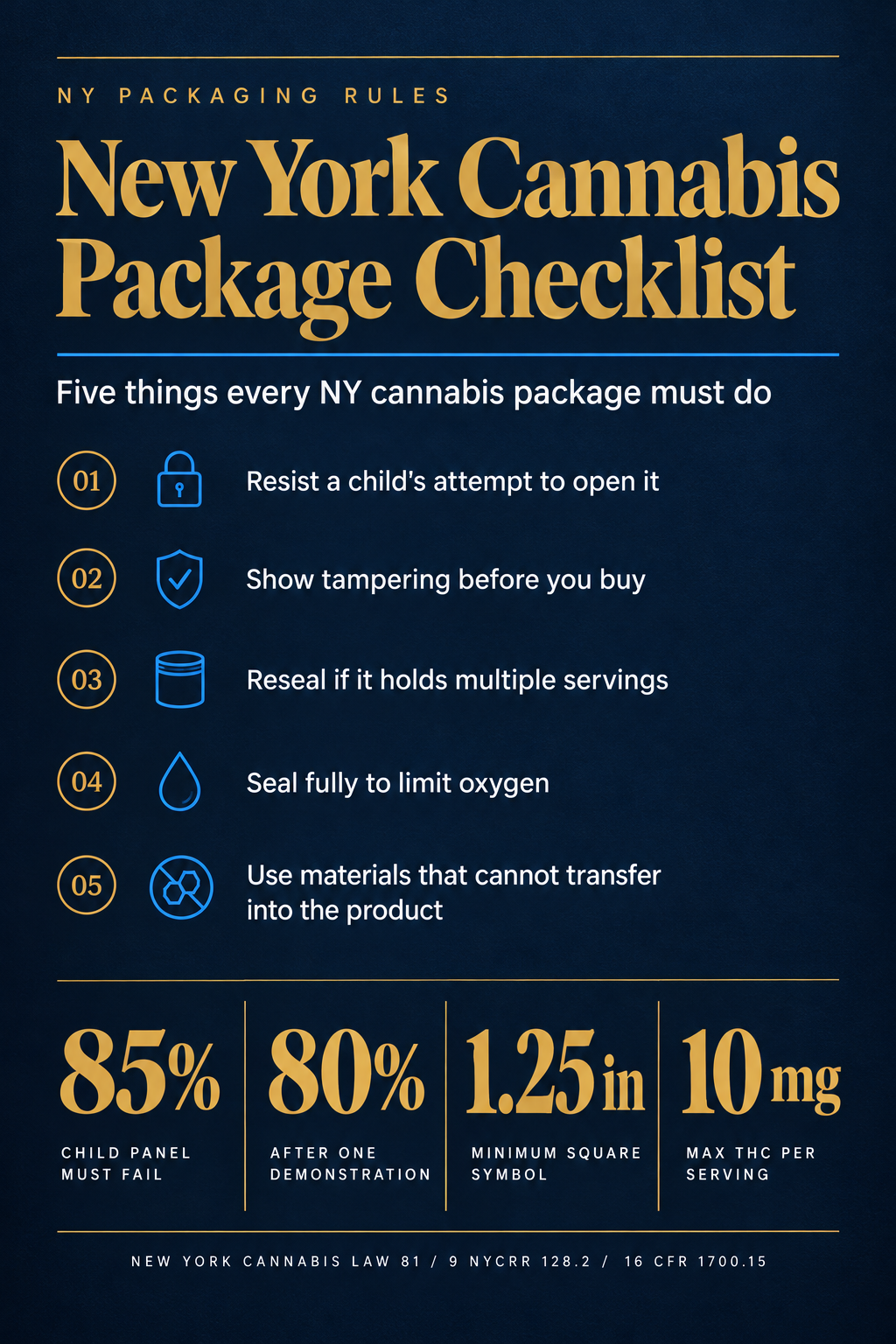
New York cannabis packaging rules require every retail cannabis package sold to adults 21 and older to be child-resistant, tamper-evident, resealable when it holds more than one serving, fully enclosing, and made of materials that cannot transfer into the product. Those five baseline qualities come from 9 NYCRR Section 128.2, and they sit under a broader statutory duty in New York Cannabis Law Section 81.
The rulebook covers the container, the label and the shape of the product itself. This guide walks through each layer, then translates it into what a household in Rockland, Orange or Westchester County should do after the bag comes home.
What Are the New York Cannabis Packaging Rules?
New York requires every retail cannabis package to be child-resistant, tamper-evident, resealable when it holds more than one serving, fully enclosing, and free of substances that could transfer into the product.
That is the short version. The long version runs through three layers of authority that a licensee has to satisfy at the same time.
- Statute. New York Cannabis Law Section 81 directs the Cannabis Control Board to require packaging similar to the federal Poison Prevention Packaging Act of 1970, and it requires products to be labeled and placed in a resealable child-resistant package before retail sale [4].
- Regulation. 9 NYCRR Section 128.2 sets the minimum retail packaging standards, and Section 128.5 sets the minimum labeling standards [2].
- Guidance. The Office of Cannabis Management's Part 128 guidance explains how licensees apply those rules in practice, from where the label has to sit to which designs are prohibited [1].
A compliant package has to deliver all five baseline qualities at once, not pick two:
- Child-resistant for the product's entire useful life, not just at first sale
- Tamper-evident, so a broken seal is visible before purchase
- Resealable whenever the package holds more than one serving
- Fully enclosing, which limits oxygen exposure and keeps the product contained
- Made of materials that cannot transfer into the product itself
The "entire useful life" wording is the part shoppers underestimate. Child resistance is not a feature of the sealed factory package only. It has to survive the opening and closing a customer puts it through at home, which is why the federal standard underneath it includes a durability requirement rather than a single test at the factory gate.
If you are still working out the basic adult-use framework first, Is Weed Legal in New York? The Adult-Use Rules Explained covers who may buy cannabis in New York, how much they may carry, and where the line sits between legal retail and everything else.
Why Do New York Cannabis Packaging Rules Focus on Child Safety?
Because the exposures these rules are written to prevent happen at home, to children too young to read a warning label. State hospital data and national poison center data point at the same pattern from two different directions.
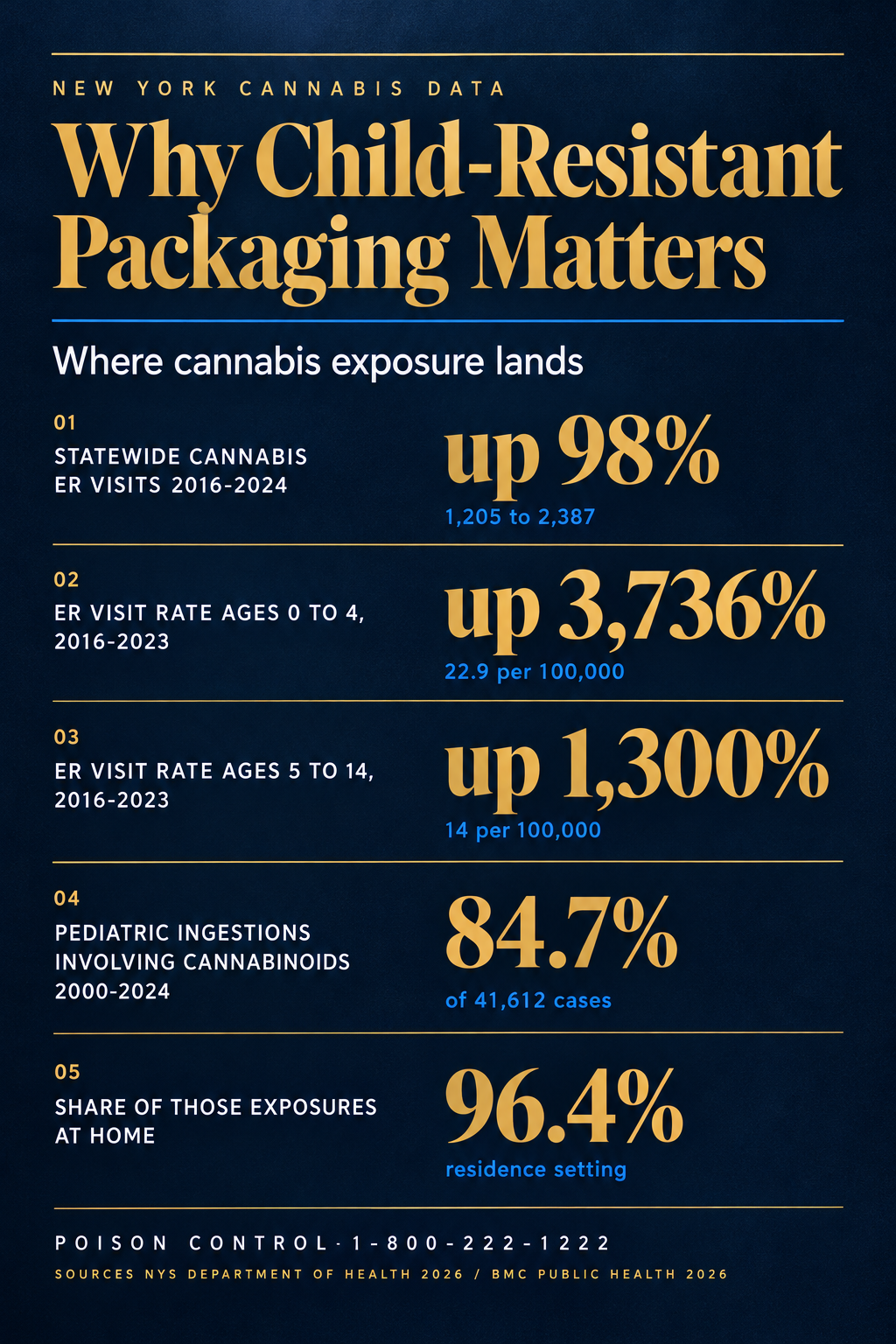
New York State Department of Health figures show cannabis-related poisoning emergency department visits statewide rose 98 percent, from 1,205 in 2016 to 2,387 in 2024 [7]. The pediatric curve is steeper than the overall one.
- Statewide cannabis-related poisoning emergency department visits up 98 percent, from 1,205 in 2016 to 2,387 in 2024
- Rate for children aged 0 to 4 up 3,736 percent between 2016 and 2023, reaching 22.9 visits per 100,000 residents
- Rate for children aged 5 to 14 up 1,300 percent over the same period, reaching 14 per 100,000
- Cannabinoids accounted for 84.7 percent of 41,612 unintentional recreational-drug ingestions by children under 6 reported to U.S. poison centers from 2000 to 2024
- 96.4 percent of those exposures occurred in a residence, 5.0 percent produced a major medical effect, and six children died [8]
Read the last two lines together. Nearly every unintentional pediatric ingestion happened inside a home, which is the one setting where no dispensary employee, no packaging inspector and no regulator is present. A package that opens easily is the last barrier standing between a child and the product, and it is the only barrier that keeps working after the sale.
The Upstate New York Poison Center makes the practical version of the same point: edibles can look like candy, baked goods or drinks, and symptoms are delayed after swallowing [9]. A delay matters because a child who seems fine ten minutes after eating something may not be fine an hour later.
None of this data establishes that legal retail cannabis caused these increases, and none of it shows that a specific package failed. It shows why the state treats child resistance and warning labels as mandatory product features rather than marketing choices.
For the surrounding rules on legal purchase, possession and home storage limits, NY Cannabis Possession & Use Rules and New York Cannabis Laws in 2026: What's Legal, What's Restricted, What Changed go deeper than this article does.
How Do Federal Standards Prove a Package Is Child-Resistant?
New York does not invent its own child-resistance test. It incorporates the federal Poison Prevention Packaging Act standards, and 9 NYCRR Section 128.2 obligates licensees to keep certificates showing compliance with 16 CFR 1700.15 and 16 CFR 1700.20 [2].
Under 16 CFR 1700.15, special packaging must resist opening by at least 85 percent of children on a test panel without a demonstration, and by at least 80 percent after one demonstration [5]. The same standard requires the package to keep working through the customary number of openings and closings for a package of its size, and it bars reusing that packaging for these products [5].
Under 16 CFR 1700.20, the child-panel and adult-panel protocol defines the test procedure a supplier has to run before it can issue that certificate [6]. That protocol is why "child-resistant" is a claim someone has to prove rather than a design opinion a brand can assert on its own.
The certificate chain runs in this order:
- The packaging supplier submits the package to the child-panel and adult-panel protocol defined in 16 CFR 1700.20 [6].
- The package must resist opening by at least 85 percent of children on the panel without a demonstration [5].
- It must resist at least 80 percent of children after one demonstration [5].
- It has to keep working through the customary number of openings and closings for its size, and it may not be reused for these products [5].
- The supplier issues the child-resistance certificate, and the New York licensee retains it as proof of compliance [2].
New York Cannabis Law Section 81 is the reason the state can borrow that framework at all: it directs the Cannabis Control Board to require packaging similar to the federal Poison Prevention Packaging Act [4]. In practice, a New York package is a federally tested package with a state filing requirement behind it.
One thing this standard does not do is change the rules about where cannabis may be consumed. Child resistance governs the container. Where Can You Legally Use Cannabis in New York? covers the separate question of location.
What Must Appear on New York Cannabis Labels?
Four warnings are mandatory on every New York cannabis label, plus one rotating risk warning, and the per-serving and per-package THC and CBD milligram figures must appear in bold on the principal display panel.
The required warnings read as follows:
- "This product contains cannabis and THC"
- "KEEP OUT OF REACH OF CHILDREN AND PETS. For use only by persons 21 years of age and older"
- "Warning: Do not use if pregnant or nursing"
- "Poison Center 1-800-222-1222"
- One rotating risk warning drawn from the state's list [1]
Inhalable products add a vaping warning. Edibles add a warning about four-hour delayed effects [1]. That delayed-effects line exists for the same reason the poison center fact sheet stresses timing: an edible that has not kicked in yet is not evidence that nothing is happening.
The universal symbol has to appear on the principal display panel, and the minimum size depends on which version the package uses:
| Symbol format | Minimum size |
|---|---|
| Square | 1.25 inches tall |
| Vertical | 0.5 inches wide |
| Horizontal | 0.5 inches tall |
Those sizes are floors, not recommendations, and the artwork and colors cannot be altered without Board authorization [3]. The symbol must also contrast with the background it sits on, which is a practical requirement as much as a design one.
Type size is regulated too. Required label text must be at least 6 point in Times New Roman, Calibri, Arial or Helvetica, the mandatory warnings cannot be moved onto a peel-and-reseal or accordion label, and the labeling has to sit on the outermost retail layer rather than an inner wrapper [1].
Label rules are easier to absorb in person than on a screen. Ask to look at a B.A.M • Flower • 70g package at the counter and you can read the bold milligram figures, the symbol size and the warning block for yourself, then compare them against any Small Buds Flower jar on the shelf.
What Cannabis Packaging Designs Are Prohibited in New York?
Packaging, labeling and product shapes cannot be attractive to anyone under 21. That single principle rules out a long list of specific design choices, and the statute and the Part 128 guidance both enforce it.
Prohibited design elements include:
- Cartoons, mascots and characters
- Imitations of candy, soda or cereal packaging
- The words candy or kandy
- Images of people who appear to be under 21, plus toys and games
- Candy-like flavor names on vaporized products, including cotton candy, bubble gum, mint, vanilla, chocolate and cereal [1]
The statute frames the same prohibition at a higher level, barring packages, labels and product shapes that target anyone under 21 [4]. Note the scope of the flavor restriction: it applies to vaporized products. The research behind this article does not support a claim that every sweet flavor in every category is banned.
The second half of the design rule is a serving cap. No single serving of an edible or other orally ingested product may exceed 10 milligrams of total THC, calculated as THC plus THCA multiplied by 0.877, and each serving has to be physically identified or delineated during production [1].
That delineation requirement is a packaging rule disguised as a dosing rule. If a chocolate bar is scored into ten pieces, a child who eats two pieces has eaten two servings, and the label can say so. If the bar is one undifferentiated slab, the same 10 milligram cap tells a household nothing useful. Every Boysenberry 1:1:1 THC:CBD:CBN • 10 Pack package sold in the state has to resolve that question on the label, and the Edibles category is a straightforward place to see how a delineated serving is presented.
Who Is Responsible for Compliance, the Processor or the Dispensary?
Both, and in sequence. The processor or packaging licensee has to meet Part 128 before the product is transferred, and the retail dispensary has to verify the shipment before offering it for sale [2].
The sequence looks like this:
- The processor or packaging licensee meets Part 128 before the product is transferred
- The retail dispensary verifies the shipment against Office of Cannabis Management checklists before offering it for sale
- Noncompliant product triggers an incident report to the Office of Cannabis Management
- The product is returned to the transferring licensee, with the return and the specific reason recorded in the inventory tracking system
- A corrected label may resolve the issue, but violations can suspend, cancel or revoke a license [1]
The same sequence, sorted by who acts at each stage:
| Stage | Who acts | What the rule requires |
|---|---|---|
| Before transfer | Processor or packaging licensee | Meet the Part 128 packaging and labeling standards [2] |
| Before sale | Retail dispensary | Verify the shipment against OCM checklists [1] |
| When a problem is found | Retail dispensary | File an OCM incident report and pull the product [1] |
| After the return | Processor or packaging licensee | Correct the label, or face suspension, cancellation or revocation [4] |
Offering mislabeled products for sale is not permitted, which is why the retailer carries a duty that a shopper never sees. The dispensary is the last checkpoint before a package reaches a customer, and the checklist step exists to catch a labeling problem that started upstream.
The remedy for noncompliance is not always a return. A corrected label can sometimes resolve the issue, but "sometimes" is the operative word: the guidance does not promise that relabeling cures every violation, and the penalty structure runs all the way to suspension, cancellation or revocation of the license [4].
That duty does not vary by product category. The same verification applies whether the shipment is Laughing Gas | House Of Sacci | Disposable Vape | 2g or Flower, because the labeling standard is a property of the package, not of the product inside it.
How Should You Store Cannabis Safely at Home?
Keep cannabis locked up and out of sight, in its original child-resistant labeled package, and treat every edible as something a child would mistake for candy.
A workable household routine looks like this:
- Store cannabis locked up and out of sight, not in a kitchen or bathroom cabinet
- Keep products in their original child-resistant, labeled package rather than a bag or tin
- Treat edibles as indistinguishable from candy to a child, and never leave one unattended
- Call 1-800-222-1222 immediately after a suspected ingestion instead of waiting for symptoms
- Call 911 if a child is unresponsive, seizing or struggling to breathe
The instruction to keep the original package is not fussiness. The federal standard requires packaging to keep working through the customary number of openings and closings for its size [5], which means the container was engineered for repeated use by an adult hand. A sandwich bag, a pill organizer or a decorative tin discards that engineering entirely and leaves a child with an unregulated container.
The poison center also flags the visual problem directly: edibles can look like candy, baked goods or drinks [9]. A gummy in a drawer is indistinguishable from a gummy in a candy dish to a four-year-old, which is why "out of sight" and "locked" are separate requirements rather than the same one.
If an ingestion is suspected, watch for these signs rather than waiting for the product to "kick in":
- Trouble walking or standing
- Extreme sleepiness or difficulty waking
- Vomiting
- Trouble breathing [9]
Call the Poison Center at 1-800-222-1222 as soon as an ingestion is suspected, before symptoms appear. Call 911 if a child is unresponsive, seizing or struggling to breathe. Do not wait to see whether the child seems fine, because the delay in edible onset is exactly what makes waiting risky.
For carrying product to and from the car or on a trip, a locking bag such as the Treehouse Locking Cross Body Smell-Proof Bag keeps cannabis out of casual reach and contains the smell. It supplements the original child-resistant package; it does not replace it.
Shopping at a licensed dispensary in Rockland, Orange or Westchester County means every package you carry out has already cleared New York's child-resistant and labeling standards. Ask the team at Treehouse Cannabis to walk you through the label on any product before you take it home, and store it locked up in its original package.
Frequently Asked Questions
What are New York child-resistant packaging requirements for cannabis?
Every retail cannabis package sold in New York must be child-resistant for the product's entire useful life, tamper-evident, resealable when it holds multiple servings, fully enclosing, and free of substances that could transfer into the product. Licensees must keep documentation showing each package meets federal Poison Prevention Packaging Standards under 16 CFR 1700.15 and 1700.20 [2].
What warnings must appear on a New York cannabis label?
Labels must carry "This product contains cannabis and THC," "KEEP OUT OF REACH OF CHILDREN AND PETS. For use only by persons 21 years of age and older," "Warning: Do not use if pregnant or nursing," and "Poison Center 1-800-222-1222." Inhalable products add a vaping warning, edibles add a four-hour delayed-effects warning, plus one rotating risk warning [1].
What is the New York universal symbol and how large must it be?
New York requires the Office of Cannabis Management universal symbol on the principal packaging display panel. Minimum sizes are 1.25 inches tall for the square version, 0.5 inches wide for the vertical version, and 0.5 inches tall for the horizontal version. The artwork and colors cannot be altered, and the symbol must contrast with its background [3].
Can New York cannabis packaging look like candy or snacks?
No. Packaging and labeling cannot be attractive to anyone under 21. Cartoons, mascots, imitations of candy, soda or cereal, the words candy or kandy, images of people who appear under 21, toys, and games are all prohibited. Vaporized products also cannot use candy-like flavors such as cotton candy, bubble gum, mint, vanilla, chocolate, or cereal [1].
How much THC can a single serving contain in New York?
No single serving of an edible or other orally ingested cannabis product may contain more than 10 milligrams of total THC, calculated as THC plus THCA multiplied by 0.877. Edibles must also have each serving physically identified or delineated during production, and the label must reflect those servings [1].
Who is responsible for compliant packaging, the processor or the dispensary?
Processors and other licensees who package products must meet Part 128 before transfer. Retail dispensaries must verify incoming shipments using the Office of Cannabis Management checklists, because offering mislabeled products for sale is not permitted. Responsibility is shared: the processor builds compliance and the retailer confirms it before a sale [2].
What happens if a dispensary receives noncompliant packaging?
The retailer must immediately notify the Office of Cannabis Management by filing an incident report and return the product to the licensee who transferred it. The return and the specific reason for noncompliance must be recorded in the inventory tracking system. A corrected label can sometimes fix the problem, but violations can suspend, cancel, or revoke a license [4].
What should I do if a child eats a cannabis edible?
Call the Poison Center at 1-800-222-1222 immediately instead of waiting for symptoms, which can be delayed. Watch for trouble walking, extreme sleepiness, difficulty waking, vomiting, and trouble breathing. Call 911 if the child is unresponsive, seizing, or struggling to breathe. Store products locked up, out of sight, in their original labeled packaging [9].
Sources
- New York State Office of Cannabis Management — OCM guidance spells out the operative rules retailers and processors must follow
- Cornell Legal Information Institute (9 NYCRR Section 128.2) — The regulation requires every retail package to be child-resistant, tamper-evide
- Cornell Legal Information Institute (9 NYCRR Section 128.5) — Labeling rules require bold per-serving and per-package THC and CBD milligram fi
- New York State Cannabis Law (Public.Law) — The statute directs the Cannabis Control Board to require packaging similar to t
- U.S. Consumer Product Safety Commission (16 CFR Section 1700.15) — Federal special packaging must resist opening by at least 85 percent of children
- U.S. Consumer Product Safety Commission (16 CFR Section 1700.20) — This section defines the child-panel and adult-panel test protocol that New York
- New York State Department of Health — Statewide cannabis-related poisoning emergency department visits rose 98 percent
- BMC Public Health (Nationwide Children's Hospital researchers) — Of 41,612 unintentional recreational-drug ingestions by children under 6 reporte
- Upstate New York Poison Center (SUNY Upstate) — The regional poison center fact sheet warns that edibles can look like candy, ba
About Treehouse Cannabis
Treehouse Cannabis is a licensed adult-use dispensary serving Rockland, Orange and Westchester County, New York. Every product on the shelf has already cleared the state's child-resistant packaging and labeling standards, and the team will walk any customer through a label before the bag leaves the counter.
Cannabis is for adults 21 and older. Keep all cannabis products locked up and out of reach of children and pets. This article is educational, is not medical advice, and does not describe how to treat a suspected ingestion. If you think a child has swallowed cannabis, call the Poison Center at 1-800-222-1222 immediately.

Shop our products

Shop All

Deals

Flower

Pre-rolls

Vaporizers

Edibles

Drinks

Concentrates

Tinctures

Topicals

CBD

Pet CBD

Accessories