
How to Choose Between THC, CBD, and Balanced Products
How to Choose Between THC, CBD, and Balanced Products
Choosing between THC, CBD, and balanced products comes down to the experience you want and your tolerance for THC's psychoactive effects. THC-dominant products deliver pronounced psychoactive effects, CBD-dominant products deliver no high at all, and balanced 1:1 THC:CBD products fall in between — milder, more body-forward, and a common starting point for first-time or THC-sensitive consumers. This guide walks through how to pick the right ratio, the right dose, and the right format for adult-use customers shopping in New York.
What Is the Difference Between THC and CBD?
THC (delta-9-tetrahydrocannabinol) is the main psychoactive compound in cannabis and produces the high by binding to CB1 receptors in the brain, while CBD (cannabidiol) is a separate, non-intoxicating cannabinoid that acts through different receptor systems [1]. Because they hit different receptors, the two cannabinoids produce noticeably different effects — and when both are present, CBD can soften some of THC's psychoactive intensity [8].
Key differences at a glance:
- Psychoactivity: THC produces a high; CBD does not.
- Receptor target: THC binds primarily CB1 in the brain and central nervous system; CBD acts on a broader, different set of pathways.
- Legal status: Plants with 0.3% THC or less by dry weight are classified as hemp; anything above that threshold falls under marijuana regulations [2].
- Combined use: When CBD is present alongside THC, the high often feels softer — the basic chemical reason a balanced product differs from a pure-THC product [8].
| Attribute | THC | CBD |
|---|---|---|
| Psychoactive | Yes | No |
| Primary receptor | CB1 (brain, CNS) | Multiple non-CB1 pathways |
| Intoxication | High of varying intensity | None on its own |
| Common reason to use | Relaxation, sleep, appetite, euphoria | Calming, anti-inflammatory, clear-headed relief |
| Effect on each other | — | CBD can moderate THC's intensity [8] |
That legal line is why a CBD-heavy product sold over the counter and a CBD-heavy product sold at a licensed New York dispensary are different categories, even when the milligram numbers on the label look similar. For customers building a mental map of the menu, the practical shortcut is: THC-dominant products produce a high of varying intensity, CBD-dominant products do not produce a high, and balanced products fall somewhere in between. To go deeper on the plant chemistry and the role of terpenes, the Treehouse Cannabis guide A Guide to Terpenes and Their Effects lays out how the aromatic compounds in cannabis shape the subjective effects of any given ratio. For a focused walk-through of how ratios map to different consumer goals, How to Choose the Right THC:CBD Ratio for Your Needs goes one level deeper on the decision logic.
What Does a Balanced THC:CBD Product Feel Like?
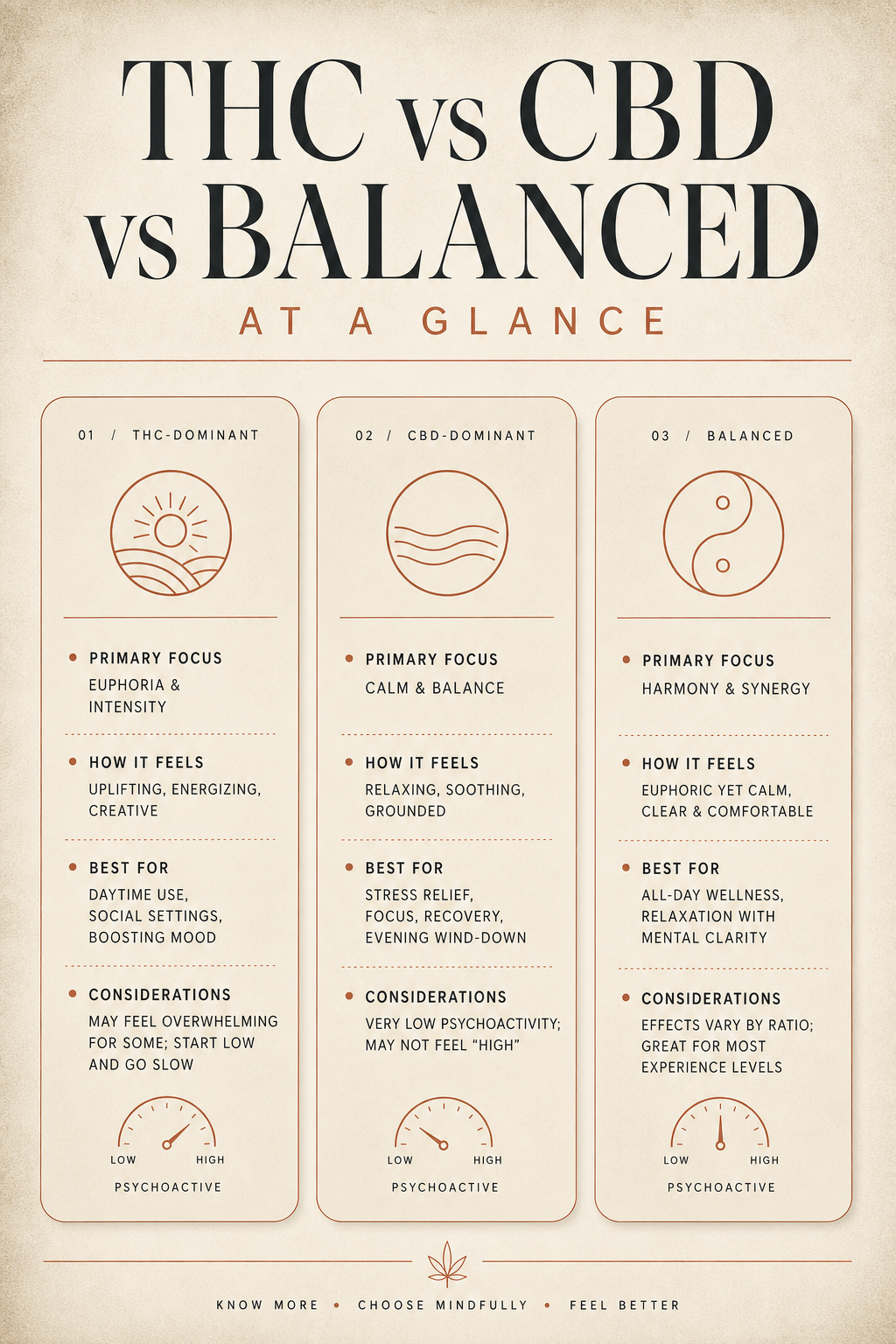
A balanced THC:CBD product feels milder, more body-forward, and less cerebral than a THC-dominant product of the same total dose, because CBD buffers some of THC's intensity at CB1 receptors [7]. The most common formulation is a 1:1 THC:CBD ratio, though 2:1 THC:CBD and 1:2 THC:CBD products are also marketed as balanced [6].
What consumers typically report:
- Less intoxication: CBD reduces the psychoactive spike of THC, so the high is shorter and softer.
- Body-forward relaxation: More physical ease, less racing mind.
- Clearer head: Reduced anxiety compared to high-THC options for sensitive consumers.
- Gradual onset: Especially with edible or sublingual formats, balanced products arrive slowly rather than hitting all at once.
The bigger framework behind that experience is the entourage effect — the theory that cannabinoids, terpenes, and other plant compounds work better together than as isolates [5]. A 2024 review of that hypothesis found that whole-plant extracts containing both THC and CBD (plus minor cannabinoids and terpenes) produced greater effects than isolated THC or CBD in several preclinical and clinical studies, including a cancer-pain trial where the THC-plus-CBD extract outperformed THC alone [5]. The entourage effect is not settled science, and reviews describe the evidence as mixed-but-promising rather than conclusive [5]. It is a useful lens for understanding why a 1:1 tincture feels different from a 10:1 THC tincture at the same total cannabinoid dose, but it is not a guarantee of any specific effect. For the underlying receptor biology behind all of this, How THC and CBD Work covers the pharmacology in plain language.
Who Should Choose THC-Dominant, CBD-Dominant, or Balanced?
The right ratio matches the goal, the tolerance, and the time of day. The simplest framework is to ask whether the consumer wants a pronounced high, no high at all, or a moderate middle ground — and then pick the ratio that delivers it.
| Goal | Best ratio | Why |
|---|---|---|
| Strong relaxation, sleep, or appetite support | THC-dominant | Pronounced psychoactive effects, suited for experienced consumers [1] |
| Daytime calm without intoxication | CBD-dominant | No high; clear-headed relief for new or THC-sensitive consumers [8] |
| Curiosity about THC without full intensity | Balanced 1:1 | CBD moderates THC's psychoactivity, a common beginner starting point [6] |
| Past anxiety with THC-only products | Balanced 1:1 | CBD can reduce overstimulation for THC-sensitive users [7] |
THC-dominant products suit experienced consumers who want pronounced psychoactive effects, strong relaxation, sleep support, or appetite stimulation, and who have built enough tolerance that lower ratios feel underwhelming [1]. They are also the right choice for adult-use customers who specifically want a high as part of the experience.
CBD-dominant products are the right choice for customers who want potential calming or anti-inflammatory support without any intoxication at all — including people who are new to cannabis, who are THC-sensitive, or who need to stay clear-headed during the day [8]. The 2017 NASEM review noted that evidence is strongest for cannabinoids in chronic pain, chemotherapy-induced nausea, and multiple-sclerosis spasticity, which is why many consumers with specific symptom targets still land on a CBD-heavy product [3].
Balanced 1:1 products are the conservative middle ground. They are commonly recommended for first-time consumers and for anyone who wants to try THC without committing to its full intensity, since the CBD component can blunt THC's psychoactive spike [6]. Customers who have tried THC-only products in the past and felt anxious or overstimulated are also a natural fit for balanced products, because the CBD can moderate that response [7]. are a particularly clean way to start with a balanced ratio, since the milligram content is printed on the label and the dose can be measured drop by drop.
Quick comparison:
- THC-dominant — pronounced high, best for experienced consumers and evening use
- CBD-dominant — no high, best for daytime use, new consumers, or THC-sensitive individuals
- Balanced 1:1 — moderate high, best for first-time THC use and consumers who want a middle path
For an example of how the ratio decision plays out inside a specific product format, THC Beverages: A Buyer's Guide to Dosing, Onset, and Effects walks through how ratio and beverage format interact in practice.
How Does Consumption Method Change the Ratio Decision?
Ratio is only half the decision. The same THC:CBD blend will feel different depending on whether it is inhaled, held under the tongue, or swallowed, because the onset time and duration drive the perceived intensity.
- Inhalation (smoking, vaping, dabbing): effects arrive in 1–5 minutes and taper over 1–3 hours. This is the fastest feedback loop, which makes it the easiest format for titrating a dose up or down [8].
- Sublingual tincture (held under the tongue): onset in 15–30 minutes, duration of 4–6 hours. Tinctures are the format most clinics recommend for the start-low-go-slow approach, because the milligram content per milliliter is labeled and the dose is easy to measure [8].
- Edibles and swallowed tinctures: onset in 30–90 minutes, duration of 4–8 hours. The slow onset is what makes accidental overconsumption common with edible THC — a 2.5 mg edible feels like nothing for 60 minutes and then arrives all at once [8].
This is why a 1:1 edible and a 1:1 vape are not interchangeable. The vape delivers the same ratio within minutes and fades within a couple of hours; the edible delivers the same ratio slowly and holds it through the evening. Many experienced adult-use customers use vapes for daytime and Tinctures or Edibles products for nighttime, even when the ratio is identical.
What Is a Safe Starting Dose for THC, CBD, and Balanced Products?
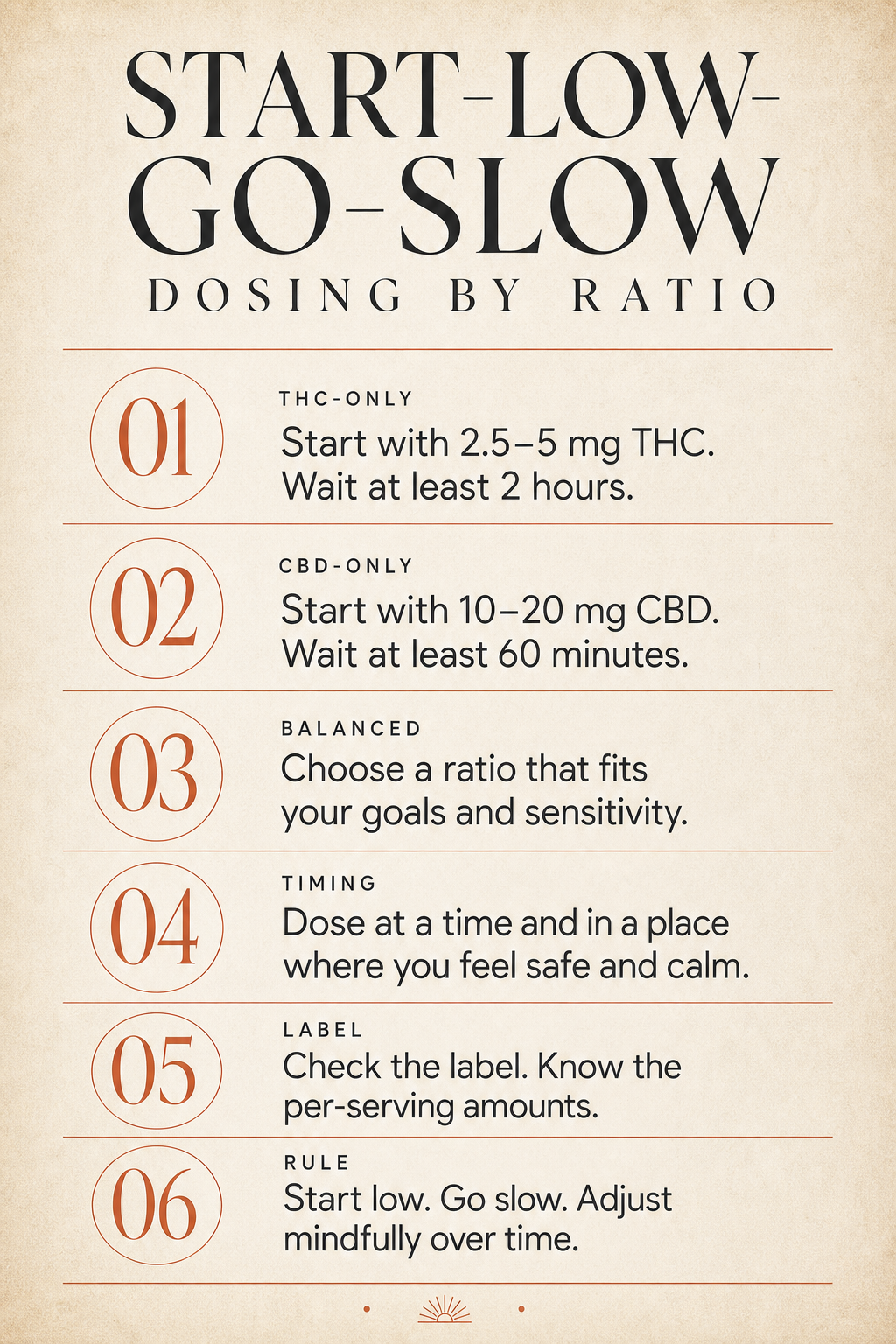
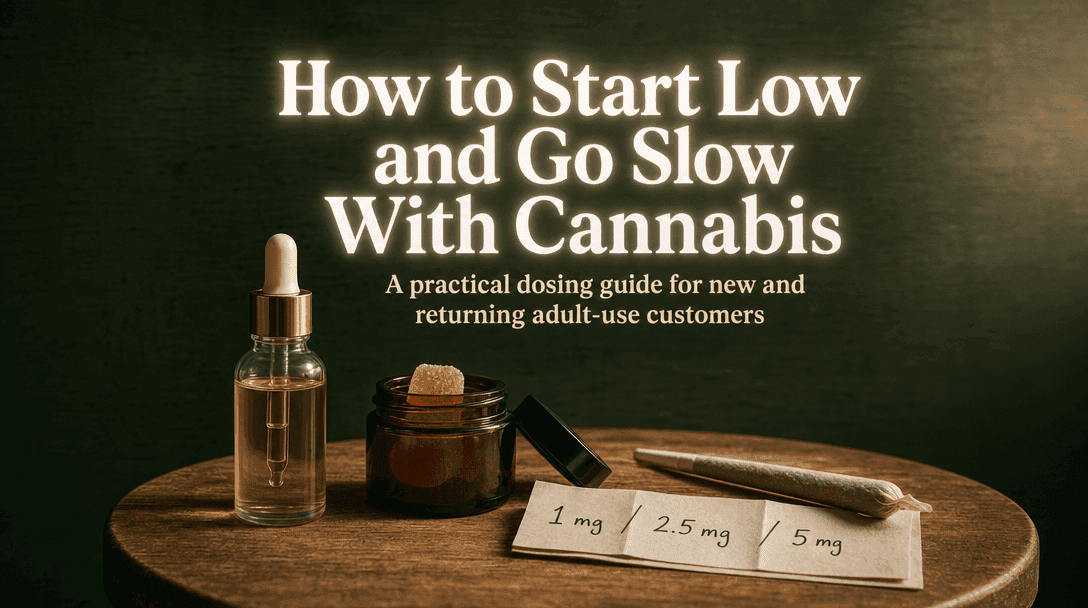
A safe starting dose for cannabis-naive consumers is 2.5 mg THC per serving, paired with at least two hours before any additional dose, per the standard start-low-go-slow protocol [8].
Starting doses by ratio:
- THC-only: Begin at 2.5 mg THC per serving; wait two hours before re-dosing.
- CBD-only: Begin at 5–20 mg CBD per serving, depending on format and consumer sensitivity [4].
- Balanced 1:1: Begin at 2.5 mg THC + 2.5 mg CBD; leave the dose untouched for at least two hours [8].
- Edible timing: Never stack doses because the first one "didn't work" — that is the most common beginner mistake.
For balanced products, the cleanest starting point is the lowest available THC content on the label — often 2.5 mg THC paired with 2.5 mg CBD — and to leave the dose untouched for at least two hours before considering more [8]. The two-hour wait is the rule most beginners skip, and it is the rule that prevents the most common beginner mistake: stacking an edible dose because the first one "didn't work," only to have both doses hit at once.
A second, less obvious rule is to read the actual milligram number, not the package weight. A 10-gram chocolate bar is not the same dose as a 10 mg THC chocolate bar, and the difference matters. Labeling accuracy is also a known weak spot in the consumer CBD market — a study found 69% of commercially available CBD extracts were inaccurately labeled for CBD content, with 43% underlabeled and 26% overlabeled, and 21% contained detectable THC [4]. That is one reason adult-use customers in New York buy from licensed dispensaries: state-regulated products are tested for cannabinoid content and the milligram numbers on the label are verifiable.
How Do You Pick the Right Ratio at a New York Dispensary?
A short checklist can keep the in-store decision from drifting. Before adding anything to the bag, run through these:
- Clarify the goal: relaxation, sleep, daytime calm, or a social high — different ratios serve different goals.
- Pick the ratio first: THC-dominant, CBD-dominant, or balanced 1:1. The ratio is the bigger decision than the format.
- Pick the method second: inhalation for fast feedback, sublingual for measured titration, edible for longer duration.
- Read the milligram content on the label, not the package weight.
- Ask staff for the certificate of analysis — every regulated product in New York has one.
- Start with the lowest available THC content, then wait two hours before re-evaluating.
For adult-use customers shopping at Treehouse Cannabis in Rockland County, the staff can walk through this checklist in person and help match a ratio to a specific product format. The same logic applies whether the customer is browsing flower, vapes, or accessory formats like the 9.5" Concentrate Rig with Banger | Blue for concentrate use — the ratio decision sits one step above the format decision, and getting the ratio right makes the format choice much easier.
Sources
- National Center for Complementary and Integrative Health (NCCIH, NIH) — THC is the main psychoactive compound in cannabis and is responsible for the hig
- U.S. Food and Drug Administration (FDA) — Unapproved CBD products have not been evaluated by the FDA for effectiveness, pr
- National Academies of Sciences, Engineering, and Medicine (via NCBI Bookshelf, NIH) — The 2017 NASEM review concluded that cannabis and cannabinoids have substantial
- Spindle et al., Current Addiction Reports (via PubMed Central, NIH) — CBD has demonstrated efficacy in treatment-resistant epilepsy (the basis for FDA
- Ferber et al., Pharmaceuticals (via PubMed Central, NIH) — A comprehensive 2024 review of the entourage effect found that whole-plant canna
- CannaMD (medical-cannabis physician group) — 1:1 THC:CBD products aim to deliver the therapeutic potential of both cannabinoi
- Leafwell (clinical cannabis education) — A 1:1 CBD:THC product is generally less intoxicating than one that contains pure
- Project CBD — CBD and THC work better together than as isolates; CBD can lessen or neutralize
About Treehouse Cannabis
Treehouse Cannabis is a licensed adult-use dispensary serving Rockland County, NY and customers from across Orange and Westchester Counties. The menu spans THC-dominant, CBD-dominant, and balanced 1:1 products across flower, pre-rolls, vapes, edibles, and tinctures. Customers can browse the live menu online or stop in to compare ratios side by side with staff support.
Cannabis is for adults 21 and older. Keep all cannabis products out of the reach of children and pets. Do not drive or operate heavy machinery after consuming cannabis. Effects may be delayed for edible and swallowed-tincture formats. If you are pregnant, nursing, or taking other medications, consult a qualified clinician before use. This article is for educational purposes only and is not medical advice.
Shop our products

Shop All

Flower

Pre-rolls
Vaporizers

Edibles
Drinks

Concentrates
Tinctures

Topicals

CBD

Pet CBD

Accessories