
How to Choose Fresh Pre-Rolls at a Dispensary
How to Choose Fresh Pre-Rolls at a Dispensary
What the package date, the seal, the label and the roll itself actually tell you about what you are about to smoke
Knowing how to choose pre rolls comes down to three checks you can do at the counter: read the package date, confirm the seal is unbroken, and look at the flower visible at the tip. Freshness is a function of time and air, not brand, and those three signals beat any shelf talker or potency number.
Everything below is about those three checks in order, plus the two things that look like quality signals and are not.
How Do You Tell If a Pre-Roll Is Fresh Before You Buy It?
A pre-roll is the one cannabis product where you can partly see the goods before you pay. The tip is exposed through clear cones and tubes. Treat it like produce, not like a sealed bottle of wine.
The regulatory floor is worth knowing because it explains why the checks work. New York's adult-use packaging rules require every retail package to be sealed to protect the product from oxygen exposure, contaminants and degradation. The same rules require a use-by or expiration date that the licensee has to establish from stability data [1]. That date is a claim the producer is accountable for, not a sticker somebody typed at the register.
The label carries the rest. New York's consumer fact sheet explains that inhalable products such as pre-rolls list cannabinoids as a percentage of the product, usually name the cultivar inside, and carry a QR code that links to the certificate of analysis [3]. Between the date, the seal and the label, you already have more information than most shoppers use.
Here are the three checks, in order of how fast they are:
- Read the package date first, because New York requires it and requires the producer to base it on stability data
- Check that the seal on the tube or jar is unbroken before you pay
- Look at the flower visible at the tip and through any clear cone
- Treat smell as a bonus check, not a reliable one, since a sealed tube will not tell you much
None of these take more than a minute. The rest of this article walks through each one in detail, then covers what the THC number does and does not mean, and what to ask when you want a second opinion from the person behind the counter. If you already have pre-rolls at home and want to keep them in condition, How to Store Pre-Rolls So They Stay Fresh covers the after-purchase side.
What Does the Date on a Pre-Roll Package Actually Mean?
The date is the producer's own estimate of how long the product holds up, and New York requires that estimate to be rooted in stability data rather than guesswork [1]. That makes it more meaningful than a best-by sticker on a snack. It is still an estimate under an assumption: that the seal stayed intact and the package stayed out of heat and light.
The Office of Cannabis Management's own consumer framing is blunt about this. Cannabis changes when exposed to air, which is why the certificate of analysis is only trustworthy up to the printed expiration date [3]. Past that date you are not reading a measurement of your product. You are reading a measurement of a product that used to be in that package.
One practical distinction to sort out at the counter: a packaged-on date tells you when the flower went into the tube, while an expiration or use-by date tells you how long the producer thinks it holds. New York requires the use-by or expiration date, so that is the one to look for on a New York label. Some producers print both.
How fast does the clock actually run? A 360-day controlled storage study found total potential THC fell 11.8 percent by day 30 and 34.6 percent by day 360 across every container and temperature tested, and the authors concluded cannabis is best sold, distributed or consumed within 30 days of packaging [6]. That is useful calibration. A date months out is not a promise that month six is as good as month one.
What the date does and does not tell you:
- It is set by the producer from stability data, and New York requires it on the package
- It assumes the seal was never broken and the package stayed cool and dark
- The certificate of analysis is trustworthy up to the printed date, not past it
- Storage research showed THC down 11.8 percent by day 30 and 34.6 percent by day 360
- A date months away is not a claim that the last month is as good as the first
If the format on the package is unfamiliar, Cannabis Holiday Gifts 2026: The Complete Buyer's Guide walks through how labels and package formats differ across product types. For the difference between a single, a pack and an infused roll, Pre-Rolls Explained: Singles, Packs, Infused, and What You're Smoking breaks down what is actually inside each one.
Why Do Pre-Rolls Lose Freshness Faster Than Whole Buds?
Because grinding multiplies surface area, and terpenes are volatile. An intact bud protects its interior with its own outer layers. A pre-roll has already been broken open, so every gram of flower in that tube is exposed to whatever air gets past the paper.
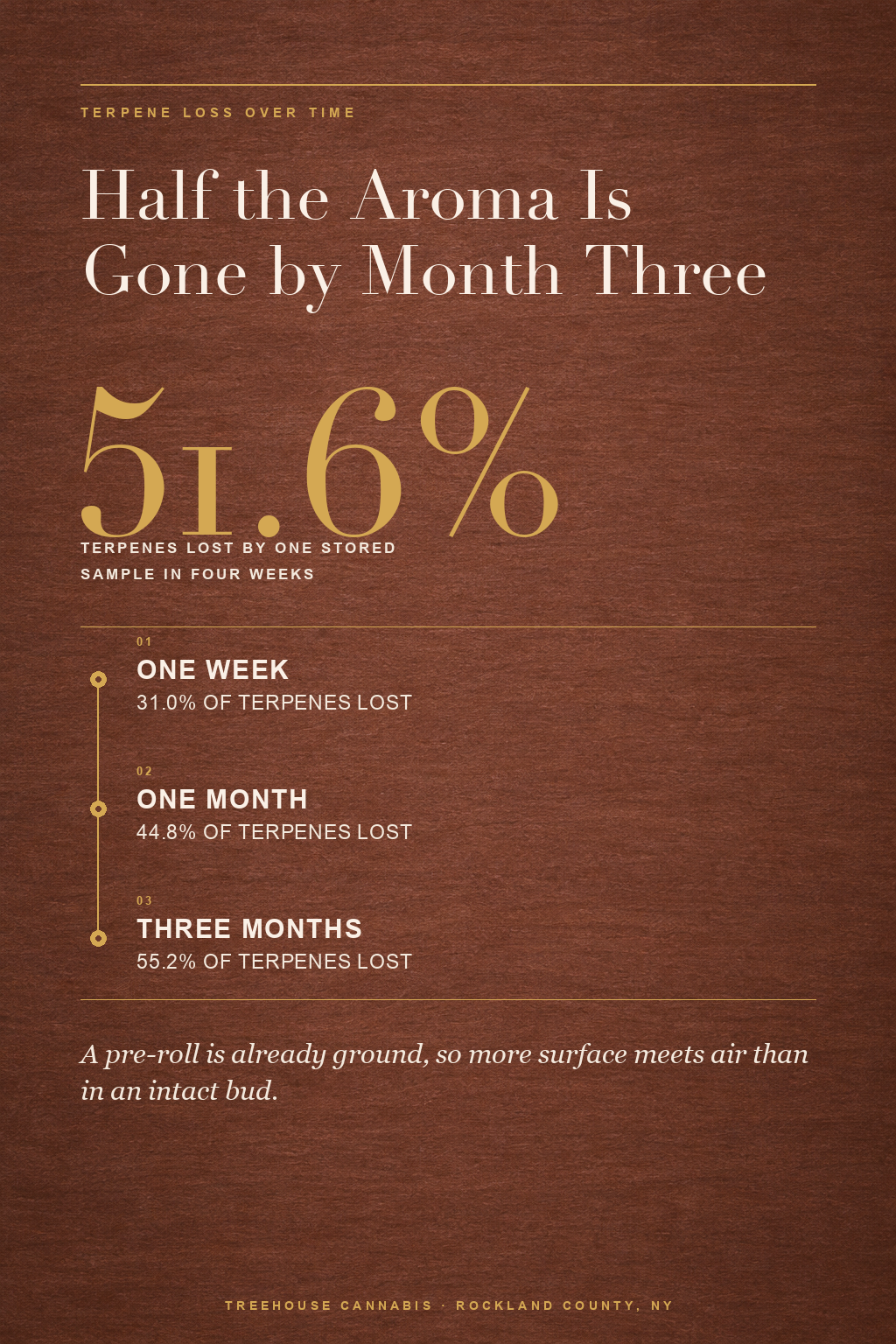
The terpene numbers are not subtle. A review of volatile terpenes in cannabis inflorescence cites measured losses of 31.0 percent at one week, 44.8 percent at one month and 55.2 percent at three months, and reports that one stored sample in its own experiment lost 51.6 percent of its terpene content in four weeks [4]. Those measurements come from stored inflorescence, not from pre-rolls, so read them as a floor rather than an exact prediction for a ground product.
New York sets the guardrails on the other side of the equation. Labs must test raw and infused pre-rolls for water activity at or below 0.65 and for moisture content, where flower samples typically run 5.0 to 15.0 percent and anything above 15.0 percent is not acceptable [2].
That number does two jobs at once. Too dry and the roll burns hot and harsh. Too damp and it is a mold risk rather than proof of freshness. Neither extreme is a good sign, which is why "it feels moist" is not the freshness test people assume it is.
Cannabinoids age on the same timeline, just more slowly than aroma. A four-year storage study of six high-potency products found THC degrading into CBN until almost 100 percent of it was gone at room temperature, and the authors found temperature changed only the speed of that conversion while light changed both the speed and the outcome [5].
The four things working against every pre-roll:
- Air, because oxygen drives oxidation once the flower is ground and the package is open
- Light, which the four-year study found changes both the rate and the outcome of THC degradation
- Heat, which accelerates the conversion of THC to CBN
- Time, which does the rest on its own, sealed or not
Whole bud and ground flower sit in different positions on that clock:
| Factor | Whole bud | Pre-roll |
|---|---|---|
| Surface meeting air | Low, since the outer layers protect the interior | High, since the flower is already ground |
| Terpene loss in storage research | 31.0 percent at one week, 44.8 percent at one month, 55.2 percent at three months | Not measured directly, but expected to run faster than intact flower |
| What protects it | The bud's own outer layers plus the package seal | The package seal alone |
| What you can inspect first | The exterior, through the package | The pack and the tip, through clear cones and tubes |
This is why a stale joint reads thin and sharp rather than simply weak. The flavor compounds left first, and the material that remains burns differently. For what to do about it after you get home, the storage guide is the right place to look. If the vocabulary here is new, What Is a Pre-Roll? A Beginner’s Guide explains what a pre-roll is and how the format is built.
What Should You Check on the Pre-Roll Itself Before You Buy?
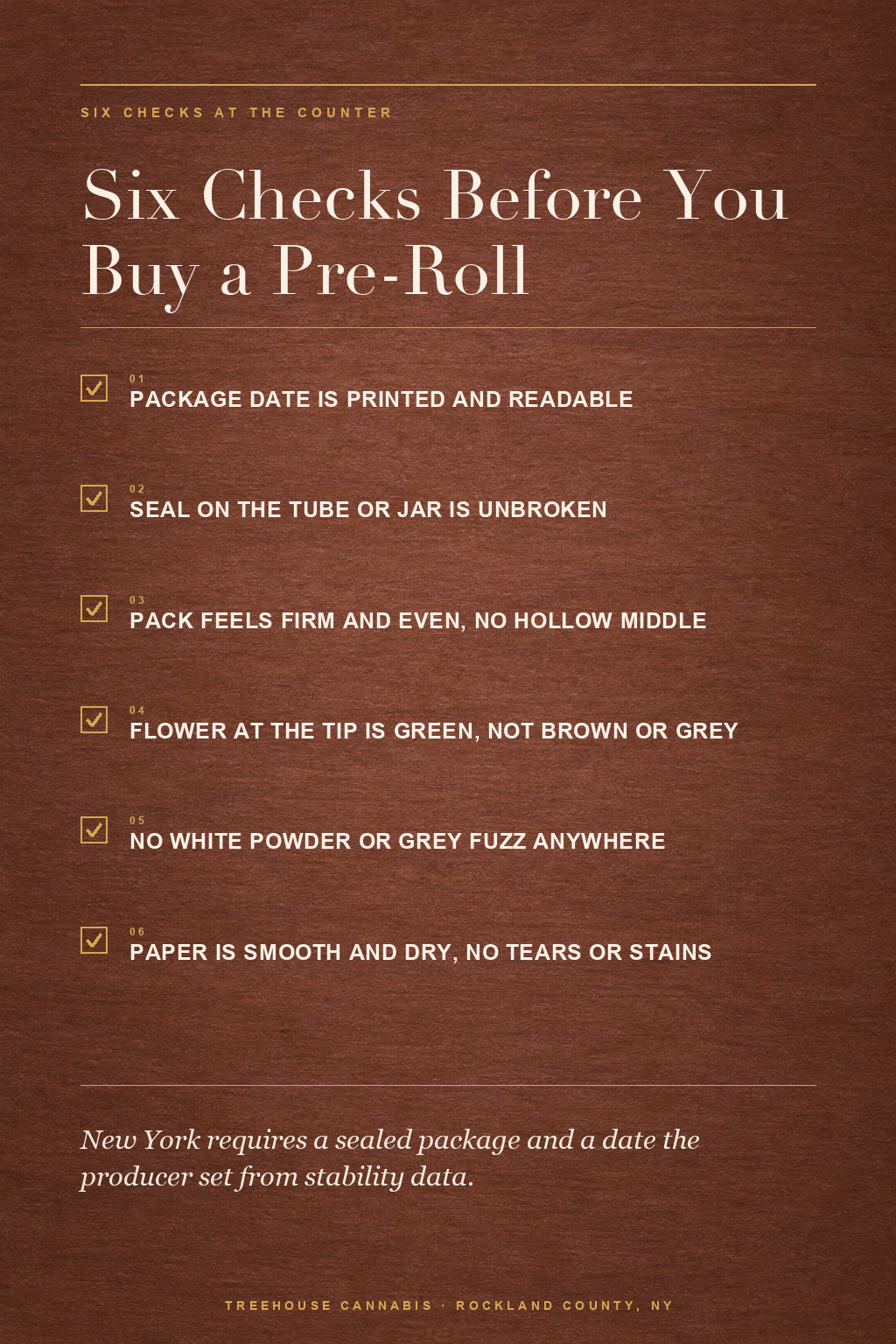
Look for an even pack with no soft or hollow spots, flower that still has color at the tip, paper with no tears or damp patches, and absolutely no white powder or grey fuzz. Those four observations cover most of what a sealed package will let you see.
The two defects worth memorizing are both visible. Powdery mildew shows as distinct white powdery patches on flowers, with spores that release when the plant is disturbed. Botrytis bud rot yellows the sugar leaves and turns buds brown with a fuzzy grey growth that starts inside dense flowers [9]. That second detail matters at the counter: bud rot begins in the interior of a dense flower, which is exactly why a soft, dense, discolored pre-roll is a reject and not a bargain.
Here is what good, acceptable and reject look like side by side:
| Check | Good | Acceptable | Reject |
|---|---|---|---|
| The pack | Firm and even from tip to filter, no soft spots | Slight give at the very tip | Hollow middle, crunchy, or loose enough to rattle |
| Flower at the tip | Green with visible trichomes | Pale green, slightly dry at the surface | Brown, tan, grey, or matted |
| The paper | Smooth, dry, evenly wrapped | A small wrinkle near the twist | Tears, damp patches, stains, or a loose seam |
| What you can smell | Bright, distinct aroma if the package allows | Faint aroma through a sealed tube | Musty, ammonia, or basement smell |
The moisture context behind that middle column: New York holds water activity at or below 0.65 with moisture typically 5.0 to 15.0 percent, which is the range where flower neither crumbles nor feels spongy [2].
How the roll is built explains the rest. Machine-smoking 0.5 gram joints in a smoke cycle simulator showed 1 mm flower delivered the most cannabinoid per puff while 5 mm flower burned longer, terpenes came off strongest at the start of the joint and cannabinoids at the end, and only 34 to 59 percent of the THC in the joint actually reached the smoke [8]. An uneven grind and pack means an uneven burn, and an uneven burn is what people describe as a harsh or "hot" joint.
The physical checks, in the order to perform them:
- Squeeze gently along the length, feeling for a hollow or crunchy middle
- Look at the tip for green flower with visible trichomes, not brown or grey
- Run your eye along the paper for tears, wrinkles, damp patches or stains
- Check the whole package for white powder or grey fuzz, and ask for another if you see any
- Compare the pack against the weight on the label as a sanity check
- Read the date one more time before you pay
Be realistic about the limits. An opaque tube hides most of this, and a clear cone shows considerably more, which is one honest argument for glass tips and clear papers. You do not need to open a sealed package in the store, and you should not. Ask the budtender to hold a second package next to the first if something looks off. If the format matters to you, Halftime Haze • Glass Tip Infused 5 pack Pre-Roll • 2.5g is an example of a glass-tip infused five pack where the tip and the roll are visible before you commit.
Do Higher THC Numbers Mean a Better Pre-Roll?
No. A 2025 study of 178 flower products, including 11 pre-rolls, purchased from 52 dispensaries found only 56.7 percent tested within 15 percent of their labeled THC, and measured potency ran significantly lower than labeled, with mean labeled flower potency of 22.5 percent against a measured 20.8 percent [7]. That is roughly a two-point gap on average, with a wide spread on either side.
Two points does not sound like much until you notice what it does to the shopping decision. If the label separates packages by two or three points and the measurement error runs that wide, then the biggest number on the shelf is not sorting products by much of anything. It is sorting them by which label was written most optimistically.
New York also caps total terpenes in inhaled products at 10 percent [2], which puts a ceiling on the arms race. A producer cannot simply load a roll with flavor compounds to compensate for a thin profile, because the cap is enforced at testing.
And the number that leaves the package is not the number that reaches you. In machine smoking, only 34 to 59 percent of the THC present in a joint transferred into the smoke, and grind size moved the per-puff delivery [8]. A well-built roll at a modest labeled potency can deliver more than a badly packed one at a higher number.
What each label figure actually tells you:
| Label figure | What it tells you | How much weight to give it |
|---|---|---|
| Total THC percentage | A tested value from one sample of the batch, with real measurement error | Some, but not as a quality ranking |
| CBD percentage | Whether the product carries meaningful CBD alongside THC | Useful if you are choosing a ratio deliberately |
| Total terpenes | Flavor and aroma potential, capped at 10 percent in New York inhaled products | Useful, and a better freshness proxy than THC |
| Weight in grams | How much product is in the package | Useful for comparing value |
| Package or expiration date | How long the producer says it holds up | The single most useful line on the label |
Better signals than the THC number:
- The package date, because it is the only printed claim about time
- An intact seal, because every other claim assumes it
- An even pack, because it predicts how the roll will burn
- A named cultivar, because it tells you what you are actually buying
- How fast that specific product moves, because inventory age follows turnover
There is also a threshold effect worth naming without turning it into advice: past a certain point, higher THC does not automatically mean a better experience for a given person, and going higher than your tolerance is the most common way to have a bad evening. Match the potency to what you already know about yourself, not to the highest number on the shelf. If you would rather control the grind and the pack yourself, whole Flower lets you do exactly that.
What Should You Ask a Budtender About Pre-Roll Freshness?
Ask four questions: which batch is on the shelf, what the package date is, whether the tubes are sealed, and how quickly that specific product turns over. Then compare the answers against what the label and the package already told you.
None of these are special requests. New York's consumer fact sheet is built around reading the label, and the date and the QR code to the certificate of analysis are already there for you [3]. A staff member who can walk you through them is doing their job, not doing you a favor.
The seal question matters more than it sounds. The package is required to be sealed to protect the product from oxygen and degradation [1], and a shop that stores loose or opened packages has broken the assumption the date rests on. That is not a knock on any particular store. It is the reason the question is worth asking out loud.
The four questions, in order:
- Which batch is on the shelf right now?
- What is the package date, and is it a packaged-on date or an expiration date?
- Are the tubes or jars sealed and untouched?
- How fast does this specific product move?
Green flags and red flags look like this:
| Green flags | Red flags |
|---|---|
| A readable date the staff can point to | No readable date, or a date nobody can find |
| Sealed tubes, still tight in the package | Tubes that rattle loosely in the box |
| Steady turnover on that specific pre-roll | Dusty packaging, sun-faded boxes |
| Staff who answer the date question without checking twice | A roll that crumbles when the package is handled |
| A named cultivar and a matching certificate | A discount that is the only reason it is being offered |
One rule covers the rest: steady turnover of a specific pre-roll beats a deep discount on something that has sat. Discounting is often how slow inventory gets moved, and freshness is the thing it costs you. If you cannot get a date, buy something else. There is always another package, and usually another product.
If you would rather check the date and the seal yourself than take a listing's word for it, come look at what is on the shelf at Treehouse Cannabis. We are a licensed New York adult-use dispensary serving customers 21 and older in Rockland County, and our budtenders will pull the package and read you the date before you decide. You can browse the current Pre_rolls selection before you come in.
Frequently Asked Questions
How can I tell if a pre-roll is fresh?
Start with the package date. In New York the label must carry a use-by or expiration date set from stability data, and the outer package must be sealed against oxygen. Then check that the seal is intact and look at the flower visible at the tip. An even pack with green flower is the best sign you can get before lighting it.
What does the expiration date on a pre-roll package actually mean?
It is the producer's own estimate of how long the product holds up, and New York requires that estimate to come from stability data rather than guesswork. It assumes the package stayed sealed and out of heat and light. Once you open the tube, the date no longer describes what is inside.
How much flavor do pre-rolls lose as they age?
A lot, and quickly. Research on stored cannabis inflorescence measured about 31 percent terpene loss after one week, roughly 45 percent after a month, and more than half after three months. A pre-roll is already ground, so more surface area meets air and the aroma fades faster than inside an intact bud.
Do higher-THC pre-rolls mean better quality?
Not reliably. A 2025 study of 178 flower products bought at 52 dispensaries found only 56.7 percent tested within 15 percent of their labeled THC, and measured potency ran lower than labeled. Treat total THC as one data point. Package date, grind and how evenly the roll is packed change the experience at least as much.
Should a fresh pre-roll feel soft or dry?
Neither extreme is good. New York labs must hold flower product water activity at or below 0.65, with moisture typically between 5.0 and 15.0 percent. A roll that crumbles when you squeeze it has dried past the point where it smokes well, and one that feels damp or spongy is a mold risk rather than a sign of freshness.
Why does an old pre-roll taste harsh and burn hot?
Volatile terpenes have evaporated, so the flavor reads thin, and THC has been converting to CBN over time. Dry flower also burns faster and hotter than properly conditioned flower. That combination is why a stale joint can feel sharp on the throat and finish much faster than you expected.
Can I ask a budtender for the package date before buying?
Yes, and you should. New York requires the date on the package, so it is not a special request. Ask which batch is on the shelf, whether the tubes are sealed, and how fast that product moves. A shop with steady turnover of a specific pre-roll is usually a better bet than a deep discount on something that has sat.
How long do pre-rolls stay good after I open the package?
Weeks, not months. Sealed and stored cool and dark, an unopened pre-roll can hold quality for a while under the producer's stated date, but once the tube is open, reseal it after each session and plan to finish it within a few weeks. Flavor disappears before potency does, so taste is your earliest warning.
Sources
- New York State Office of Cannabis Management — New York's adult-use packaging rules require every retail package to be sealed t
- New York State Office of Cannabis Management — New York requires labs to test raw and infused pre-rolls for water activity at o
- New York State Office of Cannabis Management — The Office's consumer fact sheet tells shoppers that inhalable products such as
- Journal of Cannabis Research (Bueno, Leuer, Kearney, Green & Greenbaum) — Terpenes are inherently volatile and are lost steadily after harvest: the paper
- Forensic Science International (Zamengo et al.), indexed in PubMed — Six high-potency cannabis products stored for four years showed THC degrading in
- Anresco Laboratories — In a 360-day controlled storage study, total potential THC fell 11.8 percent by
- Scientific Reports (Nature) — Of 178 flower products including 11 pre-rolls purchased from 52 Colorado dispens
- Cannabis Science and Technology (Delic Labs / Roggen et al.) — Machine-smoking 0.5 gram joints in a smoke cycle simulator showed grind size dri
- Government of British Columbia, Ministry of Agriculture and Food — The province's plant pathology fact sheet describes the two defects a shopper mi
About Treehouse Cannabis
Treehouse Cannabis is a New York State licensed adult-use dispensary serving customers across Rockland, Orange and Westchester Counties. The team will pull a package off the shelf and read you the printed date, the batch number and the cultivar name before you decide, so you can check the seal and the label yourself instead of guessing from a shelf tag.
Cannabis is for adults 21 and older. Keep all cannabis products locked and out of reach of children and pets. Do not drive or operate machinery while under the influence of cannabis. This article is intended for educational purposes only and is not medical advice; consult a qualified clinician with questions about cannabis and your health. Always purchase cannabis from a licensed New York adult-use dispensary.

Shop our products

Shop All

Deals

Flower

Pre-rolls
Vaporizers

Edibles
Drinks

Concentrates
Tinctures

Topicals

CBD

Pet CBD

Accessories